Rep. Alexandria Ocasio-Cortez said no government rescue of artificial intelligence firms “as healthcare is being denied to everyday Americans.”
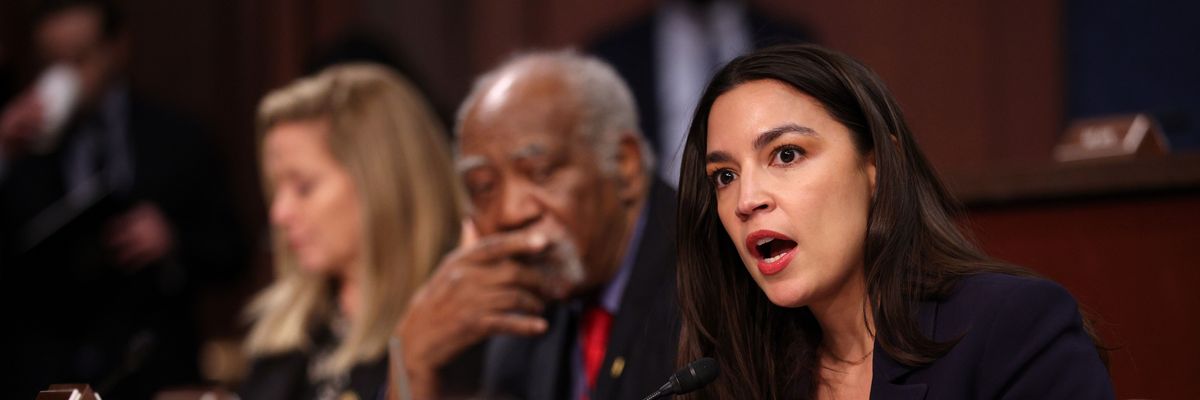
US Rep. Alexandria Ocasio-Cortez (D-NY) speaks during a House Oversight and Government Reform Committee hearing on March 5, 2025.
(Photo by Kayla Bartkowski/Getty Images)
Jake Johnson
Nov 19, 2025
COMMON DREAMS
US Rep. Alexandria Ocasio-Cortez said Tuesday that the federal government should not consider a taxpayer bailout of the artificial intelligence industry as fears grow that the rapidly expanding sector poses systemic risks to the global economy.
“Should this bubble pop, we should not be entertaining a bailout,” Ocasio-Cortez (D-NY) said during a House subcommittee hearing. “We should not entertain a bailout of these corporations as healthcare is being denied to everyday Americans, as SNAP and food assistance is being denied to everyday Americans, precipitating some of the very mental crises that people are turning to AI chat bots to try to resolve.”
Ocasio-Cortez echoed the concerns of industry insiders and analysts who have warned in recent weeks that the AI investment boom created a bubble whose rupture would cause far-reaching economic carnage.
“We’re talking about a massive economic bubble,” the New York Democrat said Tuesday. “Depending on the exposure of that bubble, we could see 2008-style threats to economic stability.”
Ocasio-Cortez’s remarks came on the same day that Sen. Elizabeth Warren (D-Mass.) sounded the alarm about potential Trump administration plans to “use taxpayer dollars to prop up OpenAI and other AI companies at the expense of working class Americans.”
“The Trump administration’s close ties with AI executives and donors—including millions of dollars of contributions to President Trump’s new ballroom project—raise concerns that the administration will bail out AI executives and shareholders while leaving taxpayers to foot the bill,” Warren wrote in a letter to the White House’s AI czar, David Sacks.
“Perhaps not so coincidentally, OpenAI president Greg Brockman was among the attendees at a dinner for donors to Trump’s White House ballroom, though neither he nor OpenAI have been reported to be actual donors,” Weissman added.
Writing for the Wall Street Journal last week, Sarah Myers West and Amba Kak of the AI Now Institute observed that “the federal government is already bailing out the AI industry with regulatory changes and public funds that will protect companies in the event of a private sector pullback.”
“The Trump administration is rolling out the red carpet for these firms,” they wrote. “The administration’s AI Action Plan aims to accelerate AI adoption within the government and military by pushing changes to regulatory and procurement processes. Government contracting offers stable, often lucrative long-term contracts—exactly what these firms will need if the private market for AI dips.”
“Federal policy has jumped the gun: We don’t yet know if AI will transform the economy or even be profitable,” West and Kak added. “Yet Washington is insulating the industry from all sorts of risk. If a bubble does pop, we’ll all be left holding the bag.”
Warnings of AI Bubble Grow Louder as Big Investors Dump Nvidia Stock
“I’m very nervous about the size of these investments in these data centers,” one tech CEO said.
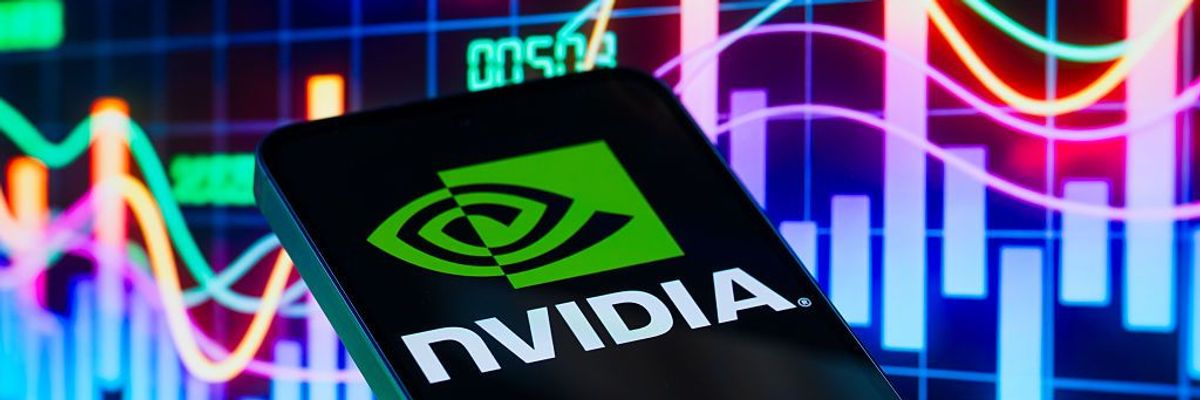
The NVIDIA logo is displayed on a mobile phone with a financial stock graph visible in the background, in this photo illustration in Brussels, Belgium, on November 18, 2025.
(Photo by Jonathan Raa/NurPhoto via Getty Images
Brad Reed
Nov 18, 2025
COMMON DREAMS
Tech industry insiders are growing more wary of a financial bubble in the artificial intelligence industry that many analysts have been warning could tip the global economy into a severe recession.
Sundar Pichai, CEO of Google parent company Alphabet, said in an interview with BBC published Tuesday that he believes the speculation currently pumping up investment in AI is akin to the kind of speculation that occurred in the late 1990s ahead of the dot-com stock crash.
“We can look back at the internet right now,” he told BBC. “There was clearly a lot of excess investment, but none of us would question whether the internet was profound. I expect AI to be the same. So I think it’s both rational and there are elements of irrationality through a moment like this.”
PIchai said that he believed his firm would be well positioned to weather the bursting of an AI bubble, although he also cautioned that “I think no company is going to be immune, including us,” were such a scenario to occur.
Sebastian Siemiatkowski, CEO of global payments network Klarna, told the Financial Times on Monday that while he still believed in the potential of AI, he also thought many of the biggest players in tech were vastly overspending to build out infrastructure that would not be needed to power the technology.
Siemiatkowski pointed to advances made this year by Chinese AI firm DeepSeek in vastly reducing the power needed to run AI as evidence that the energy-devouring data centers being constructed across the US would be a massive overbuild.
“I think OpenAI can be very successful as a company but at the same time I’m very nervous about the size of these investments in these data centers,” he said. “That’s the particular thing that I am concerned about.”
Some major investors are also signaling that the boom may be over for AI.
MarketWatch reported on Monday that Palantir chairman Peter Thiel’s hedge fund, Thiel Macro LLC, dropped all its shares in Nvidia, the US-based semiconductor giant that manufactures most of the chips used to power AI. The move by Thiel was revealed just one week after Japanese investment holding company SoftBank disclosed that it had divested its entire $5.8 billion stake in Nvidia.
Nvidia has also become a target for investor Michael Burry, who famously made a fortune by short-selling the US housing market ahead of the 2008 financial crisis, and who recently revealed that his firm was making bets against Nvidia and Palantir.
Concerns about a potential AI bubble have roiled global markets this week, and all major US stock indexes once again traded lower on Tuesday, marking the fourth consecutive losing session.
According to the Wall Street Journal, the current selloff is being driven by investors spooked about “lofty valuations and a pile-up of debt to build data centers,” and the paper pointed to a new survey showing that “45% of fund managers see an AI bubble as the top ‘tail risk’ for markets” right now.
“I’m very nervous about the size of these investments in these data centers,” one tech CEO said.
The NVIDIA logo is displayed on a mobile phone with a financial stock graph visible in the background, in this photo illustration in Brussels, Belgium, on November 18, 2025.
(Photo by Jonathan Raa/NurPhoto via Getty Images
Brad Reed
Nov 18, 2025
COMMON DREAMS
Tech industry insiders are growing more wary of a financial bubble in the artificial intelligence industry that many analysts have been warning could tip the global economy into a severe recession.
Sundar Pichai, CEO of Google parent company Alphabet, said in an interview with BBC published Tuesday that he believes the speculation currently pumping up investment in AI is akin to the kind of speculation that occurred in the late 1990s ahead of the dot-com stock crash.
“We can look back at the internet right now,” he told BBC. “There was clearly a lot of excess investment, but none of us would question whether the internet was profound. I expect AI to be the same. So I think it’s both rational and there are elements of irrationality through a moment like this.”
PIchai said that he believed his firm would be well positioned to weather the bursting of an AI bubble, although he also cautioned that “I think no company is going to be immune, including us,” were such a scenario to occur.
Sebastian Siemiatkowski, CEO of global payments network Klarna, told the Financial Times on Monday that while he still believed in the potential of AI, he also thought many of the biggest players in tech were vastly overspending to build out infrastructure that would not be needed to power the technology.
Siemiatkowski pointed to advances made this year by Chinese AI firm DeepSeek in vastly reducing the power needed to run AI as evidence that the energy-devouring data centers being constructed across the US would be a massive overbuild.
“I think OpenAI can be very successful as a company but at the same time I’m very nervous about the size of these investments in these data centers,” he said. “That’s the particular thing that I am concerned about.”
Some major investors are also signaling that the boom may be over for AI.
MarketWatch reported on Monday that Palantir chairman Peter Thiel’s hedge fund, Thiel Macro LLC, dropped all its shares in Nvidia, the US-based semiconductor giant that manufactures most of the chips used to power AI. The move by Thiel was revealed just one week after Japanese investment holding company SoftBank disclosed that it had divested its entire $5.8 billion stake in Nvidia.
Nvidia has also become a target for investor Michael Burry, who famously made a fortune by short-selling the US housing market ahead of the 2008 financial crisis, and who recently revealed that his firm was making bets against Nvidia and Palantir.
Concerns about a potential AI bubble have roiled global markets this week, and all major US stock indexes once again traded lower on Tuesday, marking the fourth consecutive losing session.
According to the Wall Street Journal, the current selloff is being driven by investors spooked about “lofty valuations and a pile-up of debt to build data centers,” and the paper pointed to a new survey showing that “45% of fund managers see an AI bubble as the top ‘tail risk’ for markets” right now.

No comments:
Post a Comment