'Not in our name': Afrikaners push back against Trump’s false white genocide claims in South Africa
While the US has announced special treatment for white South Africans seeking asylum, local division between left and right leaning groups in South Africa deepens.
Issued on: 16/11/2025 - 14:27
FRANCE24
By: Eunice Masson
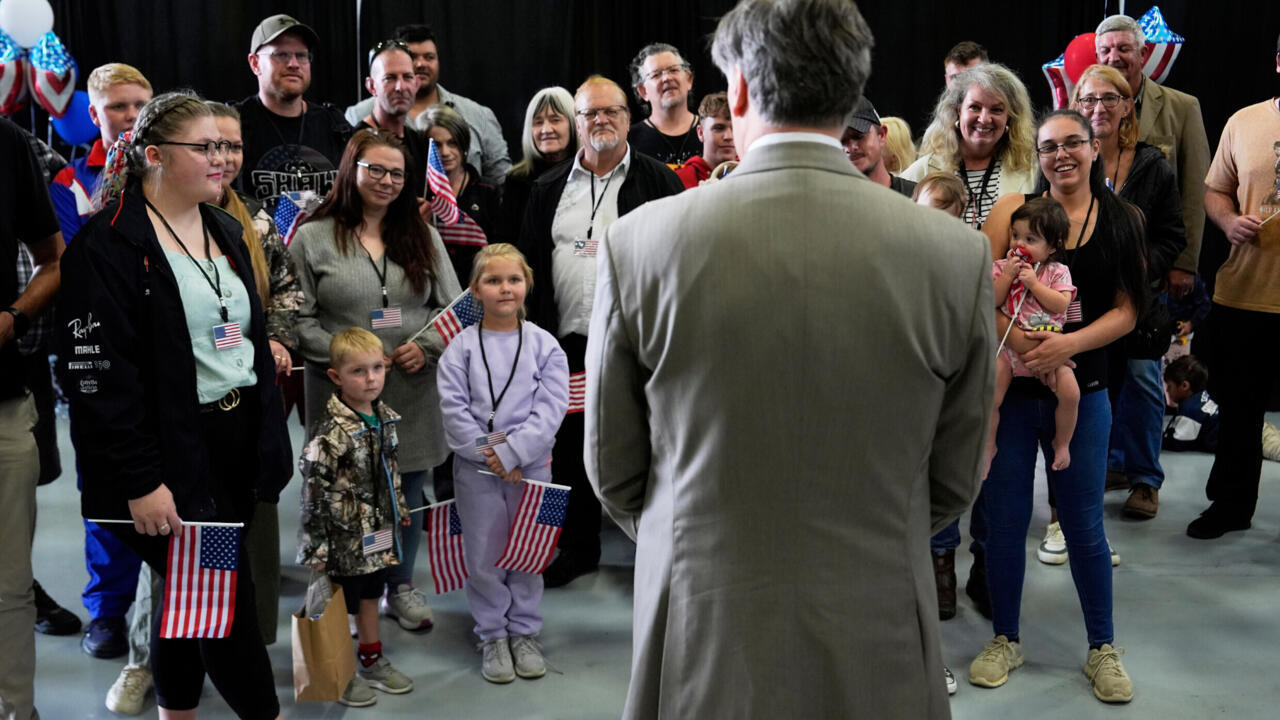
Deputy Secretary of State Christopher Landau welcomes Afrikaner refugees from South Africa on May 12, 2025, at Dulles International Airport in Virginia, US. © Julia Demaree Nikhinson, AP
A group of prominent Afrikaners has denounced US President Donald Trump’s claims of "white genocide" in South Africa and reached out to members of the United States Senate Committee on Foreign Relations.
The group – made up of writers, academics, business leaders and descendants of apartheid-era figures – wrote an open letter titled "Not in Our Name", rejecting Trump’s repeated assertions that white South Africans face systematic persecution.
They argue that white Afrikaners are not under any "existential threat" and urge the international community to challenge Trump’s misinformation.
Political analyst Dr Piet Croucamp, one of the main initiators of the letter, told FRANCE 24 that he had held direct talks with Senator Chris Coons, a Democrat, about Trump’s false claims.
Croucamp confirmed that the letter was sent to multiple senators, mainly from the Democratic Party, and said that although they were "speaking to the converted", they hoped the Democrats ’opposition to the refugee policy would help convey the truth to the Senate.
A group of prominent Afrikaners has denounced US President Donald Trump’s claims of "white genocide" in South Africa and reached out to members of the United States Senate Committee on Foreign Relations.
The group – made up of writers, academics, business leaders and descendants of apartheid-era figures – wrote an open letter titled "Not in Our Name", rejecting Trump’s repeated assertions that white South Africans face systematic persecution.
They argue that white Afrikaners are not under any "existential threat" and urge the international community to challenge Trump’s misinformation.
Political analyst Dr Piet Croucamp, one of the main initiators of the letter, told FRANCE 24 that he had held direct talks with Senator Chris Coons, a Democrat, about Trump’s false claims.
Croucamp confirmed that the letter was sent to multiple senators, mainly from the Democratic Party, and said that although they were "speaking to the converted", they hoped the Democrats ’opposition to the refugee policy would help convey the truth to the Senate.
Trump prioritises white Afrikaners, boycotts G20
The Trump administration has announced plans for a refugee policy that would cap the country’s refugee admissions for the 2026 fiscal year at 7,500 and prioritise white Afrikaners.
Only a handful of white South Africans appear eager to apply for asylum in the US. While public data do not show the full tally of South Africans granted refugee status, media reports suggest that around 59 white South Africans were resettled in the US in May this year. According to the Afrikaans newspaper Rapport, about 400 white South Africans had been granted asylum by the end of September.
Meanwhile, Trump continues to promote a narrative of white victimhood in South Africa. Last week, he announced on his social media platform Truth Social that the US would not attend the 2025 G20 summit in South Africa on November 22 - 23 "as long as these human-rights abuses continue.
"Afrikaners – people descended from Dutch settlers, as well as French and German immigrants – are being killed and slaughtered, and their land and farms are being illegally confiscated," he wrote.
During a recent conference in Miami, Trump added that South Africa "shouldn’t even be in the G20 anymore, because what’s happened there is bad. I’m not going to represent our country there. It shouldn’t be there".
It is against this backdrop that the group of Afrikaners wrote their open letter to challenge Trump’s narrative of "white genocide".
South Africa’s Department of International Relations and Cooperation has repeatedly debunked Trump’s claims.
Opening the letter: 'Not in Our Name'
The open letter initially had 40 signatories but has gathered more than 1,500 in just one week.
Responding to reports that white South Africans are receiving priority treatment as refugees in the US, the letter states that this has "brought our identity into the spotlight in ways that are deeply troubling. We reject the narrative that casts Afrikaners as victims of racial persecution in post-apartheid South Africa".
It goes on to say that singling out white Afrikaners as "victims of multiracialism" not only alienates them from their fellow South Africans but also harms relationships built since the end of apartheid 30 years ago.
The letter also argues that using race as a basis for special asylum status undermines the principles of refugee protection. "To elevate white suffering above others is to reinforce a racialised worldview that places whiteness at the centre and sees white identity as under existential threat."
The signatories insist this does not reflect their values or lived experience in South Africa. To call crime in South Africa "white genocide", they write, is "crass and narcissistic" when compared with people’s lived experiences in places such as Gaza and Sudan.
In its final paragraph, the letter urges South Africans and international observers "to challenge these distorted narratives and to recognise the dignity of all people – not just those who fit a political agenda".
Local divisions deepen
The open letter has reignited long-standing ideological divisions in South Africa over race, identity and representation within the Afrikaner community.
While the letter reflects the sentiment of many white South Africans critical of Trump’s remarks, it has also exposed a growing rift between the country’s left- and right-leaning groups.
Left-leaning media outlets have largely welcomed the letter as a rejection of victimhood politics while several commentators have sought to discredit it, claiming that a government official helped draft the statement. Although a government employee was involved, she did so in a personal capacity.
Ernst Roets, deputy chief executive officer of the right-leaning civil-rights organisation, AfriForum, who has repeatedly criticised the open letter, told FRANCE 24 that its signatories are "completely removed" from the reality and lived experiences of South Africans.
According to Roets, the division that followed the letter reflects long-standing tensions between conservative groups and intellectuals who are oblivious to people’s feelings and experiences on the ground.
The letter’s authors argue that portraying Afrikaners as victims of racial persecution – as some US conservatives and local lobby groups have done – feeds into the far-right "Great Replacement" theory and echoes campaigns such as "Make Afrikaners Great Again", a local variation of Trump’s "Make America Great Again" slogan.
AfriForum and Solidarity have in recent years sent representatives to the United States to lobby against South Africa’s proposed land-expropriation policies and to highlight farm attacks. But the letter’s signatories, who describe themselves as progressive Afrikaners, reject the notion that these groups represent all white Afrikaans speakers.
"No single organisation has a clear or legitimate mandate to speak on behalf of all Afrikaners," the letter states. "Afrikaners like us, who trace our South African roots to the 17th and 18th centuries, choose to identify as members of an inclusive and diverse Afrikaans-speaking community."
Roets said: "They are worried about criticism, but they themselves criticise," adding that the letter’s authors "do not understand their own people" and that this explains why they were "so shocked" by the backlash they received.
Speaking on condition of anonymity, a refugee who left South Africa for the US in late August told FRANCE 24 that she and her family do not disclose their refugee status to everyone as "some liberals here do not like refugees".
Her family have been resettled in the southern part of the US, where she says she feels safer than in South Africa. Although she was not personally affected by a farm attack, her husband was victim of one. She added that her family is progressing financially "much faster" in the US, but that success requires "a willingness to start with entry-level work" even after holding a professional position back in South Africa.

No comments:
Post a Comment