SCI-FI-TEK 70 YRS IN THE MAKING
First of Russian test rigs delivered to ITER construction site
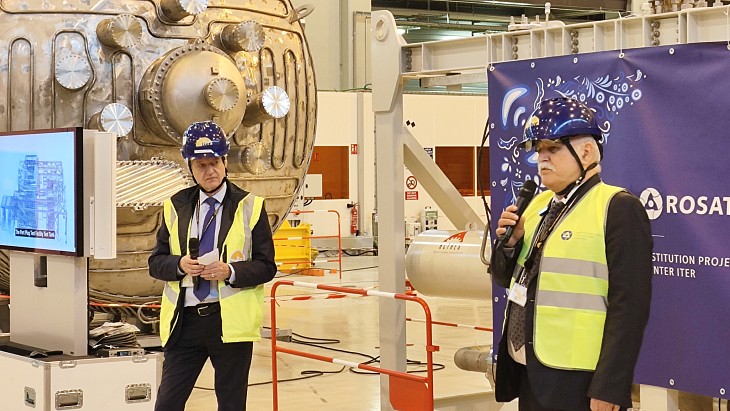
The test rig is designed for vacuum, thermal, and functional testing of port plugs, which are a key diagnostic element of the giant multinational fusion facility. It was manufactured in Bryansk in Russia by GKMP Research and Production Association, for the ITER Project Centre, which is part of Russia's state nuclear corporation Rosatom.
Testing will now take place, with the aim being to try to replicate as closely as possible operational conditions.
Anatoly Krasilnikov, Director of the ITER Project Centre, said: "This test facility is one of the most complex and science-intensive systems in the scope of our responsibilities for the project. To develop and manufacture it, our key suppliers had to develop and implement cutting-edge innovative solutions."
ITER Project Manager Sergio Orlandi said the work demonstrated Russia's high industrial capabilities, "which ensured the project's completion on time, with the required quality, and within budget. I would like to express special gratitude to the Russian Federation specialists who provided expert supervision throughout all stages of the facility's design, procurement, and assembly. I also express my gratitude to Rosatom State Corporation for ensuring the creation of such a critical system".
ITER is a major international project to build a tokamak fusion device designed to prove the feasibility of fusion as a large-scale and carbon-free source of energy. The goal of ITER is to operate at 500 MW (for at least 400 seconds continuously) with 50 MW of plasma heating power input. It appears that an additional 300 MWe of electricity input may be required in operation. No electricity will be generated at ITER.
Thirty-five nations are collaborating to build ITER - the European Union is contributing almost half of the cost of its construction, while the other six members (China, India, Japan, South Korea, Russia and the USA) are contributing equally to the rest. Construction began in 2010 and the original 2018 first plasma target date was put back to 2025 by the ITER council in 2016. However, in June last year, a revamped project plan was announced which aims for "a scientifically and technically robust initial phase of operations, including deuterium-deuterium fusion operation in 2035 followed by full magnetic energy and plasma current operation".
Zap Energy exceeds gigapascal fusion plasma pressures on new fusion device, FuZE-3
New generation of fusion device reaches record plasma pressures in a sheared-flow-stabilized Z pinch
image:
FuZE-3’s plasma chamber is only about 12 feet long and produces hot dense plasma filaments a few millimeters wide.
view moreCredit: Zap Energy
Operating a new device named the Fusion Z-pinch Experiment 3, or FuZE-3, Zap Energy has now achieved plasmas with electron pressures as high as 830 megapascals (MPa), or 1.6 gigapascals (GPa) total, comparable to the pressures found deep below Earth’s crust. The results are the highest-pressure performance to date in a sheared-flow-stabilized Z pinch and an important marker on the path to scientific energy gain, or Q>1.
FuZE-3 is Zap’s first device to incorporate a third electrode to separate the forces that drive plasma acceleration and compression. Details of the preliminary results were presented today at the American Physical Society’s Division of Plasma Physics meeting in Long Beach, Calif.
“There are some big changes in FuZE-3 compared to Zap’s previous systems and it’s great to see it perform this well so quickly out of the gate,” says Colin Adams, Head of Experimental Physics.
Under Pressure
Unlocking energy from fusion requires an extreme recipe of hot, dense plasma. Reaching high pressures, a measurement that combines temperature with density, is essential in fusion because the higher the plasma pressure, the more fusion reactions occur and produce energy. While some fusion machines strive for the highest pressures that can possibly be attained, others rely on longer confinement times to make up for low pressure. Zap’s sheared-flow-stabilized Z pinches aim for a middle ground that balances both compression and confinement.
Zap’s highest single-shot electron pressure measurement to date is 830 MPa. However, plasmas are more than just electrons; they are composed of both electrons and much heavier ions. If the temperature of both the electrons and ions are close to equal, as they are expected to be, the total plasma pressure (electrons and ions) is roughly double the electron measurements, or 1.6 GPa. A gigapascal is about ten thousand times the atmospheric pressure at sea level, or ten times the pressure at the bottom of the Mariana Trench.
The pressures were sustained for approximately a microsecond (one millionth of a second) and were determined using a technique called optical Thomson scattering, the gold-standard for such measurements.
The recent FuZE-3 campaigns include multiple repeated shots with electron densities in the range of 3-5x1024 m-3 and electron temperatures above 1 keV (equal to 21,000,000 degrees Fahrenheit).
“This was a major effort by the team that was successful because of a tightly coupled cycle of theoretical predictions, computational modeling, rapid build and test engineering, experimental validation, and measurement expertise,” remarks Ben Levitt, Vice President of R&D. “With a smaller system we have the benefit of being able to move quickly, and achieving these results in systems that are a fraction of the size and cost of fusion devices of comparable performance is a big part of what makes this such a significant accomplishment.”
Introducing FuZE-3
FuZE-3 is the third generation of FuZE devices, and the fifth sheared-flow-stabilized Z-pinch device. Zap’s initial device FuZE was the first to exceed 1 keV temperatures and has now been decommissioned. FuZE-Q, Zap’s highest performing device by power and fusion neutron yield, remains in regular operation alongside FuZE-3.
FuZE-3 was designed to climb to new levels of triple product, an important metric in fusion that is the mix of three measurements: density, temperature and confinement time. Critically, it includes three electrodes and two capacitor banks.
Separating acceleration and compression
Tests at Zap to date have relied on systems with a single pulse of electrical current conducting between two electrodes. This means that the power driven into the device must accelerate the plasma to provide stabilizing flow as well as compress the plasma into a Z pinch.
“The capability to independently control plasma acceleration and compression gives us a new dial to tune the physics and increase the plasma density,” explains Adams. “The two-electrode systems have been effective at heating, but lacked the compression targeted in our theoretical models.”
Though the new measurements demonstrate very high pressures, Zap’s physics is a form of quasi-steady-state magnetic confinement, not the inertial fusion physics targeted by systems that compress a target in nanoseconds using huge arrays of powerful lasers (or also in some cases Z pinches). For Zap’s approach, controlling plasma acceleration to generate and sustain stabilizing flow is as important as controlling compression.
Aiming for milestone triple products
Zap’s latest results remain preliminary as the team continues active scientific campaigns on FuZE-3. Further details are being presented this week at the APS DPP meeting and the team plans to publish FuZE-3 results in the scientific literature in the coming months.
“We’re really just getting started with FuZE-3,” says Levitt. “It was built and commissioned just recently, we’re generating lots of high-quality shots with high repeatability, and we have plenty of headroom to continue making rapid progress in fusion performance. We’ll be integrating lessons from FuZE-3 into our next generation systems as we continue advancing toward commercial fusion.”
While FuZE-3 tests are ongoing, Zap plans to commission yet another next generation FuZE device, scheduled to come online this winter. Power plant engineering continues in parallel, anchored by the Century demonstration platform.
About Zap Energy
Zap Energy is building a low-cost, compact and scalable fusion energy platform that confines and compresses plasma without the need for expensive and complex magnetic coils. Zap’s sheared-flow-stabilized Z-pinch technology provides compelling fusion economics and requires orders of magnitude less capital than conventional approaches. Zap Energy has 150 team members in Seattle and San Diego and is backed by leading financial and strategic investors.
Method of Research
Experimental study
Flowing Z pinch compression [VIDEO]
A high-speed camera captures a sheared-flow-stabilized Z pinch inside the FuZE-3 device. The camera is pointed straight toward the column of fusion plasma and the compression wave is visible as it collapses inward. The process takes only around a microsecond.
Credit
Zap Energy
The hidden rule behind ignition — An analytic law governing multi-shock implosions for ultrahigh compression
A theoretical compass to complement the age of AI-driven fusion physics
The University of Osaka
image:
Conceptual illustration of the Stacked Converging Shocks (SCS) framework. Each successive shock stage compresses the target further in a self-similar manner, producing a geometrically ordered sequence of pressure waves. The relation ρr ∝ P̂β(N−1) expresses how the final density increases with the stage-to-stage pressure ratio P̂ and the number of shocks N, where β is a constant determined by the adiabatic index γ. The horizontal arrow indicates the direction of time, showing the cumulative buildup of compression through multiple converging shocks. While schematic, the image evocatively conveys the harmony and rhythm underlying the extreme dynamics of matter under compression.
view moreCredit: M. Murakami
Osaka, Japan — Physicists at The University of Osaka have unveiled a breakthrough theoretical framework that uncovers the hidden physical rule behind one of the most powerful compression methods in laser fusion science — the stacked-shock implosion. While multi-shock ignition has recently proven its effectiveness in major laser facilities worldwide, this new study identifies the underlying law that governs such implosions, expressed in an elegant and compact analytic form.
A team led by Professor Masakatsu Murakami has developed a framework called Stacked Converging Shocks (SCS), which extends the classical Guderley solution — a 1942 cornerstone of implosion theory — into the modern high-energy-density regime. In this self-similar system, each stage of compression mirrors the previous one, forming a repeating pattern of converging waves that amplify both pressure and density in perfect geometric proportion. The result reveals a natural harmony underlying one of the most extreme processes in physics.
From Simulation to Understanding
Recent ignition experiments worldwide have relied heavily on massive numerical optimization and AI-assisted design. Murakami’s work provides a long-missing analytic counterpart — a framework that can describe the same physics using simple, transparent scaling laws. It is, in his words, “not a substitute for computation, but a theoretical compass that guides it.”
The SCS framework bridges two approaches that have long advanced separately — data-driven simulation and analytic insight — showing that both can operate as two wheels of the same vehicle in the pursuit of fusion ignition.
A Universal Scaling Law
Hydrodynamic simulations confirm the analytic predictions across both weak- and strong-shock regimes. As the number of shocks increases, the cumulative process tends toward a quasi-isentropic (nearly reversible) behavior, suggesting an efficient pathway to achieve ultradense states of matter. The work establishes a universal scaling law that directly links the number of shocks, stage-to-stage pressure ratios, and final compression — an analytic bridge connecting classical theory with next-generation fusion design.
Why It Matters
Extreme compression lies at the heart of many scientific frontiers:
- Fusion Energy: Offers a new analytic foundation to complement large-scale AI-driven design in achieving efficient, multi-stage implosions.
- Material Science: Enables exploration of solid matter under multi-gigabar pressures.
- Astrophysics: Helps model the evolution of dense stellar and planetary interiors in laboratory settings.
Beyond its immediate applications, the study marks a philosophical shift — showing that even in an age dominated by computation, this work reminds us that clarity from first principles remains indispensable for progress.
###
The article, “Self-Similar Multi-Shock Implosions for Ultra-High Compression of Matter,” was published in Physical Review E at DOI: https://doi.org/10.1103/bbvn-x95v
About The University of Osaka
The University of Osaka was founded in 1931 as one of the seven imperial universities of Japan and is now one of Japan's leading comprehensive universities with a broad disciplinary spectrum. This strength is coupled with a singular drive for innovation that extends throughout the scientific process, from fundamental research to the creation of applied technology with positive economic impacts. Its commitment to innovation has been recognized in Japan and around the world. Now, The University of Osaka is leveraging its role as a Designated National University Corporation selected by the Ministry of Education, Culture, Sports, Science and Technology to contribute to innovation for human welfare, sustainable development of society, and social transformation.
Website: https://resou.osaka-u.ac.jp/en
Journal
Physical Review E
Method of Research
Computational simulation/modeling
Subject of Research
Not applicable
Article Title
Self-Similar Multi-Shock Implosions for Ultra-High Compression of Matter
Article Publication Date
17-Nov-2025

No comments:
Post a Comment