Showing posts sorted by relevance for query SCI-FI-TEK 70 YRS IN THE MAKING. Sort by date Show all posts

Wednesday, October 22, 2025

SCI-FI-TEK 70 YRS IN THE MAKING

Nordic study on siting of fusion pilot plant


Denmark, Finland, Norway and Sweden all meet the technical requirements to host a pilot fusion reactor, but Finland is the most prepared in terms of regulatory readiness, according to a report conducted by Finland's VTT Technical Research Centre on behalf of Swedish fusion energy company Novatron Fusion Group.
 
A rendering of the N3 pilot plant (Image: NFG)

Novatron Fusion Group (NFG) - the only private fusion energy company in the Nordics - is developing a magnetic mirror fusion reactor concept, targeting to create a commercially viable and cost-effective source of clean energy. NFG's roadmap includes four incremental fusion facilities from lab-scale experiment N1 to a prototype of a commercial fusion power plant N4. The company plans to construct the N2 fusion pilot plant in the Stockholm area. On the roadmap, N3 represents an industrial-scale pilot demonstrating technical feasibility of fusion energy under operational conditions. NFG is preparing to build N3 in the Nordic region during the 2030s.

NFG commissioned VTT to conduct a study that focuses on siting N3 in Denmark, Finland, Norway, or Sweden. This assessment considered national fusion strategies and regulations, technical, environmental, and societal factors, as well as stakeholder input. International experience with fusion pilot plant siting was reviewed as a reference. During the project, a set of preliminary screening criteria was developed and applied using geospatial data to map suitable areas and locations for the N3 plant. The aim was to identify promising sites for further evaluation, which will involve more detailed criteria and collaboration with local stakeholders, regulators, landowners, technical experts, and investors.

Based on the study, the most promising regions (primary focus areas) for the pilot fusion reactor are: the Helsinki metropolitan area in Finland; the area between Stockholm and Nyköping in Sweden; and the Copenhagen-Malmö corridor spanning Denmark and Sweden. In addition, the study identified approximately ten secondary focus areas that represent all four countries.

The most promising locations for a fusion reactor are found in existing industrial zones with strong transport connections, noted Markus Airila, Research Team Leader at VTT. "Proximity to ports, heavy-load land transport links and access to research hubs are key features of the most suitable locations," he said.

"All primary focus areas are currently hosting relatively strong technology hubs with nuclear and fusion expertise and are characterised by favourable logistical conditions," the study says. "The ranking of these areas in the presented order is based on the regulatory readiness of each country."

When comparing the regulatory environments in each country, the study found that Finnish legislation is the most advanced, followed closely by that of Sweden. Finland is in the process of renewing its Nuclear Energy Act, which will streamline the licensing process and reduce barriers for pilot fusion sites. The changes are expected to become effective in 2027. Sweden has an established nuclear legislation that explicitly includes fusion reactors. However, the regulation is still subject to comprehensive, fission-focused requirements. Denmark and Norway operate under older nuclear regulations with no specific mentions of fusion energy, resulting in some political and procedural uncertainty.

The next phase of the project will involve detailed, site-specific investigations in cooperation with interested Nordic stakeholders and industrial partners. This stage will refine potential sites based on land ownership, local engagement and technical feasibility.

"The report provides a basis for subsequent, more detailed site-specific investigations in selected locations and serves as a reference for future regional analyses for similar projects," VTT said.

"VTT has done an excellent job delivering a thorough report that provides us with a clear and actionable roadmap to move from concept to construction," said Novatron Fusion Group CEO Peter Roos. "Cross-border collaboration, legislative reforms and the development of fusion strategies will be key to accelerating a fusion ecosystem in the Nordic region."

Energy company St1 Nordic Oy announced earlier this that it has invested EUR13 million (USD15 million) in NFG to support the energy transition in the Nordics.

"Novatron Fusion Group is driving a breakthrough in clean energy, and we're proud to support that momentum with a long-term commitment," said Henrikki Talvitie, CEO of St1. "The insights from this report highlight the Nordic region's opportunities in the global fusion development race. We're excited to contribute to the advancement of secure, fossil-free energy and to help shape a collaborative fusion ecosystem across the Nordic borders."

Monday, November 03, 2025

 SCI-FI-TEK 70 YRS IN THE MAKING

Merz Action Plan Aims for World's First Commercial Fusion Reactor

  • Germany has announced a €1.7 billion investment in nuclear fusion, aiming to develop the world's first commercial fusion reactor, a significant reversal of its long-standing anti-nuclear energy stance.

  • This policy shift is driven by Germany's ambitious decarbonization goals and the need to overhaul its energy mix, moving away from heavy reliance on fossil fuels.

  • The investment positions Germany at the forefront of a global technology race in nuclear fusion, a field experiencing major breakthroughs and considered crucial for future energy sovereignty.

Germany just made a huge bet on nuclear fusion, putting an exclamation point at the end of its historic u-turn on nuclear energy policy. A new action plan from Chancellor Friedrich Merz aims to ensure that the world’s first commercial fusion reactor and throws €1.7 billion ($1.98 billion) in funding behind the cause. The unexpected announcement is making major waves in what is already a conflicted political environment when it comes to energy planning.

This announcement comes as something of a shock considering that Germany has been Europe’s staunchest nuclear energy opponent for years. Germany decommissioned its last three nuclear power plants offline in 2023, and has – until very recently – stood firmly unified in this resolve. "We have decided to phase out nuclear power. This has also been accepted by society," the nation’s Environment Minister Carsten Schneider told Deutsche Welle (DW) just a few months ago. "There are no further commitments [to the nuclear industry], nor will there be any," he went on to say.

But cracks have been showing in that unified front for a while now. Back in May, German Economy Minister Katherina Reiche publicly said that she was "open to all technologies,” marking a major departure from Germany’s traditional stance. Even more surprising, Germany ceded its side of a long-standing nuclear energy cold war with France, agreeing to make peace with French officials by dropping anti-nuclear power rhetoric from European Union legislation. 

Even against this backdrop, however, Germany’s bid to become the preeminent global superpower for nuclear fusion technology is a surprising one. But though it’s politically fraught, the plan has logical strategic grounding. An ambitious approach to clean energy production is absolutely necessary if Germany has any hope of meeting its decarbonization goals. As Europe’s largest economy, Germany’s greenhouse gas footprint is also pivotal to the wider climate goals of the European Union. The pressure is on for the nation, which currently relies heavily on fossil fuels, to overhaul its energy mix in the coming years.

Sarah Klein, commissioner for fusion research at the Fraunhofer Institute for Laser Technology in Aachen, told DW this week that investing in fusion technology is a "smart long?term strategic bet” that “keeps Germany at the forefront of a global technology race.” She added that in tandem with renewable energy development, nuclear fusion is “crucial for ensuring energy sovereignty after the phaseout of fossil fuels.”

Germany’s policy shift comes as part of a sea change of nuclear energy sentiment in Europe and abroad. Just this year, Italy and Denmark began motions to overturn their respective 40-years ban on nuclear energy production, and the government of Spain indicated that they were considering extending the lives of domestic nuclear power plants slated for phaseout. 

The shift also comes at a time of major technological breakthroughs in the field of nuclear fusion science. Researchers around the world are racing to achieve commercially viable nuclear fusion, and they are getting closer all the time. China, in particular, is investing heavily in fusion research and development and aims to achieve viability by 2050. Labs in the United States are also breaking record after record for achieving net positive energy production from their laser-based fusion models. 

The ramifications of any country or project achieving commercial nuclear fusion are difficult to overstate. In the words of a Daily Galaxy report from earlier this year, “If China or any other nation succeeds in making fusion commercially viable, it could trigger an energy revolution, transforming how the world powers homes, industries, and even space exploration.”

And, of course, it means a major geopolitical leg up for the country that gets there first. As a result, even Germany, once the world’s biggest anti-nuclear government, is now throwing its hat into the crowded ring. 

By Haley Zaremba for Oilprice.com

Saturday, June 22, 2024

ITER's proposed new timeline - initial phase of operations in 2035


FUSION IS SCI-FI-TEK 70 YRS IN THE MAKING

20 June 2024


The revamped project plan for the International Thermonuclear Experimental Reactor (ITER) aims for "a scientifically and technically robust initial phase of operations, including deuterium-deuterium fusion operation in 2035 followed by full magnetic energy and plasma current operation".

The giant ITER construction site in September 2023 (Image: ITER/EJF Riche)

The ITER Organisation has been working on what Director General Pietro Barabaschi described as a "realistic" project timeline, since he took up the role two years ago. The previous baseline, established in 2016, was for first plasma in 2025 at the giant international collaborative project which is taking shape in the south of France.

At the 34th meeting of the ITER Council on Wednesday and Thursday this week, there were presentations on progress made in construction as well as the proposed update of the project baseline which would "prioritise the start of substantial research operations as rapidly as possible. This would be achieved by consolidating tokamak assembly stages, enhancing pre-assembly testing, and reducing machine assembly and commissioning risks. Throughout this phase of assembly, the project will continually progress through critical technical milestones that will be relevant to the global fusion innovation programme".

A statement issued after the ITER Council meeting said that the director general would give more details at a press conference in July of the updated proposal "which leads to a scientifically and technically robust initial phase of operations, including deuterium-deuterium fusion operation in 2035 followed by full magnetic energy and plasma current operation. Achieving these goals will enable progression to full fusion power in the deuterium-tritium phase. The proposed baseline will be further evaluated and validated, including the increased cost and the schedule implications driven by this new approach, and recommendations will be shared with the ITER Council for consideration".

The 2016 baseline had the start of deuterium-tritium operation set for 2035. Although the new baseline means a considerable delay compared with the previous one, the reform of the programme means they cannot be directly compared, ITER says. The 2016 baseline was for first plasma to be a brief low-energy machine-test at 100 kiloamperes followed by substantial assembly and incremental operation, whereas the new baseline's start of research operation is for operation at 15 megaamperes, which would require installation of components that would not have been needed for that part of the previous baseline.

ITER at a glance


ITER is a major international project to build a tokamak fusion device designed to prove the feasibility of fusion as a large-scale and carbon-free source of energy. The goal of ITER is to operate at 500 MW (for at least 400 seconds continuously) with 50 MW of plasma heating power input. It appears that an additional 300 MW of electricity input may be required in operation. No electricity will be generated at ITER, and as well as what will be learned when it begins operations, as a first-of-a-kind project it is providing lessons and benefits for the international fusion industry throughout its construction.

Thirty-three nations are collaborating to build ITER - the European Union is contributing almost half of the cost of its construction, while the other six members (China, India, Japan, South Korea, Russia and the USA) are contributing equally to the rest. Construction began in 2010. The ITER Council members reaffirmed their support for the project, saying "the fusion operations pursued by ITER remain strongly relevant for global fusion research and development and the national fusion programmes of the ITER Members".

What has caused the delays?


There are a variety of reasons which have been given for the delays to the project. As well as general first-of-a-kind type issues there has also been the COVID-19 pandemic and the emergence of problems in the vacuum vessel sector's welding joint region and corrosion-induced cracks in thermal shield piping. Barabaschi, speaking in October 2023, said that even without those issues the 2025 first plasma deadline was not going to be met.

In the update report, the council noted the progress made on repairs and also the completion of manufacturing of all toroidal field coils, judged to be one of the most technically challenging components. Manufacturing of all the poloidal field coils has also been completed and "are examples of the critical milestones the project will accomplish throughout the assembly phase".

In the ITER statement it was also stressed that "council members re-emphasised the strong value of the ITER mission and resolved to work together to find solutions to facilitate ITER’s success ... and noted the ongoing challenges facing the project and expressed appreciation that all ITER Members are continuing to meet their in-kind and in-cash commitments to support project success".

Researched and written by World Nuclear News


Saturday, October 18, 2025

SCI-FI-TEK 70 YRS IN THE MAKING

World's largest toroidal field coil box delivered


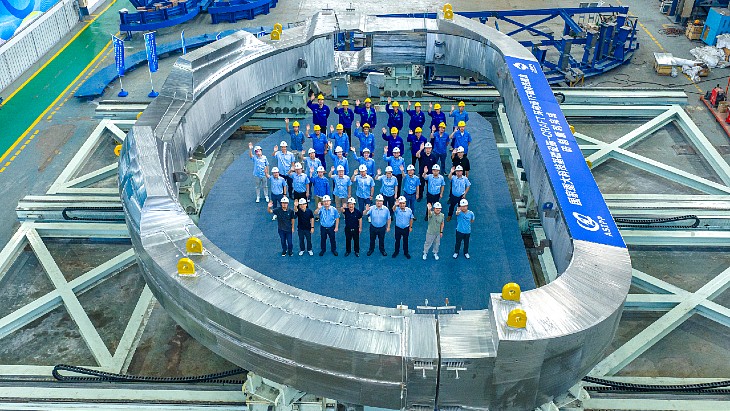
A delivery ceremony has been held for the toroidal field magnet coil box - measuring 21 metres by 12 metres - at the Comprehensive Research Facility for Fusion Technology in Hefei, China.
 
(Image: Shanghai Electric)

Shanghai Electric delivered the coil box, the primary load-bearing structural component of the toroidal field magnet and a core component of the magnet system as it protects the toroidal field coil windings and supports and secures other superconducting magnets, including the poloidal field magnet.

Consisting of ultra-low-temperature austenitic steel, it weighs 400 tonnes and Shanghai Electric said it was the world's largest toroidal field magnet coil box, at more than 1.2-times the size, and about twice the weight, of similar components in the multinational ITER fusion project in France.

The project team spent five years overcoming numerous technical challenges, said the Institutes of Physical Science, Chinese Academy of Sciences, adding: "In terms of manufacturing technology, facing the challenge of welding with a maximum thickness of 360mm, they developed a combination of high-thickness laser welding and ultra-deep narrow-gap tungsten inert gas welding, as well as phased array non-destructive testing technology, achieving shape and quality control during coil box welding. They also developed precision forming technology for 30-metre-long space bends and cooling tube fixation using low-temperature resin and brazing, enabling high-precision installation of the cooling tubes."

"The successful delivery of the coil box not only accumulates relevant technical experience for the manufacturing of high-end equipment for China's fusion devices, but also fosters a comprehensive, end-to-end industrial supply chain system, marking a significant step towards the commercialisation of fusion energy. The related technologies can also be applied in aerospace, energy equipment, shipbuilding, and offshore engineering."

Shanghai Electric said that the work "demonstrates its outstanding innovation and high-end manufacturing capabilities in major projects".

The company, in collaboration with the Institute of Plasma Physics, in July completed the design and delivery of the magnet cold test cryostat for the International Thermonuclear Experimental Reactor (ITER). The item, the largest transported, arrived at the construction site in Cadarache, southern France, following a 104-kilometre-long journey by road from the port of Berre-l'Étang, near Marseille.


The giant delivery to ITER (Image: ITER organisation)

The cryostat - into which some of the D-shaped toroidal field coils as well as PF1, the smallest of the ring-shaped poloidal field coils, will be inserted - is shaped "like a giant sardine box", the ITER Organisation said. It measures 22 metres in length and almost 11 metres in width and weighs 330 tonnes.

Shanghai Electric said that with its two decades of experience in the "future-oriented energy technology" of fusion, "industrialisation is key to driving technological breakthroughs and commercial applications".

Background

According to the recently published IAEA World Fusion Outlook 2025: "The Institute of Plasma Physics at the Chinese Academy of Sciences is advancing a complementary suite of facilities that together address physics, engineering and fuel cycle questions that will be foundational for future fusion plants."

These include the Comprehensive Research Facility for Fusion Technology (CRAFT), "now in the final stages of construction ... designed as a single campus-style platform bringing together some 20 specialised test stands covering superconducting magnets, heating and current-drive systems, blankets, and tritium technologies.

"Its purpose is to help address the engineering integration challenges involved in advancing magnetic fusion energy from present experiments towards a functional fusion power plant.

"The BEST tokamak is being built at the same site, next to the CRAFT facility, to explore steady state control of deuterium-tritium plasmas and to validate tritium production, extraction and recycling schemes. Civil works began in 2023, with a target of 2027 for first deuterium plasma; plans for subsequent deuterium-tritium operation are under review."

ITER is a major international project to build a tokamak fusion device designed to prove the feasibility of fusion as a large-scale and carbon-free source of energy. The goal of ITER is to operate at 500 MW (for at least 400 seconds continuously) with 50 MW of plasma heating power input. It appears that an additional 300 MWe of electricity input may be required in operation. No electricity will be generated at ITER.

Thirty-five nations are collaborating to build ITER - the European Union is contributing almost half of the cost of its construction, while the other six members (China, India, Japan, South Korea, Russia and the USA) are contributing equally to the rest. Construction began in 2010 and the original 2018 first plasma target date was put back to 2025 by the ITER council in 2016. However, in June last year, a revamped project plan was announced which aims for "a scientifically and technically robust initial phase of operations, including deuterium-deuterium fusion operation in 2035 followed by full magnetic energy and plasma current operation".

Friday, October 03, 2025

SCI-FI-TEK 70 YRS IN THE MAKING

ITER's Control Building completed

Fusion for Energy - the ITER Organisation's European domestic agency - and its contractor Demathieu Bard have completed the Control Building for the International Thermonuclear Experimental Reactor at Cadarache in south-eastern France.

(Image: F4E)

French engineering firm Demathieu Bard designed and constructed the building, which has a 3,500-square-metre footprint. The works lasted five years, totalling more than 200,000 person-hours.

Besides the main control room and server rooms, the Control Building has offices, a command post, a gallery for visitors and a dining room. Staff will enter it from the ITER headquarters (just outside the platform) via a footbridge. 

Once the structure was finished, the teams started installing services like ventilation, electricity or fire protection, whilst ITER Organisation’s contractors set up all the computer hardware. In total, there are 80 cubicles containing electronic systems to process the massive volume of information.

The 800-square-metre control room is equipped with 30 workstations and the first workers have started moving in. The various temporary control rooms, in charge of monitoring the plant systems under commissioning, will now be relocated in the new building.

"Unlike the rest of the industrial buildings, this one is made to host people during the 24 hours, so we included many provisions for accessibility and ergonomics, such as noise reduction and natural indirect light," noted Eric Brault, F4E's Project Manager.

"We are proud to deliver another ITER building, especially one with such symbolic value, as the future centre of operations," said Sébastien Berne, Major Project Director of Demathieu Bard. "We designed its layout and services to offer the best work experience. We then executed it meeting the complex requirements in a challenging schedule, thanks to the good planning and collaboration with F4E, as well as ITER Organisation and their suppliers."

ITER is a major international project to build a tokamak fusion device designed to prove the feasibility of fusion as a large-scale and carbon-free source of energy. The goal of ITER is to operate at 500 MW (for at least 400 seconds continuously) with 50 MW of plasma heating power input. It appears that an additional 300 MWe of electricity input may be required in operation. No electricity will be generated at ITER.

Thirty-five nations are collaborating to build ITER - the European Union is contributing almost half of the cost of its construction, while the other six members (China, India, Japan, South Korea, Russia and the USA) are contributing equally to the rest. Construction began in 2010 and the original 2018 first plasma target date was put back to 2025 by the ITER council in 2016. However, in June last year, a revamped project plan was announced which aims for "a scientifically and technically robust initial phase of operations, including deuterium-deuterium fusion operation in 2035 followed by full magnetic energy and plasma current operation".

Germany boosts funding for fusion research

The German cabinet has approved the federal government's action plan aimed at accelerating commercial fusion deployment in Germany. By 2029, more than EUR2 billion (USD2.3 billion) will be invested in fusion research, as well as the development of new research infrastructures and pilot projects.
 
(Image: noelsch / Pixabay)

The Fusion Action Plan implements a flagship measure of the High-Tech Agenda Germany - announced in July by the Federal Ministry of Research, Technology and Space (BMFTR) - in fusion, identified as one of six critical future technologies for the country.

"Fusion energy could be an important component in the power grid of the future," the action plan says. "However, significant technological challenges still need to be overcome on the path to the first fusion power plant. The technologies required for a power plant must be researched and developed to market readiness in a joint effort by industry and science."

The Federal Government's adopted action plan identifies eight fields of action and measures that should be addressed in order to realise a fusion power plant in Germany.

Firstly, it will strengthen research funding by increasing public funding within the framework of the Fusion 2040 funding programme and the announced joint energy research programme to a total of about EUR1.7 billion during this legislative period.

The government will also promote the development of a fusion ecosystem comprising science and industry. thereby supporting the transfer of knowledge from research to companies, which can then assume the leading role on the path to fusion power plants. At the same time, it will promote the comprehensive development of value chains for a fusion power plant in Germany.

Funds will be allocated for the establishment and expansion of research infrastructures and pilot projects, even beyond the current financial planning, so that the goals agreed upon in the action plan can be achieved. In this legislative period alone, funds amounting to up to EUR755 million are to be used from the special infrastructure fund.

The Federal Government will, within the scope of its federal structure, support the training and further education of specialists and will regularly engage in dialogue with the states on this matter.

The action plan calls for the Federal Government to continue to regulate fusion within the framework of the Radiation Protection Act and not within the framework of the Atomic Energy Act. This, it says, provides a reliable framework for companies and investors and thus supports necessary investments, including private capital.

The Federal Government will advocate for the protection of intellectual property and support efforts towards internationally harmonised standardization. It will also enter into long-term and strategic international cooperation with value-based partners that will further accelerate the already internationally positioned fusion research.

"Recent years have clearly shown us all that our energy supply is facing challenges," said Federal Minister for Research, Technology and Space Dorothee Bär. "It is the foundation for competitiveness, value creation, and sovereignty. Our energy of tomorrow should be safe, environmentally compatible, climate-friendly, and affordable for everyone. In the future, the key technology of fusion could help fulfill this demand. With the Fusion Action Plan, we are paving the way for the world's first fusion power plant in Germany."

In September 2023, then Federal Research Minister Bettina Stark-Watzinger announced that Germany would significantly increase research funding for fusion with an additional EUR370 million over the next five years. Together with funds already earmarked for research institutions, the ministry will provide more than EUR1 billion for fusion research by 2028. The move was aimed at paving the way for the first fusion power plant to be constructed in Germany by 2040.

World Nuclear News

Friday, November 28, 2025

 SCI-FI-TEK 70 YRS IN THE MAKING...

Conceptual design completed for Japan's FAST fusion demo project


The Fusion by Advanced Superconducting Tokamak project, designed to demonstrate fusion energy power generation in Japan in the 2030s, has reached its first key milestone, Starlight Engine and Kyoto Fusioneering have announced.
 
(Image: Kyoto Fusioneering)

The Conceptual Design Report has been put together in the year since the project's launch in November 2024, and involved the two companies and researchers and experts from a number of Japanese universities and public institutions, as well as support from a number of other Japanese companies.

The Fusion by Advanced Superconducting Tokamak (FAST) device, to be sited in Japan, aims to generate and sustain a plasma of deuterium-tritium (D-T) reactions, demonstrating an integrated fusion energy system that combines energy conversion including electricity generation and fuel technologies. The project will employ a tokamak configuration, chosen for its well-established data and scalability.

Targeting a power generation demonstration by the end of the 2030s, FAST will address remaining technical challenges en route to commercial fusion power plants. The FAST Project Office notes that power generation refers to producing energy from fusion reactions, but does not imply net positive power production where electricity output exceeds electricity consumption.

The project team said the conceptual design work involved "designing the fusion energy plant for power generation demonstration, assessing technical and engineering feasibility, clarifying the project direction, conducting safety and economic evaluations, and defining the plant's fundamental design specifications".

"With the completion of the conceptual design phase, the project will now shift to engineering design, accelerated engineering R&D, and will proceed with site selection, site preparation, regulatory approvals, and the procurement of long-lead items, with the aim of construction after 2028," it said.

Kiyoshi Seko, CEO of Starlight Engine Ltd and President and COO of Kyoto Fusioneering Ltd, said: "Completing the conceptual design in just one year is a result of Japan's decades of research achievement. FAST is now moving into the engineering design phase. We will harness the strength of Japan's manufacturing industry and accelerate the project with a sense of urgency."

Satoshi Konishi, co-founder and CEO of Kyoto Fusioneering, said: "First and foremost, it's a great achievement to complete the conceptual design activities within the planned one-year timeframe. We succeeded in creating an innovative design that incorporates new technologies essential for commercial plants, such as high-temperature superconducting magnets, liquid breeding blanket systems, and highly efficient tritium fuel cycle systems, by mobilising domestic experts. Preparations for safety design, regulatory approvals, and site selection are steadily progressing. In the next engineering design phase we expect to fully leverage our strengths in plant engineering and our broad network across diverse industries, including finance and construction."

Kenzo Ibano, Assistant Professor, Osaka University, said: "Thanks to the power of industry-academia collaboration, we have successfully produced Japan’s first CDR for a power generation demonstration project. Working alongside researchers with decades of experience and private-sector partners in driving this project forward is both stimulating and rewarding, giving a strong sense of mission."

The Conceptual Design Report is due to be presented at the 42nd Annual Meeting of the Japan Society of Plasma Science and Nuclear Fusion Research being held from 1 December.

Other academics and businesses participating in and supporting the FAST project include Professor Akira Ejiri, University of Tokyo and Professor Takaaki Fujita, Nagoya University, as well as Sumitomo Mitsui Banking Corporation, Electric Power Development (J-Power), JGC JAPAN Corporation, Hitachi, Fujikura, Furukawa Electric, Marubeni Corporation, Kajima Corporation, Kyocera, Mitsui & Co., Mitsui Fudosan, and Mitsubishi Corporation.

Wednesday, July 23, 2025

Nuclear fusion start-up claims to have cracked alchemy

 SCI-FI-TEK 70 YRS IN THE MAKING
Marathon Fusion claims to have discovered a method of converting mercury into gold - Marathon Fusion

The promise of turning base metals into gold has transfixed some of the greatest minds in history, from the ancient Egyptians to Sir Isaac Newton.

But now a Silicon Valley start-up claims to have finally cracked the millennia-old riddle of alchemy – by using nuclear fusion technology.

Marathon Fusion claims to have discovered a method of converting mercury into gold by bombarding mercury isotopes with high-energy neutrons.

The neutrons are released during nuclear fusion, when two hydrogen isotopes are forced together to form helium.

This means the alchemy process can be carried out alongside power generation.

“Unlike previous attempts, our method is massively scalable, pragmatically achievable, and economically irresistible,” Marathon Fusion said. “This marks the beginning of a new golden age.”

The company, which is developing ways of processing and recycling fuel for the nascent fusion industry, has published a scientific paper on the proposed transmutation method. It has not yet been peer-reviewed.

The history of alchemy stretches back thousands of years and has long focused on transforming metals into gold and seeking an elixir of immortality.

Over thousands of years, it has captivated thinkers such as Newton, the English physicist who developed the mathematical law of universal gravitation in the late 17th century.

Many dreamed of creating a “philosopher’s stone” that would be used as a catalyst for transmuting base metals such as lead into gold.

Marathon’s idea relies on substituting materials used in the well-understood process of nuclear fusion instead.

Fusion takes place when two isotopes of hydrogen, deuterium and tritium, are forced together to create helium, releasing high-energy subatomic particles called neutrons.

It is accomplished by heating the deuterium and tritium atoms to extreme temperatures of more than 100 million degrees Celsius and then confining them into a tight space so that they collide.

The process becomes self-sustaining when helium atoms collide with the fuel particles, transferring their energy and ensuring the reaction keeps going.

But fusion reactors typically contain other materials, including isotopes of beryllium, lead, or lithium, to ensure there is continuously enough tritium in the mix.

These are known as “multipliers” because when they are hit by a neutron, they release two neutrons in their place. These extra neutrons then react with lithium to produce tritium.

Radical transformation

Marathon’s method uses mercury-198, a common form of mercury, as a multiplier. When hit by a neutron, these atoms change into a less stable form called mercury-197.

Over a few days, those atoms then naturally break down into a stable form of gold.

Marathon claims this means the fusion process can be used to generate supplies of gold as a byproduct, “without any compromise to fuel self-sufficiency or power output”.

Using the new approach, the company says a fusion power plant with a capacity of about one gigawatt could generate 5,000 kilograms of gold per year.

The gold produced by the reaction is stable, but could contain some radioactive gold isotopes, potentially meaning it must be stored for up to 18 years, according to the company.

The start-up added: “Marathon’s techno-economic modelling suggests that fusion plants could create as much economic value from gold production as they do from electricity production, potentially doubling the value of these facilities, radically transforming the economics of fusion and of energy more broadly.”

Beyond gold, it also claimed the transmutation process could be used for making precious metals such as palladium, synthesising medical isotopes, or producing materials for “nuclear batteries”.

Marathon was founded by Adam Rutkowski, a former engineer at Elon Musk’s rocket company, SpaceX, and Kyle Schiller, who was a fellow at ex-Google boss Eric Schmidt’s research foundation, Schmidt Futures.

UK to ease planning rules for fusion projects

Monday, 21 July 2025


The UK government announced plans to develop a National Policy Statement to unblock fusion energy projects, making the UK the first country in the world to develop fusion-specific planning rules.
UK to ease planning rules for fusion projects
A cutaway of the STEP fusion plant (Image: UKAEA)

Currently, fusion projects must submit an application to the local authority with no set timelines for approval and no guidance on which sites are appropriate – potentially hindering the technology's development in the UK.

The plans will see fusion introduced into the Nationally Significant Infrastructure Project regime, putting fusion energy projects on the same footing as other clean energy technologies such as solar, onshore wind and nuclear fission. It will help fusion energy projects move faster along the process from identifying sites to the start of construction. 

"The introduction of a National Policy Statement will provide clarity to developers and streamline the planning process for fusion, giving applicants clearer guidance on where and how quickly projects can be developed," the Department for Energy Security and Net Zero said. "This will give industry certainty, break down regulatory barriers and get projects built quicker to cement the UK's position at the forefront of the global race for fusion."

"The future of fusion energy starts now," said Energy Secretary Ed Miliband. "We are ensuring the clean energy of the future gets built in Britain, supporting the creation of highly skilled jobs and driving growth into our industrial heartlands as part of our Plan for Change."

UK Atomic Energy Authority CEO Tim Bestwick added: "The inclusion of fusion energy in the Nationally Significant Infrastructure Project regime is a clear indication of the government's support for fusion. Fusion promises to be a safe, sustainable part of the world's future energy supply and the UK has a huge opportunity to become a global hub of fusion and related technology. 

"Fusion-specific planning rules will help provide certainty about investing in UK fusion developments, and strengthen the UK's position as a leader in the quest to commercialise fusion energy."

The government's Spending Review - released earlier this month - also delivered a commitment to invest more than GBP2.5 billion (USD3.4 billion) in fusion research and development. This includes progressing with the STEP (Spherical Tokamak for Energy Production) programme, which aims to develop and build a world-leading fusion power plant by 2040 at West Burton near Retford in Nottinghamshire. The demonstration plant is due to begin operating by 2040.