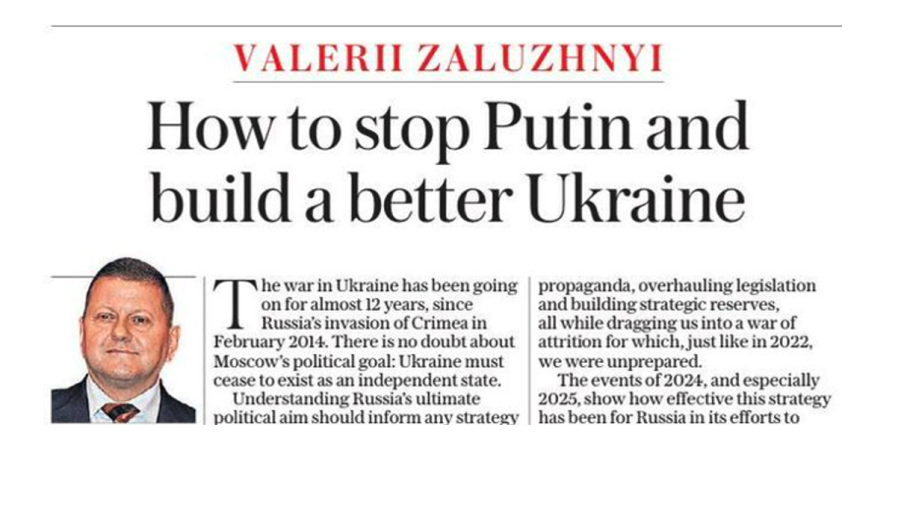
Ukraine’s former commander in chief and now ambassador to the UK General Valerii Zaluzhnyi lashed out at the Zelenskiy administration in what appears to be the start of a bid to take over as president.
The well-liked Zaluzhnyi was sacked by Ukrainian President Volodymyr Zelenskiy last year following the failure of the 2023 summer offensive which he described as bringing the war to a stalemate. However, it is widely believed that Zelenskiy removed Zaluzhnyi after he overtook the president in the polls.
Zaluzhnyi took the unusual step of publishing a critical opinion piece in the UK’s Telegraph titled “How to defeat Putin and build a better Ukraine”, as well as posting similar remarks on social media the same day.
The criticism comes at a sensitive time for Zelenskiy, who is embroiled in the largest corruption scandal of his career, after his former business partner Timur Mindich was accused by the National Anti-Corruption Bureau of Ukraine (NABU) of masterminding a $100mn kick-back scheme at the state-owned utility company Energoatom. Mindich skipped the country only hours before NABU raided his office and home, where a solid gold toilet was discovered as well as packs of hundreds of thousands of euros and dollars.
The corruption scandal has been expanding and claimed the powerful éminence grise of Ukraine on November 28, Andriy Yermak, the head of Ukraine’s presidential office and Zelenskiy closest advisor.
Yermak resigned after NABU searched his home and office. He has since said he will enlist and go to the frontline. Critics have pointed out that if Yermak enlists the relevant authority in charge of investigating crimes committed by soldiers is the State Bureau of Investigation and technically the investigation by NABU will have to be transferred to the State Bureau of Investigation, which reports to the president. NABU is entirely independent of the government and president and has its own independent Anti-Corruption Court (ACC) to prosecute high officials.
The Zaluzhny attack accused the Zelenskiy’s administration of not being able to define the political goal of Ukraine’s war efforts.
“He goes on to define the goal in even more radical terms than Zelenskiy ever defined it - a full destruction of the “Russian empire”. Also, he conveniently ignores the fact that Ukraine’s political goals had to shift when he failed to deliver a victorious counter-offensive in 2023 as Ukraine’s commander-in-chief,” journalist and bne IntelliNews columnist Leonid Ragozin said in a comment.
“More than anything, the article sells Zaluzhny himself as a leader who - unlike Zelenskiy - understands war and grand political strategy. A clear presidential pitch, Ragozin added.
The wartime trinity
“War cannot be waged effectively without a clear political goal. After all, war is not an end in itself, it is waged for political goals. Russia has long ago defined its goal as the destruction of Ukraine as an independent state,” Zaluzhnyi said in a social media post. “Ukraine's political goal in the Russian-Ukrainian war should be formed on the basis of such challenges. And the basis of such a goal should be to deprive Russia of opportunities for aggression against Ukraine in the foreseeable future.”
In a detailed conversation with the Ukrainian publication Liga.net, Zaluzhnyi gave more details of his objections to Zelenskiy's war strategy.
The philosophical framing of the criticism suggests that Zelenskiy has not understood the nature of war and its political problems, whereas he, Zaluzhnyi, does understand this problem and by implication is better suited to lead the country.
“The political purpose of war is what answers all questions. It is this term that makes it possible to see not only what the enemy is doing, but also how to move forward ourselves. And if, according to the [military analyst] Clausewitz, war is a "trinity": the population, the armed forces and the state administration, then these aspects are three different codes of laws and among these parties, it is the population that is the most sensitive party in terms of supporting the war,” Zaluzhnyi said.
“Without public support, it is impossible to wage a war successfully. Then perhaps the main form of such public support is the attitude of society, first of all, to mobilisation, which quickly began to fail,” Zaluzhnyi added.
Immediately after the Russian invasion, the government imposed martial law and began an aggressive and highly unpopular mandatory conscription drive. Military police officers have been grabbing men from the street and throwing them into buses before they are sent to the frontline.
Zaluzhnyi goes on to argue that Russia has managed to marshal all three elements of Clausewitz’s trinity and is well prepared for a long war should the current peace negations with the US fail. Ukraine, however, continues to suffer from its trinity of problems: the lack of men, money and materiel. More stingingly, Zaluzhnyi accuses Zelenskiy of having no clear political goal in the war.
“War does not always end with the victory of one side and the defeat of the other. We Ukrainians strive for complete victory, but we cannot reject the option of a long-term end to the war. Peace, even in anticipation of the next war, provides a chance for political change, for deep reforms, for full recovery, economic growth and the return of citizens,” Zaluzhnyi said on social media in what appears to be a political agenda for a post-war recovery in Ukraine.
“It is even possible to speak about the beginning of the formation of a safe, protected state through innovation and technology; of strengthening the foundations of justice through the fight against corruption and the creation of an honest court system; and of economic development, including on the basis of international economic recovery programmes,” he added.
Ukrainian Corruption Investigation Reveals Derkach’s Role – Analysis
File photo of Andrei Derkach. Photo: Andriy Derkach / Telegram
December 2, 2025
By Dr. Taras Kuzio
A high-level corruption scandal has been roiling Ukraine’s domestic politics and undermining trust in Ukrainian President Volodymyr Zelenskyy. The scandal follows the president’s attempts in July to remove the independence of the National Anti-Corruption Bureau (NABU) and the Special Anti-Corruption Prosecutor (SAPO), which have been investigating this corruption case since last year (Zmina, July 31).
Russia’s long-term involvement in Ukraine’s economy allowed it to collect kompromat (компромат, compromising material) on Ukrainian elites, sow internal strife to undermine national unity and morale in the army, and collect intelligence on Ukraine’s air defenses (Argument, November 13). Some of the funds stolen in the corruption scandal were meant to build defenses for Ukrainian utilities.
In November, evidence released by the NABU showed that $100 million from contracts for nuclear facility protection that was reported to have been stolen was laundered at a central Kyiv office owned by the family of Andrei Derkach, a former Ukrainian member of parliament and current Russian senator (NABU, November 10; Euromaidan Press, November 11). Ihor Myronyuk, an aide to Derkach for over a decade, handled the cash for the corruption scheme (Euromaidan Press, November 11). At least $2 million of the stolen funds were transferred to Derkach. NABU detectives found items in the office labeled “Federal Protective Service of the Russian Federation” (Euromaidan Press, November 11).
Derkach grew up in a Committee for State Security (KGB) family during the Soviet Union (Liga.net, November 12). His father, Leonid, worked in the Soviet Ukrainian KGB from 1972—when a major pogrom targeting Ukrainian dissent and culture took place—until the Soviet Union’s collapse in late 1991 to early 1992. Leonid Derkach then served as chairman of the Security Service of Ukraine (SBU) from 1998 to 2001. He was removed from the SBU over the scandal surrounding the murder of journalist Georgi Gongadze in the fall of 2000, and after a July 2000 recording showed his involvement in the sale of four Kolchuga radars to Iraq, which was under international sanctions at that time (Maidan.org.ua, February 19, 2001; Ukrainska Pravda, May 22, 2002).
Andrei Derkach served with the Soviet KGB and the Russian Federal Security Service (FSB) in Moscow from 1990 until 1993. He was then a parliamentary deputy for the pro-presidential For a United Ukraine, Socialist Party, Party of Regions, and one of its successors, Will of the People. He owned ERA TV and Radio and the Russian-language newspaper Kievskij Telegraf (Kyiv Telegraph), named after a newspaper published in Kyiv from 1859 to 1876.
The Yuliya Tymoshenko government appointed Derkach as president of Energoatom in 2006. Since then, he has maintained a network of corrupt allies with ties to Russia inside Ukraine’s nuclear power sector. This, as seen in the explosive corruption scandal, was undertaken on behalf of Russia (Liga.net, November 14). For years, Ukraine’s entire nuclear energy sector was under the complete control of an FSB agent network, created by Derkach back in 2006 (Argument, November 13). He attempted to consolidate Ukraine’s nuclear industry into the Kremlin’s structures (Liga.net, November 14).
Throughout the last two decades, U.S. intelligence has been ahead of the SBU in monitoring Derkach’s ties to Russian intelligence. In September 2020, the U.S. Treasury Department accused Derkach of being an active Russian agent for over a decade (U.S. Treasury Department, September 10, 2020).
Despite former Chief of Staff of the Ukrainian Presidential Administration Andriy Yermak promising tough measures against Ukrainians who had interfered in the 2020 U.S. election, the U.S. sanctions against Derkach led to no criminal charges (Kyiv Post, January 13, 2021; Radio Svoboda, August 20, 2021). Derkach fled to Russia only after Russia’s February 2022 full-scale invasion of Ukraine. After fleeing, Derkach received Russian citizenship and has lived in Astrakhan. In fall 2024, he became a senator in Russia’s Federation Council and a member of its Defense Committee (Hromadske.ua, November 14, 2024).
Five months after he fled Ukraine, the SBU accused Derkach of receiving $3–4 million per month from the Russian Military Intelligence Agency (GRU) to create private security companies to assist Russian invasion forces (Kyiv Independent, September 16, 2024). Inform Napalm, a Ukrainian non-governmental organization (NGO) that has investigated Russian disinformation since 2014, concluded that Russia controlled Derkach’s operation in the United States (Inform Napalm, February 15, 2021). The Kremlin’s goals were to worsen U.S.–Ukrainian relations, end U.S. military support for Ukraine, foil former U.S. President Joe Biden’s 2020 presidential campaign, and portray Ukraine as a U.S. puppet state (Ukrainska Pravda, October 9, 2019).
An additional goal was to fabricate evidence of Zelenskyy’s supposed personal vendetta against former Ukrainian President Petro Poroshenko and sow political instability in Ukraine. In May 2020, Derkach released tapes in four batches, including doctored conversations between Poroshenko and Biden. Zelenskyy quickly ordered criminal charges of treason against Poroshenko (Zerkalo Nedeli, May 24, 2020). The tapes allegedly showed high-level corruption in Ukraine under Poroshenko and the U.S. Embassy in Kyiv’s control over the Ukrainian president, government, and NABU (Ukrainska Pravda, October 9, 2019). The fake tapes and the NABU-leaks.com website claimed Biden had tried to halt Ukraine’s investigation into the gas company Burisma, where his son, Hunter, was a consultant.
In July 2022, Derkach’s head bodyguard was detained together with a large amount of cash, weapons, and pro-Russian literature (Ukrainska Pravda, July 27, 2022). In September 2022, the NABU and SAPO charged Derkach in absentia with high treason and illicit enrichment. In 2023, Derkach was stripped of his Ukrainian citizenship (President of Ukraine, January 10, 2023). In November 2023, the Ukrainian State Bureau of Investigation (DBR) accused Derkach, Servant of the People Deputy Oleksandr Dubinsky, and former General Prosecutor Kostyantyn Kulyk of working for the GRU (Ukrainian State Bureau of Investigation, November 13, 2023). At the same time, a federal indictment from the U.S. Attorney’s Office in the Eastern District of New York was issued under the International Emergency Economic Powers Act (IEEPA), accusing Derkach of bank fraud and conspiracy to commit money laundering. Derkach had purchased condos in Beverley Hills using shell companies to hide ownership and move millions of dollars (U.S. Justice Department, December 7, 2022).
Derkach’s Corruption Network
The SBU, which has a history of success in uncovering spies, seemingly allowed a Russian agent to operate in the Ukrainian parliament for twelve years. This was only possible because, as Holos (Voice) Party deputy Yaroslav Zheleznyak stated, Derkach’s corrupt network had high-level protection (in criminal slang, a krysha [крышa; roof]), which meant he and his allies were virtually untouchable (Kyiv Post, November 11). For example, in November 2020, Prosecutor General Iryna Venediktov refused to open criminal cases against Derkach and Dubinsky for treason and money laundering (Ukrainska Pravda, November 3, 2020). Timur Mindich, head of the corruption conspiracy, ran an illegal diamond business in Russia and Ukraine from 2015 to 2024 (Zerkalo Nedeli, October 23). Ukraine only launched criminal action against Derkach and Mindich after they had been allowed to flee from Ukraine. Mindich’s whereabouts are unconfirmed, but he is most likely to be in Israel, where he holds a second citizenship.
Derkach’s May 2019–2020 network included pro-Russian politician Anatoly Shariy; businessman Taras Kozak; the wife of Viktor Medvedchuk and owner of a Crimean gas company, Oksana Marchenko; former President Viktor Yanukovych’s legal assistant Andrei Portnov; oligarch Ihor Kolomoysky; and pro-Russian Nash (Ours) TV journalist Nazar Diorditsa. Portnov was assassinated in Madrid in May (Kyiv Independent, May 22).
The intermediary in the conspiracy was Dmytro Firtash. The United States has sought to extradite Firtash from Austria since 2014 for violating the Foreign Corrupt Practices Act (FCPA) in a titanium mine in India, some of whose exports were to be sold to a Chicago company. After Firtash’s arrest in 2014, his bail was paid by the head of Russia’s judo association, which has close links to Russian President Vladimir Putin (Profil.at, October 23, 2019). Firtash had been Russia’s representative in Ukraine since the late 1990s, tasked with buying up strategic sectors of Ukraine’s economy on behalf of the Kremlin (seeEDM, July 26, 2010).
In 2017, Spain issued an additional extradition request over Firtash’s ties to Russian organized crime operating in the country. In 2017, the U.S. Department of Justice accused Firtash of being in the “upper echelon associates of Russian organized crime,” a reference to his ties to mobster Semyon Mogilevich, who is on a Federal Bureau of Investigation (FBI) wanted list. Firtash had told then-U.S. Ambassador to Ukraine William Taylor as far back as 2008 of his links to Mogilevich (Wikileaks, December 10, 2008).
Mindich was the youngest partner of oligarch Ihor Kolomoysky, whose TV channel 1+1 was hostile to Poroshenko because of the removal of Kolomoysky’s control over UkrNafta state oil company in 2015 and the nationalization of Privat Bank in 2016. Kolomoysky was Zelenskyy’s main backer in the 2019 elections against Poroshenko. Ukraine only detained Kolomoysky in September 2023 on money laundering charges at Privat Bank, eighteen months after the U.S. Department of Justice opened charges of embezzlement and fraud (U.S. Department of Justice, January 20, 2022).
Mindich is a co-owner of the Kvartal 95 television production company with Zelenskyy. Zelenskyy’s birthday was celebrated in Mindich’s Kyiv apartment in January 2021. In November of that year, Mindich attended Yermak’s birthday party in the presidential residence in western Ukraine (Euromaidan Press, November 12). Zelenskyy and his former Chief of Staff, Yermak, promised a full investigation. The main opposition party, led by Poroshenko, called for a government of national unity staffed by technocrats (European Solidarity, November 11).
The root of the corruption scandal lies in the president’s office providing a krysha. Investigation of high-level corruption is prevented because the president controls the SBU and the Prosecutor General’s Office. The NABU and SAPO, established under Poroshenko, are independent of the president, which is likely why Zelenskyy sought to curtail their operational independence. To avoid future scandals and conflicts of interest, the SBU and Prosecutor General’s Office should gain the same level of independence from the president as the NABU and SAPO.
Dr. Taras Kuzio
Taras Kuzio is a professor of political science at the National University of Kyiv Mohyla Academy. He is co-author of The Four Roots of Russia’s War Against Ukraine (Cambridge University Press, 2026); co-editor of Russia and Modern Fascism: New Perspectives on the Kremlin’s War Against Ukraine (Columbia University Press, 2025); Crimea: Where Russia’s War Started and Where Ukraine Will Win (Jamestown Foundation, 2024), and Russian Nationalism and the Russian-Ukrainian War (Routledge, 2022). He can be found on X/Twitter @TarasKuzio

No comments:
Post a Comment