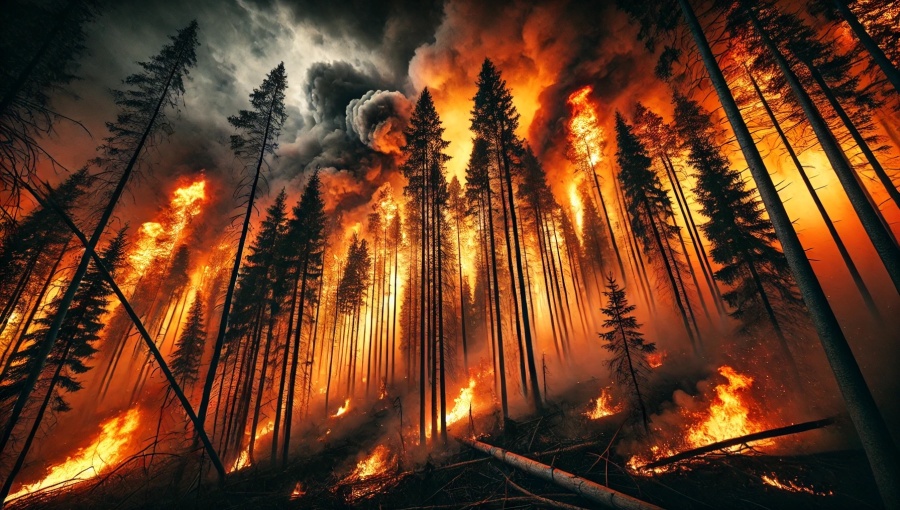
The market for wildfire catastrophe bonds surged in 2025, with more than $5bn in new issuance — more than double the previous year’s total — as investors start to grapple with the accelerating Climate Crisis that is already causing tens billions of dollars of damage each year.
Previously thought to be virtually uninsurable, damage from extreme weather is now part of the annual disaster season of extreme weather events that are only getting worse. Financiers are increasingly facing the problem of how to pay for insurance claims after entire cities have been wrecked by storms, hurricanes or flooding.
Wildfire-linked cat bonds helped drive total catastrophe bond issuance to a record $23bn in 2025, according to insurance- securities tracker Artemis, as fires become a major problem during the increasingly hot and long summer season, Bloomberg reports.
The European Union endured its worst wildfire season since records began, with more than 1.01mn hectares of land scorched in 2025, surpassing previous highs and raising concerns over climate preparedness and environmental management across the bloc.
According to data from the European Forest Fire Information System (EFFIS), fires burned 1,016,000 hectares of land— an area larger than Cyprus and equivalent to roughly one-third of Belgium -- the first time the EU has crossed the 1mn hectare threshold.
The United Nations’ Intergovernmental Panel on Climate Change (IPCC) says that the Paris Agreement goal of keeping temperature increases to less than 1.5°C-2°C above the pre-industrial benchmark has already been missed. Temperature increases are on course to reach a catastrophic 2.7C-3.1C by 2050. After the failure of the last three COP meetings, including COP30 in Brazil, extreme temperature events will become routine and the emphasis has switched from prevention to mere mitigation. That will cost money. A lot of money.
The broader cat bond market is now expected to close 2025 at around $60bn, underscoring the growing role of capital markets to pay for the now inevitable extreme weather damage.
Catastrophe bonds are a type of insurance-linked security that allows insurers to transfer the risk of large-scale natural disasters — such as hurricanes, earthquakes, or now, wildfires — to investors. In exchange for regular coupon payments, investors agree to forfeit all or part of their principal if a pre-defined catastrophe event occurs. If no such event happens, the investors receive their capital back in full, earning above-average yields for the risk. For insurers and reinsurers, cat bonds offer a way to access deeper pools of capital beyond traditional reinsurance markets.
“Historically, wildfire exposure was included within a mix of earthquake and hurricane risk,” Dirk Schmelzer, senior fund manager at Plenum Investments AG told Bloomberg. “Now, it’s become such a big peril in the market, it’s worth placing that risk on a standalone basis.”
The rise of wildfire-linked issuance follows a series of catastrophic fire seasons, particularly in California. The wildfires swept through Los Angeles in January last year destroying over 16,000 buildings and caused $40bn in insured losses — the highest ever for a wildfire event. That contributed to total global insured disaster losses surpassing $100bn for the sixth consecutive year, according to Bloomberg.
Catastrophe bond investors were largely insulated from those losses. Fitch Ratings estimates the total impact to the cat bond market at less than $250mn, a fraction of overall insured losses. That performance has bolstered investor confidence in the asset class, even as climate-driven disasters become more frequent and severe.
Experts say the surge in issuance is underpinned by major improvements in risk modelling, particularly for wildfires, which were long considered too complex and unpredictable to price accurately. The one-way street that the Climate Crisis has become is making it more predictable and so easier to price the risk.
While wildfire bonds still represent a small segment of the overall market, their rapid growth suggests a broader shift in how risk is being structured and securitised. As insurers face rising premiums and tightening capacity in traditional reinsurance, catastrophe bonds are increasingly viewed as a vital instrument for managing climate-related volatility.
As the crisis accelerates, experts are expecting new classes of cat bonds to appear — potentially including bonds to cover the impact of heatwaves, floods, and other perils. For example, Category 5 hurricane Melissa devastated Jamaica last year, the worst storm in recorded history, but meteorologists say it is only a matter of time before the world sees its first ever Category 6 hurricane – a city killer. The message from the capital markets is already clear: no catastrophe is off-limits — if the price is right.

No comments:
Post a Comment