France's health minister has warned requisitions could be used as self-employed doctors and specialists launch a 10-day strike on Monday to protest measures in the 2026 social security budget. Unions predict the movement will be widely followed.
Issued on: 05/01/2026 - RFI
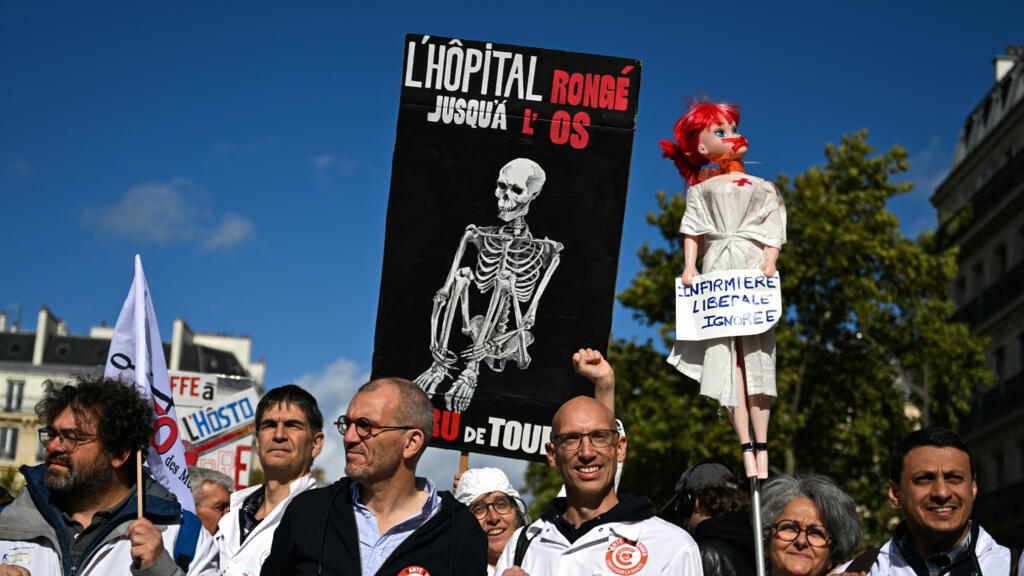
Healthcare workers take part in a white march called by hospital and private practice doctors' unions "to demand the protection of health budgets" and "adapted responses to the real public health needs", in Paris on 4 October 2025. © Anna Kurth/AFP
Self-employed practitioners and doctors in private clinics will begin a ten-day strike on Monday aimed at denouncing a range of measures in the 2026 Social Security Budget Law.
Unions are calling for private practices to close and consultations to be cancelled or postponed. Operating theatres in private clinics are expected to be shut down, with potential repercussions for public hospitals.
The Confederation of French Medical Trade Unions (CSMF), says it expects the movement to be "extremely well followed”, with 85 per cent of its members saying they plan to strike.
Health Minister Stéphanie Rist said on Sunday that steps had been taken “to organise continuity of care with the regional health agencies, healthcare facilities and professionals themselves, so that our fellow citizens are not put at risk during this mobilisation”.
“We can also resort to requisitions, if necessary,” she said in an interview with La République du Centre, adding that she would ensure that patients can be treated, while respecting the right of professionals to strike.
Self-employed practitioners and doctors in private clinics will begin a ten-day strike on Monday aimed at denouncing a range of measures in the 2026 Social Security Budget Law.
Unions are calling for private practices to close and consultations to be cancelled or postponed. Operating theatres in private clinics are expected to be shut down, with potential repercussions for public hospitals.
The Confederation of French Medical Trade Unions (CSMF), says it expects the movement to be "extremely well followed”, with 85 per cent of its members saying they plan to strike.
Health Minister Stéphanie Rist said on Sunday that steps had been taken “to organise continuity of care with the regional health agencies, healthcare facilities and professionals themselves, so that our fellow citizens are not put at risk during this mobilisation”.
“We can also resort to requisitions, if necessary,” she said in an interview with La République du Centre, adding that she would ensure that patients can be treated, while respecting the right of professionals to strike.
Dispute over fees and controls
The new Social Security financing law introduces mechanisms to regulate tariffs and supplements to fees charged by liberal doctors, particularly those who exceed base reimbursement rates.
The government wants to control healthcare spending by giving the health insurance fund (CNAM) the power to adjust "excessively profitable" fees and limit how much extra GPs can charge.
Self-employed doctors are opposed to such tighter controls as well as changes to sick leave prescriptions, which from 1 January are limited to a maximum of one month in the first instance.
They claim the authorities are behaving “in an authoritarian manner”, by "bypassing" social dialogue.
They also oppose new digital management tools seen as bureaucratic and poorly adapted to their daily work, and which they deem will worsen workload and contribute to so-called "medical deserts" where healthcare provision is already sparse.
Overall, they claim the changes threaten the viability of private practice and access to care.
Doctors in England begin their longest strike in NHS history
The health minister has defended the government’s approach, citing what she described as an “exponential” rise in extra billing in recent years.
“Even if abuses concern only a minority of doctors, we cannot leave the situation as it is," she said, "because some of our fellow citizens are giving up treatment for financial reasons."
The new Social Security financing law introduces mechanisms to regulate tariffs and supplements to fees charged by liberal doctors, particularly those who exceed base reimbursement rates.
The government wants to control healthcare spending by giving the health insurance fund (CNAM) the power to adjust "excessively profitable" fees and limit how much extra GPs can charge.
Self-employed doctors are opposed to such tighter controls as well as changes to sick leave prescriptions, which from 1 January are limited to a maximum of one month in the first instance.
They claim the authorities are behaving “in an authoritarian manner”, by "bypassing" social dialogue.
They also oppose new digital management tools seen as bureaucratic and poorly adapted to their daily work, and which they deem will worsen workload and contribute to so-called "medical deserts" where healthcare provision is already sparse.
Overall, they claim the changes threaten the viability of private practice and access to care.
Doctors in England begin their longest strike in NHS history
The health minister has defended the government’s approach, citing what she described as an “exponential” rise in extra billing in recent years.
“Even if abuses concern only a minority of doctors, we cannot leave the situation as it is," she said, "because some of our fellow citizens are giving up treatment for financial reasons."

No comments:
Post a Comment