Hopefully, the sociopolitical reaction to the US invasion of Venezuela will, instead of deepening our oil dependency, actually contribute to our recovery.
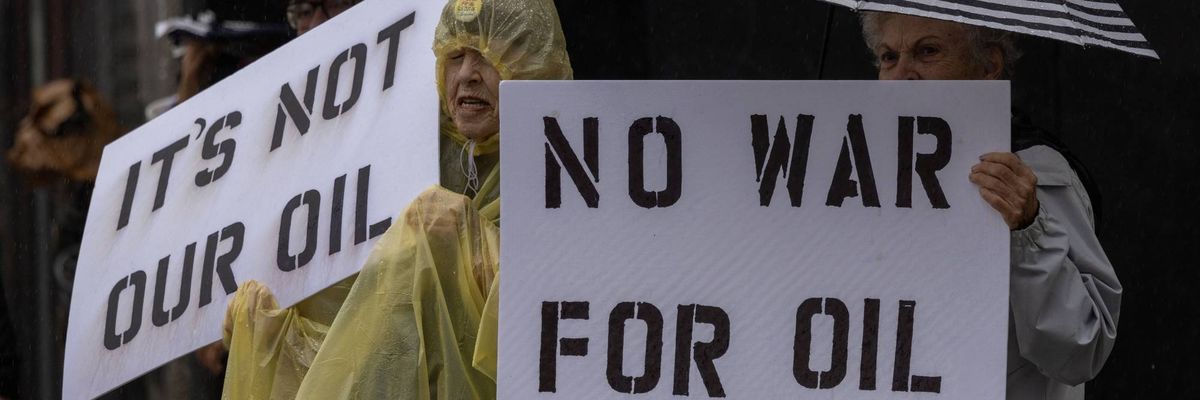
People participate in a ‘No War on Venezuela’ protest in the rain on January 3, 2026 in Los Angeles, California. The United States invaded Venezuela with a “large-scale strike” this morning and President Nicolás Maduro and his wife were captured by Special Forces and taken to the United States, according to President Trump who also announced that “we will run the country”.
(Photo by David McNew/Getty Images)
Rick Steiner
Jan 05, 2026
The Trump administration’s extraordinary, illegal attack on Venezuela was always about oil, and now the whole world knows that Mr. Trump lied all along about his real interest in Venezuela. This was not about stopping the flow of dangerous drugs, but was about increasing the flow of the dangerous drug some pushers want to keep us all hooked on—oil.
As such, this seems a good time to reexamine our nation’s destructive addiction to oil.
The first step in recovering from addiction is to tell the truth—admit the addiction, acknowledge its consequences. Yet this is something we still seem unwilling to do with our addiction to oil. Addicts would rather stay high than confront their addiction and commit to recovery.
The truth about oil is that while there are benefits—jobs, energy, government revenue, etc.—there are also enormous long-term risks, impacts and costs. And while government and industry extol the benefits of oil, they remain unwilling to tell the truth about its costs or to aggressively pursue sustainable alternatives.
Some costs are obvious. Oil spills, such as the 1989 Exxon Valdez in Alaska and the 2010 Deepwater Horizon in the Gulf of Mexico, are easily recognizable disasters that attract widespread public condemnation. Many oil-producing areas of the world, such as the Niger Delta, the Caspian Sea, Siberia and the Amazon, continue to suffer from decades of chronic oil spills.
Indeed, the age of oil is ending, but the hard-core oil addicts in government and industry remain unwilling to concede the fact or to embrace a sustainable energy future. Clearly, a lot of damage can and will occur in the waning years of oil.
But the true cost of oil goes far beyond the obvious damage from spills. More gradual, less visible costs of oil include ecological habitat degradation from exploration, production and pipelines; health costs from breathing polluted air; urban sprawl, traffic congestion and deadly accidents in all major cities; and seemingly endless wars fought to secure oil supplies, costing thousands of lives and trillions of dollars.
Climate change from carbon emissions is incurring enormous present and future costs—storm damage, drought, wildfires, lost agricultural productivity, infrastructure damage, climate refugees, disease, forest decline, marine ecosystem collapse, species extinction and lost ecosystem services—already exceeding $1 trillion a year.
Wherever it is produced, there arises a “sociopolitical toxicity” of oil—a significant distortion of economic, social and political systems. Rather than the prosperity promised, oil discoveries around the world often become more curse than blessing, causing social dysfunction, assimilation of indigenous cultures, inflation, decline in traditional exports, corruption, crime and unsustainable growth.
In oil-producing regions of the world—including the US and the states of Alaska, Louisiana, Texas, and North Dakota—governments are “captured” and controlled by oil interests ensuring policies to limit regulation, lower taxation, and to favor increased oil production and demand over development of sustainable low-carbon alternatives. In Alaska, 50 years of oil has distorted and corrupted many elements of government and society, including the state university system and the media.
The addictive power of oil was recognized as early as 1939, when Saudi Arabia’s King Abdul Aziz joked: “Do you know what they will find when they reach Mars? They will find Americans out there in the desert hunting for oil.”
Former Venezuelan oil minister Juan Pablo Perez Alfonso, a founder of OPEC and once a true believer in the promise of oil, thought differently after he saw the corruption, greed, waste, debt, and decay it caused, and came to call oil “the devil’s excrement.”
Today, the world uses more than 100 million barrels of oil a day, with the US alone accounting for over 20 million barrels per day. We have already pumped and burned over one trillion barrels, and there may be another trillion barrels of recoverable “conventional” oil left, along with several trillion barrels in unconventional reserves such as tar sands and oil shale formations.
But if we want anything resembling a sustainable future, we simply have to leave most of this oil buried right where it is in the ground and seabed, as the global atmosphere and biosphere cannot handle much more additional carbon without becoming dangerously unstable.
Yet the oil pushers see trillions of dollars just waiting to be dug up and are anxious to get to it regardless of the consequences. There seems no end to their greed and disregard for our planetary environment and common future.
As with any addiction, when the easy stuff is gone and supplies tighten, hard-core addicts become desperate and willing to take more risk to secure the next fix, such as fracking, drilling in the Arctic and deep ocean basin, and invading oil-rich countries.
President George W. Bush stunned the world in his 2006 State of the Union speech, admitting that “we have a serious problem, America is addicted to oil,” yet his administration did virtually nothing to wean us from our oil addiction.
Despite candidate Obama’s promise to end “the tyranny of oil,” and that if he was elected, “the rise of the oceans will begin to slow,” as President, Mr. Obama boasted that “We’re opening up more than 75 percent of our potential oil resources offshore. We’ve quadrupled the number of operating rigs to a record high. We’ve added enough new oil and gas pipeline to encircle the Earth, and then some.” US oil production steadily increased throughout the Obama presidency.
And although President Joe Biden repeatedly declared his intention to transition the nation away from fossil fuels in order to combat climate change, US oil production reached record levels during his administration.
The seas continue to rise, and the tyranny of oil continues.
Governments encourage fossil fuel addiction with annual subsidies of some $7 trillion globally, including $760 billion per year in the US in subsidies, tax breaks, and “unpriced externalities.” So much for the “free-market.” These government fossil fuel subsidies artificially depress prices and encourage overconsumption; compete with government spending on health care, education and social services; and keep alternative energy “uncompetitive” – just as the oil pushers want.
Studies have estimated that for every gallon of gasoline we buy at the pump, we are actually paying as much as $14 a gallon in additional “hidden” costs. Yet, we continue to ignore these hidden costs, paying some indirectly through income taxes, while deferring most to future generations. We are tricking ourselves into using “cheap and easy” oil as fast as we can pump it out of the ground.
The 2010 Supreme Court “Citizens United” ruling allowed oil companies and others to pour unlimited funds into oil-friendly candidates and issues, without public disclosure. And millions have been spent on a strategic disinformation campaign (by government and industry) to deceive the public about the real costs of oil.
Clearly, the oil pushers are running the show.
Perhaps the most pernicious cost of oil is that it fueled a dangerous, unsustainable expansion of the ecological footprint of human civilization. With access to artificially “cheap and easy” oil over the past century, human population quadrupled and resource consumption increased many times more, now significantly exceeding Earth’s carrying capacity. Without access to fossil carbon, humanity almost certainly would have evolved on a more sustainable trajectory. But by not accounting for its true cost, oil has allowed us to dig ourselves deeper into a dangerous, unsustainable hole. The environmental debt we are accruing is far larger and more consequential than our national financial debt.
The sooner we get to the far side of our troubled oil addiction, the better chance we have at a sustainable future.
It’s high time we kicked the oil habit. The full “social cost of carbon” has been estimated at $50 to $200 per ton of CO2, and with global emissions now exceeding 40 billion tons per year, this would amount to $2 trillion to $8 trillion in total damages annually. When we account for these very real costs, sustainable alternatives become competitive and we make more rational choices.
Government needs to correct this self-destructive dynamic by eliminating all fossil fuel subsidies, reducing emissions through regulation, instituting a carbon tax to capture the long-term “hidden” cost of carbon, and applying the former subsidies and carbon tax revenues to support the low-carbon energy transition.
As Sheikh Zaki Yamani, a former Saudi Arabian oil minister, once famously said, “The stone age did not end for lack of stones, and the oil age will end long before the world runs out of oil.”
Indeed, the age of oil is ending, but the hard-core oil addicts in government and industry remain unwilling to concede the fact or to embrace a sustainable energy future. Clearly, a lot of damage can and will occur in the waning years of oil.
Hopefully, the sociopolitical reaction to the US invasion of Venezuela will, instead of deepening our oil dependency, actually contribute to our recovery.
The sooner we get to the far side of our troubled oil addiction, the better chance we have at a sustainable future. Then, like most recovering addicts, we will wonder why we didn’t get clean sooner.
Our work is licensed under Creative Commons (CC BY-NC-ND 3.0). Feel free to republish and share widely.
Rick Steiner
Rick Steiner is a conservation biologist in Anchorage, retired professor with the University of Alaska, and author of Oasis Earth: Planet in Peril (available as a free download here: https://www.oasis-earth.com/oasis-earth-planet-in-peril).
Full Bio >
Venezuela holds nearly 20% of the world's proven oil reserves, but pumps less than a percent of global crude. After capturing its leader, Trump is now promising that US companies will revive production. Can he unlock the world's largest oil reserves?
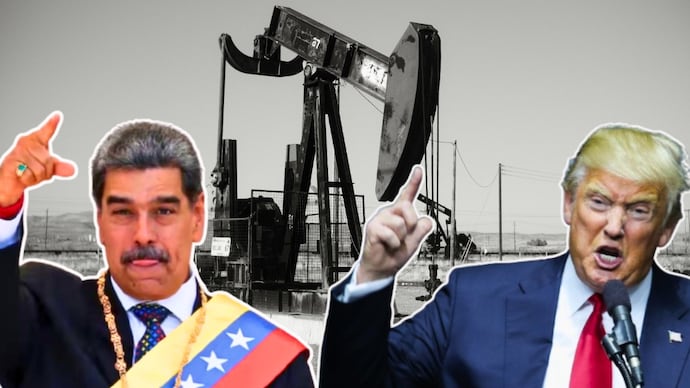
Maduro's policies accelerated Venezuela's oil collapse. Trump now aims to reverse the decline by bringing US companies in to revive production. (Images: AP/Unsplash/Getty)
India Today News Desk
New Delhi,
Written By: Sushim Mukul
Venezuela, the country Donald Trump once claimed would be ruled by the US after its leader Nicolas Maduro was captured in deadly airstrikes, holds the world’s largest proven oil reserves. This alone explains the keen interest of the world’s most powerful leader in the South American nation. What makes the situation even more striking is that, despite sitting atop the largest proven reserves, Venezuela produces just about one million barrels of oil a day, roughly 0.8% of global crude output. This is where Trump’s so-called “big plan” enters the picture
Trump unleashed airstrikes on Venezuela in an operation dubbed Operation Absolute Resolve, leaving over 40 people dead. On January 3, elite US Delta Force commandos captured Venezuelan President Maduro and his wife from their heavily guarded bedroom inside a military base in Caracas. While Washington said the operation stemmed from long-standing drug-trafficking charges, experts believe the move was driven just as much by Caracas’ most prized asset, oil.
Venezuela holds an estimated 303 billion barrels of proven oil reserves, nearly 20% of the global total, more than Saudi Arabia. Yet it produces barely one million barrels per day (bpd). This gap is the result of decades of political mismanagement, corruption, chronic underinvestment, US sanctions, and the technical complexity of extracting Venezuela's extra-heavy crude.
US President Donald Trump has since Maduro's capture announced plans to seize control of Venezuela's oil reserves. He said American companies would be invited to invest billions to revive the shattered industry and potentially redirect crude supplies to refineries in the US. The move aligns with Washington's and Trump's long-standing interest in Venezuelan energy resources. It is an interest that intensified after sanctions were imposed on Caracas in 2019.
According to news agency Reuters, Washington believes a production increase of Venezuelan crude to 2 million bpd by 2030 could shave $4 per barrel off global oil prices.
So what lies behind the mismatch between oil reserves and production? And with Washington now laying out plans to get Venezuelan crude flowing, is such a revival economically feasible? How long would it take, how many dollars would it consume?
HOW VENEZUELA'S OIL PRODUCTION WENT DOWN SINCE 1990s?
Venezuela's oil output collapsed from a peak of 3.5 million bpd in the late 1990s to around 956,000 bpd in October 2025, before inching up to 1.142 million bpd in November, according to data by Trading Economics, a Lisbon-based global economic data platform. The decline fuelled a broader economic implosion in Venezuela marked by hyperinflation, state collapse, and one of the largest migration crises in the world.
Most of the Venezuelan oil lies in the Orinoco Belt. It is home to vast extra-heavy crude deposits. The extra-heavy oil is difficult to extract because of its high viscosity. It requires costly technologies, imported diluents, and specialised refineries. So, systemic failures have left much of this potential stranded.
WHAT BROUGHT DOOM ON VENEZUELA'S ENERGY SECTOR
The rot began under the rule of Maduro's mentor and former president, Hugo Chavez. After a 2002 strike at the state oil firm PDVSA, Chavez fired nearly 18,000 skilled workers.
In 2007, his government forced foreign companies out through nationalisation. This replaced professional management with politically loyal appointees, according to a report in Forbes.
Revenue that should have been invested was diverted to fund social programmes. Corruption flourished and infrastructure decayed. The oil drilling rigs rusted, Venezuelan refineries ran at barely 20% capacity during the rule of Chavez.
Under Maduro, matters worsened. Debt defaults further scared away investors, which halved production. It isolated the PDVSA from global capital markets, according to the Council on Foreign Relations.
US SANCTIONS, CORRUPTION, MISMANAGEMENT WORSENED SITUATION
The US sanctions imposed in 2019 barred American companies from dealing with PDVSA. This cut Venezuela off from crucial technology, markets, and the diluents needed to process heavy crude.
After the disputed election of 2024, more restrictions were imposed in 2024. This choked off any scope of recovery. Venezuela increasingly relied on shadow tanker fleets and informal networks to sell its oil to China and Iran. However, inefficiencies, corruption and discounts ate into revenues, according to the US Department of Treasury.
Now, with Maduro out and Trump signalling that American companies will move in to get Venezuela's oil flowing again, the question is how long it would take to unlock production in a country that holds nearly 20% of the world's proven reserves, and whether such an effort would be economically feasible at all?
REVIVING VENEZUELA'S OIL SECTOR IS NO CAKE WALK
Experts estimate that restoring Venezuela's oil industry to 3 million bpd could take at least 10 to 20 years and require $50-100 billion in investment, according to a report in UK-based The Guardian.
Infrastructure across Venezuela's oil sector will have to be rebuilt, skilled workers brought back, and legal and regulatory frameworks rewritten. Short-term gains are possible, with output potentially rising to 1.5 million barrels per day within two to three years if sanctions are lifted and US firms assume operational control. However, sustained recovery will depend on restructuring of debts, legal certainty, and long-term political stability.
Trump has claimed that American companies are willing to invest billions of dollars upfront, with costs to be recovered through oil sales.
However, according to a report in The Guardian, American companies have remained non-committal. Its report noted that the statements from ExxonMobil, Chevron and ConocoPhillips stopped short of confirming Trump's investment plans.
"My hunch is that if President Trump said this publicly, probably there was already an agreement with the US companies," geopolitical expert Jorge Leon, told The Guardian.
With global crude prices hovering between 50 and 60 dollars a barrel and impending political risks, returns are likely to be slow and uncertain, according to a report by news agency Reuters. So, for now, until Venezuelan crude starts to flow as Trump has hoped, the Latin American nation remains the ultimate oil paradox. It's sitting on immense wealth but unable to pump its way out of economic collapse.
- Ends
How Washington's Control of Venezuelan Oil Could Reshape China's Energy Supply
- The FTSE 100 saw an early rally driven by defense and metal stocks, including Babcock, BAE Systems, and gold miners, in reaction to the US capture of Venezuelan President Nicolas Maduro.
- The US plans to install its own oil majors to repair and run Venezuela's vast oil infrastructure, a move that analysts predict will force China to pay higher rates for its crucial heavy crude supply.
- The Labour government, led by Keir Starmer, adopted a cautious stance on the US's operation, refusing to condemn it as a breach of international law despite pressure from party backbenchers and opposition groups.
The FTSE 100 kicked off the new year on the front foot with a morning rally after the fallout from the United States’ capture of Venezuelan President Nicolas Maduro sent a batch of City stocks on the march.
London’s blue-chip index sprung up towards the 10,000 points mark as markets opening before giving up some gains to land 0.2 per cent higher at near 9,970.
Leading the pack was defence and metal stocks after President Donald Trump’s strike on Venezuela – and openess to further escalation with other nations – sent jitters across markets.
Gold miners Endeavour Mining and Fresnillo were among top risers with gains of over four per cent, which comes after the price of the “safe haven” asset jumped 2.2 per cent in early trading to $4,424 an ounce.
Meanwhile, defence stocks were benefiting from the rising tensions with shares in blue-chip giant Babcock netting an all-time high at 1,329p after a 4.4 per cent rally. BAE Systems was up 4.5 per cent and Rolls-Royce 2.3 per cent.
It comes after Trump refused to rule out military action in Colombia telling reported in Sunday it “sounds good to [him]” whilst also doubling down on previous suggestions the US “need” Greenland and is considering an offensive on Cuba.
Foreign Secretary Yvette Cooper is expected to make a statement to MPs following the US’ operation to lay out the government’s formal response.
Chris Beauchamp, chief market analyst at IG, told City AM the slow influx of corporate news for the New Year was “more than compensated” by the fallout in Venezuela.
US could dictate China’s oil supply
On Saturday, Trump announced the capture of Venezuelan President Maduro, who is set to appear in US Federal Court in New York. Trump has clamped down on Venezuela following accusations of the nation dumping its prisoners into the US and failing to stop the flow of fentanyl into the country.
But oil has also remained a central piece to the conflict with Venezuela holding the world’s largest estimated oil reserves, though the country’s output remains at a fraction of capacity due to decades of mismanagement.
Trump has said the US plans to “run” Venezuela and insert its own oil majors to the country to control and ramp up its oil production.
“We’re going to have our very large United States oil companies, the biggest anywhere in the world, go in, spend billions of dollars, fix the badly broken infrastructure, the oil infrastructure, and start making money for the country,” the President said.
The US’ Energy Information Administration estimates Venezuela has near 303bn barrels worth of crude – near 20 per cent of the world’s resource – but exports just 900,000 per day with China acting as the biggest customer.
Bejing has urged the US to “stop toppling” the Venezuelan government with the top diplomat of China accusing the White House as behaving like a “world judge”.
Despite the rising tensions, oil prices have remained subdued in the fallout.
Brent crude dropped near 1.3 per cent despite Trump’s pledge to pump billions into the oil-rich nation to fix infrastructure.
Analysts expect China to be forced to pay higher rates for oil, should the US maintain control of Venezuelan production.
Jordan Rochester, an analyst at Mizuho Bank, said: “By controlling Venezuela, the US doesn’t need to own the oil; it just needs a hand on the tap.
“This shapes global energy flows and decides whether China gets cheap heavy crude or has to pay market rates elsewhere.”
How is the UK government reacting?
The Labour government has taken a coy line on the US’s involvement in Venezuela despite pressure from party backbenchers and opposition groups.
Keir Starmer emphasised the UK was not involved in the strikes on Friday night while saying he would “shed no tears” over the end of Maduro’s time as president.
Starmer and other government ministers including chief secretary to the prime minister Darren Jones refused to say whether the operation to capture Maduro represented a breach of international law.
Starmer added he was a “lifelong advocate of international law” and would seek to gather more information before making a full comment. Foreign secretary Yvette Cooper is expected to address parliament by the end of the day on the matter.
Labour MPs Emily Thornberry, Jon Trickett, and Richard Burgon are among those who have called for Starmer to stand up to Trump, along with the Liberal Democrats and the Greens.
The Conservatives also said it would wait for “full facts” on the operation and hope to see Venezuelans “enjoy democratic norms and freedoms”.
Reform UK’s Nigel Farage said that while the capture broke international law, it could “make China and Russia think twice” about taking on global powers.
By City AM

No comments:
Post a Comment