Luxury Expedition Cruise Ship Will Feature Sails for Sustainable Cruising
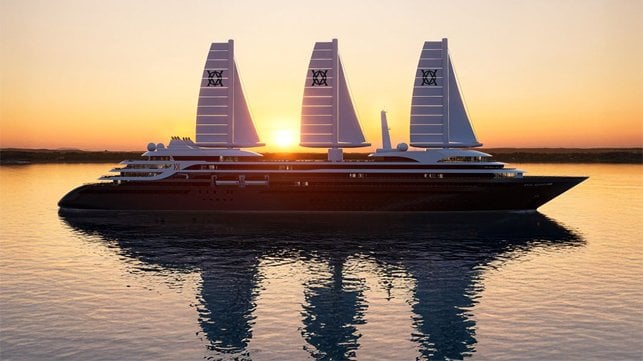
In what is being billed as a new era of luxury expedition cruising, Atlas Ocean Voyages unveiled its designs for a new expedition cruise ship that will include three masts and large sails. The company is presenting the ship, which will be built in China, as a luxury expedition sailing yacht capable of accommodating up to 400 passengers.
Named Atlas Adventure, the ship, which will be 26,000 gross tons, will measure 690 feet (210 meters) in length. It will have an Ice Class 1B (Polar Category C) hull to permit Arctic and Antarctic expeditions, and the most striking feature is the large carbon-fiber sails, which will give the ship an air draft of 225 feet (68.5 meters).
The company says it will have Sustainable Dual-Source Propulsion, which will also include W?rtsil? dual-fuel engines and electric-hybrid propulsion with a large, 9-megawatt marine battery. The ship is designed to sail at 14 knots and a design speed of up to 16 knots. The sail-assisted technology will be used when conditions permit and will reduce fuel consumption by up to 40 percent. It will also be equipped with zero-speed stabilizers and two vertical fin stabilizers.
The ship follows a trend in the industry of combining luxury with expedition capabilities. The ship will feature seven different dining options, five lounges, a cocktail bar, outdoor bars, a swimming pool, and a retractable marina. It will carry both a fleet of Zodiacs and motorboats for shore access and exploring.
Atlas Ocean Voyages was started in 2019 by Portuguese travel and tourism sector investor Mystic Invest Holding, which also has investments in river cruising and the German Nicko Cruises. Atlas launched its first ship, the 200-passenger World Navigator (9,923 gross tons), in 2021, followed by the World Traveler and World Voyager. The ships were built at Portugal’s West Sea - Viana Shipyard. Two additional ships are being completed and sold by Mystic to Windstar Cruises.
Mystic completed a contract with China Merchants Cruise Shipbuilding in December 2025, which is reported to be for the Atlas Adventure at a cost of just under $300 million and with an option for up to three more cruise ships. Atlas reports the new exploration cruise ship will enter service in late 2028.
The itineraries show the ship launching from Japan in November 2028 and sailing to ports in China, Vietnam, Cambodia, Thailand, Malaysia, Indonesia, Singapore, and the Philippines. In February and March 2029, it will sail to the Seychelles and South and East Africa.
Masts of Famed Glasgow Tall Ship Removed for Restoration
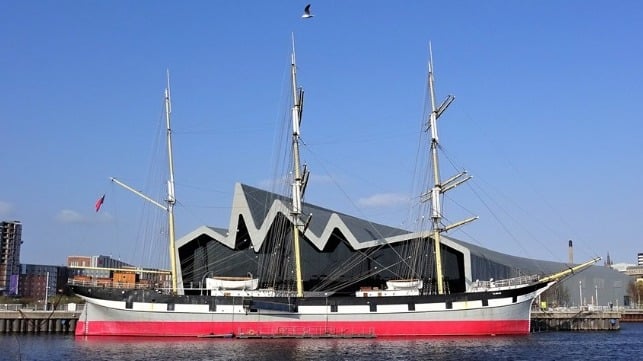
In the port city of Glasgow, Scotland, the masts of a famous ship that serves as a reminder of a proud shipping past have been removed for the first time in 30 years.
For decades, the masts of tall ship Glenlee have been a familiar site on River Clyde where she serves as a floating museum sitting alongside Glasgow’s Riverside Museum. Over the coming few months, the masts will be conspicuously absent following their removal as part of efforts to conserve the historic ship.
The Tall Ship Glenlee Trust, an independent charity that owns Glenlee, said the removal of the masts forms the second phase of the ship’s restoration project that is being funded by a $2.4 million grant from the National Heritage Memorial Fund. In the first phase, which was completed last year, the refurbishment focused on the internal hull and steel works.
Built 130 years ago by Anderson Rodger in the Bay Yard at Port Glasgow, the steel-hulled ship that was designed to carry cargo across the world today stands as an iconic representation of Glasgow’s proud shipping past. When she was built, Glenlee was originally fitted with three masts made mainly of steel, with wooden sections at the top to reduce overall weight. The masts would be her only means of propulsion for during her first two decades of service that saw the ship traverse oceans using wind power alone.
For her next two decades, Glenlee served as a British cargo sailing ship before she was acquired by the Spanish Navy over the 1922 – 1979 period and used for training. Over that period, the original wooden sections were removed and replaced with an entirely new steel rig.
As time passed, the tall ship lost her former glory, and by the 1990s she was in a sad state of disrepair. Clyde Maritime Trust, now the Tall Ship Glenlee Trust, rescued the ship in 1993 and returned her to the River Clyde.
Though refurbishments were carried out over the intervening years, Glenlee is now undergoing its deepest restoration project in over three decades. Following their removal, two of the ship’s three masts have been transported to a workshop where a detailed analysis of their strength and condition will be performed. Once complete, the masts will be returned to Glasgow and reinstalled on Glenlee, which will enable the tall ship to continue attracting visitors and hosting events.
“Maintaining an historic vessel is an expensive but essential business: we want to ensure that Glenlee remains in best possible condition,” said Fiona Greer, Development Director of The Tall Ship Glenlee.
Top image courtesy Rosser1954 / CC BY SA 4.0


No comments:
Post a Comment