Taiwan Refocuses Offshore Wind Tenders to Maximize Viability
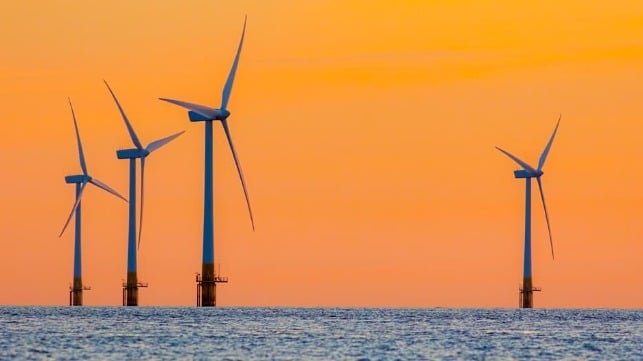
For the upcoming Round 3.3 offshore wind auction, Taiwan has proposed a raft of measures geared towards improving project viability. In 2025, the offshore wind sector proved rather turbulent, with multiple projects globally failing to reach final investment decision. To counter these challenges, Taiwan has signaled a change in policy guiding allocation of offshore wind capacity going forward.
Last week, the Ministry of Economic Affairs (MOEA) held a public consultation on draft rules for Round 3.3. Although a consensus is yet to be reached, the government highlighted the need for a shift in the country’s renewable energy strategy. The proposed rules prioritize execution and delivery capability of a developer. Previously, offshore wind auctions were price-led and strict on localization rules.
One of the major changes in the proposed updates is the removal of Taiwan's localization regulations, satisfying a cost-control priority for developers. In its place, developer track record and financial capacity will become a key focus, accounting for 35 points of the total evaluation score. Again, the track record will incorporate a “negative list,” evaluating issues such as past delays by a developer, early termination and failure to sign administrative contracts.
“This effectively screens out speculative players and those who have damaged credibility in earlier rounds. Only a limited number of developers can independently meet both execution and financial requirements. The likely market response will be more joint-development partnerships, allowing capital-strong investors and technically capable developers to complement one another in order to participate,” commented Will Liu, Senior Consultant at the global engineering and management consulting firm, AFRY.
Most importantly, the new guidelines have introduced ESG requirements, which will account for 10-15% of the total evaluation score. Conventionally, ESG assessments are carried out during financing stage. The need to incorporate ESG in the early planning stages appears to be an effort aimed at reducing project delays. ESG assessments carried out after capacity is awarded have led to additional baseline surveys, increasing costs and project timelines.
The awarded wind farms must complete grid connection between 2030-2031. The minimum application capacity is 300 MW, with a maximum cap of 1 GW. MOEA plans the new rules will be finalized by this Q1, with a selection mechanism issued during the same period. The target capacity for this round is 3.6 GW, closing in on the goal to have 60% renewably sourced power by 2050. To date, Taiwan has installed around 4GW of offshore wind capacity.
Maersk Offshore Wind’s Installation Vessel Completes Sea Trials
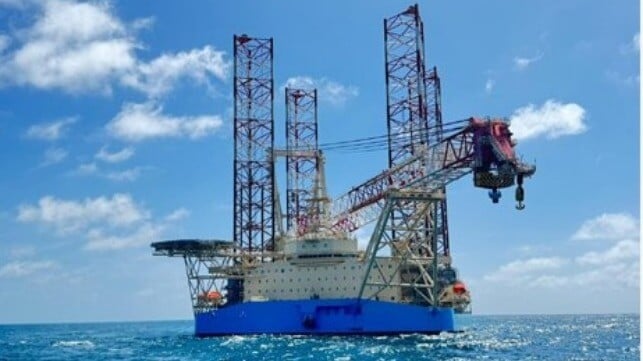
Maersk Offshore Wind and Seatrium reported that their under-construction massive offshore wind installation vessel has completed sea trials. The vessel’s delivery, however, is approaching as the future of the U.S. offshore wind industry for which it was designed remains uncertain.
Seatrium reports that the vessel, which is approximately 475 feet (145 meters) in length, successfully completed its trials in the South China Sea. Both Maersk Offshore Wind and the vessel’s classification society participated in the trials. They are continuing to work towards the agreed delivery of the vessel by the end of February.
The ship was designed with a coordinated feeder system using barges to transport materials from shore. The barges interlock with the installation vessel, making it possible for the ship to remain on site and speed installation times. The largest of the WTIV’s cranes will have a lifting capacity of 1,900 tonnes and the ability to reach up to 590 feet (180 meters) above the deck. Maersk has highlighted in the past that the vessel would be capable of handling the largest offshore wind turbines. It will have 100 cabins and a walk-to-work gangway. In late December, Seatrium had reported the vessel was approximately 99.8 percent completed.
The project appears to be back on track after a dispute between the customer and shipbuilder last fall. Citing problems with the construction, Maersk Offshore Wind had announced it was canceling the contract, and both companies invoked arbitration. The dispute was settled in December with Seatrium agreeing to finance $250 million of the $360 million contract price, giving Maersk Offshore Wind an interest-bearing credit arrangement good for up to 10 years. Seatrium will have a mortgage on the vessel as well as first priority rights, with the financing to be paid through the cash generated by the vessel.
The installation vessel is contracted to Equinor for the Empire Wind offshore project located south of New York’s Long Island. It is one of the five projects that were ordered in December by the Trump administration to stop offshore work. Equinor has filed suit seeking a preliminary injunction to resume offshore work, but the company has said in court filings that if work does not resume by January 16, “cascading effects” could result in the project’s cancellation. Heerema’s heavy-lift vessel Sleipnir is currently transporting the project’s topside and is scheduled to install it in late January. If that cannot proceed as scheduled, Equinor warns the topside might have to be sent to Europe, as it doubts a storage site and crane could be secured in the United States.
Maersk Offshore Wind has not commented on its outlook. The company was launched several years ago, shedding its oil service work to focus on wind energy. Owned by AP Moller Holdings, the company had emphasized the strong opportunities in the business. Its website says a second, XL conventional jack-up installation vessel was designed in collaboration with GustoMSC, but the vessel has not been reported as ordered,
The first WTIV was ordered in 2023 to be built at what is now Seatrium’s yard in Singapore for delivery to the United States by 2025. In 2024, they announced a partnership with Edison Chouest Offshore, saying the U.S. shipyard would build the tugs and barges for the installation system at the Bollinger Shipyards.


No comments:
Post a Comment