France’s National Assembly has thrown its weight behind a proposal to nationalise ArcelorMittal – France's biggest steelmaker – in a vote that has energised the left but sparked a pushback from the government, which argues the plan is more political theatre than practical solution.
Issued on: 28/11/2025 - RFI
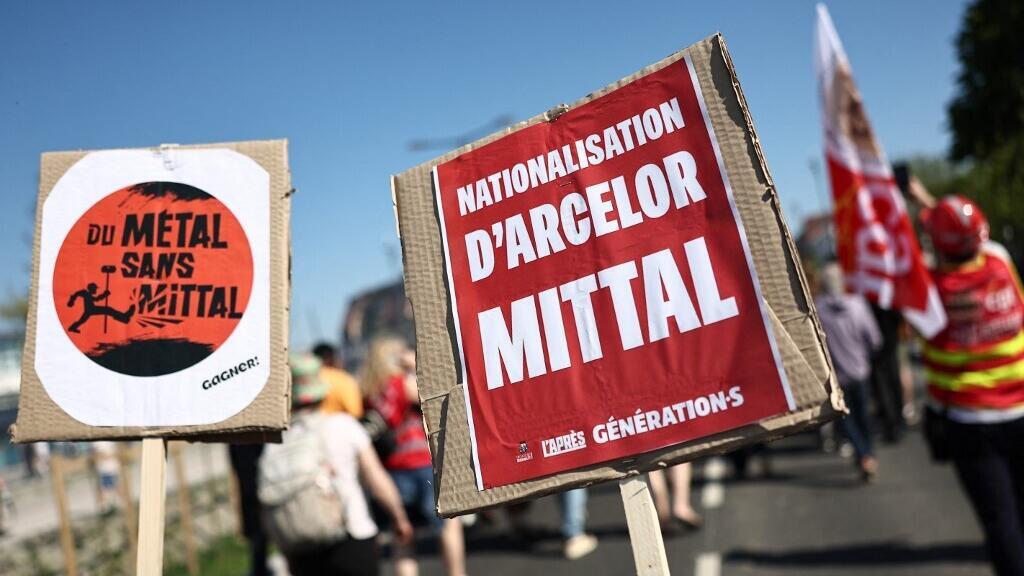
Placards reading 'Steel without Mittal' and 'nationalisation of Arcelor Mittal' are seen during a May Day rally, marking International Workers' Day, in Dunkirk, northern France, on 1 May 2025. AFP - SAMEER AL-DOUMY
The bill, championed by the hard-left France Unbowed (LFI) and backed by a united left-wing bloc – Socialists, Greens and Communists included – was passed late on Thursday by 127 votes to 41.
The far-right’s National Rally chose to abstain, while parties backing President Emmanuel Macron’s minority government voted against.
The proposal now faces a more hostile reception in the Senate, dominated by centrists and the right, and is widely expected to stall.
Finance Minister Roland Lescure has criticised the move, describing it as “a populist response to a structural problem”.
Posting on social media this Friday, he took aim at what he called an “opportunistic and unnatural” alignment between LFI and the National Rally, insisting it would do nothing to tackle the unfair competition undermining the French steel industry.
For Lescure, the debate comes down to strategy rather than symbolism. “France needs a clear industrial roadmap – not some supposed magic formula like nationalisation,” he argued, adding that the government would continue opposing the bill while working on “structural answers” for ArcelorMittal and its workforce.
The bill, championed by the hard-left France Unbowed (LFI) and backed by a united left-wing bloc – Socialists, Greens and Communists included – was passed late on Thursday by 127 votes to 41.
The far-right’s National Rally chose to abstain, while parties backing President Emmanuel Macron’s minority government voted against.
The proposal now faces a more hostile reception in the Senate, dominated by centrists and the right, and is widely expected to stall.
Finance Minister Roland Lescure has criticised the move, describing it as “a populist response to a structural problem”.
Posting on social media this Friday, he took aim at what he called an “opportunistic and unnatural” alignment between LFI and the National Rally, insisting it would do nothing to tackle the unfair competition undermining the French steel industry.
For Lescure, the debate comes down to strategy rather than symbolism. “France needs a clear industrial roadmap – not some supposed magic formula like nationalisation,” he argued, adding that the government would continue opposing the bill while working on “structural answers” for ArcelorMittal and its workforce.
'Illusion of protection'
Industry Minister Sébastien Martin echoed Lescure's message, warning that the text “creates the illusion of protection” but does little to address the real pressures on the sector – from falling European demand to distorted global competition and high production costs.
He stressed that the real battleground is in Brussels, where France is pushing for measures to shield European steel from a surge of cheap imports, particularly from Asia.
China produced 1 billion tonnes of steel last year – over half of global output – compared with 150 million for India and under 100 million each for Japan and the United States.
Europe, by contrast, lags far behind, with Germany producing 37 million tonnes, Italy 20 million, Spain 12 million and France just 11 million.
With supply so heavily skewed, French ministers argue that nationalising a single company won’t change the situation.
Industry Minister Sébastien Martin echoed Lescure's message, warning that the text “creates the illusion of protection” but does little to address the real pressures on the sector – from falling European demand to distorted global competition and high production costs.
He stressed that the real battleground is in Brussels, where France is pushing for measures to shield European steel from a surge of cheap imports, particularly from Asia.
China produced 1 billion tonnes of steel last year – over half of global output – compared with 150 million for India and under 100 million each for Japan and the United States.
Europe, by contrast, lags far behind, with Germany producing 37 million tonnes, Italy 20 million, Spain 12 million and France just 11 million.
With supply so heavily skewed, French ministers argue that nationalising a single company won’t change the situation.
Chinese steel
Speaking on RTL radio, French Labour Minister Jean-Pierre Farandou stated: “The real issue isn’t nationalising Arcelor – it’s fighting massive imports of Chinese steel. That’s where we need to put our weight.”
For him, the priority is collective European action rather than a domestically focused takeover.
ArcelorMittal – the world’s second-largest steelmaker – employs more than 7,000 people across seven sites in northern France, forming part of a wider steel sector that supports around 15,000 direct jobs.
The company has announced plans to cut around 270 roles as part of Europe-wide cost-saving measures, prompting left-wing MPs to push for nationalisation as the only sure-fire way to safeguard employment.
The price tag, however, is an estimated €3 billion.
(with newswires)

 Two National Guard soldiers were injured when an Afghan national allegedly opened fire on them near the White House © Brendan SMIALOWSKI / AFP/File


.jpg)