From Gaza to Syria: The Unyielding Reality of Israeli Settler Colonialism
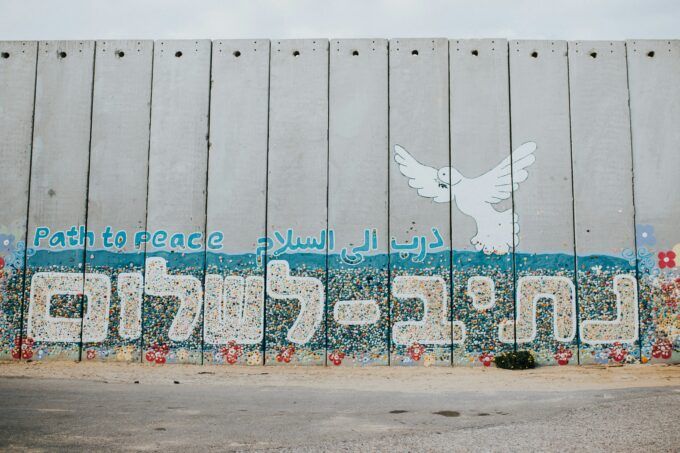
Image by Cole Keister.
The conversation on settler colonialism must not be limited to academic discussion. It is a political reality, clearly demonstrated in the everyday behavior of Israel.
Israel is not merely an expansionist regime historically; it remains actively so today. Additionally, the core of Israeli political discourse, both past and present, revolves around territorial expansion.
Frequently, we succumb to the trap of blaming such language on a specific set of right-wing and extremist politicians or on a particular US administration. The truth is vastly different: the Israeli Zionist political discourse, though it may change in style, remains fundamentally unchanged throughout time.
Zionist leaders have always associated the establishment and expansion of their state with the ethnic cleansing of the Palestinians, later referred to in Zionist literature as the “transfer.”
Theodor Herzl, the founder of modern political Zionism, wrote in his diary about the ethnic cleansing of the Arab population from Palestine:
“We shall try to spirit the penniless population across the border by procuring employment for it in the transit countries, while denying it any employment in our own country… Both the process of expropriation and the removal of the poor must be carried out discreetly and circumspectly.”
It is unclear what happened to Herzl’s grand employment scheme aimed at “spiriting” the population of Palestine across the region. What we know is that the so-called “penniless population” resisted the Zionist project in numerous ways. Ultimately, the depopulation of Palestine occurred through force, culminating in the Nakba, the Catastrophe of 1948.
The discourse of the erasure of the Palestinian people has been the shared foundation among all Israeli officials and governments, though it has been expressed in different ways. It has always had a material component, manifesting in the slow but decisive takeover of Palestinian homes in the West Bank, the confiscation of farms, and the constant construction of “military zones.”
Despite Israeli claims, this “incremental genocide” is not directly linked to the nature and degree of Palestinian resistance. Jenin and Masafer Yatta illustrate this clearly.
Take, for example, the ongoing ethnic cleansing in the northern West Bank, which, according to UNRWA, is the worst since 1967. The displacement of tens of thousands of Palestinians has been justified by Israel as a military necessity due to the fierce resistance in that region, primarily Jenin, but other areas as well.
However, many parts of the West Bank, including the area of Masafer Yatta, have not been engaged in armed resistance. Yet, they have been primary targets for Israel’s colonial expansion.
In other words, Israeli colonialism is in no way linked to Palestinian resistance, action or inaction. This has remained true for decades.
Gaza is a stark example. While one of the most horrific genocides in recent history was being carried out, Israeli real estate developers, members of the Knesset (Parliament), and leaders of the illegal settlement movement were all meeting to discuss investment opportunities in a depopulated Gaza. The callous tycoons were busy promising villas on the beach for competitive prices while Palestinians starved to death, amid an ever-growing body count. Even fiction cannot be as cruel as this reality.
It is no wonder that the Americans joined in, as evidenced by equally ruthless comments made by Jared Kushner, the son-in-law of US President Donald Trump, and eventually by the President himself.
While many at the time spoke about the strangeness of US foreign policy, few mentioned that both countries are prime examples of settler colonialism. Unlike other settler colonial societies, both Israel and the US are still committed to the same project.
Trump’s desire to take over and rename the Gulf of Mexico, his ambition to occupy Greenland and claim it as American territory, and, of course, his comments about owning Gaza are all examples of settler colonial language and behavior.
The difference between Trump and previous presidents is that others used military power to expand US influence through war and hundreds of military bases worldwide without explicitly using expansionist language. Instead, they referenced the need to challenge the Soviet “red menace,” “restore democracy,” and launch a global “war on terror” as justifications for their actions. Trump, however, feels no need to mask his actions with false logic and outright lies. Brutal honesty is his brand, though in essence, he is no different than the rest.
Israel, on the other hand, rarely feels the need to explain itself to anyone. It remains a model of a ferocious, traditional colonial society that fears no accountability and has no regard for international law.
While the Israelis pushed to conquer and ethnically cleanse Gaza, they remained entrenched in southern Lebanon, insisting on remaining in five strategic areas, thus violating the ceasefire agreement with Lebanon, which was signed on November 27.
A perfect case in point was the immediate—and I mean immediate—expansion into southern Syria, the moment the Syrian regime collapsed on December 8.
As soon as the events in Syria opened up security margins, Israeli tanks rolled in, warplanes destroyed almost the entirety of the Syrian army, and Israeli Prime Minister Benjamin Netanyahu canceled the armistice agreement signed in 1974.
That expansion continued, though Syria represented no so-called security threat to Israel whatsoever. Israel is now in control of the Sheikh Mountain and Quneitra inside Syria.
The unquenchable appetite for land in Israel remains as strong as it was upon the formation of the Zionist movement and the takeover of the Palestinian homeland nearly eight decades ago.
This realization is crucial, and Arab countries, in particular, must understand this. Sacrificing Palestinians to the Israeli death machine with the flawed calculation that Israel’s ambitions are limited to Gaza and the West Bank is a fatal mistake.
Israel will not hesitate for a minute to militarily move into any Arab geographic space the moment it feels able to do so, and it will always find US support and European silence, regardless of how destructive its actions are.
Jordan, Egypt, and other Arab countries could find themselves facing the same predicament as Syria today: watching their territories being devoured while remaining powerless and without recourse.
This realization should also matter to those busy finding “solutions” to the Palestinian-Israeli “conflict,” which narrowly frame the problem to that of the Israeli occupation of the West Bank and Gaza.
Settler colonialism can never be resolved through creative solutions. A settler colonial state ceases to exist, and a settler colonial society ceases to function if territorial expansion is not a permanent state of affairs.
The only solution to this is that Israel’s settler colonialism must be challenged, curtailed, and ultimately defeated. It may be a difficult task, but it is an inescapable one.
Stop the Weaponization of Humanitarian Aid

Photograph Source: HRW – CC BY-SA 3.0
Israel’s assault on Gaza, with backing from the United States, has created one of the worst humanitarian crises on the planet. Now Israel is violating a hard-won ceasefire deal by refusing to admit all aid into Gaza.
The Israeli government also passed legislation recently to outlaw UNRWA, the United Nations Relief and Works Agency for Palestine Refugees. This is an outrageous violation of international law that will only lead to more suffering.
UNRWA was established by the United Nations in 1949 to alleviate the “the conditions of starvation and distress” of more than 750,000 Palestine refugees forcibly displaced by the establishment of Israel in 1948. It was intended to be temporary, pending “a just and durable solution to their plight.”
But in the stubborn absence of a political solution, UNRWA has continued to help Palestinian refugees over the last 75 years. Today, Israel’s ban on UNRWA threatens to cripple the humanitarian response in Gaza. It will deprive millions of Palestine refugees of essential food assistance, along with education and health care.
In Gaza, Israel’s deliberate weaponization of starvation has left 345,000 people facing catastrophic food insecurity. Over 90 percent of children aged 6-23 months, along with pregnant and breastfeeding women, are facing “severe food poverty.”Innocent people, including children, continue to die from hunger and malnutrition by being denied the most basic assistance: food.
I’m the executive director of the UNRWA USA National Committee — and a proud Jewish American.
My grandfather escaped Nazi Germany while his sister and her family were murdered for being Jewish. My family knows firsthand what it’s like when the suffering and deaths of some innocents are mourned and not others — and how that’s contributed to a world in which innocents can be killed en masse and we are silenced into not objecting.
Indeed, Amnesty International, Human Rights Watch, the Lemkin Institute for Genocide Prevention, and many genocide scholars, even some inside Israel itself, have called Israel’s war on Gaza a genocide. We see the attacks on UNRWA — including the killing of 275 UNRWA staff members during this war — as part of that assault.
Rarely do governments baselessly attack and smear humanitarian workers with decades of service, as this Israeli government has. But these abuses, along with other propaganda efforts intended to intimidate and harass critics into silence, are well funded efforts to distract us from the brutality of the crimes being committed in Gaza, with total impunity, under our watch.
Unfortunately, the U.S. has supported these actions — by first pausing and ultimately ending all funding to UNRWA under the Trump administration.
But this cruelty doesn’t speak for the American people. Ordinary Americans have courageously stepped up to support suffering innocent people, donating over $56 million in life-saving critical humanitarian aid to Gaza through UNRWA USA while our own government has sadly stepped down from its humanitarian duty.
My Jewish faith demands me to play my part in repairing the world. To defend the hate and killing that I see everyday is actually the most antisemitic and immoral position I could hold. I hope one day UNRWA can be dissolved because peace makes their work no longer necessary — but not because an extremist government unlawfully tries to shut it down.
This is why I ask all compassionate Americans to join UNRWA USA in standing against Israel’s outrageous and unjust ban. Let’s raise our voices in declaring “hands off UNRWA” and demand an immediate resumption of aid to protect the precious lives of children and their families in Gaza.
The U.S. and Israel: An Alliance of Blood, Politics and Money
March 12, 2025
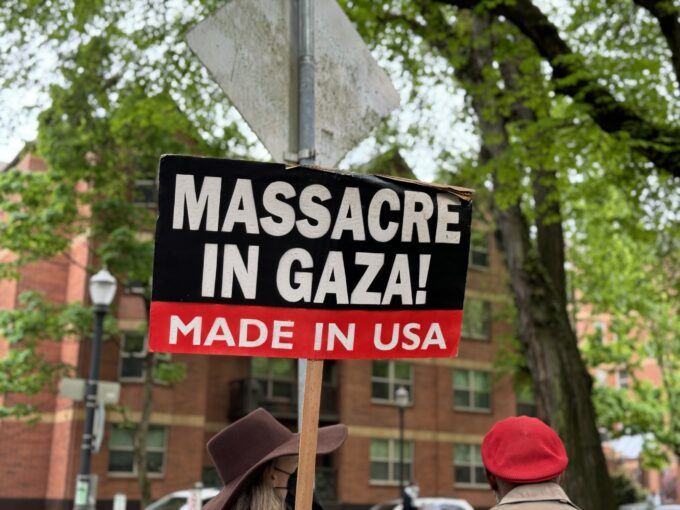
Photograph by Nathaniel St. Clair
To begin to correct the injustices that generations of Palestinians have faced, and to become “a society that can live with its conscience,” the story of Palestine and its people must be told.
After the Second World War, the United States made the decision to tie its destiny to the ethno-nationalist settler-colonial state of Israel. And since then, the Palestinian people have stood alone in their struggle.
The establishment of Israel was a violent process that has never ended. Beginning in 1947, Zionist paramilitary forces launched large-scale attacks on Palestinian towns and villages, leading ultimately to the Nakba (the catastrophe)—the culminating stage of the Zionist ethnic cleansing project.
During the Nakba, 531 Palestinian towns and villages were destroyed, 15,000 Palestinians were murdered, 800,000 were forcibly driven from their homeland to the West Bank, Gaza Strip and to neighboring Arab countries, and 70 massacres were committed.
Before Israel’s declaration of statehood on 14 May 1948, Zionist militias had committed numerous massacres, whose histories have largely been suppressed:
+ Baldat al-Sheikh, 31 December 1947: 70 Palestinians massacred.
+ Sa’sa, 14 February 1948: 16 houses and their 6 inhabitants blown up.
+ Deir Yasin, 9 April 1948: 107 killed, including scores of children, women and elders. Some victims were found maimed, raped and then killed. Masses of men were put on trucks and paraded across Jerusalem before being taken to a quarry to be executed. These atrocities were committed by Irgun and Stern Gangs led by Menachim Begin and Yitzhak Shamir, respectively, who would later become prime ministers of Israel.
+ Abu Shusha, 13 May 1948: Despite efforts of the residents to protect their homes, the village fell to occupation; 60 Palestinians massacred.
During the 1948 war, Zionist and Israeli forces committed more than 30 documented massacres in Palestine. Israeli military historian, Uri Milstein, has suggested that there were more than 100. In ensuing years, Israel continued its campaigns of forced displacement and massacres.
Notably, it was the Qibya massacre of 14 October 1953 that gave birth to what would become the most powerful pro-Israel lobby in the United States. Born in the blood of the natives of Palestine, the American Israel Public Affairs Committee (AIPAC) has spared no efforts to insure that Israel’s ethnic cleansing of the Palestinians be kept hidden from the American people.
It is important to know the origins of the Israeli lobby to realize the significant sway it has had on American politics and politicians. For that, we have to go back in time to post-World War II history:
Harry S. Truman is president of the United States and running for reelection with few prospects and little support; until the Israeli lobby literally enters the campaign in the person of Abraham Feinberg, a hosiery/manufacturing magnate. And the rest, as they say, is history—Israeli history.
The man who made Truman’s 1948 election victory possible explained how it was done in an interview conducted in 1973 for the Harry S. Truman Library—“Oral History Interview with Abraham Feinberg.” He stated in the interview that “without Truman, Israel would have had very difficult days and times trying to even come into existence.”
Israel’s American enforcers faced challenges during the Eisenhower years (1953-1961) from an administration inclined toward a more nuanced policy. During the president’s first year in office, news of the massacre in the Palestinian village of Qibya sparked widespread disapproval.
Time magazine, for example, carried the story describing how Israeli soldiers “shot every man, woman and child they could find, then turned their fire on the cattle;” reporting also that soldiers were seen “slouching in the doorways of Palestinian homes, smoking and joking.” Sixty-six people were killed that night, 45 were blown up in their homes that had been dynamited by soldiers. The New York Times ran excerpts from the United Nations Mixed Armistice Commission—in charge of the 1949 truce— deploring the act as “coldblooded murder” and refuting Israeli lies about the assault.
Israel’s defenders quickly gathered for damage control. Isaiah L. Kenen, founder of the American Zionist Committee for Public Affairs (AZCPA), the forerunner of AIPAC, wrote of the ill effect it would have on what he called “our propaganda.”
To manage the Qibya fallout and to prepare for future cover-ups, Kenen created AZCPA in 1954. Under his leadership, the group grew stronger and richer when it joined with the new Conference of Presidents of the Major American Jewish Organizations, an association of top Jewish leaders who promoted Israel’s interests with U.S. politicians, that included presidents and secretaries of state.
Influencers like Abraham Feinberg and Kenen were instrumental in selling Israel to Americans and influencing policies favoring Israel. By the time Kenen died in 1988, AIPAC had gained an outsized role in shaping U.S. policy in the Middle East.
Over the years, AIPAC has demonstrated that nothing will diminish its vested interest in Israel, including genocide. Since 7 October 2023, the death and destruction Israel’s defenders have been willing to accept are woefully incomprehensible. For example, 26 days into its bombardment of Gaza, the Israeli military had dropped 25,000 tons of bombs (American made), on 12,000 targets—50 bombs dropped every hour. By that date, Gaza had been bombarded with the equivalent of two nuclear bombs over an area smaller than Hiroshima in 1945. Israel has also used banned cluster and white phosphorous munitions, that can cause permanent environmental damage.
The pain of that destruction was explicit in the words of 61-year-old Gazan farmer, Sami Abu Amir, trying to revive a patch of his once productive ground: “It is as if they wanted to kill the land before they killed us.”
After dropping more than 85,000 tons of toxic bombs on the small enclave for 15 months, it is obvious that Israel intended to poison the soil, to make Gaza uninhabitable for survivors.
A November 2024 report published by the Environmental Quality Authority—an independent agency established in the 1990s by the Palestinian Authority—concluded that as a result of the bombing, the soil of Gaza has become so polluted with toxic chemicals that it will “hinder agriculture for decades.”
Unable to defeat the Palestinian resistance with bombs and lethal ground forces, the Tel Aviv regime has reimposed a total blockade once again on Gaza, returning to its October 2023 weapon of war—starvation and deprivation. In addition to halting humanitarian aid, Israel threatened the resistance with additional consequences if they refused to extend phase one of the January ceasefire agreement and accept its new proposal.
It is clear that Israel has no intention of putting an end to this human catastrophe that has been in the making for over 80 years. There will be no resolution until Palestinians recapture their land.
Against this history and backdrop, Arab “leaders” met in Cairo on 4 March 2025 to find a “day after” plan for the quagmire Israel and the United States have weighted the region with in Gaza. Essentially, Israel destroys and the Arab world, not Tel Aviv, is expected to pick up the tab of reconstruction.
American politicians and Israel’s influencers lack an understanding of Palestinians’ connection to and determination to remain steadfast on their land. It is the force that has enabled them to withstand unimaginable hardships. The inseparability and steadfastness were expressed by those who survived the genocide, returning to what was left of their homes, determined to rebuild.
Amir Karaja, for example, told CNN that he would “rather eat the rubble” than be forced to leave his homeland; and Khan Younis survivor, Ahmed Safi, stressed that “We prefer Gaza’s hell than the paradise of any other country… if we are given all the money in the world, we won’t leave this land.”
When discussing the Palestinian experience and identity, the words of Palestinian poet, Mahmoud Darwish (1941-2008), remind us that “The metaphor for Palestine is stronger than the Palestine of reality.” To the detriment of Palestinians and the entire region, Israel and its defenders are determined the metaphor never becomes a political reality.

No comments:
Post a Comment