GOP 'can run' from vote on Trump tariffs — but 'can't hide from voters': WSJ editorial
Matthew Chapman
March 12, 2025
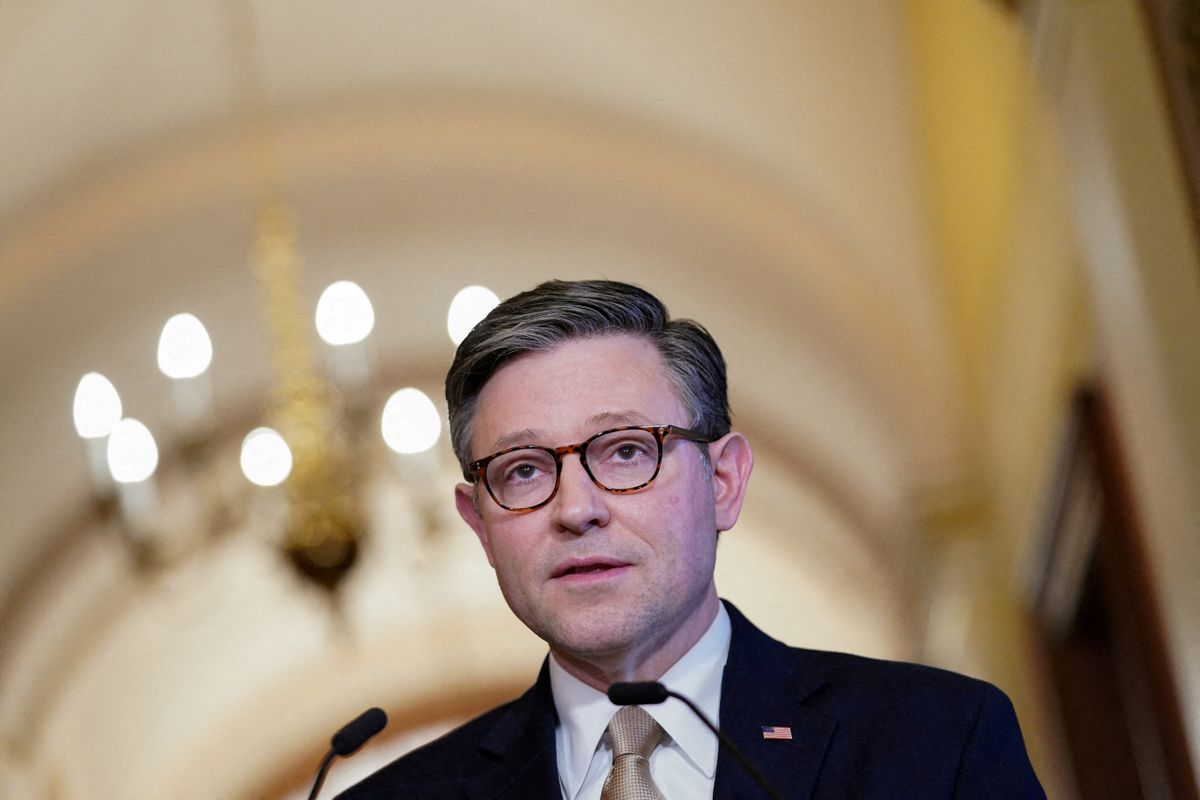
FILE PHOTO: U.S. House Speaker Mike Johnson (R-LA) speaks to reporters next to Israeli Prime Minister Benjamin Netanyahu (not pictured) at the U.S. Capitol in Washington, U.S., February 7, 2025. REUTERS/Nathan Howard/File Photo
House Republicans are hiding from anything that would force them to vote one way or the other on President Donald Trump's controversial tariffs, wrote the conservative Wall Street Journal editorial board in an analysis published on Wednesday.
Trump enacted the tariffs, which have caused a firestorm of economic uncertainty and selloffs, under wide-ranging powers granted by Congress to let presidents declare emergencies — and they have the power to pare that authority back. But GOP leaders have no interest in being put on the spot on that, the board wrote.
"The National Emergencies Act provides fast-track procedures for Congress to end a presidential emergency," wrote the board. "New York Democrat Gregory Meeks introduced a resolution to terminate Mr. Trump’s emergency on March 6 and he intended to force a floor vote this month. This would force Republicans to vote on the record for supporting Mr. Trump’s tariffs, which are a tax increase. However, Republicans inserted a provision in a rule governing debate on their government funding bill that would block consideration of Mr. Meeks’ resolution for the rest of the year."
The GOP, for their part, argue that Democratic lawmakers blocked another measure the GOP passed that would have ended an emergency declaration former President Joe Biden used to cancel student debt — but, the board noted, this isn't actually a stance on Trump's policy.
"GOP House leaders are no doubt trying to protect Members in swing districts where Mr. Trump’s tariffs are unpopular. An Emerson College poll this week reported that 53% of voters say Mr. Trump’s tariffs will hurt the economy, versus 37% who said they would help it. Hispanics by a margin of two-to-one said tariffs would hurt," wrote the board — a result in line with a new CNN poll showing even Trump voters growing skeptical. "Beyond the MAGA echo chamber, Mr. Trump’s tariffs are unpopular. But businesses don’t want to challenge them in court because they are afraid of retaliation. Nor do Democratic state Attorneys General, perhaps because they want to preserve a future Democratic President’s flexibility under the law to declare climate an emergency to impose carbon tariffs."
At the end of the day, the board concluded, "While House Republicans can run from a vote, they can’t hide from voters in 2026 who may not find Mr. Trump’s tariffs beautiful."
Matthew Chapman
March 12, 2025
RAW STORY
FILE PHOTO: U.S. House Speaker Mike Johnson (R-LA) speaks to reporters next to Israeli Prime Minister Benjamin Netanyahu (not pictured) at the U.S. Capitol in Washington, U.S., February 7, 2025. REUTERS/Nathan Howard/File Photo
House Republicans are hiding from anything that would force them to vote one way or the other on President Donald Trump's controversial tariffs, wrote the conservative Wall Street Journal editorial board in an analysis published on Wednesday.
Trump enacted the tariffs, which have caused a firestorm of economic uncertainty and selloffs, under wide-ranging powers granted by Congress to let presidents declare emergencies — and they have the power to pare that authority back. But GOP leaders have no interest in being put on the spot on that, the board wrote.
"The National Emergencies Act provides fast-track procedures for Congress to end a presidential emergency," wrote the board. "New York Democrat Gregory Meeks introduced a resolution to terminate Mr. Trump’s emergency on March 6 and he intended to force a floor vote this month. This would force Republicans to vote on the record for supporting Mr. Trump’s tariffs, which are a tax increase. However, Republicans inserted a provision in a rule governing debate on their government funding bill that would block consideration of Mr. Meeks’ resolution for the rest of the year."
The GOP, for their part, argue that Democratic lawmakers blocked another measure the GOP passed that would have ended an emergency declaration former President Joe Biden used to cancel student debt — but, the board noted, this isn't actually a stance on Trump's policy.
"GOP House leaders are no doubt trying to protect Members in swing districts where Mr. Trump’s tariffs are unpopular. An Emerson College poll this week reported that 53% of voters say Mr. Trump’s tariffs will hurt the economy, versus 37% who said they would help it. Hispanics by a margin of two-to-one said tariffs would hurt," wrote the board — a result in line with a new CNN poll showing even Trump voters growing skeptical. "Beyond the MAGA echo chamber, Mr. Trump’s tariffs are unpopular. But businesses don’t want to challenge them in court because they are afraid of retaliation. Nor do Democratic state Attorneys General, perhaps because they want to preserve a future Democratic President’s flexibility under the law to declare climate an emergency to impose carbon tariffs."
At the end of the day, the board concluded, "While House Republicans can run from a vote, they can’t hide from voters in 2026 who may not find Mr. Trump’s tariffs beautiful."
AlterNet
March 12, 2025
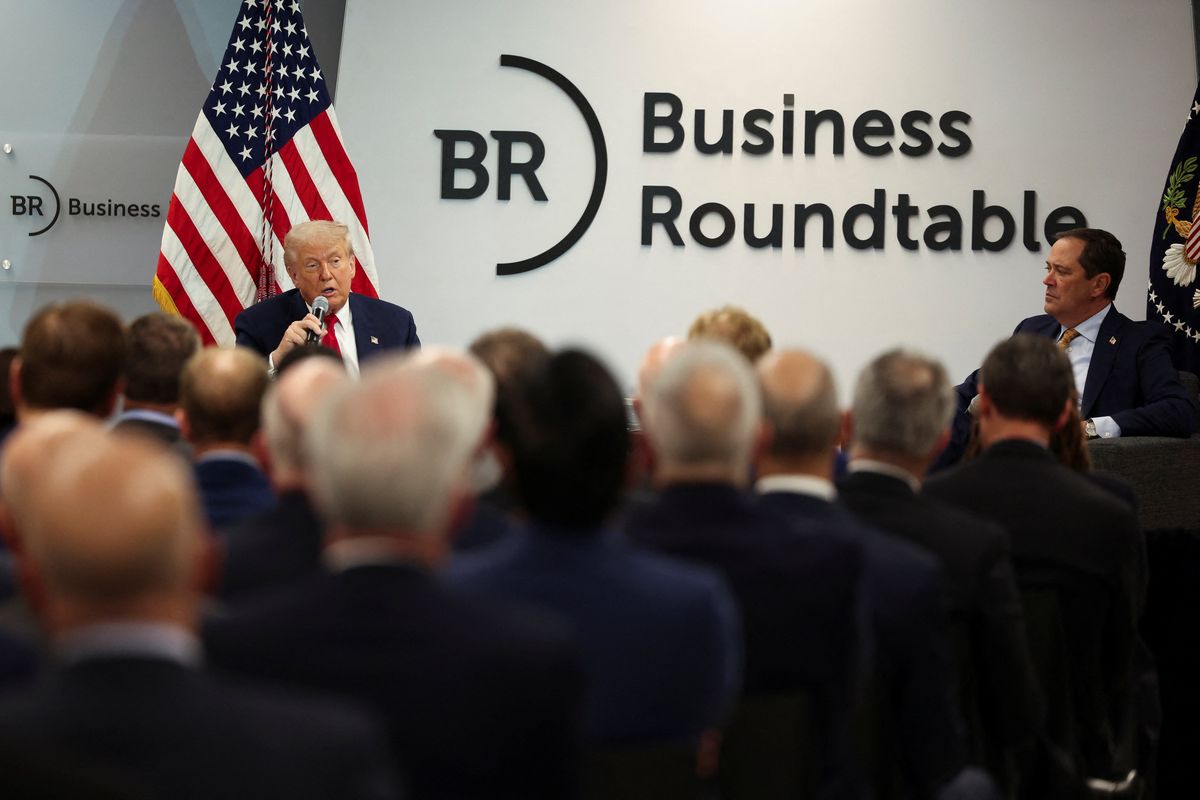
U.S. President Donald Trump speaks next to Chair and Chief Executive Officer of Cisco Chuck Robbins during a Business Roundtable event in Washington, D.C., U.S., March 11, 2025. REUTERS/Kevin Lamarque
Several top corporate CEOs recently confided that despite their public shows of fealty to President Donald Trump, they are less than flattering of him behind closed doors.
According to the Wall Street Journal, Trump was the main topic of conversation a gathering of corporate executives at the Yale CEO Caucus earlier this week. The economy has been on a roller coaster ride since Trump announced — and then almost immediately withdrew — punishing new tariffs on all goods imported from Canada and Mexico. 25% tariffs on Canadian imported steel and aluminum products went into effect Wednesday, however.
When Trump suggested doubling his steel and aluminum tariffs, the roomful of CEOs — which included JPMorgan CEO Jamie Dimon, Pfizer CEO Albert Boula and Dell CEO Michael Dell — the Journal reported that the room "responded with a mix of groans and shocked laughter."
"There was universal revulsion against the Trump economic policies," Yale School of Management professor Jeffrey Sonnenfeld, who organized the event, told the paper. "They’re also especially horrified about Canada."
Bill George, who is the former CEO of Medtronic, remarked that the corporate world has since learned to keep its criticisms of the 47th president of the United States under wraps out of fear of retribution. He said he was "struck by how fearful people are and how unwilling they are to speak out," adding that executives "don’t want to get on the wrong side of the president and his constituents."
He went on to lament the new uncertain economic climate that has taken hold in Trump's second term, which has lately seen financial markets dip precipitously this week as investors fear a trade war. He said companies are worried that outbursts from Trump could end up hurting their bottom line,, leading some to consider moves to curry favor with the regime in order to be spared from his wrath.
“The mood has totally changed,” George said. “What you’re hearing publicly is not what you’re going to hear privately.”
Click here to read the Journal's full article (subscription required).
March 12, 2025
U.S. President Donald Trump speaks next to Chair and Chief Executive Officer of Cisco Chuck Robbins during a Business Roundtable event in Washington, D.C., U.S., March 11, 2025. REUTERS/Kevin Lamarque
Several top corporate CEOs recently confided that despite their public shows of fealty to President Donald Trump, they are less than flattering of him behind closed doors.
According to the Wall Street Journal, Trump was the main topic of conversation a gathering of corporate executives at the Yale CEO Caucus earlier this week. The economy has been on a roller coaster ride since Trump announced — and then almost immediately withdrew — punishing new tariffs on all goods imported from Canada and Mexico. 25% tariffs on Canadian imported steel and aluminum products went into effect Wednesday, however.
When Trump suggested doubling his steel and aluminum tariffs, the roomful of CEOs — which included JPMorgan CEO Jamie Dimon, Pfizer CEO Albert Boula and Dell CEO Michael Dell — the Journal reported that the room "responded with a mix of groans and shocked laughter."
"There was universal revulsion against the Trump economic policies," Yale School of Management professor Jeffrey Sonnenfeld, who organized the event, told the paper. "They’re also especially horrified about Canada."
Bill George, who is the former CEO of Medtronic, remarked that the corporate world has since learned to keep its criticisms of the 47th president of the United States under wraps out of fear of retribution. He said he was "struck by how fearful people are and how unwilling they are to speak out," adding that executives "don’t want to get on the wrong side of the president and his constituents."
He went on to lament the new uncertain economic climate that has taken hold in Trump's second term, which has lately seen financial markets dip precipitously this week as investors fear a trade war. He said companies are worried that outbursts from Trump could end up hurting their bottom line,, leading some to consider moves to curry favor with the regime in order to be spared from his wrath.
“The mood has totally changed,” George said. “What you’re hearing publicly is not what you’re going to hear privately.”
Click here to read the Journal's full article (subscription required).

No comments:
Post a Comment