UPDATES
Oxfam Warns Israel's 'Annihilation Campaign' Is 'Entirely Erasing Gaza'
"The pattern suggests not an effort to neutralize a threat, but a deliberate campaign to dismantle and depopulate Gaza—a process of forced displacement which is a war crime."
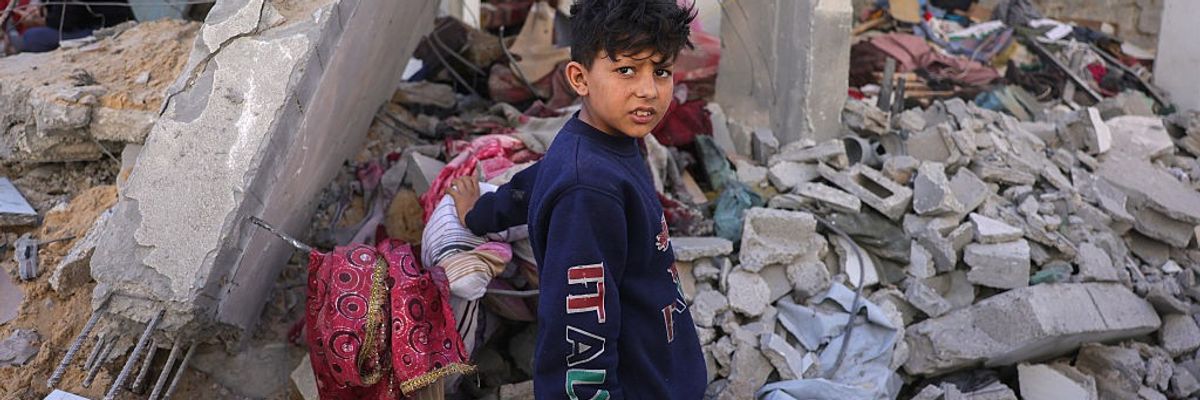
A Palestinian boy walks among the rubble of a home destroyed by Israeli bombing in Jabalia, Gaza, Palestine on May 29, 2025.
(Photo: Bashar Taleb/AFP via Getty Images)
Brett Wilkins
May 29, 2025
COMMON DREAMS
Israel's U.S.-backed mass displacement of Palestinians in the Gaza Strip "is entirely erasing Gaza," a leading international charity said Thursday as the United Nations' Middle East peace envoy warned that ongoing airstrikes, forced starvation, and general despair have plunged the embattled coastal enclave into "an abyss."
Since unilaterally breaking a cease-fire on March 2, "Israel issued nearly one displacement order every two days, strangling people into isolated areas covering less than 20% of the Gaza Strip," Nairobi, bKenya-based Oxfam International noted.
"Combined with deliberate deprivation, this reveals a strategy not of targeting militants, but of dismantling and erasing Gaza itself," Oxfam added. Some Israeli leaders have explicitly called for Gaza's "erasure" to avenge the Hamas-led October 7, 2023 attack on Israel.
"People are so exhausted, many would rather face death than flee again."
"For over 600 days, Israel has been saying it's targeting Hamas, but it is civilians who have been corralled, bombed, and killed en masse every day," said Bushra Khalidi, Oxfam's policy lead in the Occupied Palestinian Territory.
"The displacement orders follow a clear and calculated pattern: using the threat of violence to herd civilians into ever-shrinking zones of confinement," Khalidi added. "This isn't counterterrorism, as Israel alleges—it's the systematic clearing of Gaza through militarized force into enclaves of internment."
Oxfam analyzed Israel's more than 30 displacement orders, which, combined with Israel Defense Forces (IDF)-designated "no-go zones," cover more than 80% of the 141-square mile Gaza Strip.
"The sheer scale and relentless frequency of these orders have made it virtually impossible for people to find refuge," the charity said. "The pattern suggests not an effort to neutralize a threat, but a deliberate campaign to dismantle and depopulate Gaza—a process of forced displacement which is a war crime."
As Oxfam noted:
In just the last week (15–20 May), over 160,000 people were displaced—part of a broader total of nearly 600,000 people displaced since March 18, many of them repeatedly. One of the most significant recent orders, issued on 20 May, covered 34.9 square kilometers, roughly 10% of Gaza's land area, that affected 150,000–200,000 people in North Gaza's Beit Lahia and Jabalia. The effect of such orders on already-displaced populations has been devastating.
"Imagine trying to move with four children or an elderly parent in the middle of the night, with no transport and nowhere to go," said Oxfam gender adviser Fidaa Alaraj, who has been displaced with her family several times. "People are so exhausted, many would rather face death than flee again."
Palestinians, United Nations experts, international humanitarian groups, progressive U.S. lawmakers, and others including a former right-wing Israeli defense minister have called Israel's forced displacement ethnic cleansing.
Fugitive Israeli Prime Minister Benjamin Netanyahu—who is wanted by the International Criminal Court for alleged war crimes and crimes against humanity in Gaza, including extermination and forced starvation—recently said that Israel will control all of Gaza after Operation Gideon's Chariots, a campaign to conquer, ethnically cleanse, and indefinitely occupy the strip.
Far-right members of Netanyahu's Cabinet and the Israeli Knesset want to permanently seize Gaza and reestablish Jewish-only apartheid colonies in the coastal enclave, which U.S. President Donald Trump has proposed taking over and turning into the "Riviera of the Middle East."
"There is one essential condition: We must not reach a situation of famine, both from a practical standpoint and a diplomatic one," Netanyahu said on May 19. "People simply won't support us."
While 82% of Israelis surveyed in a recent poll said they supported the ethnic cleansing of Gaza—and nearly half backed a biblical genocide of Palestinians—much of the world is aghast at Israel's annihilation of the strip, which has left more than 191,000 people dead, maimed, or missing and around 2 million others forcibly displaced, often more than once.
Meanwhile, the famine against which Netanyahu warned looms larger than ever as hundreds of Gazans, mostly children and the elderly, have recently died from malnutrition and lack of medical care, according to local officials.
On Thursday, Sigrid Kaag, the interim U.N. Special Coordinator for the Middle East Peace Process, warned that Gazans are "being starved and denied the very basics" by Israel, which in March tightened an already crippling "complete siege" of Gaza. The blockade has been cited in the South Africa-led genocide case against Israel currently before the International Court of Justice.
"The entire population of Gaza is facing the risk of famine," she warned, likening the trickle of aid allowed into the strip by Israel to offering "a lifeboat after the ship has sunk."
Kaag highlighted the despair pervasive among Gazans, who she said bid farewell not by saying, "Goodbye, see you tomorrow," but rather with the words "see you in heaven."
"Death is their companion. It's not life, it's not hope," she said.
"Since the collapse of the ceasefire in March, civilians have constantly come under fire, confined to ever-shrinking spaces, and deprived of lifesaving relief," Kaag added. "Israel must halt its devastating strikes on civilian life and infrastructure."
"This annihilation campaign and the bloodshed must end."
Echoing Kaag's remarks, Oxfam's Khalidi said that "this annihilation campaign and the bloodshed must end. It is long past time for Western governments and other influential powers to move beyond statements and apply meaningful pressure on Israel to lift the siege and abandon any designs on annexing Gaza."
"Peace cannot be brokered on the ruins of Gaza nor the theft of Palestinian land," she stressed. "Ahead of the Two-State Solution Summit planned in New York next month, world leaders must urge Israel to lift the siege and abandon any annexation plans of Gaza or the West Bank."
"What's at stake is not only Palestine's future," Khalidi argued, "but the integrity of every nation that claims to uphold international law."
"The pattern suggests not an effort to neutralize a threat, but a deliberate campaign to dismantle and depopulate Gaza—a process of forced displacement which is a war crime."
A Palestinian boy walks among the rubble of a home destroyed by Israeli bombing in Jabalia, Gaza, Palestine on May 29, 2025.
(Photo: Bashar Taleb/AFP via Getty Images)
Brett Wilkins
May 29, 2025
COMMON DREAMS
Israel's U.S.-backed mass displacement of Palestinians in the Gaza Strip "is entirely erasing Gaza," a leading international charity said Thursday as the United Nations' Middle East peace envoy warned that ongoing airstrikes, forced starvation, and general despair have plunged the embattled coastal enclave into "an abyss."
Since unilaterally breaking a cease-fire on March 2, "Israel issued nearly one displacement order every two days, strangling people into isolated areas covering less than 20% of the Gaza Strip," Nairobi, bKenya-based Oxfam International noted.
"Combined with deliberate deprivation, this reveals a strategy not of targeting militants, but of dismantling and erasing Gaza itself," Oxfam added. Some Israeli leaders have explicitly called for Gaza's "erasure" to avenge the Hamas-led October 7, 2023 attack on Israel.
"People are so exhausted, many would rather face death than flee again."
"For over 600 days, Israel has been saying it's targeting Hamas, but it is civilians who have been corralled, bombed, and killed en masse every day," said Bushra Khalidi, Oxfam's policy lead in the Occupied Palestinian Territory.
"The displacement orders follow a clear and calculated pattern: using the threat of violence to herd civilians into ever-shrinking zones of confinement," Khalidi added. "This isn't counterterrorism, as Israel alleges—it's the systematic clearing of Gaza through militarized force into enclaves of internment."
Oxfam analyzed Israel's more than 30 displacement orders, which, combined with Israel Defense Forces (IDF)-designated "no-go zones," cover more than 80% of the 141-square mile Gaza Strip.
"The sheer scale and relentless frequency of these orders have made it virtually impossible for people to find refuge," the charity said. "The pattern suggests not an effort to neutralize a threat, but a deliberate campaign to dismantle and depopulate Gaza—a process of forced displacement which is a war crime."
As Oxfam noted:
In just the last week (15–20 May), over 160,000 people were displaced—part of a broader total of nearly 600,000 people displaced since March 18, many of them repeatedly. One of the most significant recent orders, issued on 20 May, covered 34.9 square kilometers, roughly 10% of Gaza's land area, that affected 150,000–200,000 people in North Gaza's Beit Lahia and Jabalia. The effect of such orders on already-displaced populations has been devastating.
"Imagine trying to move with four children or an elderly parent in the middle of the night, with no transport and nowhere to go," said Oxfam gender adviser Fidaa Alaraj, who has been displaced with her family several times. "People are so exhausted, many would rather face death than flee again."
Palestinians, United Nations experts, international humanitarian groups, progressive U.S. lawmakers, and others including a former right-wing Israeli defense minister have called Israel's forced displacement ethnic cleansing.
Fugitive Israeli Prime Minister Benjamin Netanyahu—who is wanted by the International Criminal Court for alleged war crimes and crimes against humanity in Gaza, including extermination and forced starvation—recently said that Israel will control all of Gaza after Operation Gideon's Chariots, a campaign to conquer, ethnically cleanse, and indefinitely occupy the strip.
Far-right members of Netanyahu's Cabinet and the Israeli Knesset want to permanently seize Gaza and reestablish Jewish-only apartheid colonies in the coastal enclave, which U.S. President Donald Trump has proposed taking over and turning into the "Riviera of the Middle East."
"There is one essential condition: We must not reach a situation of famine, both from a practical standpoint and a diplomatic one," Netanyahu said on May 19. "People simply won't support us."
While 82% of Israelis surveyed in a recent poll said they supported the ethnic cleansing of Gaza—and nearly half backed a biblical genocide of Palestinians—much of the world is aghast at Israel's annihilation of the strip, which has left more than 191,000 people dead, maimed, or missing and around 2 million others forcibly displaced, often more than once.
Meanwhile, the famine against which Netanyahu warned looms larger than ever as hundreds of Gazans, mostly children and the elderly, have recently died from malnutrition and lack of medical care, according to local officials.
On Thursday, Sigrid Kaag, the interim U.N. Special Coordinator for the Middle East Peace Process, warned that Gazans are "being starved and denied the very basics" by Israel, which in March tightened an already crippling "complete siege" of Gaza. The blockade has been cited in the South Africa-led genocide case against Israel currently before the International Court of Justice.
"The entire population of Gaza is facing the risk of famine," she warned, likening the trickle of aid allowed into the strip by Israel to offering "a lifeboat after the ship has sunk."
Kaag highlighted the despair pervasive among Gazans, who she said bid farewell not by saying, "Goodbye, see you tomorrow," but rather with the words "see you in heaven."
"Death is their companion. It's not life, it's not hope," she said.
"Since the collapse of the ceasefire in March, civilians have constantly come under fire, confined to ever-shrinking spaces, and deprived of lifesaving relief," Kaag added. "Israel must halt its devastating strikes on civilian life and infrastructure."
"This annihilation campaign and the bloodshed must end."
Echoing Kaag's remarks, Oxfam's Khalidi said that "this annihilation campaign and the bloodshed must end. It is long past time for Western governments and other influential powers to move beyond statements and apply meaningful pressure on Israel to lift the siege and abandon any designs on annexing Gaza."
"Peace cannot be brokered on the ruins of Gaza nor the theft of Palestinian land," she stressed. "Ahead of the Two-State Solution Summit planned in New York next month, world leaders must urge Israel to lift the siege and abandon any annexation plans of Gaza or the West Bank."
"What's at stake is not only Palestine's future," Khalidi argued, "but the integrity of every nation that claims to uphold international law."
New Illegal Settlements Show Israel Is 'Blatantly Working to Destroy the Palestinian People'
"The international community is enabling Israel's crimes by standing aside while millions of Palestinians are subjected to this racist and brutal regime of the Israeli government," said the Israeli human rights group B'Tselem.

Palestinian women look at the ruins of what used to be their home in Nour Shams Refugee Camp in the occupied West Bank on May 29, 2025.
(Photo: Wahaj Bani Moufleh/Middle East Images via AFP)
Jake Johnson
May 30, 2025
COMMON DREAMS
Israeli government officials confirmed Thursday that they have approved the largest expansion of unlawful settlements in the occupied West Bank in decades, including the construction of new settlements and the "legalization" under Israeli law of existing outposts in the Palestinian territory.
The decision, reportedly made during a secret Israeli security cabinet meeting last week, drew sharp backlash from Israeli human rights organizations. A spokesperson for B'Tselem said the latest expansion of settlements—which the International Court of Justice has condemned as part of an illegal annexation campaign—shows that "Israel continues to promote Jewish supremacy through the theft of Palestinian land and the ethnic cleansing of the West Bank."
"The Israeli government is openly and blatantly working to destroy the Palestinian people, and any chances for a normal future for the people living between the Jordan River and the sea," the spokesperson said. "The international community is enabling Israel's crimes by standing aside while millions of Palestinians are subjected to this racist and brutal regime of the Israeli government."
Israeli settlements in the West Bank have grown rapidly since the Hamas-led attack of October 7, 2023, with the United Nations Human Rights Office estimating that Israel moved ahead with plans to build more than 20,000 housing units in new or existing settlements between November 2023 and October 2024.
"This extremist Israeli government is trying by all means to prevent the establishment of an independent Palestinian state," Nabil Abu Rudeineh, a spokesperson for Palestinian President Mahmoud Abbas, toldReuters on Thursday.
Israeli Defense Minister Israel Katz confirmed that's the government's objective, declaring that settlement expansion "prevents the establishment of a Palestinian state that would endanger Israel."
"The Israeli government no longer pretends otherwise: The annexation of the occupied territories and expansion of settlements is its central goal."
The new expansion will add nearly two dozen settlements, according to far-right Israeli Finance Minister Bezalel Smotrich, who lives in a West Bank settlement and vocally supports annexation of the Palestinian territory.
"This is a great day for settlement and an important day for the state of Israel," Smotrich wrote in a social media post on Thursday.
The announcement came amid continued Israeli raids and home demolitions in the West Bank, alongside the Israeli military's devastating assault on the Gaza Strip. Israel's attacks have displaced tens of thousands of people in the West Bank and virtually the entire population of Gaza.
It's unclear where the new settlements will be located in the West Bank, given that the expansion decision was made in secret. The Israeli anti-occupation group Peace Now suggested that the secrecy could stem from "concerns about the proceedings in the International Criminal Court, which has begun investigating Israel's settlement construction and development as possible war crimes."
The Wall Street Journalreported earlier this week that the chief prosecutor of the International Criminal Court was considering arrest warrants against Smotrich and Israeli National Security Minister Itamar Ben-Gvir for their roles in expanding West Bank settlements.
"The Israeli government no longer pretends otherwise: The annexation of the occupied territories and expansion of settlements is its central goal," Peace Now said in a statement Thursday. "The cabinet's decision to establish 22 new settlements—the most extensive move of its kind since the Oslo Accords, under which Israel committed not to establish new settlements—will dramatically reshape the West Bank and entrench the occupation even further."
"At a time when both the Israeli public and the entire world is demanding an immediate end to the war, the government is making clear—again and without restraint—that it prefers deepening the occupation and advancing de facto annexation over pursuing peace," the group added.
"The international community is enabling Israel's crimes by standing aside while millions of Palestinians are subjected to this racist and brutal regime of the Israeli government," said the Israeli human rights group B'Tselem.
Palestinian women look at the ruins of what used to be their home in Nour Shams Refugee Camp in the occupied West Bank on May 29, 2025.
(Photo: Wahaj Bani Moufleh/Middle East Images via AFP)
Jake Johnson
May 30, 2025
COMMON DREAMS
Israeli government officials confirmed Thursday that they have approved the largest expansion of unlawful settlements in the occupied West Bank in decades, including the construction of new settlements and the "legalization" under Israeli law of existing outposts in the Palestinian territory.
The decision, reportedly made during a secret Israeli security cabinet meeting last week, drew sharp backlash from Israeli human rights organizations. A spokesperson for B'Tselem said the latest expansion of settlements—which the International Court of Justice has condemned as part of an illegal annexation campaign—shows that "Israel continues to promote Jewish supremacy through the theft of Palestinian land and the ethnic cleansing of the West Bank."
"The Israeli government is openly and blatantly working to destroy the Palestinian people, and any chances for a normal future for the people living between the Jordan River and the sea," the spokesperson said. "The international community is enabling Israel's crimes by standing aside while millions of Palestinians are subjected to this racist and brutal regime of the Israeli government."
Israeli settlements in the West Bank have grown rapidly since the Hamas-led attack of October 7, 2023, with the United Nations Human Rights Office estimating that Israel moved ahead with plans to build more than 20,000 housing units in new or existing settlements between November 2023 and October 2024.
"This extremist Israeli government is trying by all means to prevent the establishment of an independent Palestinian state," Nabil Abu Rudeineh, a spokesperson for Palestinian President Mahmoud Abbas, toldReuters on Thursday.
Israeli Defense Minister Israel Katz confirmed that's the government's objective, declaring that settlement expansion "prevents the establishment of a Palestinian state that would endanger Israel."
"The Israeli government no longer pretends otherwise: The annexation of the occupied territories and expansion of settlements is its central goal."
The new expansion will add nearly two dozen settlements, according to far-right Israeli Finance Minister Bezalel Smotrich, who lives in a West Bank settlement and vocally supports annexation of the Palestinian territory.
"This is a great day for settlement and an important day for the state of Israel," Smotrich wrote in a social media post on Thursday.
The announcement came amid continued Israeli raids and home demolitions in the West Bank, alongside the Israeli military's devastating assault on the Gaza Strip. Israel's attacks have displaced tens of thousands of people in the West Bank and virtually the entire population of Gaza.
It's unclear where the new settlements will be located in the West Bank, given that the expansion decision was made in secret. The Israeli anti-occupation group Peace Now suggested that the secrecy could stem from "concerns about the proceedings in the International Criminal Court, which has begun investigating Israel's settlement construction and development as possible war crimes."
The Wall Street Journalreported earlier this week that the chief prosecutor of the International Criminal Court was considering arrest warrants against Smotrich and Israeli National Security Minister Itamar Ben-Gvir for their roles in expanding West Bank settlements.
"The Israeli government no longer pretends otherwise: The annexation of the occupied territories and expansion of settlements is its central goal," Peace Now said in a statement Thursday. "The cabinet's decision to establish 22 new settlements—the most extensive move of its kind since the Oslo Accords, under which Israel committed not to establish new settlements—will dramatically reshape the West Bank and entrench the occupation even further."
"At a time when both the Israeli public and the entire world is demanding an immediate end to the war, the government is making clear—again and without restraint—that it prefers deepening the occupation and advancing de facto annexation over pursuing peace," the group added.
Israel minister says ‘time to go in with full force’ in Gaza
By AFP
May 30, 2025

Israeli tanks take position on the Gaza border amid calls from a far-right minister to use "full force" in the battered territory. - Copyright AFP/File ISAAC LAWRENCE
Alice CHANCELLOR
An Israeli far-right minister said on Friday it was time to use “full force” in Gaza, after Hamas said a new US-backed truce proposal failed to meet its demands.
Negotiations to end nearly 20 months of war have so far failed to achieve a breakthrough, with Israel resuming operations in Gaza in March ending a six-week truce.
Israel recently intensified its offensive in what it says is a renewed push to destroy Palestinian militant group Hamas, whose October 7, 2023 attack triggered the war.
“Mr Prime Minister, after Hamas rejected the deal proposal again — there are no more excuses,” far-right National Security Minister Itamar Ben Gvir said on his Telegram channel, addressing Prime Minister Benjamin Netanyahu.
“The confusion, the shuffling and the weakness must end. We have already missed too many opportunities. It is time to go in with full force, without blinking, to destroy, and kill Hamas to the last one.”
The White House said on Thursday that President Donald Trump and US envoy Steve Witkoff had “submitted a ceasefire proposal to Hamas that Israel backed”.
Press Secretary Karoline Leavitt added that discussions were “continuing” with the militants.
Israel has not confirmed that it approved the new proposal.
Hamas sources said last week the group had accepted a US-backed deal, but on Thursday political bureau member Bassem Naim said the new version meant “the continuation of killing and famine… and does not meet any of our people’s demands, foremost among them halting the war”.
“Nonetheless, the movement’s leadership is studying the response to the proposal with full national responsibility,” he added.
– ‘Retreat’ –
A source close to the group said the new version “is considered a retreat” from the previous one, which “included an American commitment regarding permanent ceasefire negotiations”.
According to two sources close to the negotiations, the new proposal involves a 60-day truce, potentially extendable to 70 days, and the release of five living hostages and nine bodies in exchange for Palestinian prisoners during the first week.
It also involves a second exchange of the same number of living and dead hostages during the second week, according to the sources.
The same sources said Hamas had agreed last week to two exchanges on the same terms, but one during the first week of the truce and the other during the final week.
Out of 251 hostages seized during the October 2023 attack, 57 remain in Gaza, including 34 the Israeli military says are dead.
The humanitarian situation in the territory remains dire despite aid beginning to trickle in after a more than two-month Israeli blockade.
Food security experts say starvation is looming for one in five people.
Medical facilities in Gaza, meanwhile, have come under increasing strain and repeated attack.
French President Emmanuel Macron said Friday that European countries should “harden the collective position” against Israel if it does not respond appropriately to the humanitarian situation in Gaza.
With international pressure mounting on Israel over the deepening hunger crisis, Macron said action was needed “in the next few hours and days”.
In its latest update Thursday, the health ministry in Hamas-run Gaza said at least 3,986 people had been killed in the territory since Israel resumed major operations on March 18, taking the war’s overall toll to 54,249, mostly civilians.
Hamas’s attack on Israel resulted in the deaths of 1,218 people, mostly civilians, according to an AFP tally based on official figures.
By AFP
May 30, 2025
Israeli tanks take position on the Gaza border amid calls from a far-right minister to use "full force" in the battered territory. - Copyright AFP/File ISAAC LAWRENCE
Alice CHANCELLOR
An Israeli far-right minister said on Friday it was time to use “full force” in Gaza, after Hamas said a new US-backed truce proposal failed to meet its demands.
Negotiations to end nearly 20 months of war have so far failed to achieve a breakthrough, with Israel resuming operations in Gaza in March ending a six-week truce.
Israel recently intensified its offensive in what it says is a renewed push to destroy Palestinian militant group Hamas, whose October 7, 2023 attack triggered the war.
“Mr Prime Minister, after Hamas rejected the deal proposal again — there are no more excuses,” far-right National Security Minister Itamar Ben Gvir said on his Telegram channel, addressing Prime Minister Benjamin Netanyahu.
“The confusion, the shuffling and the weakness must end. We have already missed too many opportunities. It is time to go in with full force, without blinking, to destroy, and kill Hamas to the last one.”
The White House said on Thursday that President Donald Trump and US envoy Steve Witkoff had “submitted a ceasefire proposal to Hamas that Israel backed”.
Press Secretary Karoline Leavitt added that discussions were “continuing” with the militants.
Israel has not confirmed that it approved the new proposal.
Hamas sources said last week the group had accepted a US-backed deal, but on Thursday political bureau member Bassem Naim said the new version meant “the continuation of killing and famine… and does not meet any of our people’s demands, foremost among them halting the war”.
“Nonetheless, the movement’s leadership is studying the response to the proposal with full national responsibility,” he added.
– ‘Retreat’ –
A source close to the group said the new version “is considered a retreat” from the previous one, which “included an American commitment regarding permanent ceasefire negotiations”.
According to two sources close to the negotiations, the new proposal involves a 60-day truce, potentially extendable to 70 days, and the release of five living hostages and nine bodies in exchange for Palestinian prisoners during the first week.
It also involves a second exchange of the same number of living and dead hostages during the second week, according to the sources.
The same sources said Hamas had agreed last week to two exchanges on the same terms, but one during the first week of the truce and the other during the final week.
Out of 251 hostages seized during the October 2023 attack, 57 remain in Gaza, including 34 the Israeli military says are dead.
The humanitarian situation in the territory remains dire despite aid beginning to trickle in after a more than two-month Israeli blockade.
Food security experts say starvation is looming for one in five people.
Medical facilities in Gaza, meanwhile, have come under increasing strain and repeated attack.
French President Emmanuel Macron said Friday that European countries should “harden the collective position” against Israel if it does not respond appropriately to the humanitarian situation in Gaza.
With international pressure mounting on Israel over the deepening hunger crisis, Macron said action was needed “in the next few hours and days”.
In its latest update Thursday, the health ministry in Hamas-run Gaza said at least 3,986 people had been killed in the territory since Israel resumed major operations on March 18, taking the war’s overall toll to 54,249, mostly civilians.
Hamas’s attack on Israel resulted in the deaths of 1,218 people, mostly civilians, according to an AFP tally based on official figures.
UN blasts new US-backed aid distribution system in Gaza
By AFP
May 28, 2025

Palestinians receive food packages from a US-backed foundation in the southern Gaza Strip - Copyright AFP -
AFP team in Gaza, Louis Baudoin-Laarman in Ramallah and Kyoko Hasegawa in Tokyo
The UN on Wednesday condemned a US-backed aid system in Gaza after 47 people were injured during a chaotic food distribution, where the Israeli military said it did not open fire at crowds.
The issue of aid has come sharply into focus amid a hunger crisis coupled with intense criticism of the Gaza Humanitarian Foundation (GHF), a shadowy group that has bypassed the longstanding UN-led system in the territory.
According to the UN, 47 people were injured in the mayhem that erupted on Tuesday when thousands of Palestinians desperate for food rushed into a GHF aid distribution site, while a Palestinian medical source said at least one had died.
Ajith Sunghay, the head of the UN Human Rights Office in the Palestinian territories, said most of the wounded had been hurt by gunfire, and based on the information he had, “it was shooting from the IDF” — the Israeli military.
The Israeli military rejected the accusation, with Colonel Olivier Rafowicz telling AFP that Israeli soldiers “fired warning shots into the air, in the area outside” the centre managed by the GHF, and “in no case towards the people.”
With the war sparked by Hamas’s October 2023 attack on Israel entering its 600th day on Wednesday, Palestinians in Gaza felt there was no reason to hope for a better future.
In Israel, the relatives of people held hostage in Gaza since the October 7 attack longed for the return of their loved ones, with hundreds gathering in their name in Tel Aviv.
“Six hundred days have passed and nothing has changed. Death continues, and Israeli bombing does not stop,” said Bassam Daloul, 40, adding that “even hoping for a ceasefire feels like a dream and a nightmare.”
– ‘Waste of resources’ –
The UN has repeatedly hit out against the GHF, which faces accusations of failing to fulfil the principles of humanitarian work, and Philippe Lazzarini, head of the UN agency for Palestinian refugees, on Wednesday reiterated the criticism.
“I believe it is a waste of resources and a distraction from atrocities. We already have an aid distribution system that is fit for purpose,” he said during a visit in Japan.
In Gaza, the civil defence agency said Israeli air strikes killed 16 people since dawn Wednesday.
Heba Jabr, 29, who sleeps in a tent in southern Gaza with her husband and their two children, was struggling to find food.
“Dying by bombing is much better than dying from the humiliation of hunger and being unable to provide bread and water for your children”, she told AFP.
Israel imposed a full blockade on Gaza for over two months, before allowing supplies in at a trickle last week.
A medical source in southern Gaza told AFP that after Tuesday’s stampede at the GHF site “more than 40 injured people arrived at Nasser Hospital, the majority of them wounded by Israeli gunfire”, adding that at least one had died since.
The source added that “a number of other civilians also arrived at the hospital with various bruises”.
– Hostage families’ anguish –
On Tuesday, the GHF said around “8,000 food boxes have been distributed so far… totalling 462,000 meals”.
UN agencies and aid groups have argued that the GHF’s designation of so-called secure distribution sites contravenes the principle of humanity because it would force already displaced people to move again in order to stay alive.
Israel stepped up its military offensive in Gaza earlier this month, while mediators push for a ceasefire that remains elusive.
In Israel, hundreds of people gathered to call for a ceasefire that would allow for the release of hostages held by militants in Gaza since their 2023 attack.
Protesters gathered along the country’s roads and on the main highway running through the Israeli coastal city of Tel Aviv at 6:29 am, the exact time the unprecedented October 7 attack began.
Most Israeli media headlines read “600 days”, and focused on the hostage families’ struggle to get their relatives home.
Other events were planned across Israel to make the 600th day of captivity for the 57 remaining hostages still in Gaza.
Some 1,218 people were killed in Hamas’ October 7, 2023, attack, mostly civilians, according to an AFP tally based on official figures.
The health ministry in Hamas-run Gaza said on Wednesday that at least 3,924 people had been killed in the territory since Israel ended a ceasefire on March 18, taking the war’s overall toll to 54,084, mostly civilians.
By AFP
May 28, 2025
Palestinians receive food packages from a US-backed foundation in the southern Gaza Strip - Copyright AFP -
AFP team in Gaza, Louis Baudoin-Laarman in Ramallah and Kyoko Hasegawa in Tokyo
The UN on Wednesday condemned a US-backed aid system in Gaza after 47 people were injured during a chaotic food distribution, where the Israeli military said it did not open fire at crowds.
The issue of aid has come sharply into focus amid a hunger crisis coupled with intense criticism of the Gaza Humanitarian Foundation (GHF), a shadowy group that has bypassed the longstanding UN-led system in the territory.
According to the UN, 47 people were injured in the mayhem that erupted on Tuesday when thousands of Palestinians desperate for food rushed into a GHF aid distribution site, while a Palestinian medical source said at least one had died.
Ajith Sunghay, the head of the UN Human Rights Office in the Palestinian territories, said most of the wounded had been hurt by gunfire, and based on the information he had, “it was shooting from the IDF” — the Israeli military.
The Israeli military rejected the accusation, with Colonel Olivier Rafowicz telling AFP that Israeli soldiers “fired warning shots into the air, in the area outside” the centre managed by the GHF, and “in no case towards the people.”
With the war sparked by Hamas’s October 2023 attack on Israel entering its 600th day on Wednesday, Palestinians in Gaza felt there was no reason to hope for a better future.
In Israel, the relatives of people held hostage in Gaza since the October 7 attack longed for the return of their loved ones, with hundreds gathering in their name in Tel Aviv.
“Six hundred days have passed and nothing has changed. Death continues, and Israeli bombing does not stop,” said Bassam Daloul, 40, adding that “even hoping for a ceasefire feels like a dream and a nightmare.”
– ‘Waste of resources’ –
The UN has repeatedly hit out against the GHF, which faces accusations of failing to fulfil the principles of humanitarian work, and Philippe Lazzarini, head of the UN agency for Palestinian refugees, on Wednesday reiterated the criticism.
“I believe it is a waste of resources and a distraction from atrocities. We already have an aid distribution system that is fit for purpose,” he said during a visit in Japan.
In Gaza, the civil defence agency said Israeli air strikes killed 16 people since dawn Wednesday.
Heba Jabr, 29, who sleeps in a tent in southern Gaza with her husband and their two children, was struggling to find food.
“Dying by bombing is much better than dying from the humiliation of hunger and being unable to provide bread and water for your children”, she told AFP.
Israel imposed a full blockade on Gaza for over two months, before allowing supplies in at a trickle last week.
A medical source in southern Gaza told AFP that after Tuesday’s stampede at the GHF site “more than 40 injured people arrived at Nasser Hospital, the majority of them wounded by Israeli gunfire”, adding that at least one had died since.
The source added that “a number of other civilians also arrived at the hospital with various bruises”.
– Hostage families’ anguish –
On Tuesday, the GHF said around “8,000 food boxes have been distributed so far… totalling 462,000 meals”.
UN agencies and aid groups have argued that the GHF’s designation of so-called secure distribution sites contravenes the principle of humanity because it would force already displaced people to move again in order to stay alive.
Israel stepped up its military offensive in Gaza earlier this month, while mediators push for a ceasefire that remains elusive.
In Israel, hundreds of people gathered to call for a ceasefire that would allow for the release of hostages held by militants in Gaza since their 2023 attack.
Protesters gathered along the country’s roads and on the main highway running through the Israeli coastal city of Tel Aviv at 6:29 am, the exact time the unprecedented October 7 attack began.
Most Israeli media headlines read “600 days”, and focused on the hostage families’ struggle to get their relatives home.
Other events were planned across Israel to make the 600th day of captivity for the 57 remaining hostages still in Gaza.
Some 1,218 people were killed in Hamas’ October 7, 2023, attack, mostly civilians, according to an AFP tally based on official figures.
The health ministry in Hamas-run Gaza said on Wednesday that at least 3,924 people had been killed in the territory since Israel ended a ceasefire on March 18, taking the war’s overall toll to 54,084, mostly civilians.
By AFP
May 28, 2025

The EU has long struggled to have an impact on the conflict - Copyright AFP -
Olivier BAUBE
With reports of acute suffering in Gaza flooding the airwaves, EU leaders have toughened their tone on Israel — but the bloc will need to bridge deep divisions to move from rhetoric to a real-world impact on the conflict.
The shift has been most noticeable from key power Germany, one of Israel’s staunchest allies in the world, its loyalty rooted in the trauma of the Holocaust.
After an Israeli strike killed dozens, including many children, in a Gaza school-turned-shelter Monday, German Chancellor Friedrich Merz declared he “no longer understands” Israel’s objectives in the war-ravaged Palestinian enclave.
“The way in which the civilian population has been affected… can no longer be justified by a fight against Hamas terrorism,” he said.
Berlin’s stern new tone found an echo Tuesday in Brussels, where the German head of the European Commission, Ursula von der Leyen, denounced as “abhorrent” and “disproportionate” the past days’ attacks on civilian infrastructure in Gaza.
An EU diplomat called such language both “strong and unheard of” coming from the commission chief, among the first to rally to Israel’s side in the wake of the October 7, 2023 Hamas attacks that triggered the Gaza war.
The explanation? “Merz has moved the dial” in Brussels, said one EU official.
“There’s been a very notable shift over recent weeks,” agreed Julien Barnes-Dacey, head of the Middle East programme at the European Council on Foreign Relations (ECFR), in a podcast by the think-tank — arguing it reflects a “sea change of European public opinion”.
Translating talk into action is another matter, however.
– Longstanding divisions –
Germany, the main supplier of weapons to Israel after the United States, this week rebuffed calls to cut off arms sales to Prime Minister Benjamin Netanyahu’s government.
On Tuesday however, in a barely veiled threat, its foreign minister warned Israel against crossing a line.
“We defend the rule of law everywhere and also international humanitarian law,” said Johann Wadephul. “Where we see that it is being violated, we will of course intervene and certainly not supply weapons that would enable further violations.”
The European Union has long struggled to have an impact on the Mideast conflict due to long-standing divisions between countries that back Israel and those seen as more pro-Palestinian.
Last week, in a milestone of sorts, the bloc launched a review to determine whether Israel is complying with human-rights principles laid out in its association agreement with the EU — a move backed by 17 of 27 member states.
EU top diplomat Kaja Kallas said Wednesday she hopes to present options on the next steps to foreign ministers at a June 23 meeting in Brussels.
Suspending the EU-Israel accord outright would require unanimity among member states — seen by diplomats as virtually unthinkable.
Berlin was among the EU capitals that opposed even reviewing the deal, as did fellow economic heavyweight Italy.
But Barnes-Dacey sees “the possibility of a qualified majority of states imposing some restrictions” under the trade component of the agreement.
The EU is Israel’s biggest commercial partner, with 42.6 billion euros ($48.2 billion) traded in goods in 2024. Trade in services reached 25.6 billion euros in 2023.
An EU diplomat says it is not yet clear whether there is sufficient support for the move, which needs backing from 15 member states, representing 65 percent of the bloc’s population.
For Kristina Kausch, a Middle East expert at the German Marshall Fund think tank, it is too soon to speak of a European policy shift.
“Even the review of the association agreement is only a review,” she said. “What counts is the action.”
Momentum to ramp up pressure is growing by the day, however, spearheaded by the most vocal critics of Israel’s assault such as Spain, Belgium and Ireland.
“My personal view is that it very much looks like genocide,” said Belgium’s foreign minister, Maxime Prevot. “I don’t know what further horrors need to take place before we dare use the word.”
Accusations that Israel is committing “genocide” in Gaza have been levelled by rights groups, UN officials and a growing number of countries.
Israel rejects the charge, and in Europe even the governments most sympathetic to the Palestinians are treading carefully.
One tangible next step could be the broader recognition of Palestinian statehood — with France seeking to move forward on the matter ahead of a UN conference in June.
“Will that have an immediate impact? Probably not,” said Barnes-Dacey.
“But I do think it will have an impact if Israel knows that it no longer has the free path that it’s had for so long.”
With reports of acute suffering in Gaza flooding the airwaves, EU leaders have toughened their tone on Israel — but the bloc will need to bridge deep divisions to move from rhetoric to a real-world impact on the conflict.
The shift has been most noticeable from key power Germany, one of Israel’s staunchest allies in the world, its loyalty rooted in the trauma of the Holocaust.
After an Israeli strike killed dozens, including many children, in a Gaza school-turned-shelter Monday, German Chancellor Friedrich Merz declared he “no longer understands” Israel’s objectives in the war-ravaged Palestinian enclave.
“The way in which the civilian population has been affected… can no longer be justified by a fight against Hamas terrorism,” he said.
Berlin’s stern new tone found an echo Tuesday in Brussels, where the German head of the European Commission, Ursula von der Leyen, denounced as “abhorrent” and “disproportionate” the past days’ attacks on civilian infrastructure in Gaza.
An EU diplomat called such language both “strong and unheard of” coming from the commission chief, among the first to rally to Israel’s side in the wake of the October 7, 2023 Hamas attacks that triggered the Gaza war.
The explanation? “Merz has moved the dial” in Brussels, said one EU official.
“There’s been a very notable shift over recent weeks,” agreed Julien Barnes-Dacey, head of the Middle East programme at the European Council on Foreign Relations (ECFR), in a podcast by the think-tank — arguing it reflects a “sea change of European public opinion”.
Translating talk into action is another matter, however.
– Longstanding divisions –
Germany, the main supplier of weapons to Israel after the United States, this week rebuffed calls to cut off arms sales to Prime Minister Benjamin Netanyahu’s government.
On Tuesday however, in a barely veiled threat, its foreign minister warned Israel against crossing a line.
“We defend the rule of law everywhere and also international humanitarian law,” said Johann Wadephul. “Where we see that it is being violated, we will of course intervene and certainly not supply weapons that would enable further violations.”
The European Union has long struggled to have an impact on the Mideast conflict due to long-standing divisions between countries that back Israel and those seen as more pro-Palestinian.
Last week, in a milestone of sorts, the bloc launched a review to determine whether Israel is complying with human-rights principles laid out in its association agreement with the EU — a move backed by 17 of 27 member states.
EU top diplomat Kaja Kallas said Wednesday she hopes to present options on the next steps to foreign ministers at a June 23 meeting in Brussels.
Suspending the EU-Israel accord outright would require unanimity among member states — seen by diplomats as virtually unthinkable.
Berlin was among the EU capitals that opposed even reviewing the deal, as did fellow economic heavyweight Italy.
But Barnes-Dacey sees “the possibility of a qualified majority of states imposing some restrictions” under the trade component of the agreement.
The EU is Israel’s biggest commercial partner, with 42.6 billion euros ($48.2 billion) traded in goods in 2024. Trade in services reached 25.6 billion euros in 2023.
An EU diplomat says it is not yet clear whether there is sufficient support for the move, which needs backing from 15 member states, representing 65 percent of the bloc’s population.
For Kristina Kausch, a Middle East expert at the German Marshall Fund think tank, it is too soon to speak of a European policy shift.
“Even the review of the association agreement is only a review,” she said. “What counts is the action.”
Momentum to ramp up pressure is growing by the day, however, spearheaded by the most vocal critics of Israel’s assault such as Spain, Belgium and Ireland.
“My personal view is that it very much looks like genocide,” said Belgium’s foreign minister, Maxime Prevot. “I don’t know what further horrors need to take place before we dare use the word.”
Accusations that Israel is committing “genocide” in Gaza have been levelled by rights groups, UN officials and a growing number of countries.
Israel rejects the charge, and in Europe even the governments most sympathetic to the Palestinians are treading carefully.
One tangible next step could be the broader recognition of Palestinian statehood — with France seeking to move forward on the matter ahead of a UN conference in June.
“Will that have an immediate impact? Probably not,” said Barnes-Dacey.
“But I do think it will have an impact if Israel knows that it no longer has the free path that it’s had for so long.”
'When The Hague Is Against Me, I Know I'm on the Right Path,' Says Accused Israeli War Criminal Ben-Gvir
"No arrest warrant of any kind will deter me," said far-right Israeli National Security Minister Itamar Ben-Gvir.

Israeli National Security Minister Itamar Ben-Gvir marches through the Muslim Quarter of Jerusalem on May 26, 2025.
(Photo: Eyal Warshavsky/SOPA Images/LightRocket via Getty Images)
Jake Johnson
May 28, 2025
COMMON DREAMS
Far-right Israeli National Security Minister Itamar Ben-Gvir responded proudly Wednesday to reports that the chief prosecutor of the International Criminal Court was considering arrest warrants against him and fellow extremist minister Bezalel Smotrich over their roles in expanding illegal settlements in the occupied West Bank.
Ben-Gvir, who has openly fought efforts to deliver aid to starving Palestinians and worked to prevent progress toward a durable cease-fire, wrote in a social media post that "when The Hague is against me, I know I'm on the right path"—suggesting he would view an arrest warrant from the ICC as a badge of honor.
"I have one clear message to the chief prosecutor at the International Criminal Court in The Hague," he wrote. "No arrest warrant of any kind will deter me from continuing to work for the people of Israel and the Land of Israel. The prosecutor in The Hague does not scare me."
The Israeli minister's post came after The Wall Street Journalreported that ICC chief prosecutor Karim Khan "was preparing to seek arrest warrants for two far-right Israeli cabinet members before he went on leave as the United Nations investigates sexual-assault allegations against him."
The Journal noted that the cases center on Ben-Gvir and Smotrich's "roles in expanding Jewish settlements in the West Bank." Both ministers live in West Bank settlements, which have expanded significantly since Israel began its full-scale assault on the Gaza Strip following the Hamas-led attack of October 7, 2023.
"A decision on whether to pursue the cases falls to Khan's two deputies, and it is unclear how they plan to proceed," the Journal reported. "ICC prosecutors have been weighing whether Smotrich and Ben-Gvir committed war crimes by pushing construction of West Bank Jewish settlements."
Late last year, the ICC issued arrest warrants for Israeli Prime Minister Benjamin Netanyahu and former Israeli Defense Minister Yoav Gallant, accusing the pair of committing war crimes in the Gaza Strip.
Khan decided to take leave earlier this month amid the U.N. probe of sexual assault allegations made by one of his aides. Khan has denied the accusations, which have thrown the ICC into chaos at a pivotal moment.
Journalist Alice Speri reported for Drop Site earlier this month that "the woman's accusations were far more serious than what has been revealed so far, and include what she described to colleagues as monthslong grooming, psychological coercion, and sexual advances, which eventually escalated into 'unwanted' and 'coerced' sex that lasted nearly a year and continued even after she told Khan that his conduct had left her suicidal."
Khan's alleged conduct and the resulting blowback risks compromising the ICC's work to hold Israeli officials to account for war crimes committed in the occupied Palestinian territories, advocates and court officials fear.
Speri reported that "many at the court, including the alleged victim... understood the abuse allegations were political dynamite and 'a gift for Israel,' as one person put it, and they worried about how they may be used to discredit the ICC, and particularly delegitimize the case against Netanyahu, which many believed was warranted and crucial."
"No arrest warrant of any kind will deter me," said far-right Israeli National Security Minister Itamar Ben-Gvir.
Israeli National Security Minister Itamar Ben-Gvir marches through the Muslim Quarter of Jerusalem on May 26, 2025.
(Photo: Eyal Warshavsky/SOPA Images/LightRocket via Getty Images)
Jake Johnson
May 28, 2025
COMMON DREAMS
Far-right Israeli National Security Minister Itamar Ben-Gvir responded proudly Wednesday to reports that the chief prosecutor of the International Criminal Court was considering arrest warrants against him and fellow extremist minister Bezalel Smotrich over their roles in expanding illegal settlements in the occupied West Bank.
Ben-Gvir, who has openly fought efforts to deliver aid to starving Palestinians and worked to prevent progress toward a durable cease-fire, wrote in a social media post that "when The Hague is against me, I know I'm on the right path"—suggesting he would view an arrest warrant from the ICC as a badge of honor.
"I have one clear message to the chief prosecutor at the International Criminal Court in The Hague," he wrote. "No arrest warrant of any kind will deter me from continuing to work for the people of Israel and the Land of Israel. The prosecutor in The Hague does not scare me."
The Israeli minister's post came after The Wall Street Journalreported that ICC chief prosecutor Karim Khan "was preparing to seek arrest warrants for two far-right Israeli cabinet members before he went on leave as the United Nations investigates sexual-assault allegations against him."
The Journal noted that the cases center on Ben-Gvir and Smotrich's "roles in expanding Jewish settlements in the West Bank." Both ministers live in West Bank settlements, which have expanded significantly since Israel began its full-scale assault on the Gaza Strip following the Hamas-led attack of October 7, 2023.
"A decision on whether to pursue the cases falls to Khan's two deputies, and it is unclear how they plan to proceed," the Journal reported. "ICC prosecutors have been weighing whether Smotrich and Ben-Gvir committed war crimes by pushing construction of West Bank Jewish settlements."
Late last year, the ICC issued arrest warrants for Israeli Prime Minister Benjamin Netanyahu and former Israeli Defense Minister Yoav Gallant, accusing the pair of committing war crimes in the Gaza Strip.
Khan decided to take leave earlier this month amid the U.N. probe of sexual assault allegations made by one of his aides. Khan has denied the accusations, which have thrown the ICC into chaos at a pivotal moment.
Journalist Alice Speri reported for Drop Site earlier this month that "the woman's accusations were far more serious than what has been revealed so far, and include what she described to colleagues as monthslong grooming, psychological coercion, and sexual advances, which eventually escalated into 'unwanted' and 'coerced' sex that lasted nearly a year and continued even after she told Khan that his conduct had left her suicidal."
Khan's alleged conduct and the resulting blowback risks compromising the ICC's work to hold Israeli officials to account for war crimes committed in the occupied Palestinian territories, advocates and court officials fear.
Speri reported that "many at the court, including the alleged victim... understood the abuse allegations were political dynamite and 'a gift for Israel,' as one person put it, and they worried about how they may be used to discredit the ICC, and particularly delegitimize the case against Netanyahu, which many believed was warranted and crucial."

No comments:
Post a Comment