MONOPOLY CAPITALI$M
Glencore’s $22B assets shift sets stage for mining mega-merger
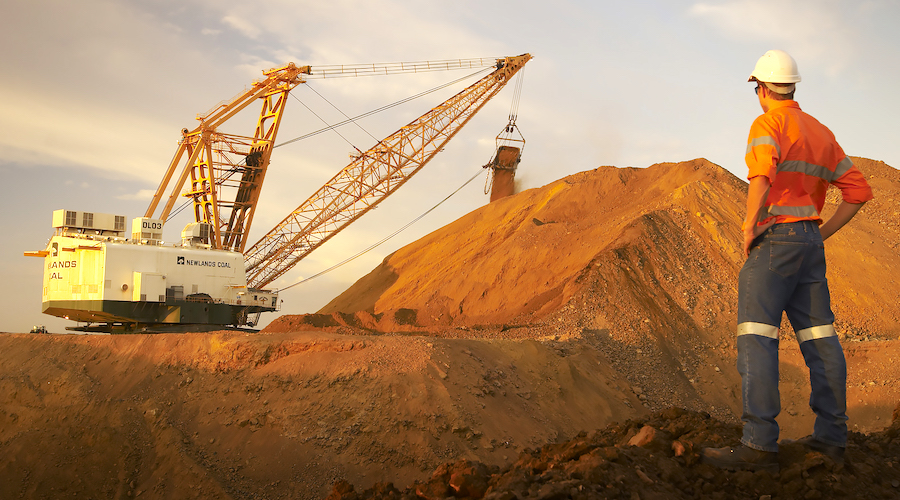
Glencore (LON: GLEN) has transferred almost $22 billion in foreign assets into its Australian subsidiary in a sweeping global restructure, laying the groundwork for a future mega-merger with a rival mining heavyweight.

The move, disclosed by the Australian Financial Review, means the total assets held by Glencore’s Australian entity have doubled to $42 billion. The shift required $3.8 billion in internal cash transfers and $614 million in intra-company share issuances to facilitate the asset migration.
The restructure consolidates coal mines in Canada, South Africa and Colombia, a major copper project in Argentina, and South African manganese, chrome and vanadium operations under Glencore Investment Pty Ltd, its Australia-based entity.
The strategic transfer of assets to Glencore’s Australian entity likely signals more than just operational streamlining. Investors say it positions the company squarely for a future merger. By centralizing key assets in a single jurisdiction, which is close to Asian markets, Glencore creates a more attractive and simplified structure for potential partners – or a mega-merger.
“Glencore coal assets would trade at a much higher multiple in Australia than London. There won’t be much reason to go to London other than cricket if Glencore and Anglo get knocked off,” Ben Cleary, a portfolio manager at Tribeca Investment Partners, told AFR.
Market observers noted the asset realignment follows months of behind-the-scenes discussions with Rio Tinto (ASX, LON: RIO), marking a dramatic shift in tone from earlier failed efforts. In 2014, Rio rejected a merger proposal outright, sparking a very public standoff between then-CEO Ivan Glasenberg and Rio’s leadership. But Glencore’s 2024 outreach met a warmer reception. Outgoing Rio chief Jakob Stausholm remained hesitant, but several senior executives, one of whom may succeed him, according to the AFR, were reportedly more receptive to the idea.
Despite shelving earlier plans to spin off its coal division, which delivered 38% of Glencore’s earnings last year, chief executive officer Gary Nagle has centralized all coal operations within the Australian unit. That includes its Canadian subsidiary Elk Valley Resources, which operates four steelmaking coal mines in British Columbia: Elkview, Fording River, Greenhills, and Line Creek. EVR also holds a 46% stake in Neptune Terminals, a key bulk export facility.
In Colombia, Glencore owns the Cerrejón open-pit coal mine. In South Africa, it controls the Impunzi thermal coal complex and holds stakes in the Mokala manganese mine, the Glencore–Merafe Chrome Venture, and the Rhovan-Bakwena Vanadium Venture. Joining the list of transferred assets is the MARA copper project in Argentina, which it acquired from Pan American in 2023.
The Australian arm also holds the company’s thermal and metallurgical coal assets in New South Wales and Queensland.
Doubling down on critical minerals
As merger speculation simmers, Glencore is also deepening its presence in Australia’s critical minerals sector. The Swiss miner and commodities trader has inked a three-year supply agreement with Cobalt Blue (ASX: COB) to provide cobalt hydroxide feedstock for the Kwinana refinery in Western Australia, which is set to become the country’s first cobalt refinery.
The deal will see Glencore supply up to 50% of the refinery’s cobalt input, starting once the facility begins commercial operations. It guarantees a minimum of 3,750 tonnes of cobalt hydroxide over the contract period, with 750 tonnes in the first year and 1,500 tonnes annually in the second and third years. The feedstock will come from Glencore’s operations in the Democratic Republic of Congo, specifically Kamoto Copper Company, in which it holds a 75% stake, and Mutanda Mining SARL.
The assets shift and cobalt supply deal show Glencore positioning itself for consolidation and growth, with Australia at the heart of its strategy.
CMB.TECH and Golden Ocean Finalize Merger Terms to Create Shipping Giant
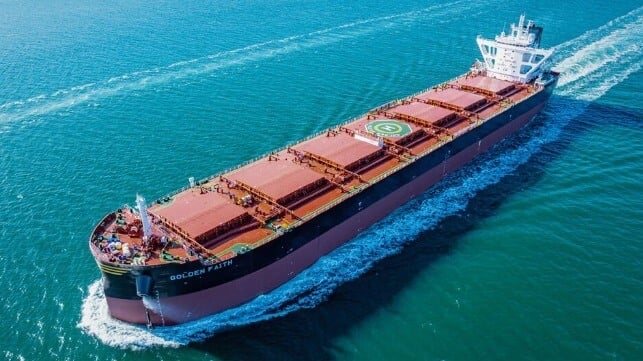
A month after announcing the intent to merge their shipping operations, the Saverys family reported that terms have been reached for the combination of Golden Ocean into the family company CMB.TECH. The resulting combination is set to create one of the largest publicly traded diversified maritime groups.
The transaction is valuing Golden Ocean, the largest listed owner of large-size dry bulk vessels, at approximately $1.4 billion. Under the agreed terms, the shareholders will receive .95 shares of CMB.TECH. After the merger, CMB.TECH shareholders will own approximately 70 percent of the shares of the combined company which will continue as CMB.TECH with Golden Ocean becoming an operating subsidiary.
Presenting the rationale for the combination, management cites the creation of a diversified shipping company that will be more resilient and positioned to lead in the industry’s decarbonization efforts. CMB.TECH currently has more than 160 vessels, including, 30 dry bulk carriers as well as tankers, containerships, offshore wind, and workboats. Golden Ocean has more than 90 dry bulk vessels with an aggregate capacity of approximately 13.7 million dwt. With a fleet of more than 250 vessels and a projected market cap of $3.2 billion, the combined company will rival Frontline as the largest publicly traded shipping company and dwarf other shipping companies.
The deal, however, has been called into question by analysts and investors after pressures emerged on the dry bulk sector. Golden Ocean reported a week ago a net loss of $44 million for the first quarter of 2025.
“Our first quarter results reflect a weaker market environment, with softer charter rates and lower trading activity impacting our performance, in addition to our current intensive drydocking schedule. These headwinds were not unexpected given the seasonal slowdown and increased macroeconomic uncertainty, including the disruption caused by recently announced trade tariffs,” said Peder Simonsen, Chief Executive Officer and Chief Financial Officer of Godel Ocean.
He however asserted that the fundamentals underpinning of dry bulk shipping remain intact, in particular for the Capesize segment. He points to limited fleet growth, shifting trade patterns, and infrastructure-led demand in key regions as continuing to support a constructive medium-term outlook for the group.
Alexander Saverys, who will remain CEO of the combined company, has in the past spoken of a strategy of using conventional shipping to drive the company's efforts to become a leader in ammonia and hydrogen as maritime fuels. CMB.TECH has established ammonia and hydrogen fuel offerings and some of the first ships to operate on the emerging alternative fuels.
The merger remains subject to customary conditions, including regulatory approval and a vote by Golden Ocean shareholders. The companies report they expect to complete the merger in the third quarter of 2025.

No comments:
Post a Comment