Video: Carbon Destroyer 1, EU’s First CO2 Carrier for CCS is Launched
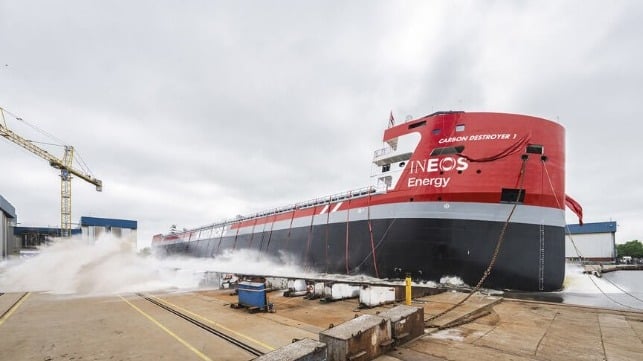
The first European-designed and built carrier for liquified CO2 to be used in a carbon capture and storage operation was launched on May 14 in the Netherlands. The vessel is being called a breakthrough designed to support a commercial-scale CCS project for the EU.
The launch took place at the Royal Niestern Sander shipyard. The Carbon Destroy 1 will have a capacity to transport approximately 5,000 tons of liquified CO2 as part of the Greensand Future project. The vessel will operate between the Port of Esbjerg in Denmark and the Nini West offshore platform, a depleted oil field in the Danish North Sea. The project, which is being led by INEOS, in March 2023, became the first to transport CO2 across international borders and completed a pilot injection of the CO2 beneath the seabed in the depleted field.
Carbon Destroyer 1 is based on Royal Wagenborg’s EasyMax shortsea bulker design and has been especially adapted for the handling of CO2 under pressure and at low temperature. The concept for the bulker class is a multi-purpose vessel with a cargo capacity of 14,000 tons, which was jointly developed by Royal Wagenborg and Royal Niestern Sander to produce a vessel requiring lower power output and achieving greater efficiency. The class is based on a design length of 492 feet (149.95 meters), a beam of 52 feet (15.9 meters), and a draught of 28 feet (8.6 meters), which also provided an enlarged cargo capacity.
Mads Weng Gade, CEO of INEOS Energy Europe, highlighted that “Carbon Destroyer 1 will transport captured CO2 from across Europe, creating a virtual pipeline between the point of capture and permanent storage deep beneath the seabed of the North Sea.”
Work has begun on a CO2 terminal to be located in the Port of Esbjerg, in the southwest of Denmark on the North Sea. The initial plan calls for captured CO2 from Denmark’s biogas plants to be delivered by truck to the terminal, where it will be stored and then transferred to the vessel.
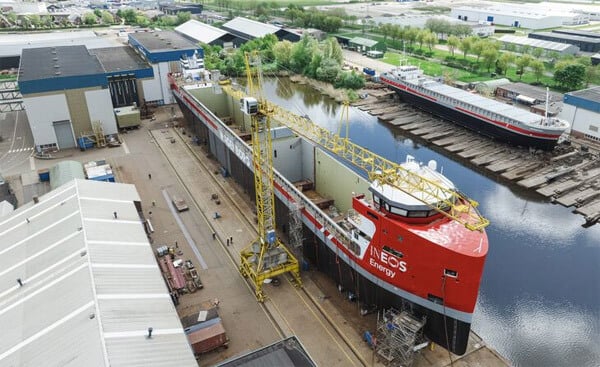
Carbon Destroyer 1 ready to launch (Greensand Future)
The vessel is expected to be fully operational by the end of 2025 or early 2026, with its delivery coordinated to the projected start date for commercial operations for Greensand. The project calls for storing CO2 over 1,800 meters beneath the seabed. Initially, Greensand aims to capture, transport, and store 400,000 tons of CO2 per year. It has the potential to gradually increase its storage capacity by 2030. The project, which is a partnership between INEOS Energy Denmark, Harbour Energy, and Nordsøfonden, which is the Danish state’s subsurface company, reports that there is potential for permanent storage of up to 8 million tons of CO? annually.
Carbon Destroyer 1 is larger than the two South Korean-built vessels that were delivered at the end of 2024 for Norway’s Northern Lights CCS project. Those vessels each have a capacity to transport 7,500 cbm of LCO2. They have completed certification and as of last week, Norway’s Ministry of Energy, the Ministry of Climate and Environment, the Norwegian Environmental Agency (NEA) and Norwegian Ocean Industry Authority (Havtil), have all given their consents for the first phase of Northern Lights. It now has all the required permits to begin injecting CO2 at its site in the North Sea off the Norwegian coast.
How Carbon Capture Can Cut Maritime Emissions
The International Maritime Organization (IMO) has set historic emissions limits aiming for net-zero by 2050, effective from 2027 for large vessels.
Wärtsilä's innovative carbon capture system could cut ship emissions by up to 70%, offering an economically viable path to compliance without scrapping fleets.
While promising, carbon capture remains controversial, with critics arguing it may delay broader decarbonization efforts.
Maritime shipping accounts for three percent of all global greenhouse gas emissions. This means that decarbonizing the sector will be critical in most scenarios to hit global climate targets. Leaders from within the sector have gotten on board with the decarbonization imperative, agreeing to target net zero emissions by 2050 – but getting there won’t be easy.
In order to decarbonize this hard-to-abate industry, a number of advances are needed, including supportive policy and oversight, real-time emissions tracking, new and disruptive technologies like hydrogen fuel cells to replace the dirty bitumen that many ships rely on, and more efficient shipping routes. Happily, advancements are being made in all of these regards.
Late last year, the International Maritime Organization adopted a Net-Zero Framework that pairs mandatory emissions limits and greenhouse gas pricing across the entire sector in a historic first. “These measures, set to be formally adopted in October 2025 before entry into force in 2027, will become mandatory for large ocean-going ships over 5,000 gross tonnage, which emit 85% of the total CO2 emissions from international shipping,” the Organization announced in a press release published last month.
While these stringent mandates are hugely positive news for climate goals, they could place significant economic strain on the shipping industry if mismanaged. But a new technology out of Scandinavia may have found a way to let the shipping industry slash its carbon emissions without having to scrap its existing, crude-thirsty fleets.
Wärtsilä, a Finland-based energy and maritime firm, just unveiled a groundbreaking carbon capture system that they hope will be a complete game changer for the sector. The team behind the technology claims that their model can cut a ship’s emissions by up to 70 percent, a staggering figure. And, even more critically, it’s not just a theoretical model – the team has already installed their CCS prototype onto a commercial vessel, Solvang ASA’s 21,000 m³ ethylene carrier Clipper Eris.
According to Agnevall, not only is the technology great news for climate goals, it should also provide a lot of relief to shipowners and investors, who can potentially now update their existing fleets for compliance with emissions regulations instead of being saddled with stranded assets.
“CCS is a game-changer for the maritime industry, and we are already seeing huge interest in the market for this solution,” Håkan Agnevall, Wärtsilä president and chief executive officer, explained to Interesting Engineering. “While the shipping sector continues to explore options for lessening its environmental impact, CCS provides a significant shortcut for achieving meaningful sustainability,” added Edvin Endresen, Solvang ASA chief executive officer.
“The firm estimates the cost of carbon capture using its system at USD 54 – 76 per metric ton of CO?,” reports Interesting Engineering. “Covering both capital and operating expenses, the figure is considered competitive and could appeal to shipowners facing carbon taxes and emissions trading requirements.”
While these advancements could make significant positive change for individual ships’ emissions, however, there is some concern that carbon capture technologies will ultimately disincentivize more sweeping decarbonization efforts. In fact, many experts dismiss CCS technologies outright as blatant greenwashing. In an example from a Cal Matters report late last year, the news outlet decried state-level carbon capture incentives, saying that “The fossil fuel industry is spending millions to persuade the public that carbon capture is a viable solution to the climate crisis, but in reality, it’s a failed technology.” A Scientific American article echoes this sentiment, warning: “Carbon capture technology is a PR fig leaf designed to help Big Oil delay the phaseout of fossil fuels.”
The Intergovernmental Panel on Climate Change has taken a more measured stance on CCS, but overall paints a rather grim picture of the technology’s potential. However, the IPCC does point out that carbon capture might be critical to reduce the emissions of certain “hard to abate” sectors – and much of the maritime shipping industry falls into that category.
By Haley Zaremba for Oilprice.com

No comments:
Post a Comment