WWIII
China's "Invasion Barge" Piers Can Receive Five Ro/Ros at a Time
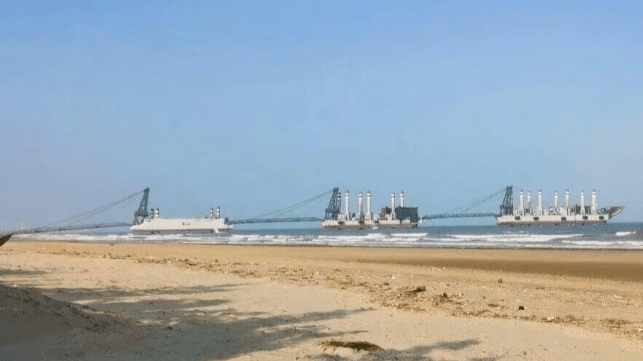
China's "invasion barges" may be even more capable than previously assumed, according to a new analysis published by the Wall Street Journal.
In January, multiple analysts (including H.I. Sutton) noticed a "matching set" of three unique vessels at Guangzhou Shipyard - all barges, all oddly equipped, and each one larger than the next. All three had jackup legs, a central open deck, and a giant hinged bridge section attached to the bow - long enough to span 400 feet when lowered. These vessels were quickly identified as amphibious logistics enablers, designed to bridge the surf zone and transfer high volumes of military cargo after a beachhead is secured.
The three barges were later spotted in a beach logistics exercise in Zhanjiang, China, and were photographed by satellite and by local bystanders. Social media images showed all three barges interconnected by their respective bridges, deployed in order of water depth capability - the smallest barge closest to shore, then the medium barge, then the largest barge with the longest jackup legs furthest out to sea. Linked together, they spanned a distance of more than 2,000 feet out into the water. All three were jacked up well above the waves, and appeared to be less affected by surface conditions than the fragile U.S. Navy/Army JLOTS system.
In a video review for the Wall Street Journal, former U.S. Navy officer and defense analyst Tom Shugart explained that the barges are even more concerning than they initially appear. A close inspection of their configuration - and of the activity conducted during the first exercise - suggests that they are designed to directly interface with up to five deep sea ro/ro ships at one time. The medium and large barges each have two fold-down platforms, which appear to provide an apron to receive the stern loading ramps of up to four typical ro/ro ferries. A civilian ro/ro ferry was spotted mooring alongside during the trial maneuvers, resting up against Yokohama fenders on the side of the middle barge.
The abundant ro/ro ramps are concerning, as China is widely expected to lean on its ro/ro ferry fleet to support an amphibious assault operation. At least one civilian ferry operator in the Gulf of Bohai trains for expeditionary military logistics.
The largest barge appears to be specially fitted to receive and offload another kind of ro/ro - the kind with a starboard quarter ramp, which is universally found on PCTCs. During the exercise, a diagonal-ramp ro/ro was indeed imaged alongside. The vast lane-meter capacity of a car carrier would be able to deliver hundreds of military vehicles per trip onto the jackup barge "pier," and all of this equipment could be driven down the line of barges and onto shore.
"To be able to deliver vehicles at huge volume straight to the beach - without having to capture a port - changes the calculus of whether China could successfully invade Taiwan," Shugart told the WSJ. "This could thin out Taiwan's defenses and make it harder to defend all the places [for an amphibious landing] that now exist."
China's Research Vessels Are Drawing Attention in Neighbors' Waters
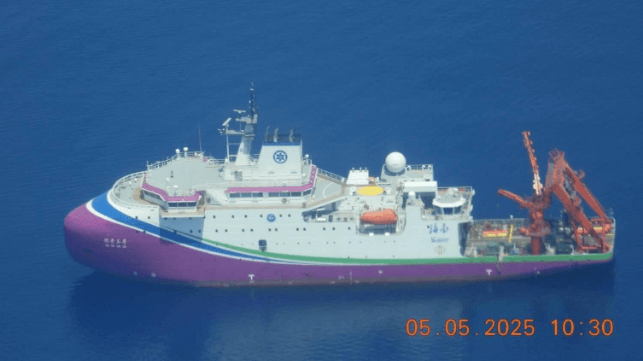
China's research vessels have been attracting attention in the waters of neighboring states, not least because of suspicions of spying. The latest encounter occurred in the Japanese EEZ, about 140 nautical miles, when a Japan Coast Guard cutter found a Chinese research vessel deploying a suspicious object and ordered it to leave.
The use of oceanographic research as a cover for espionage has a long and rich history, from the CIA's famous Glomar Explorer project to Russia's notorious spy ship Yantar. This gray-zone activity pattern extends across all of the world's leading naval powers, and China is no exception. As one example, China's Academy of Sciences has used its research vessels to place and service powerful acoustic seabed sensors near Guam, for the purpose of studying typhoons and whales; the research devices happened to be well-located for tracking U.S. Navy submarines, and are likely used for that purpose, multiple analysts have noted.
In this context, China's neighbors pay close attention to the movements of its civilian research fleet - especially in sensitive areas, like the Japanese-controlled Senkaku Islands. On Sunday morning at about 0630, the Japan Coast Guard spotted the research ship Hai Ke 001 lowering a "pipe-like" object into the water at a position about 140 miles north of Taisho Island. The Japan Coast Guard issued a radio call and ordered the Hai Ke 001 to cease its activity, and the Chinese vessel complied, departing the scene and returning to the Chinese side of the EEZ median line.
The Philippine Coast Guard has also closely followed the movements of China's research fleet, especially in the contested waters of the western Philippine EEZ. On May 5, the PCG cutter BRP Teresa Magbanua intercepted the Chinese research vessel Tan Suo 3 off Ilocos Norte, within the Philippine exclusive economic zone. The PCG radioed Tan Suo 3 and informed the crew that the Chinese vessel's operations were unlawful under the UN Convention on the Law of the Sea (UNCLOS gives the coastal state the right to regulate oceanographic research within its 200-mile EEZ). The Magbanua instructed Tan Suo 3 to get under way and remain in motion.
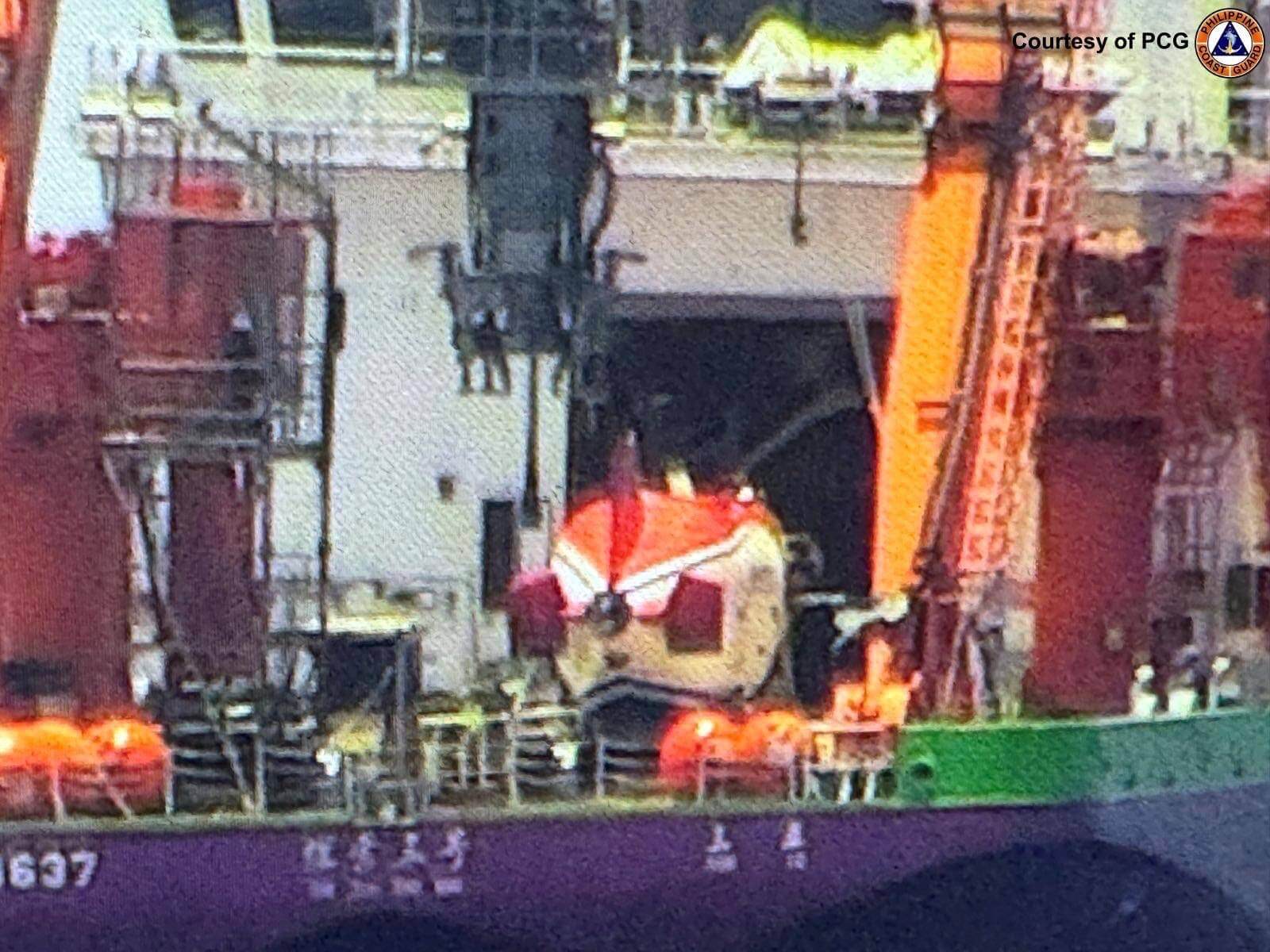
Deep Sea Warrior recovered aboard Tan Suo 3 (PCG)
During this conversation, the PCG spotted a submersible approaching Tan Suo 3. The sub was identified as the Deep Sea Warrior, a manned Chinese research sub with a maximum rated depth of 4,500 meters. An unidentified floating piece of equipment was also retrieved from the water by Tan Suo 3's crew.
"These actions [are] clear evidence that the People's Republic of China are conducting illegal marine scientific research activities within the Philippines' Exclusive Economic Zone, lacking the legal authority to undertake such activities in this area," said PCG spokesman Jay Tarriela in a statement.

No comments:
Post a Comment