It’s possible that I shall make an ass of myself. But in that case one can always get out of it with a little dialectic. I have, of course, so worded my proposition as to be right either way (K.Marx, Letter to F.Engels on the Indian Mutiny)
Friday, May 02, 2025
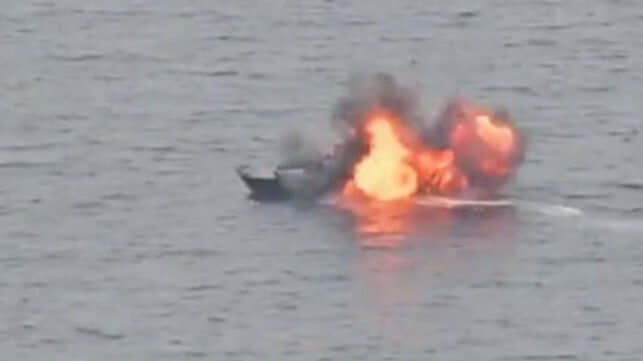
Video: French Navy Tests Weaponized Jet Ski Drone Attacking Vessel
The jet ski was weaponized and turned into a drone (French Navy)
The French Navy as part of an ongoing effort to develop new systems and defenses conducted a drone test using a modified jet ski carrying an offensive charge. The goal was to test the explosive force as well as the potential weaponization of drones.
Analysts point out that the Ukrainians have reported a high degree of success in their use of drones attacking Russian warships and other vessels in the Black Sea and ports. Other countries have also tested a broad range of drones while videos from the Houthi rebels in Yemen showed the devastating results from their unnamed drone boats launched against tankers and bulkers in the Red Sea.
The French test took place on April 26 off Toulon using a one-way attack unmanned surface vehicle based on a jet ski. The target was a decommissioned barge that was used to transport cargo. They placed metal reinforcement and tires against the hull of the vessel to increase the effectiveness of the test while attempting to prevent the vessel from sinking.
The video shows the drone boat traveling at high speed as it hones in on its target vessel. Multiple camera angles and sensors capture the moment of impact. The drone was launched from a French Navy offshore patrol vessel.
Since 2021, the French Navy has been conducting tests under its Polaris approach designed to improve training and stimulate new innovations. The approach seeks to conduct its tests in conditions as close as possible to actual operations.
Other tests in the program have included in December 2024 using a French nuclear submarine to fire a heavy torpedo at a retired navel vessel, which was sunk. They conducted shock tests on a frigate using a naval mine last February and in March tested offensive and defensive drones and drone systems in a full-scale amphibious operation.
Chinese Firm Launches High Speed, Submersible, Autonomous Research Boat
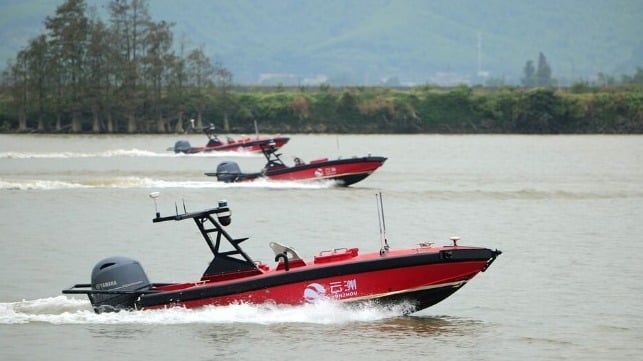
Manufacturer Yunzhou also makes swarming law-enforcement patrol boats, above (Yunzhou file image)
A Chinese autonomous tech company has launched what may be the world's fastest research vessel - the Blue Whale, a high speed unmanned craft with a unique set of features. Designed for typhoon research, this civilian vessel can loiter underwater for 30 days, launch "research rockets," and hit top speeds of about 36 knots - the speed needed to keep pace with most U.S. Navy warships.
The prototype Blue Whale was launched Monday at a pier in Zhuhai. It was funded by the National Natural Science Foundation of China in 2022 and built by a team from tech firm Yunzhou, a leading maker of unmanned vessels for Chinese security forces. Many of the company's other models are marketed for police and military applications and are capable of swarming behavior, interception and high-speed ramming.
The new research vessel is about 36 feet long, and weighs in at about 12 tonnes. Not only is it faster than perhaps any other research platform, but it is submersible, too: it can loiter up to 200 feet below the surface to escape a passing typhoon, and can stay down for 30 days - much longer than needed to wait out a storm. It can transit at up to four knots underwater, maintaining silence with magnetic fluid drives and special hydroacoustic coatings, according to SCMP.
"Through autonomous route planning and mission scheduling, it can position itself near typhoon paths to deploy rocket-powered meteorological sensors to gather critical oceanic and atmospheric data," Yunzhou head engineer Wu Guosong told the outlet.
It carries a multibeam sonar for bottom mapping, and Yunzhou says that Blue Whale has a modular payload architecture, so it could be readily adapted for new purposes.
"It not only provides us with an unprecedented tool for exploring the frontiers of science, but also provides a smart and efficient tool for serving national strategies," said Prof. Chen Dake, an American-educated scientist who heads the project for China's Second Institute of Oceanography.
After sea trials, the R&D team hopes to put the Blue Whale into operation next year.

No comments:
Post a Comment