SPACE/COSMOS
by Jeff Foust

PARIS — The European Space Agency is weighing options for programs affected by proposed major budget cuts at NASA as it also seeks to expand cooperation with other nations.
At a June 12 press briefing after a meeting of the ESA Council, agency officials said they had a “deep discussion” about the fiscal year 2026 budget proposal for NASA released May 30 that would, if enacted, affect science and exploration programs involving the two agencies, from Artemis to Earth science.
“We are impacted on quite of number of domains that, at least for the moment, are proposed for cancellations or reductions,” Josef Aschbacher, ESA director general, said. “We are doing our homework in analyzing what is the impact and what could be options and measures we could take in order to make sure that investments that have been made by our member states are utilized in the best possible way.”
That analysis includes potential actions ESA could take at its ministerial conference in late November, when member states will meet to agree on funding levels for the next three years. It is unlikely that a final 2026 spending bill for NASA will be completed by that meeting.
“We need to assess on one side how much does it cost to wait,” he said, “and how long can we wait, because there are decision points coming up on our side.”
The impacts of the NASA budget cut across ESA, illustrating the significant cooperation between the two agencies. The biggest is in exploration, with the budget proposing an end to the Orion spacecraft, to which ESA provides the service module, after Artemis 3, as well as canceling the lunar Gateway, Mars Sample Return (MSR) and NASA support for ESA’s Rosalind Franklin rover mission.
Work on those efforts is continuing currently, said Daniel Neuenschwander, director of human and robotic exploration at ESA. “Of course, we anticipate options,” he said, such as studying with industry potential, unspecified alternative uses for the Orion service module and the Earth Return Orbiter for MSR.
He said that ESA and its industrial partners are continuing work on the service module, or ESM, for Artemis 4, set for delivery this year. “We are studying with the industry consortium delivering the European service modules some alternative missions for ESM,” he said. “We will continue to deliver the ESM as long as they are needed.”
“We obviously have done our due diligence” analyzing the NASA budget proposal, said Carole Mundell, ESA director of science. She noted there are 19 space science missions ESA operates in cooperation with NASA, 16 of which can continue with “good planning” to mitigate any impacts of the NASA cuts.
Three missions, though, will require “recovery actions” by ESA: the EnVision mission to Venus, the LISA gravitational wave observatory and New Athena, an X-ray observatory. All three are in early stages of development, with ESA counting on significant NASA contributions to implement them.
“We value deeply the collaboration with NASA but we do have the technical capabilities in Europe today should it be necessary” to go it alone, she said.
In Earth observation, the NASA budget proposal would affect missions like Sentinel-6C, the third in a series of spacecraft jointly developed by NASA and ESA to study sea level rise. Simonetta Cheli, ESA’s director of Earth observation, said the agency was looking at potential options if NASA drops out of those missions, but noted ESA was still trying to understand the implications of the budget cuts on other collaboration with NASA.
Aschbacher said that ESA has maintained “close interactions” with NASA on the budget proposal, including briefings from NASA officials. “We have a very open and transparent working relationship,” he said.
Other international cooperation
ESA used the briefing to emphasize that it has a wide range of other international partnerships that could be expanded even if partnerships with NASA shrink.
“ESA is probably the agency that has the most international cooperation agreements,” he said, with more than 300 agreements among agencies large and small. “So we do have already a network, a very strong network, of international cooperation.”
“We are known as a reliable, trusted partner that has always delivered,” he said, “and we will continue to deliver on those promises.”
He said that includes looking for “reinforced partnerships” with countries to compensate for any reductions of cooperation with NASA. One example he gave was an agreement with the Indian space agency ISRO signed in May to cooperate on human spaceflight. That could lead, he said, to ESA astronauts visiting ISRO’s space station planned for the 2030s as one option for European astronauts after the retirement of the International Space Station.
He also noted cooperation with Canada. Aschbacher visited Canada earlier in the month, signing a joint statement reaffirming cooperation with Canada, who is a “cooperating state” of ESA. That was the first visit by an ESA director general to the Canadian Space Agency headquarters in 25 years.
“We got strengthened interest from Canada” to participate in ESA programs ahead of the November ministerial conference, he said, “stronger than in previous ministerials.”
There are limits to ESA’s expanded cooperation. Asked about China, he noted there are some small-scale activities with China in science, such as a joint space science mission called Smile scheduled to launch late this year. “Apart from that at the moment, we have not initiated new discussions with China, so this is at the moment not on our horizon.”
Blue Origin reveals passengers for 13th space tourism launch
By Mike Wall
published 2 days ago
The company has not yet announced a launch date for the NS-33 mission.
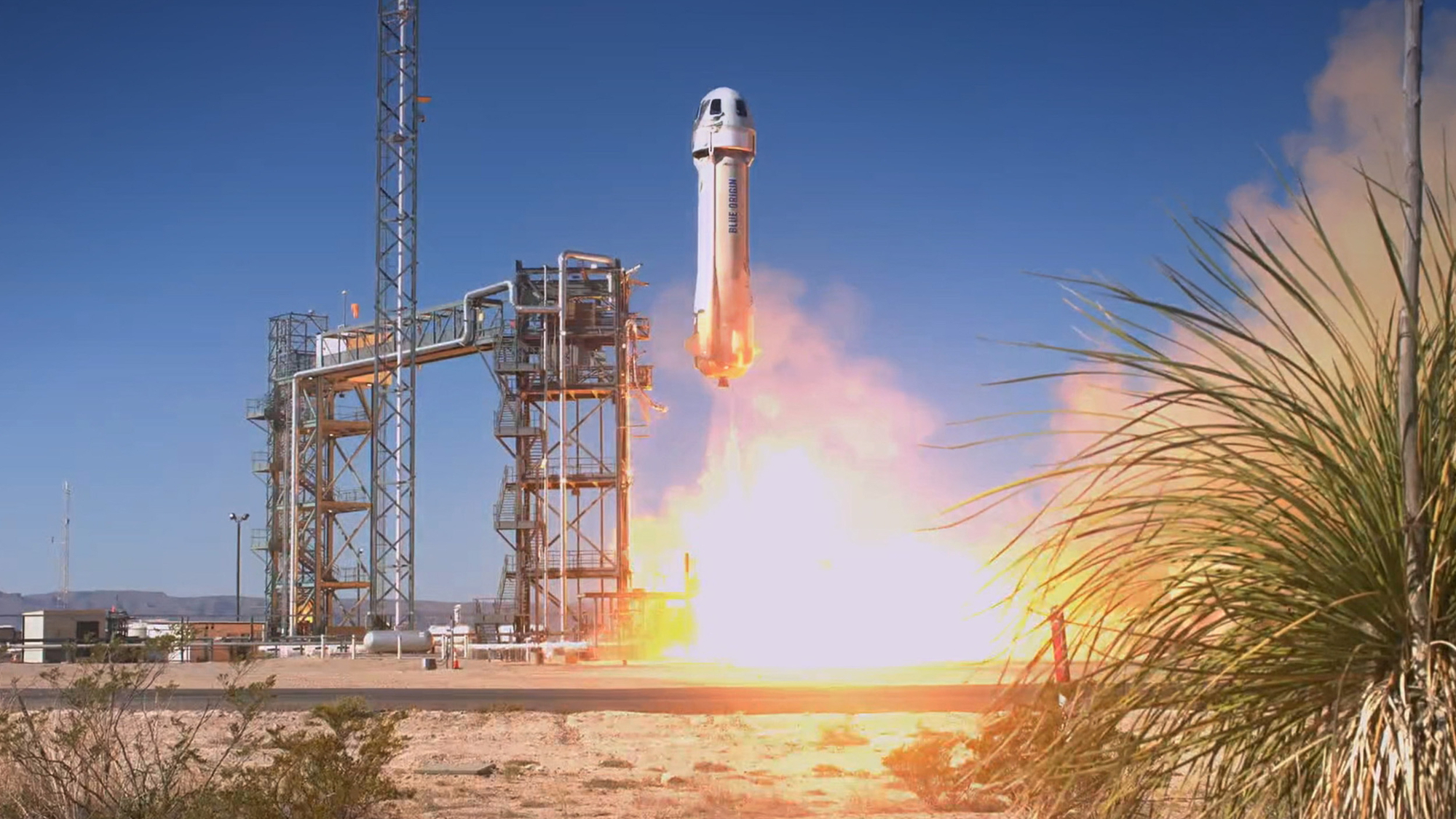
Jeff Bezos' Blue Origin has revealed who will fly on its next space tourism mission.
That six-passenger suborbital flight will lift off from the company's West Texas launch site, on a date that hasn't been announced yet.
The upcoming mission is known as NS-33, because it will be the 33rd overall launch of Blue Origin's reusable, autonomous New Shepard vehicle. It will be the company's 13th human spaceflight mission.

Here's a brief rundown of the six NS-33 passengers, using information provided by Blue Origin.
Allie Kuehner, an environmentalist, adventurer and explorer who serves on the board of the conservation nonprofit Nature is Nonpartisan.
Carl Kuehner, Allie's husband and a conservationist as well. He serves as chairman of Building and Land Technology, a real estate firm "dedicated to building communities and ecosystems that promote long-term growth and sustainability," according to Blue Origin.
Leland Larson, a philanthropist, gardener and beekeeper who previously led School Bus Services, Inc. and Larson Transportation Services, both of them family-owned Oregon businesses.
Freddie Rescigno, Jr., the founder, president and CEO of the wire and cable company Commodity Cables. He's also a competitive golfer.
Owolabi Salis, a financial consultant and lawyer who wrote the book "Equitocracy." Salis "is also a key member of The Soul Maker Ministry, which preaches diversity given the diverse nature of the universe," Blue Origin wrote. "He is dedicating this mission to victims of discrimination and civil rights violations."
Jim Sitkin, a retired attorney and lifelong adventurer who currently volunteers for a non-governmental organization that works with government and community leaders in Central Europe and sub-Saharan Africa.
New Shepard flights last 10 to 12 minutes from liftoff to the touchdown of the vehicle's crew capsule. (New Shepard's first-stage booster also comes back to Earth for a safe landing and eventual reuse).
During this brief time, New Shepard passengers get to experience a few minutes of weightlessness and see the curve of Earth against the blackness of space.
Blue Origin's first crewed mission was in July 2021, a flight that included Bezos and his brother Mark. NS-33 will be the company's fourth human spaceflight of 2025.
James Webb Space Telescope Has Spotted Something “Abnormal, Chaotic, and Strange” 60 Light-Years from Earth

Artist's impression of 14 Herculis c (Credit: Exoplanetedu95/CC 3.0)
Astronomers have observed a planetary system 60 light-years from Earth that has been characterized as “abnormal, chaotic, and strange” with the help of NASA’s James Webb Space Telescope (JWST).
The JWST’s sensitive Near-Infrared Camera, or NIRCam, imaged one of two planets known to encircle the star 14 Herculis, which is located in a distant part of the Milky Way Galaxy.
One of the most frigid ever observed, the newly spotted exoplanet stands out among the thousands currently known to astronomers, most of which are extremely hot by comparison. Dubbed 14 Herculis c, the frozen world is estimated to be close to 7 times the weight of Jupiter.
A Frozen World
William Balmer, a graduate student at Johns Hopkins University and co-first author on a new paper describing the discovery, says that colder exoplanets are among the hardest to spot in astronomical imagery, adding that “this is a totally new regime of study that Webb has unlocked with its extreme sensitivity in the infrared.”
“We are now able to add to the catalog of not just hot, young exoplanets imaged, but older exoplanets that are far colder than we’ve directly seen before Webb,” Balmer adds.
The new Webb data reveal that the planetary system in which 14 Herculis c resides is unusual compared to most others, although it possesses a Sun-like central star. However, the two planets in this unique system don’t orbit the host star as planets in our solar system do, instead crossing in an “X” formation with their star at the center, each tugging and pulling at the other as they pass through their orbit.

The peculiar misalignment is the first known to have been captured in images by astronomers. A range of theories have been proposed to account for how this planetary system is so bizarre in appearance. One possibility is that a third planet might have once cohabited with the two existing exoplanets, but somehow became ejected early in the system’s formation.
Investigating “A Planetary Crime Scene”
“The early evolution of our own solar system was dominated by the movement and pull of our own gas giants,” Balmer said in a recent statement, adding that asteroids were often ejected as such colossal forces rearranged the orientation of planets.
“Here, we are seeing the aftermath of a more violent planetary crime scene,” Balmer said. “It reminds us that something similar could have happened to our own solar system, and that the outcomes for small planets like Earth are often dictated by much larger forces.”
Fortunately, the new data supplied by JWST offers new insights into the peculiar exoplanet’s temperature, atmosphere, and orbit. It is located 1.4 billion miles from its host star in an extremely elongated elliptical orbit, which is close to 15 times the distance between Earth and the Sun.
Additional data obtained by the JWST’s coronagraph instrument helped determine the planet’s brightness, which measures at around 4.4 microns. This, in turn, points to unique activities occurring in 14 Herculis c’s atmosphere.
Daniella C. Bardalez Gagliuffi, the new paper’s co-first author, says that this indicates the planet likely cooled over the roughly 4 billion years since it formed, since there isn’t any nearby energy source to warm it. Because of this, astronomers can also predict what its temperature would likely be today.
“Added information, like the perceived brightness in direct imaging, would in theory support this estimate of the planet’s temperature,” Gagliuffi said in a statement.
A Planetary System with Unusual Properties
Still, 14 Herculis c has some additional peculiarities, including why the planet’s brightness is fainter than what astronomers would expect for an object of its age and overall mass. One possibility for this apparent discrepancy may involve carbon disequilibrium chemistry, a phenomenon mostly observed in stars like brown dwarfs.
Gagliuffi says that given the frigid temperature of 14 Herculis c, it compares best to past observations of brown dwarf stars.
“In those objects, like with 14 Herculis c, we see carbon dioxide and carbon monoxide existing at temperatures where we should see methane,” Gagliuffi said.
“This is explained by churning in the atmosphere,” Gagliuffi adds. “Molecules made at warmer temperatures in the lower atmosphere are brought to the cold, upper atmosphere very quickly.”
Going forward, the team hopes that further investigations into the unusual aspects of this strange planetary system will be revealed through future spectroscopic studies, along with other data that can be obtained with the help of JWST’s advanced instrumentation.
The team’s new paper has been accepted for publication in The Astrophysical Journal Letters and was recently presented at the 246th meeting of the American Astronomical Society in Anchorage, Alaska.
Micah Hanks is the Editor-in-Chief and Co-Founder of The Debrief. He can be reached by email at micah@thedebrief.org. Follow his work at micahhanks.com and on X: @MicahHanks.
JWST Coronagraphic Images of 14 Her c: a Cold Giant Planet in a Dynamically Hot, Multi-planet System

Most observed multi-planet systems are coplanar, in a dynamically “cold” configuration of concentric orbits like our own Solar System.
With the James Webb Space Telescope (JWST) we have detected 14 Her c, the first mature and cold exoplanet directly imaged in a dynamically “hot”, multi-planet system.
With large eccentricities and a nonzero mutual inclination, the present-day architecture of this system points to a turbulent past and ongoing angular momentum exchange between the planetary orbits of 14 Her b and c. The temperature of 14 Her c rivals both the coldest imaged exoplanet and the coldest known brown dwarf.
Moreover, its photometry at 4.4 mu is consistent with the presence of carbon disequilibrium chemistry and water ice clouds in its atmosphere. 14 Her c presents a unique laboratory to study giant planet formation, dynamical evolution of multi-planet system architectures, and atmospheric composition and dynamics in extremely cold worlds.

Sky projection of the architecture of the 14 Her system. The visual orbits for both planets, colored according to the time after the reference epoch 2020.0, MJD=58849.0. The new NIRCam relative astrometry of 14 Her c strongly constrains the relative orientation of the two planets’ possible orbital planes. — astro-ph.EP
Daniella C. Bardalez Gagliuffi, William O. Balmer, Laurent Pueyo, Timothy D. Brandt, Mark R. Giovinazzi, Sarah Millholland, Brennen Black, Tiger Lu, Malena Rice, James Mang, Caroline Morley, Brianna Lacy, Julien Girard, Elisabeth Matthews, Aarynn Carter, Brendan P. Bowler, Jacqueline K. Faherty, Clemence Fontanive, Emily Rickman
Comments: 25 pages, 10 figures
Subjects: Earth and Planetary Astrophysics (astro-ph.EP); Solar and Stellar Astrophysics (astro-ph.SR)
Cite as: arXiv:2506.09201 [astro-ph.EP] (or arXiv:2506.09201v1 [astro-ph.EP] for this version)
https://doi.org/10.48550/arXiv.2506.09201
Focus to learn more
Submission history
From: Daniella Bardalez Gagliuffi PhD
[v1] Tue, 10 Jun 2025 19:42:42 UTC (2,048 KB)
https://arxiv.org/abs/2506.09201
Missing link star? Why this 'teenage vampire' white dwarf has scientists so excited
By Robert Lea
Astronomers have discovered a "teenage vampire" dead star in the process of devouring a companion star during a short-lived, "missing link" phase of its evolution.
 Inset: an illustration of a white dwarf. Main top: Gaia22ayj seen in X-rays and visible light. Main bottom: images of Gaia22ayj taken by the Zwicky Transient Facility. (Image credit: ZTF/Caltech Optical Observatories/A. Rodriguez/ wift/XRT/NASA PanSTARRS/Univ. of Hawaii.)
Astronomers have discovered the "missing link" connecting the death of sunlike stars to the birth of white dwarf stellar remnants, in the form of a "teenage vampire" white dwarf.
This vampire isn't interested in the blood that runs through your veins, though. The white dwarf in question, designated Gaia22ayj and located around 8,150 light-years from Earth, is ravenously feeding on stellar plasma from a companion star.
The team that made this discovery observed the white dwarf using the Zwicky Transient Facility (ZTF) at the Palomar Observatory in California. The researchers scanned the night sky over the Northern Hemisphere, hunting "transients" — astronomical bodies undergoing rapid change.
However, this theory didn't quite match further observations of Gaia22ayj, which revealed it to be one of the most extreme pulsating objects ever seen, increasing in brightness by 700% over just a 2-minute span.
That's because Gaia22ayj is actually a white dwarf feeding on a companion star, with this binary in a rare and short-lived phase of its life (or should that be death).

Know your dead stars
Stars die after they use up the fuel needed for nuclear fusion. What kind of death, and afterlife, they experience depends on their mass.
Sign up for the Live Science daily newsletter now
Get the world’s most fascinating discoveries delivered straight to your inbox.Contact me with news and offers from other Future brandsReceive email from us on behalf of our trusted partners or sponsorsBy submitting your information you agree to the Terms & Conditions and Privacy Policy and are aged 16 or over.
Stars with masses above eight times that of the sun die in violent supernova explosions and then become either highly dense neutron stars or black holes. Stars with masses closer to that of the sun don't "go nova," instead undergoing more muted transformations into white dwarfs.
Our own sun will experience this latter transformation in around six billion years after shedding most of its mass during a swollen red giant phase, eventually sputtering out as a smoldering stellar ember.
However, around half of all stars with masses similar to that of the sun have a binary companion star. And, if their companion stars get too close, white dwarfs can get a second burst of life by stripping them of stellar material. That vampiric mass transfer process is exactly what seems to be happening between the white dwarf of Gaia22ayj and its companion star.

Gaia22ayj initially confused astronomers. The way that its light intensity varied over time — its light curve— made no sense for a detached double white dwarf binary.
This led Tony Rodriguez, a graduate student in the California Institute of Technology's ZTF Stellar Group, to question why the light curve would take the shape it did. Gathering more data, Rodriguez and colleagues realized that Gaia22ayj is likely a white dwarf orbited by a "normal" low-mass star, not a second white dwarf. And they further determined that Gaia22ayj is highly magnetic, with its white dwarf component spinning at a rapid rate.
This reminded them of a white dwarf pulsar, a highly magnetic dead star that sweeps electromagnetic radiation across the universe as it spins, like a cosmic lighthouse. However, the vampiric feeding process found in Gaia22ayj isn't something usually associated with white dwarf pulsars.

The team eventually concluded that Gaia22ayj is a missing link in the life cycle of white dwarf pulsars, a rare and short-lived early phase of these objects.
"We have already seen two infant systems, white dwarf stars in a binary system whose rapid spin builds up a strong magnetic field. And we had seen lots of adult star systems where the white dwarf star was spinning very slowly," Rodriguez said in a statement.
"But this was the first star we've seen that is right in the middle of its 'teenage' phase, when it has already established a strong magnetic field and is just beginning to funnel matter from the companion star onto itself," he added. "We have never before caught a system in the act of spinning so rapidly but also slowing down dramatically, all while gaining mass from its companion."
This discovery is even more exciting because this phase lasts for just around 40 million years. That might sound like an incredibly long period of time, but it's relatively short when considering that stars like the sun live for around 10 billion years before they even transform into white dwarfs. Thus, this "teenage phase" accounts for just 0.4% of a star's lifetime. For context, if the star were an average human, this teenage phase would last just around 107 days.
Hardly enough time to paint your bedroom black.
"The data taken at the W. M. Keck Observatory provided firm evidence that this system had a strong magnetic field and was funneling matter onto the white dwarf," Rodriguez said. "Additional data from the unique instruments available at Palomar Observatory showed that this system is, remarkably, slowing down."
The team's research was published in February in the journal Publications of the Astronomical Society of the Pacific.
This article was originally published on Space.com.

Robert Lea is a science journalist in the U.K. who specializes in science, space, physics, astronomy, astrophysics, cosmology, quantum mechanics and technology. Rob's articles have been published in Physics World, New Scientist, Astronomy Magazine, All About Space and ZME Science. He also writes about science communication for Elsevier and the European Journal of Physics. Rob holds a bachelor of science degree in physics and astronomy from the U.K.’s Open University
The test conducted on Saturday in collaboration with Thrust Tech India Limited saw the rocket ascend 1.1 km at 5:14:33 p.m., a complete success
Published - June 15, 2025
PTI
Space agency ISRO successfully conducted a rocket launching test here, marking the first time a payload was launched via a rocket from the soil of Uttar Pradesh, officials said.
The test conducted on Saturday in collaboration with Thrust Tech India Limited saw the rocket ascend 1.1 km at 5:14:33 p.m., a complete success.
Indian Space Research Organisation (ISRO) scientist Abhishek Singh said, "The rocket was launched at 5:14 p.m. and 33 seconds, which went up to a height of 1.1 km. After this, a small satellite (payload) came out. As soon as it fell down to 5 metres, its parachute activated and the satellite landed within 400 metres on the ground." The 15 kg rocket also descended safely.
This test was a prelude to a larger event in October-November, where around 900 youth-built satellites will be tested.
Vinod Kumar, Director of Thrust Tech India, confirmed the company's motor test success.
"This event is being organised to generate interest in space technology among children across the region and the whole of India," he said.
Unlike previous tests in Ahmedabad using drones, this was the first time a satellite was directly launched by a rocket in U.P., proving entirely successful, Mr. Singh said.
Published - June 15, 2025
NASA Teams Up With India to Launch First-of-Its-Kind $1.5 Billion Satellite

In a few days, a new satellite that can detect changes on Earth's surface down to the centimetre, in almost real time and no matter the time of day or weather conditions, is set to launch from India's Satish Dhawan Space Centre near Chennai.
Weighing almost 3 tonnes and boasting a 12-metre radar antenna, the US$1.5 billion NISAR satellite will track the ground under our feet and the water that flows over and through it in unprecedented detail, providing valuable information for farmers, climate scientists and natural disaster response teams.
Only when the conditions are right
Satellites that image the Earth have been an invaluable scientific tool for decades. They have provided crucial data across many applications, such as weather forecasting and emergency response planning. They have also helped scientists track long-term changes in Earth's ecosystems and climate.
Many of these Earth observation satellites require reflected sunlight to capture images of Earth's surface. This means they can only capture images during daytime and when there is no cloud cover.
As a result, these satellites face challenges wherever cloud cover is very common, such as in tropical regions, or when nighttime imagery is required.
The NISAR satellite – a collaboration between the national space agencies of the United States (NASA) and India (ISRO) – overcomes these challenges by using synthetic aperture radar (SAR) technology to take images of the Earth. This technology also gives the satellite its name. NISAR stands for NASA-ISRO SAR.
So what is SAR technology?
SAR technology was invented in 1951 for military use. Rather than using reflected sunlight to passively image the Earth's surface, SAR satellites work by actively beaming a radar signal toward the surface and detecting the reflected signal. Think of this as like using a flash to take a photo in a dark room.
This means SAR satellites can take images of the Earth's surface both during the day and night.
Since radar signals pass through most cloud and smoke unhindered, SAR satellites can also image the Earth's surface even when it is covered by clouds, smoke or ash. This is especially valuable during natural disasters such as floods, bushfires or volcanic eruptions.
Radar signals can also penetrate through certain structures such as thick vegetation. They are useful for detecting the presence of water due to the way that water affects reflected radar signals.
The European Space Agency used the vegetation-penetrating properties of SAR signals in its recent Biomass mission. This can image the 3D structure of forests. It can also produce highly accurate measurements of the amount of biomass and carbon stored in Earth's forests.
Sang-Ho Yun, Director of the Earth Observatory of Singapore's Remote Sensing Lab, is a key proponent of using SAR for disaster management. Yun has previously used SAR data to map disaster-affected areas across hundreds of natural disasters over the last 15 years, including earthquakes, floods and typhoons.
NISAR, which is due to launch on June 18, will significantly build on this earlier work.

Monitoring Earth's many ecosystems
The NISAR satellite has been in development for over a decade and is one of the most expensive Earth-imaging satellites ever built.
Data from the satellite will be supplied freely and openly worldwide. It will provide high-resolution images of almost all land and ice surfaces around the globe twice every 12 days.
This is similar in scope to the European Space Agency's Sentinel-1 SAR satellites. However, NISAR will be the first SAR satellite to use two complementary radar frequencies rather than one, and will be capable of producing higher resolution imagery compared with the Sentinel-1 satellites. It will also have greater coverage of Antarctica than Sentinel-1 and will use radar frequencies that penetrate further into vegetation.
The NISAR satellite will be used to monitor forest biomass. Its ability to simultaneously penetrate vegetation and detect water will also allow it to accurately map flooded vegetation.
This is important for gaining a deeper understanding of Earth's wetlands, which are important ecosystems with high levels of biodiversity and massive carbon storage capacity.
The satellite will also be able to detect changes in the height of Earth's surface of a few centimetres or even millimetres, because changes in height create tiny shifts in the reflected radar signal.
The NISAR satellite will use this technique to track subsidence of dams and map groundwater levels (since subsurface water affects the height of the Earth's surface). It will also use the same technique to map land movement and damage from earthquakes, landslides and volcanic activity.
Such maps can help disaster response teams to better understand the damage that has occurred in disaster areas and to plan their response.
Improving agriculture
The NISAR satellite will also be useful for agricultural applications, with a unique capability to estimate moisture levels in soil with high resolution in all weather conditions.
This is valuable for agricultural applications because such data can be used to determine when to irrigate to ensure healthy vegetation, and to potentially improve water use efficiency and crop yields.
Further key applications of the NISAR mission will include tracking the flow of Earth's ice sheets and glaciers, monitoring coastal erosion and tracking oil spills.
We can expect to see many benefits for science and society to come from this highly ambitious satellite mission.
Steve Petrie, Earth Observation Researcher, Swinburne University of Technology
This article is republished from The Conversation under a Creative Commons license. Read the original article.
China Focus: China launches satellite for
natural disaster monitoring
Source: Xinhua
Editor: huaxia
2025-06-14 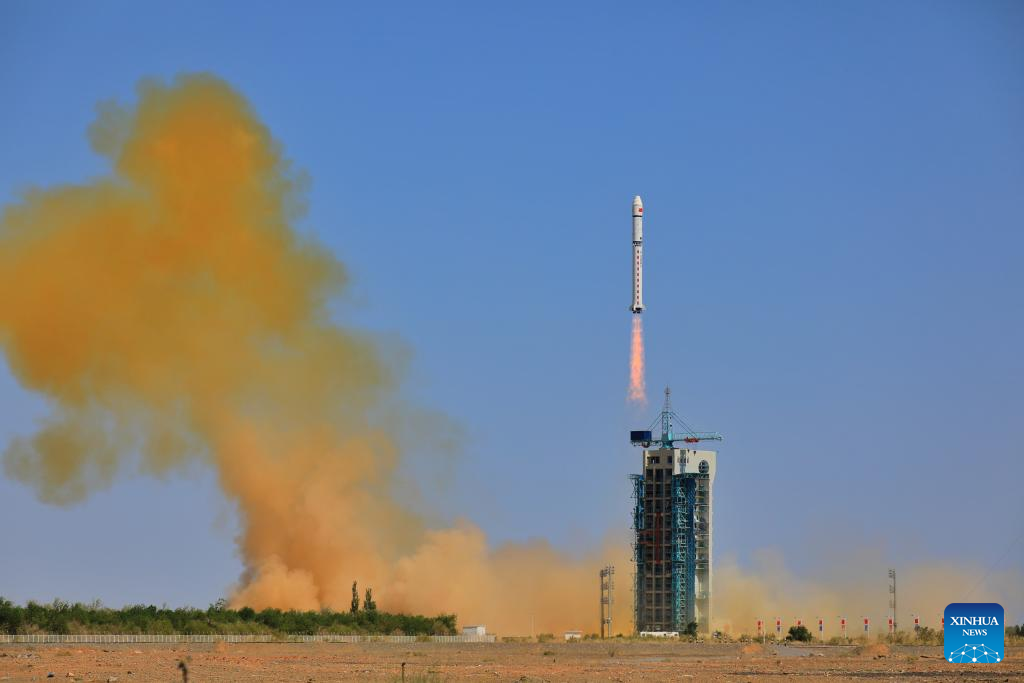
A Long March-2D carrier rocket carrying Zhangheng 1-02 satellite, an electromagnetic monitoring satellite jointly developed by China and Italy, blasts off from the Jiuquan Satellite Launch Center in northwest China on June 14, 2025. The rocket lifted off at 3:56 p.m. (Beijing Time), successfully sending the satellite into its planned orbit, according to the China National Space Administration (CNSA). (Jiuquan Satellite Launch Center/Handout via Xinhua)
JIUQUAN, June 14 (Xinhua) -- China launched an electromagnetic monitoring satellite on Saturday, which is expected to enhance the country's "space-air-ground" integrated monitoring capabilities for major natural disasters.
A Long March-2D carrier rocket lifted off from the Jiuquan Satellite Launch Center in northwest China at 3:56 p.m. (Beijing Time), successfully sending the Zhangheng 1-02 satellite into its planned orbit, according to the China National Space Administration (CNSA).
The CNSA said that this marks a significant step forward for China in the field of space-based observation of the Earth's physical fields.
Named after the ancient Chinese inventor Zhang Heng, who created the world's first seismoscope over 1,800 years ago, the satellite was jointly developed by China and Italy. It is the first operational satellite dedicated to exploring the Earth's physical fields under China's medium and long-term civil space infrastructure development plan, according to the CNSA.
With a designed lifespan of six years, the satellite is equipped with nine payloads, including an electric field detector co-developed by China and Italy, as well as a high-energy particle detector developed by Italy.
It will carry out quasi-real-time monitoring of global electromagnetic fields, electromagnetic waves, the ionosphere and the neutral atmosphere, detecting electromagnetic anomalies caused by geological and human activities, as well as monitoring thunderstorm and lightning activity, according to CNSA.
"Scientists will use these data to study the correlation between changes in the Earth's physical fields and geological activities, and to support research on the prediction of earthquakes, tsunamis, volcanic eruptions, extreme weather, and space weather disasters," said Peng Wei, deputy director of the system engineering department of the CNSA.
The satellite will significantly enhance China's early perception, risk assessment, and monitoring and early warning capabilities for major natural disasters, Peng added.
It will also provide data support for emergency management, resource mapping, and communications and navigation industries, while fostering scientific and technological cooperation in related fields among countries and regions along the Belt and Road.
The Zhangheng 1-01 satellite, launched in 2018, remains in normal operation, while the new satellite has richer physical measurements. Working in tandem, the two satellites will conduct collaborative observations, effectively improving the horizontal spatial and temporal resolution of observations, according to Peng.
China and Italy have further deepened practical cooperation in satellite payload development, data sharing, and scientific research, said Peng.
"The successful launch of this satellite marks another milestone in Sino-Italian aerospace collaboration, demonstrating closer scientific cooperation and exchanges between the two sides. It will also contribute to the well-being of the human community with a shared future," he added.
Francesco Longo, deputy director of engineering and technology of the Italian Space Agency, called the mission an important milestone. "We have a lot of expectations on the results that we acquire from this important Chinese-Italian mission."
He noted that, like China, Italy is a beautiful yet fragile country, prone to volcanoes, earthquakes and other events that can affect people's lives. This mission, he said, will contribute to protecting and improving lives impacted by natural disasters.
Longo also noted that adding this new satellite to the first, and eventually building a constellation, will double observation time, significantly boosting scientific prospects.
The Italian team named the project Limadou, the pinyin transliteration of the Chinese name for the 16th-century Italian priest Matteo Ricci, in honor of his pivotal contributions to cultural exchanges between the East and the West.
Both Marco Polo and Matteo Ricci served as bridges between Italian and Chinese cultures, and space, too, has the potential to unite all countries, Longo said.
Saturday's launch marked the 581st mission of China's Long March rocket series. ■
A Long March-2D carrier rocket carrying Zhangheng 1-02 satellite, an electromagnetic monitoring satellite jointly developed by China and Italy, blasts off from the Jiuquan Satellite Launch Center in northwest China on June 14, 2025. The rocket lifted off at 3:56 p.m. (Beijing Time), successfully sending the satellite into its planned orbit, according to the China National Space Administration (CNSA). (Jiuquan Satellite Launch Center/Handout via Xinhua)
Volcano Found Hiding 'In Plain Sight' Right Next to NASA Mars Rover

Sometimes, it's really hard to see the volcanoes for the rocks, especially if you're just a one-ton rover all alone in a remote crater on Mars.
Nevertheless, a bump on the rim of Jezero Crater is indeed a volcano, scientists have ruled – and the finding, thanks to NASA's Perseverance rover, has really exciting implications.
"Volcanism on Mars is intriguing for a number of reasons – from the implications it has on habitability, to better constraining the geologic history," says planetary scientist James Wray from the Georgia Institute of Technology.
"Jezero Crater is one of the best studied sites on Mars. If we are just now identifying a volcano here, imagine how many more could be on Mars. Volcanoes may be even more widespread across Mars than we thought."

Wray noticed the mountain, called Jezero Mons, back in 2007, but there wasn't enough evidence to support the interpretation that it was a volcano. Then Perseverance started finding volcanic rocks on the crater floor. Suspicions grew that Jezero Mons may have burst upward from Mars' molten interior.
To confirm speculations, a team led by planetary scientist Sara Cuevas-Quiñones of Georgia Tech decided to conduct a thorough investigation, looking for known characteristics of volcanoes here on Earth.
"We used data from the Mars Odyssey Orbiter, Mars Reconnaissance Orbiter, ExoMars Trace Gas Orbiter, and Perseverance Rover, all in combination to puzzle this out," Wray explains.
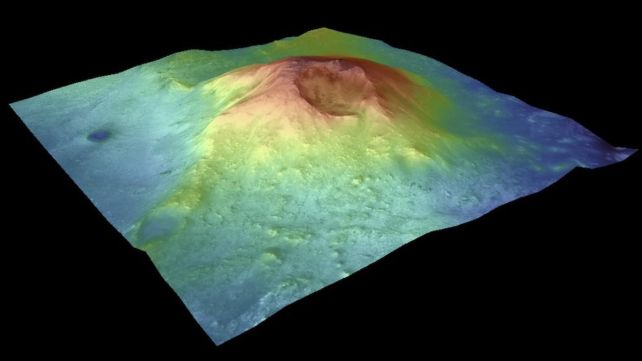
Their verdict? Jezero Mons is volcanic. It even has a volcanic crater. It's not active now, and likely hasn't been for a very long time, but this identification will make Perseverance's findings easier to interpret.
There's another interesting takeaway: Jezero Crater was once a lake. If it was sitting right next to a steaming pile of active volcano, the conditions may have been warm enough in the lake for life.
"The coalescence of these two types of systems makes Jezero more interesting than ever," Wray says. "We have samples of incredible sedimentary rocks that could be from a habitable region alongside igneous rocks with important scientific value."
The findings are published in Communications Earth & Environment.
"Greening Mars could be viewed as the ultimate environmental restoration challenge."

Image by Getty
Jun 14, 2025
But how would we even begin to pull off such a monumental feat of engineering? You can basically boil it down to three simple steps, argue the authors of a recent study published in the journal Nature Astronomy, who are encouraged by recent breakthroughs in several fields.
"Thirty years ago, terraforming Mars wasn't just hard — it was impossible," lead author Erika DeBenedictis, CEO of Pioneer Labs, told Space.com. "But new technology like Starship and synthetic biology have now made it a real possibility."
The inclusion of Starship, the Elon-Musk owned SpaceX megarocket, may warrant some pushback, since it's faced several high-profile failures and is likely far from being completed. But the fact that a spacecraft of its scale is even being attempted at all is at least worth something.
Alright, but assuming we can make the trip to the Red Planet, how do we turn it into something approaching a green one?
Recent advances in Mars science suggest that the planet's vast stores of ice harbor enough water to form an ocean around 1,000 feet deep across 3,800,000 million square miles of the planet. And according to the study, these frigid seas-in-waiting could start melting with a temperature increase of at least 30 degrees Celsius. (There also appears to be subterranean oceans hidden beneath the surface.)
So that's the first step. One way this could be achieved is by harnessing solar sails as mirrors to focus more light on the planet. This could be combined with dispersing aerosols in the atmosphere to accelerate the greenhouse effect, while techniques such as coating the Martian surface with particles called silica aerogels could help drive heating locally. Combined, the researchers estimated that the 30 degrees of warming could be achieved within the century.
The next step involves getting a little help from tiny, anaerobic creatures that can survive the harshest environments: extremophiles. To serve as "pioneer species," we would likely have to genetically engineer these organisms so they can withstand Mars' low pressure and its cold temperatures, which swing wildly. As the planet's ancient water is liberated from its icy tombs, the first surfaces bodies of water will be extremely salty brines, which many microbes on Earth are capable of surviving, the authors write. Once these microbial critters take hold, they'd go to work reforming the planet's chemistry and laying the groundwork for a food-producing ecosystem.
The final phase, however, is both the longest and most ambitious: shoring up the Martian atmosphere so that it can support diverse plant life and other organisms. To pull it off, terraformers would need to create at least a 100 millibar oxygen atmosphere, the authors write, or about a tenth of the Earth's average atmosphere at sea level.
We could initially achieve this in large, 100-meter-tall domed habitats, they speculate. Outside of these habitats, the spread of plant life would passively contribute oxygen to the atmosphere — but this process on its own would take a millennium. We could artificially accelerate this, write the authors, by freeing oxygen from the melted water, but more research is needed to determine if the materials necessary to accomplish that are abundant on Mars so that they wouldn't be required to be imported from Earth in prohibitively large quantities.
"We now know that Mars was habitable in the past, from data returned by the Mars rovers, so greening Mars could be viewed as the ultimate environmental restoration challenge," coauthor Edwin Kite, an associate professor at the University of Chicago, told Space.com.
As tempting as it would be for humanity to rise to the challenge, there are serious ethical and scientific questions to be raised about terraforming an entire planet, especially one that may have harbored life in the past, or perhaps still does.
"If we decide to terraform Mars, then we will really change it in ways that may or may not be reversible," coauthor Nina Lanza, a planetary scientist at Los Alamos National Laboratory, told Space.com. "Mars is its own planet and has its own history. When we terraform, then we effectively don't have the opportunity to study that anymore, and we may lose knowledge about how planets form and evolve."
Of course, this remains speculative — it's serious speculation, but speculation all the same. For all the promising advances we've made, we still haven't proven we can send a tiny payload of samples back from Mars, or even demonstrate that our putative best shot of getting there, Starship, is spaceworthy. But, as they say: all in good time.
More on Mars:
A Future Habitation Location On Mars?

Pit on Mars – NASA
ID: ESP_063262_1755
date: 24 January 2020
altitude: 258 km
https://uahirise.org/hipod/ESP_063262_1755
NASA/JPL-Caltech/University of Arizona
Editor’s note: On Earth pits – large caves – usually formed as chambers inside of limestone due to water erosion and collapses – can host some amazing ecosystems with their own microclimates. On the Moon similar structures have been found and are cited as possible places to build human habitations due to the shielding they can offer from radiation and meteorites. They are also found on Mars and are also seen as being sites for human habitats.
This observation was meant to examine a pit identified in a Context Camera image to see if HiRISE could resolve any details inside.
In this cutout, we see the “normal” view of the HiRISE image on the left, while the right shows what happens when we try to “enhance” the brightness of the pixels in the pit.
Fortunately, HiRISE is sensitive enough to actually see things in this otherwise dark pit. Since HiRISE turned by almost 30 degrees to capture this image, we can see the rough eastern wall of the pit.
The floor of the pit appears to be smooth sand and slopes down to the southeast. The hope was to determine if this was an isolated pit, or if it was a skylight into a tunnel, much like skylights in the lava tubes of Hawai’i.
We can’t obviously see any tunnels in the visible walls, but they could be in the other walls that aren’t visible.
Astrobiology, Mars
Space humbles the SEAL-doctor-astronaut On the ISS this week June 9-13, 2025
By Robert Z. Pearlman
A look back at the week's activities for the Expedition 73 crew.
Orbital observation
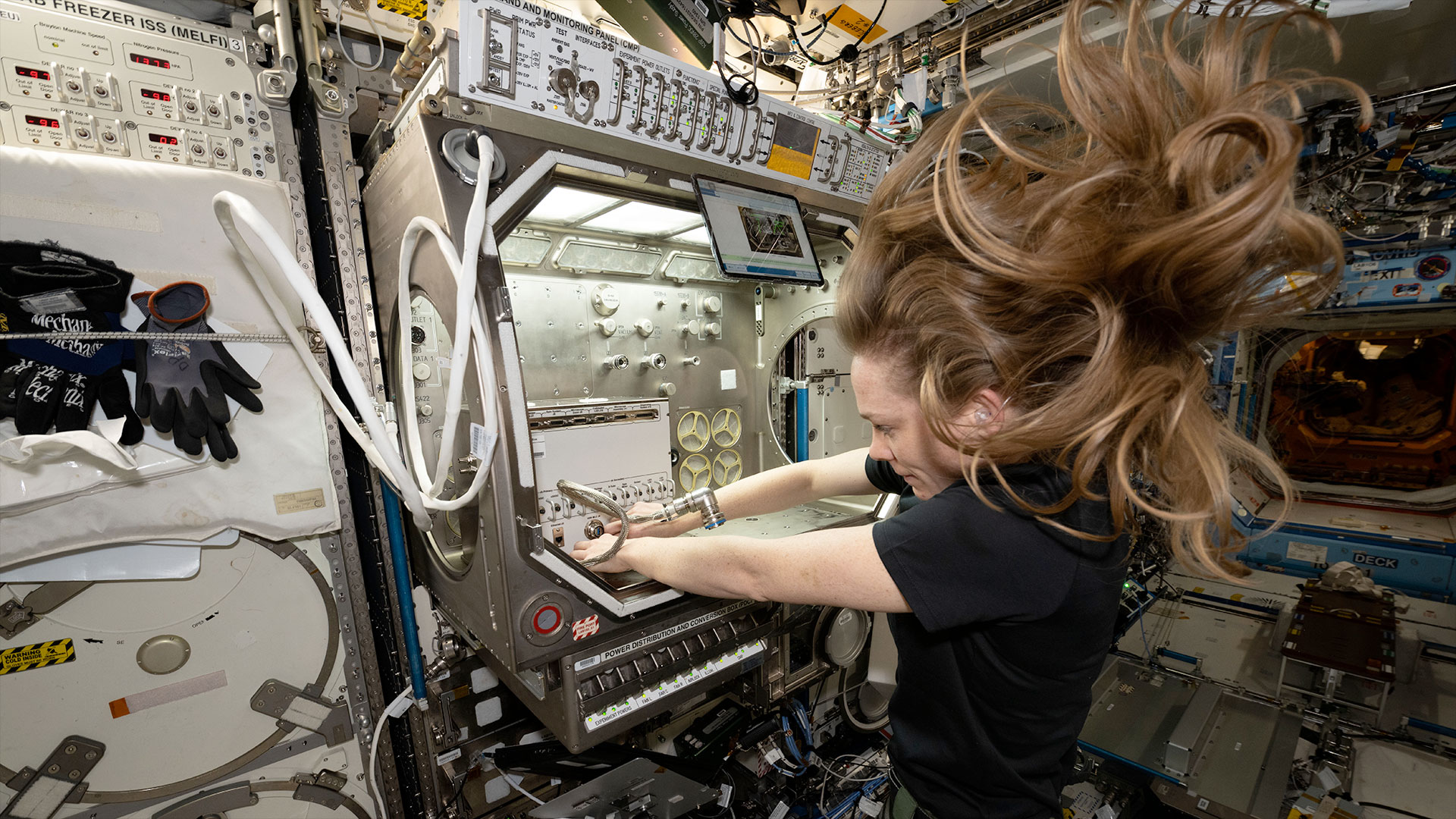
"Space is one of the most humbling environments I’ve operated in," said Expedition 73 flight engineer Jonny Kim, who before becoming a NASA astronaut was a U.S. Navy SEAL and a medical doctor.
Kim on Thursday (June 12) wrote on social media about his experience working behind the International Space Station's refrigerator-size science racks to clean air filters, examine seals and swap out chipsets for the laboratory's network servers. Even with the help of Mission Control keeping an eye on his work through live video views, it can be difficult to keep track of all of the parts, Kim found.
"One thing I’ve come to appreciate with maintenance in space is how much gravity helps keep things where they belong. For example, on the ground, I can simply set my pliers down and I know they won’t disappear. But in space, we have to think before every action, because setting pliers down is a recipe for losing them," he wrote.
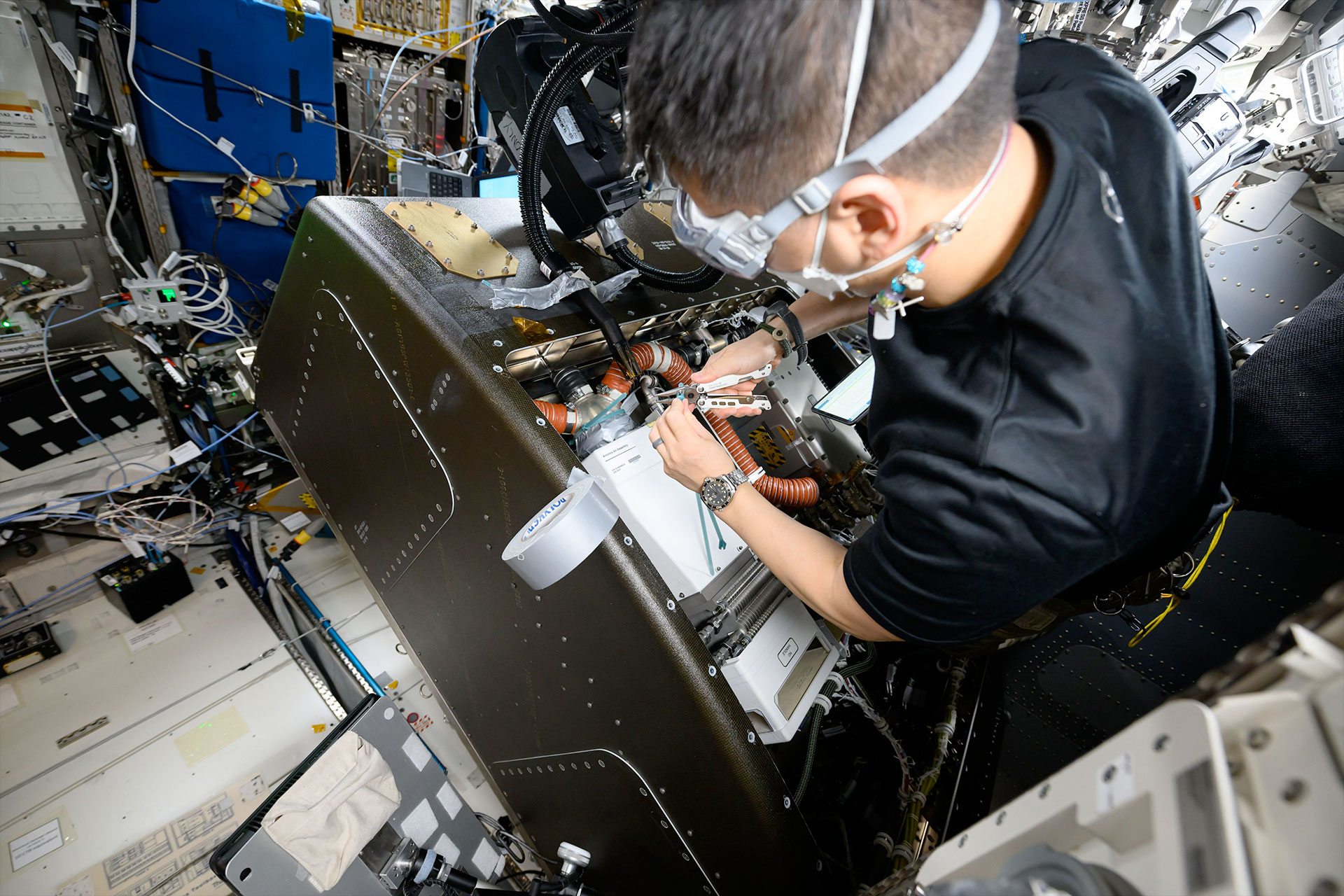
Expedition 73 flight engineer Jonny Kim of NASA uses a pair of pliers to secure a strap on an air filter aboard the International Space Station. (Image credit: NASA)
Science status
Among the research that was conducted aboard the space station this week was:
Ultrasound 2 — Anne McClain and Nichole Myers with NASA joined Expedition 73 commander Takuya Onishi of the Japan Aerospace Exploration Agency (JAXA) to use this biomedical device to undergo their first set of eye exams. Working with a doctor on the ground, the scans were to determine if the astronauts' time in space has affected the structure of their eyes.
Solid Combustion Experiment Module — Onishi also replaced the sample cartridges for an ongoing fire experiment in Japan's Kibo laboratory, which is aimed at improving the safety of spacecraft and anywhere else astronauts may live when off Earth.
Flight engineer Kirill Peskov of the Russian space agency Roscosmos continued setting up cameras to capture landmarks across Asia and Europe while fellow cosmonaut Alexey Zubritskiy set up equipment to measure neutron radiation caused by solar flares and gamma-ray bursts in an effort to learn if there is an affect on spacecraft.
Station keeping
In addition to Kim's work on swapping out air filters and chipsets, the crew also devoted time to maintaining the space station's systems, including:
Enhanced European Exploration Exercise Device (E4D) — Onishi and Kim added grease to the apparatus that is being assessed for its possible use on future missions to the moon. The E4D provides crew members with the same type of exercises as if they were bicycling, rowing and using resistive devices, such as rope pulling and climbing.
Waste and Hygiene Compartment — Working in the Tranquility Node 3 module, McClain drained the tanks for the U.S. segment's bathroom.
Extravehicular Mobility Unit (EMU) — Inside the Quest airlock, Ayers serviced one of the U.S. spacesuits. She then cleaned and documented the metal oxide containers that are used to scrub carbon dioxide from the extravehicular mobility unit (EMU) during spacewalks.
Other work included monitoring the station's decibel levels, checking the station's water quality and clearing the vents of floating debris.
Astronaut activity
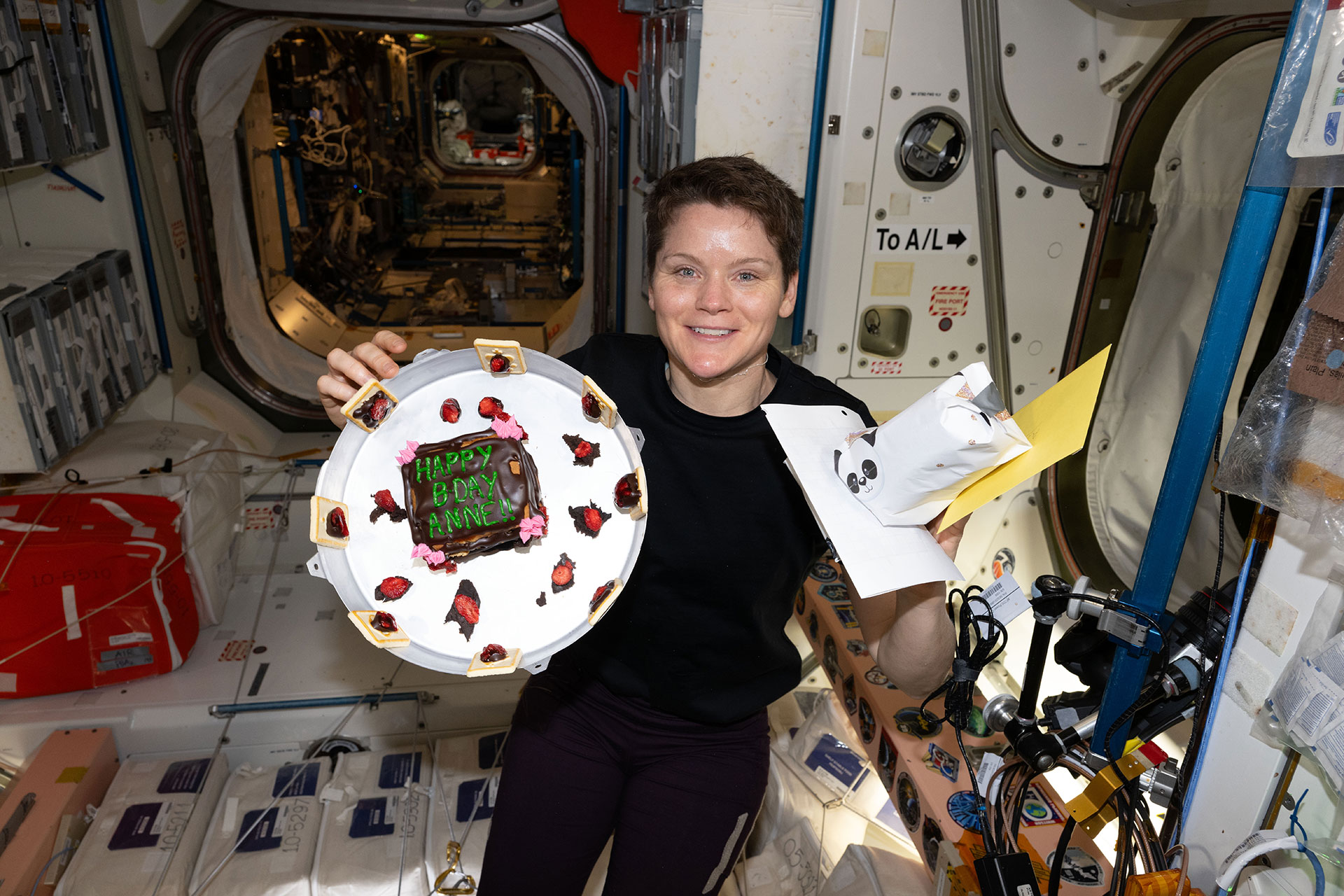
Expedition 73 flight engineer and NASA astronaut Anne McClain celebrates her birthday aboard the International Space Station. (Image credit: NASA)
Expedition 73 flight engineer and NASA astronaut Anne McClain marked two birthdays this week.
First, on Saturday (June 7) she celebrated her own 46th revolution around the sun. Here she displays cards, gifts and a cake presented to her by her crewmates. Happy birthday, Anne!!
Then on Thursday (June 12), she spoke with Dan Driscoll. Secretary of the U.S. Army, to mark the 250th anniversary of the Army's founding. McClain is an active colonel in the service.
"Thank you for your service to the Army and for all our soldiers out there celebrating our 250th birthday of our incredible United States Army, thank you for your service," she said. "I am proud to represent the Army, which is really an army of innovators, leaders and problem solvers."
Waylaid visitors
Ryzhikov began the week inspecting hatch seals in the space station’s Russian segment. That work further informed an ongoing concern about air leaks emanating from Roscosmos' Zvezda service module.
While the leak has been halted, NASA and Axiom Space decided on Thursday (June 12) to stand down from the launch of the Axiom Mission 4 (Ax-4) crew to give more time to consider additional fixes aboard the station.
A new launch date for former astronaut Peggy Whitson with a crew of three astronauts from India, Hungary and Poland is still to be determined.
By the numbers
As of Friday (June 13), there are 7 people aboard the International Space Station: commander Takuya Onishi of JAXA, Anne McClain, Nichole Ayers and Jonny Kim of NASA and Kirill Peskov, Sergey Ryzhikov and Alexey Zubritsky of Roscosmos, all flight engineers.
There are two docked crew spacecraft: SpaceX's Dragon "Endurance" attached to the forward port of the Harmony module, and Roscosmos' Soyuz MS-27 attached to the Earth-facing port of the Prichal node.
There are also two docked cargo spacecraft: Roscosmos' Progess MS-29 (90P) attached to the space-facing port of the Poisk module and Progress MS-30 (91P) attached to the aft port of the Zvezda service module.
As of Friday, the space station has been continuously crewed for 24 years, 7 months and 12 days.
Robert Z. Pearlman
collectSPACE.com Editor, Space.com Contributor
Robert Pearlman is a space historian, journalist and the founder and editor of collectSPACE.com, a daily news publication and community devoted to space history with a particular focus on how and where space exploration intersects with pop culture. Pearlman is also a contributing writer for Space.com and co-author of "Space Stations: The Art, Science, and Reality of Working in Space” published by Smithsonian Books in 2018.In 2009, he was inducted into the U.S. Space Camp Hall of Fame in Huntsville, Alabama. In 2021, he was honored by the American Astronautical Society with the Ordway Award for Sustained Excellence in Spaceflight History. In 2023, the National Space Club Florida Committee recognized Pearlman with the Kolcum News and Communications Award for excellence in telling the space story along the Space Coast and throughout the world.
The Space Station Leak Is Rearing Its Ugly Head Again
Not again...
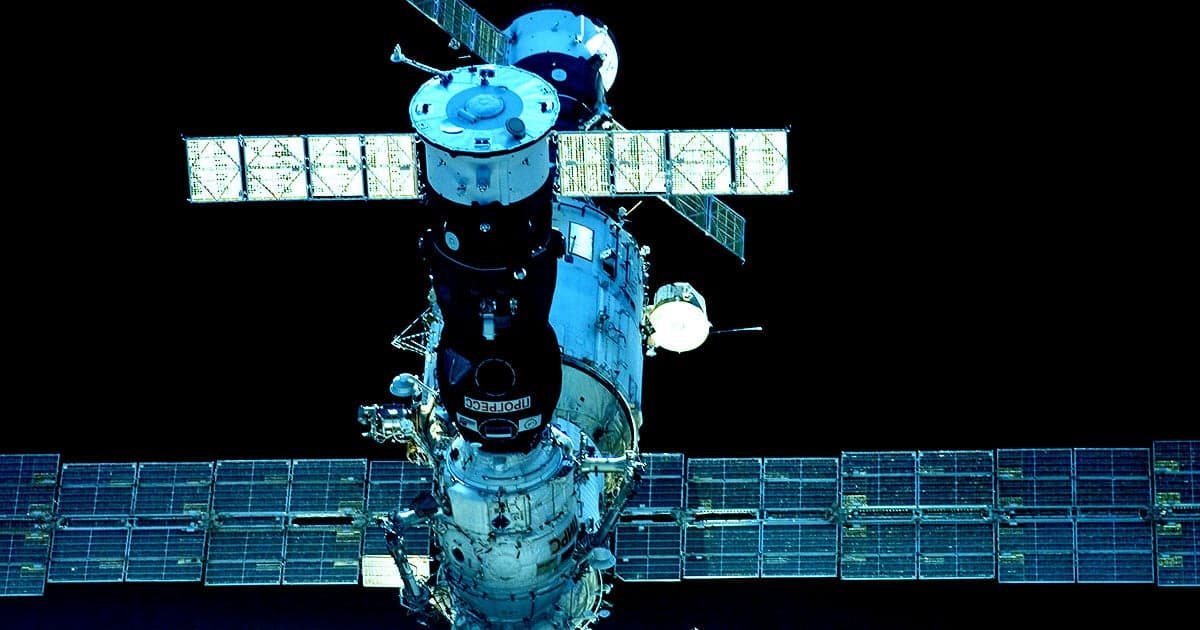
Image by Getty
Holy Moly
Jun 14, 2025
Space Draft
Space tourism company Axiom Space has had to postpone its fourth chartered SpaceX flight to the International Space Station after NASA announced it needs more time to investigate an air leak affecting the orbital lab.
For five years, NASA and its Russian counterpart Roscosmos have been hunting down leaks in the station, which has been continuously occupied for 25 years. The issue has since been traced back to the Russian segment of the ISS, specifically the Zvezda service module, and was identified as a "top safety risk," according to a 2024 report by NASA's inspector general.
The delay highlights the deteriorating condition of the rapidly aging orbital lab, which is expected to host scientists for another five years before being retired with the help of SpaceX.
Under Pressure
Most recently, three cosmonauts occupying the station had inspected the inside walls of the module and its adjoining tunnel, sealing "additional areas of interest, and measured the current leak rate," according to a Thursday update by NASA.
"Following this effort, the segment now is holding pressure," the agency said.
While NASA says none of the station's current crew members are in any danger, Axiom's fourth mission remains on hold to give NASA and Roscosmos more time to "evaluate the situation and determine whether any additional troubleshooting is necessary."
As a result, the SpaceX Falcon 9 rocket is still grounded at NASA's Kennedy Space Center. The launch had already been delayed due to bad weather. Then, a liquid oxygen leak in SpaceX's rocket delayed the launch once more.
For now, all Axiom can do is hold off on launching its crew of four astronauts, led by retired NASA astronaut Peggy Whitson, who has since joined Axiom.
"This is the right thing to do," said Axiom executive chairman Kam Ghaffarian in a statement. "We will continue to work with all of our partners to finalize a new launch date."
Ironically, the firm was awarded a NASA contract to develop a private successor to the ISS.
More on the leaks:
NASA Confirming Success of ISS Leak
Repairs Before Finalizing Ax-4 Launch Date
By Marcia Smith |
NASA, SpaceX and Axiom Space are looking at Thursday, June 19, for the launch of Axiom-4 as NASA continues to evaluate the apparent success of recent repairs in the Russian segment of the International Space Station. A tunnel leading to a docking port at the far end of the Russian segment has experienced air leaks for several years and defied previous remedies, but the tunnel now is holding pressure. NASA wants a few more tests before docking another spacecraft, however, and on Thursday abruptly postponed the launch of Ax-4. NASA said they now are “reviewing launch opportunities” and June 19 is the earliest.
NASA provided limited information about the last minute decision on June 12 to delay the launch, which is taking four private astronauts to the ISS on a 14-day mission.

The crew is launching in a SpaceX Crew Dragon spacecraft atop a SpaceX Falcon 9 rocket. SpaceX delayed the launch from June 10 to June 11 because of weather and again on June 11 because it needed to repair a liquid oxygen (LOX) leak on the rocket. By Thursday afternoon, June 12, they’d fixed the leak, successfully completed a wet dress rehearsal test, and were waiting to set a new launch date.
NASA then suddenly announced they were postponing the launch in order to “understand a new pressure signature” in the Russian tunnel even though it

The statement seemed self-contradictory. The problem was that the tunnel hadn’t been able to hold pressure, but now it could, yet the launch was postponed. NASA soon sent out a brief reassurance via email to reporters that the ISS crew was fine and normal operations continued.
“The crew aboard the International Space Station is safely conducting normal operations. We’re assessing this latest update and will provide additional information as available.” — NASA statement, June 12, 2025, 5:08 pm ET
The agency declined to comment yesterday, but this morning offered a bit more of an explanation on the ISS blog. Even though the tunnel now is holding pressure, they want to make sure that’s because the leaks are sealed and not because “of a small amount of air flowing into the transfer tunnel across the hatch seal from the main part of the space station.”

The 420 Metric Ton ISS is composed of two interdependent sections, the U.S. segment and the Russian segment. The problematic tunnel, PrK, is to a docking port for Russian cargo vehicles at the far end of Russia’s Zvezda Service Module (shown in red in the illustration below). Air leaks were first detected in the PrK in September 2019. Attempts to plug them over the years yielded mixed results.
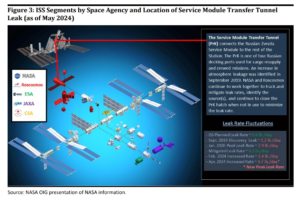
The ISS is old. The first modules, Zarya and Node 1 (Unity), were launched in 1998. Zvezda docked in July 2000 and the ISS has been permanently occupied by crews rotating on roughly 6 month schedules since November 2000.
Bob Cabana, a former NASA astronaut who commanded the first mission to the ISS in 1998 and later was Director of Kennedy Space Center and NASA Associate Administrator, retired from NASA at the end of 2023 and now chairs the NASA ISS Advisory Committee. The committee meets twice a year with its Roscosmos counterpart. Collectively they are the U.S.-Russian Joint Commission.
He reported in November 2024 and April 2025 that Russian and American technical experts disagree on the underlying cause and seriousness of the leaks. The American side is more deeply concerned, but both are committed to keeping the ISS operating until 2030 as long as it is safe to do so. Canada, Japan and 11 European countries working through the European Space Agency are the other ISS partners. All except Russia formally agreed to operating the ISS until 2030, after which it will be intentionally deorbited into the Pacific Ocean. Russia is committed only until 2028, but NASA expects it will extend that to 2030 in due course.
The question is whether the ISS will make it that long. If the repairs to the tunnel are in fact successful, that will be good news from a technical standpoint.
Another threat to the ISS right now, however, is U.S. budget cuts. The Trump Administration wants to reduce funding and the number of crew and cargo flights to the ISS, as well as limiting research to only what’s needed for sending humans to the Moon and Mars, as part of its proposed FY2026 $6 billion cut to NASA’s budget.
NASA ISS Program Manager Dana Weigel said at a May 20 Ax-4 overview briefing that she already is looking at reducing the number of crew on each flight from four to three because of FY2025 funding constraints that are limiting the number of cargo flights needed to resupply food and other essentials.
Meanwhile, Elon Musk, founder and CEO of SpaceX, twice has promoted the idea of ending operations two years from now instead of in 2030 despite the billions SpaceX earns by launching cargo and crews. His most recent post about this yesterday asserted that he has “serious concerns” about its long-term safety.

NASA awarded SpaceX an $843 million contract to build a U.S. Deorbit Vehicle (USDV) to propel the ISS from orbit into the Pacific to be ready for launch by 2029. The plan is to have it docked to the ISS for about a year as the orbit gradually lowers, with reentry in 2030. Musk hasn’t said how much earlier the USDV could be available.
By contrast, Sen. Ted Cruz (R-TX), chair of the Senate Commerce, Science, and Transportation Committee that oversees NASA, is proposing to add $1.25 billion for the ISS in the reconciliation package. Congress has been unwavering in its bipartisan determination to ensure there is no gap between ISS and the commercial space stations intended to succeed it — Commercial LEO Destinations (CLDs). Congress wants to ensure NASA can continue to conduct microgravity research to support its objectives and that China is not the only country with an Earth-orbiting space station. China’s Tiangong-3 space station has been operational since 2021, permanently occupied since 2022, and they are getting ready to expand it.

Cruz would also add $325 million for the USDV, but doesn’t specify what it’s for. The contract doesn’t include launch or integration onto the launch vehicle. Former NASA Administrator Bill Nelson told Congress last year he needed $1.5 billion for the USDV and Ken Bowersox, the head of NASA’s Space Operations Mission Directorate, warned that if Congress didn’t appropriate sufficient funds they would have to take it from other parts of the ISS budget.
Whatever the ISS’s future holds, right now the Axiom-4 crew is awaiting launch. That could happen as soon as Thursday.
Axiom has its own space station plans, too. It’s one of three companies receiving funding from NASA to facilitate the development of commercial space stations to succeed ISS. Several others have unfunded arrangements. Unlike the others, Axiom’s design relies on attaching its first module to the ISS. Axiom’s Allen Flynt said at a June 9 Ax-4 pre-launch briefing that’s now planned for 2027. The original date was 2024.
Of all the U.S. companies working on commercial space stations, Vast is saying it will be ready first, with launch of Haven-1 planned for May 2026 although it has limited capabilities. Haven-1 can accommodate four astronauts for two weeks. A more capable version with multiple modules, Haven-2, is planned for first launch in 2028 and completion in 2032. Vast has an unfunded agreement with NASA. The company is using SpaceX for launch, crew transportation, crew training, and communications via Starlink.
This article has been updated Jun 15, 2025

Iain Todd
BBC
Published: June 13, 2025


No comments:
Post a Comment