
Updated: July 07, 2025
Alberta Premier Danielle Smith says the province will hold consultations on nuclear power and whether it should be added to Alberta's energy sector.
Alberta plans to hold public consultations this fall on adding nuclear power to the province’s energy mix, Premier Danielle Smith said Monday.Sign up for breaking news emails from CTV News Edmonton, right at your fingertips
There have long been discussions about building reactors in Alberta — including ones that could power oilsands operations — but the province is currently reliant on greenhouse-gas emitting natural gas for electricity.
Those conversations are to begin anew around September or October, when Chantelle de Jonge, parliamentary secretary for affordability and utilities, plans to hold nuclear consultation sessions.
“We want to talk to Albertans, because it’s new for us,” Smith told reporters alongside Ontario Premier Doug Ford after the two flipped pancakes at the Alberta premier’s annual Stampede breakfast.
“It’s not new for Ontario. Ontario gets 60 per cent of their power, I understand, on their grid from nuclear energy.”
Small modular reactors probably make the most sense at remote rural sites that are heavy energy users, the premier added.
“Our oilsands projects are perfect for it, if you can get both the power and steam, power and heat.”
Small modular reactors, or SMRs, generate about one-third of the power of traditional nuclear plants and can be prefabricated elsewhere before being shipped to site.
Ontario Power Generation is building an SMR at its Darlington site east of Toronto, which would make it the first power company in North America to connect such a plant to the grid. There are plans to build three more SMR units there.
Ford said SMRs don’t themselves employ a lot of people when they’re up and running, but they could enable tech giants like Amazon or Google to set up shop with electricity-hungry artificial intelligence data centres.
“And that’s where the jobs are created because they just suck an endless amount of energy, these data centres,” Ford told reporters.
“So that’s the way of the future. We’re leading the world and we’re gonna make sure we share that technology right across the country.”
At least one U.S. developer of SMRs has a keen eye on Alberta as a growth market.
“We have designed a small modular reactor that is perfectly suited for Alberta,” Clay Sell, CEO of X-Energy Reactor Co., said in an interview last month.
The problem with conventional reactors has been their complexity, he said on the sidelines of the Global Energy Show in Calgary.
“If you ever get one built, you’ll run it for the next 80 years, but they’re hard to build and they’re capital intensive to build,” Sell said.
“So our whole approach has been from the beginning: ‘How do we make it simpler? How do we make it smaller? How do we have fewer components?’”
X-Energy is pursuing opportunities to add power to Alberta’s grid in general, as well as to link to steam-assisted gravity drainage oilsands projects that pull bitumen from deep underground through wells rather than mine it.
“Our plant is perfectly suited to perform that same mission on a small footprint,” Sell said.
OPG is looking at using X-Energy plants at industrial sites in Ontario.
A much larger conventional plant is also in the works in northwestern Alberta.
Energy Alberta is working on a power station in the Peace River area that would have two to four Candu reactors and a capacity of up to 4,800 megawatts. That would represent up to a quarter of the province’s existing electricity generation.
“We initially thought, ‘Wow, that would swamp our power grid,’” Smith said.
“And now with all the demands for AI data centres, we’re thinking, ‘Hmm, that’s maybe exactly what we need.’”
An initial project description was filed in April for the Peace River Nuclear Power Project, kicking off the federal review process.
In a speech to the Global Energy Show in June, Candu Energy senior vice-president Carl Marcotte said Alberta would benefit from adding nuclear to the mix.
“Whatever Albertans decide to build, you will. But you need a lot more power to do it — reliable power that runs 24/7, power that works in great weather and when it’s -45 C ... and it must be affordable — it really must,” he said.
“So yes, of course Alberta’s abundant natural gas resources can and should do all that ... But wouldn’t it benefit from having a powerful, cleaner, reliable ally in that growth, providing important baseload electricity with low emissions?”
Scott MacDougall, program director of electricity for the green think-tank Pembina Institute, said nuclear could have a role to play as a clean power source, both to feed the grid and to reduce the carbon footprint of the oilsands.
But there is lower hanging fruit.
“If the problem that they’re trying to solve is delivering that reliable, affordable, non-emitting power right away, there should be a much more all-of-the-above approach taken in Alberta, where we think renewable energy ought to be a more central pillar in that system,” said MacDougall.
“That’s partly because renewables are much quicker to deploy and lower cost as well, and their costs are coming down every year as are the costs of battery and energy storage.”
This report by The Canadian Press was first published July 7, 2025.
Lauren Krugel, The Canadian Press
World Nuclear News
Clinch River application accepted for review
_49530.jpg)
The Tennessee Valley Authority (TVA) submitted its application for Clinch River to the NRC in May, making it the first utility in the USA to submit a construction permit application for GE Vernova Hitachi Nuclear Energy's BWRX-300 technology.
"This is an exciting step to bringing the nation’s first utility-led SMR online," said TVA President and CEO Don Moul. "As the first utility in the United States to have a construction permit application under review by the Nuclear Regulatory Commission for the BWRX-300 reactor, this will create a path for other utilities to deploy the reactor - ensuring energy security and reliable electricity for all."
TVA anticipates preliminary site preparation work could begin as early as next year while the NRC reviews the company's construction permit application.
TVA has invested in the standard design of the BWRX-300 as part of a technical collaboration agreement with Ontario Power Generation, Polish company Synthos Green Energy and GE Vernova Hitachi Nuclear Energy. It is also leading a coalition of utility companies and supply chain partners that has applied for a grant of USD800 million from the US Department of Energy to accelerate construction of the USA's first small modular reactor, and a USD8 million grant to support the cost of the licence review.
Small modular reactors - SMRs - are reactors with a smaller and more modular design than the USA's currently operating commercial nuclear fleet. As well as offering safety enhancements, their smaller footprint and modular design means they can potentially be built more quickly, are easier to operate and better fit into the landscape due to their compact size, TVA said.
TVA already holds an early site permit for SMRs at the Clinch River site, certifying that the site near Oak Ridge, Tennessee, is suitable for the construction of a nuclear power plant from the point of view of site safety, environmental impact and emergency planning. It has also completed and submitted an Environmental Report for the project to the Nuclear Regulatory Commission, and says site preparation for the SMR could begin as soon as 2026.
The BWRX-300 design is a 300 MWe water-cooled, natural circulation SMR with passive safety systems that leverages the design and licensing basis of the ESBWR boiling water reactor developed by GEH. In May, the Canadian province of Ontario approved OPG to start construction of the first of four BWRX-300 units planned at the Darlington New Nuclear Project site.
Holtec ready for Palisades to enter operational mode
_26024.jpg)
The single-unit pressurised water reactor on the shores of Lake Michigan permanently ceased operations on 20 May 2022, and its licence was transferred from previous operator Entergy Nuclear Operations to Holtec Decommissioning International, LLC and Holtec Palisades, LLC, for decommissioning. Holtec later announced it would pursue a restart of the shuttered unit, and in late 2023 began the process to obtain the licensing approvals needed to return the plant to operational status for the remainder of its licensing term.
To restart the plant, Holtec would need to gain approval from the Nuclear Regulatory Commission (NRC) to restore the licensing basis of the plant to an operational status; return plant components to a status that supports safe operation; and make any upgrades necessary to meet the proposed operational licensing basis. As well as reviewing the regulatory and licensing documents for the plant, the NRC will also inspect new and restored components necessary to operate safely, and continue ongoing oversight to ensure sufficiency of all plant systems and programmes. The regulator has set up a dedicated Palisades Nuclear Plant Restart Panel to oversee this effort.
In an update issued in early April, Holtec said work at Palisades remains on schedule and on budget, targeting a restart in the fourth quarter of this year.
Holtec said the regulatory path to the reauthorisation of power operations at Palisades "is tied collectively to a suite of licensing and regulatory requests that require NRC approval and subsequent implementation by Holtec".
It noted that the associated licensing actions and activities define the regulatory scope to transition Palisades "from decommissioning to an operational 'No Mode' status under the Palisades Renewed Facility Operating License. Entry into 'No Mode' status will allow Palisades Energy to receive, possess, and use source and special nuclear material as reactor fuel, in accordance with the limitations for storage and amounts required for operation".
In a 1 July letter to the NRC, Holtec reports the six licensing and regulatory requests and its readiness to implement the associated licensing actions and activities required to support the transition of Palisades to the "power operations licensing basis".
The NRC said it is still reviewing Holtec's licensing actions.
Last month, the NRC issued its final environmental assessment and finding of no significant impacts for Holtec's request to return the Palisades Nuclear Plant to an operational status.
At the time it was taken out of service, Palisades was licensed to operate until 2031. Holtec notified the NRC last year that it intends to apply for a second, or subsequent, licence renewal for the plant during the first quarter of 2026. This would extend the plant's operating period by a further 20 years, to 2051.
Energoatom signs Westinghouse and Holtec agreements
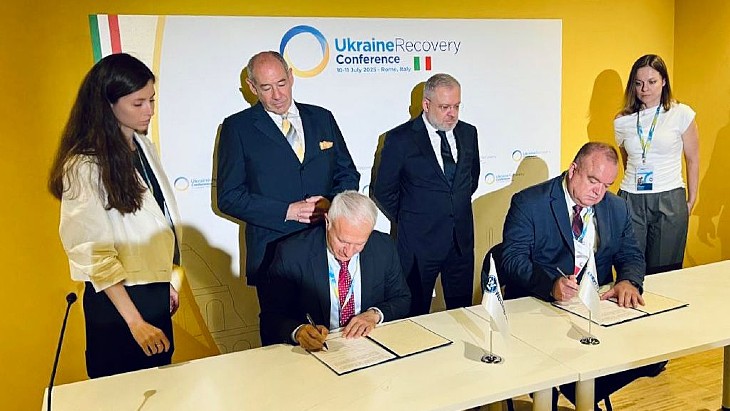
The agreements were signed at the Ukraine Recovery Conference in Italy, and are described as steps helping the country's energy independence.
The cooperation agreement with Westinghouse - which is already planning to supply nine of its AP1000 units in Ukraine - is for a joint project to pursue fuel assembly capability in Ukraine.
Earlier this year Westinghouse approved Ukraine’s AtomEnergoMash "as a qualified supplier for the manufacturing of top and bottom nozzles for Westinghouse’s VVER-1000 fuel assemblies in Ukraine, paving the way for this new advanced fuel assembly capability in the country".
Energoatom CEO Petro Koptin said: "We are continuing our path to establishing our nuclear fuel assembly line in Ukraine by implementing advanced Westinghouse technologies. I am very grateful to our partners for their trust, based on many years of successful cooperation. Step by step, Energoatom is moving towards becoming the centre of nuclear energy in Eastern Europe."
Tarik Choho, Westinghouse Nuclear Fuel President, said: "We are proud to extend our strong partnership and shared commitment to energy security in Ukraine. Westinghouse has an excellent track record of VVER nuclear fuel design used in VVER-1000 and VVER-440 nuclear power plants in Ukraine, with two decades of exceptional operational performance."
Agreement with Holtec
Energoatom and Holtec International signed a document outlining the current areas of cooperation between the two companies as well as outlining their intention to implement joint projects to create a plant in Ukraine for the production of components for Holtec small modular reactors and an agreement for Holtec technology to be used by Energoatom for manufacturing containers for storing used nuclear fuel.
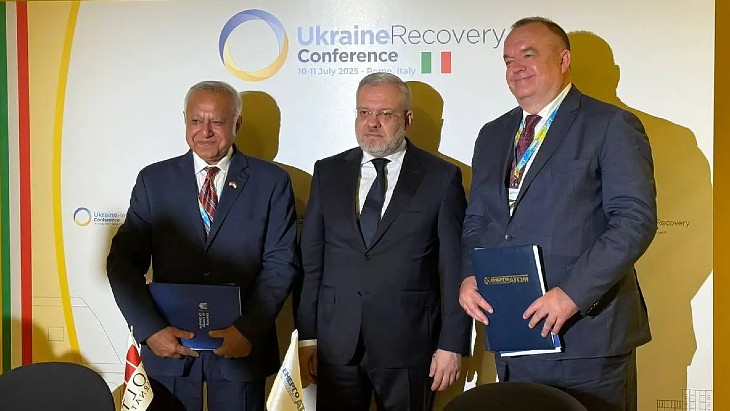
(Image: Energoatom)
The two companies already have long-standing links - notably with the Holtec-built Centralised Spent Nuclear Fuel Storage Facility, which uses the Holtec containers, which are manufactured in the USA.
Ukraine’s Energy Minister Herman Halushchenko was present for the signing of both agreements with the energy ministry saying the memorandum also envisaged steps towards the future deployment of Holtec’s SMR-300 small modular reactors in Ukraine "in particular through capacity building and technical training with the participation of Ukrainian specialists in the SMR-300 programme at the Palisades nuclear power plant" - Holtec is aiming to have two of its SMRs in operation at Palisades in 2030.
Preparation stage begins for BN-1200M construction
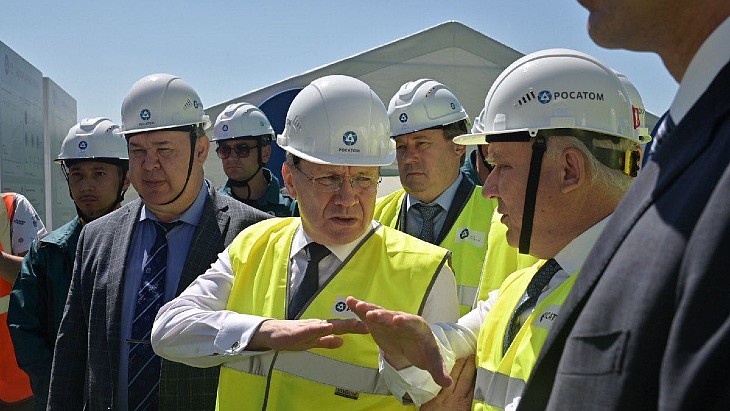
The sodium-cooled BN-series fast reactor plans are part of Rosatom's project to develop fast reactors with a closed fuel cycle whose mixed-oxide (MOX) fuel will be reprocessed and recycled. In addition to the BN-600 reactor at Beloyarsk unit 3, which began operation in 1980, the 789 MWe BN-800 fast at Beloyarsk unit 4 entered commercial operation in October 2016. This is essentially a demonstration unit for fuel and design features for the larger BN-1200, which will be unit 5 at Beloyarsk.
Russia's nuclear regulator Rostechnadzor issued a licence in April for the unit which has a target completion date of 2034, and which would be the world’s most powerful operating fast neutron reactor.
Alexei Likhachev, visiting the site, said: “With the launch of work on power unit No 5, the Beloyarsk Nuclear Power Plant strengthens its status as a leader in the development of fast reactor technology.”
He said it would help in hitting the target of nuclear generating 25% of Russia’s energy by 2045, and would also be combined with development plans for the wider Sverdlovsk region.
An agreement with the acting governor of the Sverdlovsk region Denis Pasler was signed on the development of master plans for the city of Zarechny, Novouralsk and Lesnoy which are intended to be the basis “for creating a comfortable urban environment, developing the economy, and implementing youth and social initiatives … and the attraction of federal funding for the most significant infrastructure projects”.
Pasler said: “For the Sverdlovsk region, these are new opportunities to make people's lives more harmonious, prosperous and safe. Most of the station's employees live in Zarechny. They create families here, raise children. Therefore, it is important that both at work and outside of it, each person sees and feels the prospects and opportunities for the development of their children, for the prosperous and comfortable life of their family.”
The master plans are drawn up by a combination of architects, economists, urbanists, sociologists, residents and the city leaderships, and are intended to provide a detailed image of the city in the future, which can then be implemented, Rosatom said.
Final stage of IMSR graphite irradiation testing starts
_10457.jpg)
NRG-Pallas is providing technical services to support Terrestrial Energy for "in-core" materials testing and development of its Integral Molten Salt Reactor (IMSR) power plant. The testing programme at NRG is designed to confirm the predicted performance of selected graphite grades throughout the seven-year cycle of the IMSR. Its scope simulates IMSR core conditions, encompassing the full range of IMSR operating temperatures and of the neutron flux. The programme aims to enable Terrestrial to select the most suitable graphite grade for use in the IMSR reactor, as well as qualifying graphite for IMSR use.
The company sourced multiple graphite grades from suppliers of nuclear graphite in western markets, including the USA, to commence the test programme in November 2020.
"Comprehensive irradiation tests are essential for advanced reactor development and reactor licensing, as they validate the performance of critical materials under actual operating conditions," said Terrestrial Energy CEO Simon Irish. "Our pioneering work with NRG-Pallas is providing the data needed to make our final graphite grade selection for the IMSR, marking another important milestone in our supply chain development.
"NRG-Pallas' technical expertise and research capabilities are unparalleled in the world of advanced reactor development, and this work will be a major step toward Terrestrial Energy's goal of achieving early fleet deployment."
Arjan Vreeling, manager of R&D Nuclear Fuels and Materials at NRG-Pallas added: "NRG-Pallas is committed to leveraging its test reactor and research capabilities to support advanced reactor development. We have been collaborating with Terrestrial Energy now for five years and are delighted to be moving to the final stage of in-core irradiation testing of IMSR graphites, the first developer to commence such testing."
Terrestrial's IMSR is a 4th generation reactor that uses molten salt as both fuel and coolant, with integrated components, which can supply heat directly to industrial facilities or use it to generate electrical power. The use of molten salt as both fuel and coolant also enables passive, or inherent, safety features to be built into the reactor design. The design integrates the primary reactor components, including the graphite moderator, into a sealed and replaceable reactor core unit with an operating lifetime of seven years. The reactor uses about 125 tonnes of graphite as a neutron moderator.
Lithuania to consider deployment of Newcleo SMRs
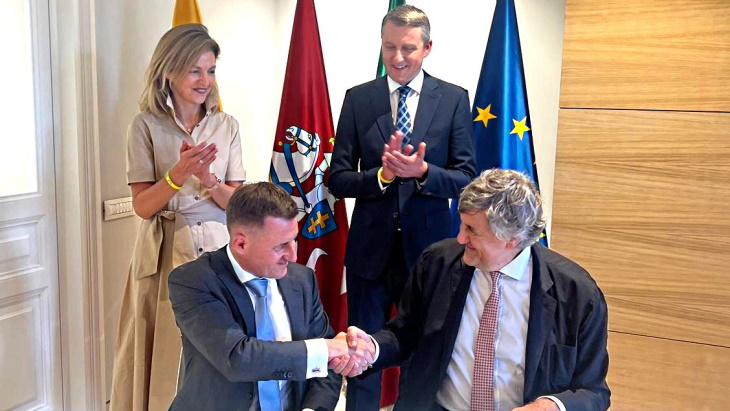
Through a memorandum of understanding signed in Rome on 9 July by Newcleo founder and CEO Stefano Buono and Ignalina NPP CEO Linas Baužys, the partners will consider the potential role of Newcleo's small modular lead-cooled fast reactor in providing economically viable, safe, reliable, and efficient energy solutions in Lithuania and for the safe handling of the country's used nuclear fuel.
The MoU - signed in the presence of the Lithuanian Energy Minister Žygimantas Vaičiūnas - paves the way for feasibility studies to be carried out on areas including: siting evaluations; reprocessing of Lithuania's stocks of used nuclear fuel; potential industrial applications in connection to hydrogen and ammonia production; and the creation of local nuclear supply chains. The project also aims to evaluate the feasibility of integrating small modular reactors (SMRs), such as Newcleo's design, into an energy system prioritising renewables – the aim being to enhance grid stability while contributing to the broader objective of decarbonisation.
Last month, Newcleo and Slovak state-owned radioactive waste management company JAVYS signed a joint venture shareholder agreement, paving the way toward the construction of up to four Newcleo lead-cooled fast reactors at the Bohunice site. The units would be powered with mixed uranium/plutonium oxide (MOX) fuel fabricated from existing Slovakian used nuclear fuel extracted from the country's current reactor fleet.
Newcleo said it is "seeking to expand this operating model to other territories with existing nuclear operations or legacy spent fuel, which include many Eastern European countries, as a way of sustainably managing waste while promoting energy independence".
"This agreement marks another step in our aim to deliver sustainable solutions for waste and in delivering energy security across Europe," Newcleo's Stefano Buono said. "I'm delighted that Lithuania, a country with a strong nuclear energy background is open to the model we can provide, and I thank Minister Vaičiūnas for his engagement and vision. This agreement could mark the first step in Lithuania unlocking potentially decades worth of sustainable energy from its legacy spent fuel and, like our partnership in Slovakia, showcases the power of European collaboration in the nuclear sector."
Ignalina NPP CEO Linas Baužys added: "This memorandum of understanding represents an important step in exploring innovative solutions for managing Lithuania's nuclear legacy. By working with Newcleo, we are looking at the future of nuclear technology - one that is safer, more sustainable, and capable of unlocking long-term energy value from existing resources. This cooperation also reflects our strategic commitment to strengthening Lithuania's energy security and independence, developing local expertise, and contributing to European technological leadership in advanced nuclear solutions."
"The Ignalina nuclear power plant has been a strategic pillar of the Lithuanian energy system for many years, along with the high competence of nuclear energy specialists, which is now used only for the decommissioning activities of the INPP," Minister of Energy Žygimantas Vaičiūnas said. "We aim not only to preserve this competence, but also to use it for the development of advanced nuclear technologies. Although the implementation of such projects is not fast, we should not miss the opportunity to assess the possibilities of such technologies to reduce the volume of spent nuclear fuel in the future, and this agreement allows us to start evaluating innovative solutions now."
Two large RBMK reactors at the Ignalina nuclear power plant provided 70% of Lithuania's electricity until their closure in 2004 and 2009 as a condition of the country joining the European Union. The power plant is being decommissioned by Ignalina NPP, which has removed fuel from the reactors and placed it into dry casks for interim storage at the site. The decommissioning process is due to last until 2038.
Last week the Lithuanian government announced it has decided to establish a working group to report on nuclear energy development opportunities in the country, with small modular reactors seen as a likely option. The working group, within the Ministry of Energy, will involve experts from the shut-down Ignalina plant, with the State Nuclear Energy Safety Inspectorate due to submit safety regulation proposals.
Lithuania's National Energy Independence Strategy - published in 2024 - called for a decision on the installation of SMRs to be made by 2028 with the first operating by 2038.
TerraPower awards Natrium supplier contracts
_31636_20723.jpg)
Natrium technology features a 345 MWe sodium-cooled fast reactor using high-assay low-enriched uranium fuel, with a molten salt-based energy storage system that can boost the system’s output to 500 MWe for more than five and a half hours when needed. TerraPower plans to build the Natrium demonstration plant near a retiring coal facility at Kemmerer.
The three supplier contracts are for: AVANTech LLC, to design advanced sodium processing system modules and supporting skids for the Natrium plant; Structural Integrity Associates, to design and fabricate the Sodium Cover Gas Gamma Spectroscopy Analysis Cabinet radiation monitoring system; and PAR Systems to design and fabricate the Pool Handling Machine, a specialised crane system to safely handle and transport used fuel assemblies with the used fuel pool for storage, inspection and maintenance purposes.
Chris Levesque, TerraPower President and CEO, said: "A resilient and diverse domestic supply chain is crucial to completing our Natrium plant and bringing the first, commercial-scale advanced reactor online in the United States. Each supplier award for the Natrium project reflects our readiness and resolve to deliver reliable, advanced nuclear energy, and I am proud of our entire TerraPower team as we continue to make key project awards."
Terrapower, the first developer to submit a construction permit application for a commercial advanced reactor to the US Nuclear Regulatory Commission (NRC) in March 2024, says it has already secured 100% of the long-lead items for the project as well as the entire Natrium reactor enclosure system.
The NRC said last week that it now expects to complete its review of TerraPower's construction licence application for the Natrium advanced reactor demonstration project by the end of 2025, ahead of the original August 2026 date.
Last month NVentures, the venture capital arm of multinational technology company NVIDIA, was among investors in a USD650 million capital raise, which TerraPower said would support the first Natrium plant as well as the company’s plans to rapidly deploy additional units in the US and abroad. Current investors, including TerraPower-founder Bill Gates and South Korean conglomerate HD Hyundai, also participated.
A ground-breaking ceremony was held in June last year to mark the start of non-nuclear construction at the site in Wyoming.

No comments:
Post a Comment