TEXAS FLOODISASTER
Daniel Hampton
July 11, 2025
RAW STORY
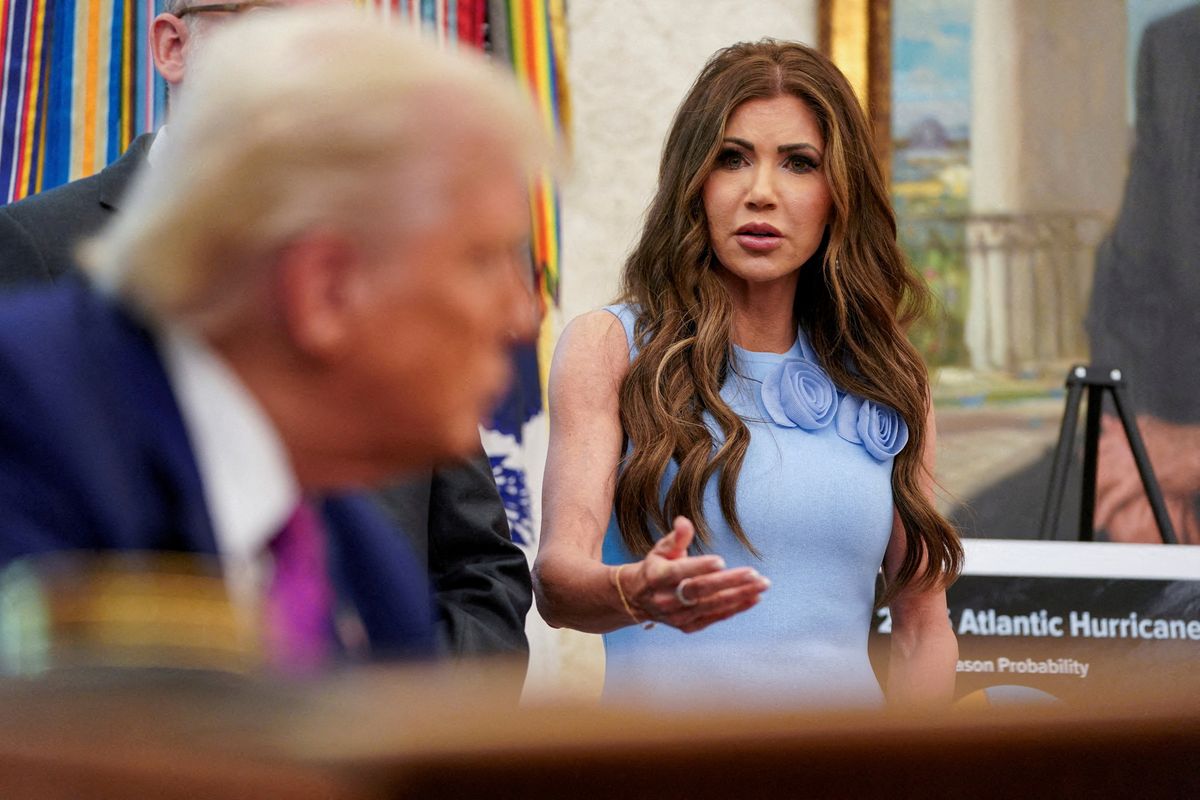
FILE PHOTO: U.S. Homeland Security Secretary Kristi Noem speaks about the Federal Emergency Management Agency next to U.S. President Donald Trump, in the Oval Office at the White House, in Washington, D.C., U.S., June 10, 2025. REUTERS/Nathan Howard/File Photo
Thousands of calls to the Federal Emergency Management Agency, just two days after deadly floods tore through central Texas, went unanswered because hundreds of call center contractors were let go the previous day, according to a new report in The New York Times.
Catastrophic flooding struck the Hill Country and Kerr County, beginning in the early hours of July 4. Torrential rains caused the Guadalupe River to rise 26 feet in just 45 minutes, creating a historic flash flood emergency.
At least 121 people died, many of them children, and more than 170 people remain missing.
As floodwaters receded on July 5, FEMA answered over 99% of the 3,027 calls from disaster survivors, according to documents obtained by the Times. But that evening, Kristi Noem, the secretary of Homeland Security, didn't renew contracts with four companies, resulting in hundreds of contractors being fired, the Times reported, citing the documents and one person briefed on the matter.
The following day, FEMA answered just 36 percent of the 2,363 calls it received, according to the report.
The calls often come from disaster survivors seeking to apply for financial assistance. People who've lost their homes can obtain an immediate payment of $750 to cover food and other needs.
FEMA's failure to take about two-thirds of calls so soon after a disaster left experts taken aback.
“Responding to less than half of the inquiries is pretty horrific,” Jeffrey Schlegelmilch, director of the National Center for Disaster Preparedness at Columbia University, told the Times.
“Put yourself in the shoes of a survivor: You’ve lost everything, you’re trying to find out what’s insured and what’s not, and you’re navigating multiple aid programs,” he added. “One of the most important services in disaster recovery is being able to call someone and walk through these processes and paperwork.”
The report comes amid revelations that Noem waited three days to send FEMA rescuers to the area, insisting she had to personally authorize expenses topping $100,000.
David Richardson, the acting administrator of FEMA, has also drawn criticism for being noticeably absent.
'There was plenty of time!' Forecaster aghast to learn his flood warning ignored
Jennifer Berry Hawes,
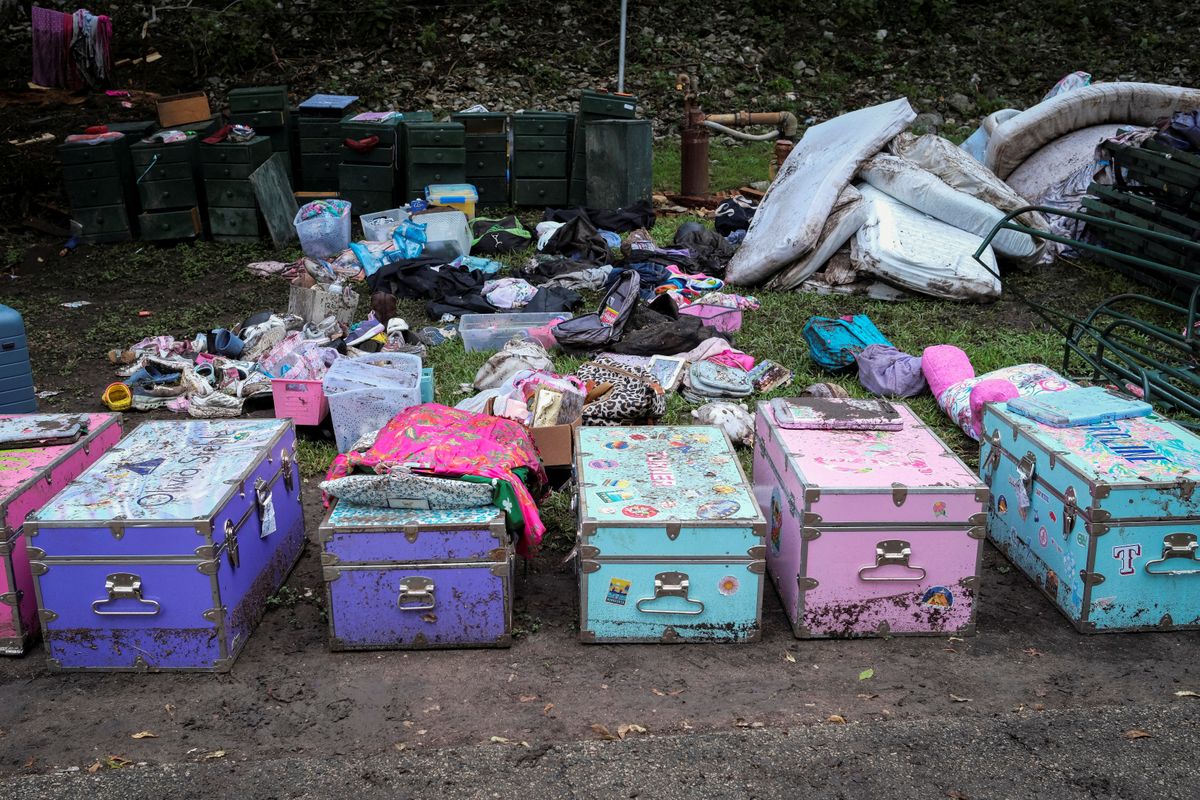
Campists' belongings lie on the ground following flooding on the Guadalupe River, at Camp Mystic, Hunt, Texas, U.S. July 7, 2025. REUTERS/Marco Bello TPX IMAGES OF THE DAY
Nine months ago, Hurricane Helene barreled up from the Gulf of Mexico and slammed into the rugged mountains of western North Carolina, dumping a foot of rain onto an already saturated landscape. More than 100 people died, most by drowning in floodwaters or being crushed by water-fueled landslides.
“We had no idea it was going to do what it did,” said Jeff Howell, the now-retired emergency manager in Yancey County, North Carolina, a rural expanse that suffered the most deaths per capita.
A week ago, the remnants of Tropical Storm Barry slipped up from the coast of Mexico, drawing moisture from the Gulf, then collided with another system and inundated rivers and creeks in hilly south central Texas. More than 100 people are confirmed dead, many of them children, with more missing.
“We had no reason to believe that this was going to be anything like what’s happened here — none whatsoever,” said County Judge Rob Kelly, the top elected official in Kerr County, Texas, where most of the deaths occurred.
The similarities between North Carolina and Texas extend beyond the words of these two officials. In both disasters, there was a disconnect between accurate weather alerts and on-the-ground action that could have saved lives.
Officials in each of those places were warned. The National Weather Service sent urgent alerts about potentially life-threatening danger hours in advance of the flash floods, leaving time to notify and try to evacuate people in harm’s way.
In Texas, some local officials did just that. But others did not.
Similarly, a ProPublica investigation found that when Helene hit on Sept. 27, some local officials in North Carolina issued evacuation orders. At least five counties in Helene’s path, including Yancey, did not. Howell said the enormity of the storm was far worse than anyone alive had ever seen and that he notified residents as best he could.
The National Weather Service described Helene’s approach for days. It sent out increasingly dire alerts warning of dangerous flash flooding and landslides. Its staff spoke directly with local emergency managers and held webinar updates. A Facebook message the regional office posted around 1 p.m. the day before Helene hit warned of “significant to catastrophic, life-threatening flooding” in the mountains. “This will be one of the most significant weather events to happen in the western portions of the area in the modern era.”
Similarly, in Texas, the weather service warned of potential for flash flooding the day before. Also that day, the state emergency management agency’s regional director had “personally contacted” county judges, mayors and others “in that area and notified them all of potential flooding,” Lt. Gov. Dan Patrick later said at a press conference.
AccuWeather, a commercial weather forecasting service, issued the first flash flood warnings for the area at 12:44 a.m. on July 4, roughly three hours before the catastrophic flooding. A half-hour later, at 1:14 a.m., the National Weather Service sent a similar warning to two specific areas, including central Kerr County, where the Guadalupe River’s banks and hills are dotted with vacation homes, summer camps and campgrounds — many filled with July 4 vacationers slumbering in cabins and RVs.
“Flash flooding is ongoing or expected to begin shortly,” the weather service alert said. Impacts could include “life threatening flash flooding of creeks and streams.”
A severity descriptor on that alert sent it to weather radios and the nation’s Wireless Emergency Alerts system, which blasts weather warnings to cellphones to blare an alarm.
AccuWeather’s chief meteorologist, Jonathan Porter, was dismayed to hear news later that all the children attending youth camps in Kerr County had not been ushered to higher ground despite those warnings.
At Camp Mystic, a beloved century-old Christian summer camp for girls, at least 27 campers and counselors were killed. Six still haven’t been found. Its director also died, while trying to rescue children. (People at the camp said they received little to no help from the authorities, according to The New York Times.)
“I was very concerned to see that campers were awoken not by someone coming to tell them to evacuate based on timely warnings issued but rather by rapidly rising water that was going up to the second level of their bunkbeds,” Porter said.
In the area, known as Flash Flood Alley, Porter called this “a tragedy of the worst sort” because it appeared camps and local officials could have mobilized sooner in response to the alerts.
“There was plenty of time to evacuate people to higher ground,” Porter said. “The question is, Why did that not happen?”
But Dalton Rice, city manager of Kerrville, the county seat, said at a press conference the next day that “there wasn’t a lot of time” to communicate the risk to camps because the floodwaters rose so rapidly.
Rice said that at 3:30 a.m. — more than two hours after the flash flood warnings began — he went jogging near the Guadalupe River to check it out but didn’t see anything concerning.
But 13 miles upriver from the park where he was jogging, the river began — at 3:10 a.m. — to rise 25 feet in just two hours.
At 4:03 a.m., the weather service upgraded the warning to an “emergency”— its most severe flash flood alert — with a tag of “catastrophic.” It singled out the Guadalupe River at Hunt in Kerr County: “This is a PARTICULARLY DANGEROUS SITUATION. SEEK HIGHER GROUND NOW!”
The local sheriff said he wasn’t made aware of the flooding until 4 to 5 a.m. He has declined to say whether the local emergency manager, who is responsible for alerting the public to approaching storms, was awake when the flash flood warnings went out starting at 1 a.m. The Texas Tribune reported that Kerrville’s mayor said he wasn’t aware of the flooding until around 5:30 a.m., when the city manager called and woke him up.
Local officials have refused to provide more details, saying they are focused on finding the more than 100 people still missing and notifying loved ones of deaths.
One challenge as disasters approach is that weather alerts often don’t reach the people in harm’s way.
In rural areas across Texas and North Carolina alike, cellphone service can be spotty on the best of days, and some people turn off alert notifications. In North Carolina’s remote mountains, many people live at least somewhat off the grid. The cell service isn’t great everywhere, and many aren’t glued to phones or social media. In Texas, Kerr County residents posted on Facebook complaints that they didn’t receive the weather service’s alerts while others said their phones blared all night with warnings.
Many counties also use apps to send their own alerts, often tailored to their specific rivers and roads. But residents must opt in to receive them. Kerr County uses CodeRed, but it isn’t clear what alerts it sent out overnight.
Pete Jensen has spent a long career in emergency management, including responding to the Sept. 11, 2001, terrorist attack. He served as an official at the Federal Emergency Management Agency during Hurricane Katrina and often ponders why more people don’t receive – and heed – weather alerts.
“There’s an awful lot of denial,” Jensen said. “Disasters happen to someone else. They don’t happen to me.” That can include local officials who “don’t always understand what their responsibilities are. They very often react like most humans do – in denial.”
There is one big difference between the disasters in Texas and North Carolina. In Texas, residents, journalists and others have demanded accountability from local officials. Gov. Greg Abbott has called the Legislature into special session starting July 21 to discuss flood warning systems, flood emergency communications and natural disaster preparation.
But that hasn’t happened in North Carolina. The state legislature has yet to discuss possible changes, such as expanding its Know Your Zone evacuation plan beyond the coast, or boost funding for local emergency managers. (Instead, lawmakers went home in late June without passing a full budget.) Many emergency managers, including in Yancey County, operate in rural areas with small tax bases and skeleton staffs.
“There still has not been an outcry here for, How do we do things differently?” said state Sen. Julie Mayfield, a Democrat from Asheville. “It still feels like we’re very much in recovery mode.”
North Carolina’s emergency management agency commissioned a review of its handling of the disaster. The report found the state agency severely understaffed, but it didn’t examine issues such as evacuations or local emergency managers’ actions before Helene hit.
Erika Andresen also lives in Asheville, a mountain city in the heart of Helene’s destruction, where she helps businesses prepare for disasters. A lawyer and former Army judge advocate, she also teaches emergency management. After Helene, she was among the few voices in North Carolina criticizing the lack of evacuations and other inactions ahead of the storm.
“I knew right away, both from my instinct and from my experience, that a lot of things went terribly wrong,” Andresen said. When she got pushback against criticizing local authorities in a time of crisis, she countered, “We need accountability.”
Jennifer Berry Hawes,
Propublica
July 11, 2025
July 11, 2025
Campists' belongings lie on the ground following flooding on the Guadalupe River, at Camp Mystic, Hunt, Texas, U.S. July 7, 2025. REUTERS/Marco Bello TPX IMAGES OF THE DAY
Nine months ago, Hurricane Helene barreled up from the Gulf of Mexico and slammed into the rugged mountains of western North Carolina, dumping a foot of rain onto an already saturated landscape. More than 100 people died, most by drowning in floodwaters or being crushed by water-fueled landslides.
“We had no idea it was going to do what it did,” said Jeff Howell, the now-retired emergency manager in Yancey County, North Carolina, a rural expanse that suffered the most deaths per capita.
A week ago, the remnants of Tropical Storm Barry slipped up from the coast of Mexico, drawing moisture from the Gulf, then collided with another system and inundated rivers and creeks in hilly south central Texas. More than 100 people are confirmed dead, many of them children, with more missing.
“We had no reason to believe that this was going to be anything like what’s happened here — none whatsoever,” said County Judge Rob Kelly, the top elected official in Kerr County, Texas, where most of the deaths occurred.
The similarities between North Carolina and Texas extend beyond the words of these two officials. In both disasters, there was a disconnect between accurate weather alerts and on-the-ground action that could have saved lives.
Officials in each of those places were warned. The National Weather Service sent urgent alerts about potentially life-threatening danger hours in advance of the flash floods, leaving time to notify and try to evacuate people in harm’s way.
In Texas, some local officials did just that. But others did not.
Similarly, a ProPublica investigation found that when Helene hit on Sept. 27, some local officials in North Carolina issued evacuation orders. At least five counties in Helene’s path, including Yancey, did not. Howell said the enormity of the storm was far worse than anyone alive had ever seen and that he notified residents as best he could.
The National Weather Service described Helene’s approach for days. It sent out increasingly dire alerts warning of dangerous flash flooding and landslides. Its staff spoke directly with local emergency managers and held webinar updates. A Facebook message the regional office posted around 1 p.m. the day before Helene hit warned of “significant to catastrophic, life-threatening flooding” in the mountains. “This will be one of the most significant weather events to happen in the western portions of the area in the modern era.”
Similarly, in Texas, the weather service warned of potential for flash flooding the day before. Also that day, the state emergency management agency’s regional director had “personally contacted” county judges, mayors and others “in that area and notified them all of potential flooding,” Lt. Gov. Dan Patrick later said at a press conference.
AccuWeather, a commercial weather forecasting service, issued the first flash flood warnings for the area at 12:44 a.m. on July 4, roughly three hours before the catastrophic flooding. A half-hour later, at 1:14 a.m., the National Weather Service sent a similar warning to two specific areas, including central Kerr County, where the Guadalupe River’s banks and hills are dotted with vacation homes, summer camps and campgrounds — many filled with July 4 vacationers slumbering in cabins and RVs.
“Flash flooding is ongoing or expected to begin shortly,” the weather service alert said. Impacts could include “life threatening flash flooding of creeks and streams.”
A severity descriptor on that alert sent it to weather radios and the nation’s Wireless Emergency Alerts system, which blasts weather warnings to cellphones to blare an alarm.
AccuWeather’s chief meteorologist, Jonathan Porter, was dismayed to hear news later that all the children attending youth camps in Kerr County had not been ushered to higher ground despite those warnings.
At Camp Mystic, a beloved century-old Christian summer camp for girls, at least 27 campers and counselors were killed. Six still haven’t been found. Its director also died, while trying to rescue children. (People at the camp said they received little to no help from the authorities, according to The New York Times.)
“I was very concerned to see that campers were awoken not by someone coming to tell them to evacuate based on timely warnings issued but rather by rapidly rising water that was going up to the second level of their bunkbeds,” Porter said.
In the area, known as Flash Flood Alley, Porter called this “a tragedy of the worst sort” because it appeared camps and local officials could have mobilized sooner in response to the alerts.
“There was plenty of time to evacuate people to higher ground,” Porter said. “The question is, Why did that not happen?”
But Dalton Rice, city manager of Kerrville, the county seat, said at a press conference the next day that “there wasn’t a lot of time” to communicate the risk to camps because the floodwaters rose so rapidly.
Rice said that at 3:30 a.m. — more than two hours after the flash flood warnings began — he went jogging near the Guadalupe River to check it out but didn’t see anything concerning.
But 13 miles upriver from the park where he was jogging, the river began — at 3:10 a.m. — to rise 25 feet in just two hours.
At 4:03 a.m., the weather service upgraded the warning to an “emergency”— its most severe flash flood alert — with a tag of “catastrophic.” It singled out the Guadalupe River at Hunt in Kerr County: “This is a PARTICULARLY DANGEROUS SITUATION. SEEK HIGHER GROUND NOW!”
The local sheriff said he wasn’t made aware of the flooding until 4 to 5 a.m. He has declined to say whether the local emergency manager, who is responsible for alerting the public to approaching storms, was awake when the flash flood warnings went out starting at 1 a.m. The Texas Tribune reported that Kerrville’s mayor said he wasn’t aware of the flooding until around 5:30 a.m., when the city manager called and woke him up.
Local officials have refused to provide more details, saying they are focused on finding the more than 100 people still missing and notifying loved ones of deaths.
One challenge as disasters approach is that weather alerts often don’t reach the people in harm’s way.
In rural areas across Texas and North Carolina alike, cellphone service can be spotty on the best of days, and some people turn off alert notifications. In North Carolina’s remote mountains, many people live at least somewhat off the grid. The cell service isn’t great everywhere, and many aren’t glued to phones or social media. In Texas, Kerr County residents posted on Facebook complaints that they didn’t receive the weather service’s alerts while others said their phones blared all night with warnings.
Many counties also use apps to send their own alerts, often tailored to their specific rivers and roads. But residents must opt in to receive them. Kerr County uses CodeRed, but it isn’t clear what alerts it sent out overnight.
Pete Jensen has spent a long career in emergency management, including responding to the Sept. 11, 2001, terrorist attack. He served as an official at the Federal Emergency Management Agency during Hurricane Katrina and often ponders why more people don’t receive – and heed – weather alerts.
“There’s an awful lot of denial,” Jensen said. “Disasters happen to someone else. They don’t happen to me.” That can include local officials who “don’t always understand what their responsibilities are. They very often react like most humans do – in denial.”
There is one big difference between the disasters in Texas and North Carolina. In Texas, residents, journalists and others have demanded accountability from local officials. Gov. Greg Abbott has called the Legislature into special session starting July 21 to discuss flood warning systems, flood emergency communications and natural disaster preparation.
But that hasn’t happened in North Carolina. The state legislature has yet to discuss possible changes, such as expanding its Know Your Zone evacuation plan beyond the coast, or boost funding for local emergency managers. (Instead, lawmakers went home in late June without passing a full budget.) Many emergency managers, including in Yancey County, operate in rural areas with small tax bases and skeleton staffs.
“There still has not been an outcry here for, How do we do things differently?” said state Sen. Julie Mayfield, a Democrat from Asheville. “It still feels like we’re very much in recovery mode.”
North Carolina’s emergency management agency commissioned a review of its handling of the disaster. The report found the state agency severely understaffed, but it didn’t examine issues such as evacuations or local emergency managers’ actions before Helene hit.
Erika Andresen also lives in Asheville, a mountain city in the heart of Helene’s destruction, where she helps businesses prepare for disasters. A lawyer and former Army judge advocate, she also teaches emergency management. After Helene, she was among the few voices in North Carolina criticizing the lack of evacuations and other inactions ahead of the storm.
“I knew right away, both from my instinct and from my experience, that a lot of things went terribly wrong,” Andresen said. When she got pushback against criticizing local authorities in a time of crisis, she countered, “We need accountability.”
'Evil person': Trump lashes out as reporter asks about flood alert failure
Sarah K. Burris
July 11, 2025 4:53PM
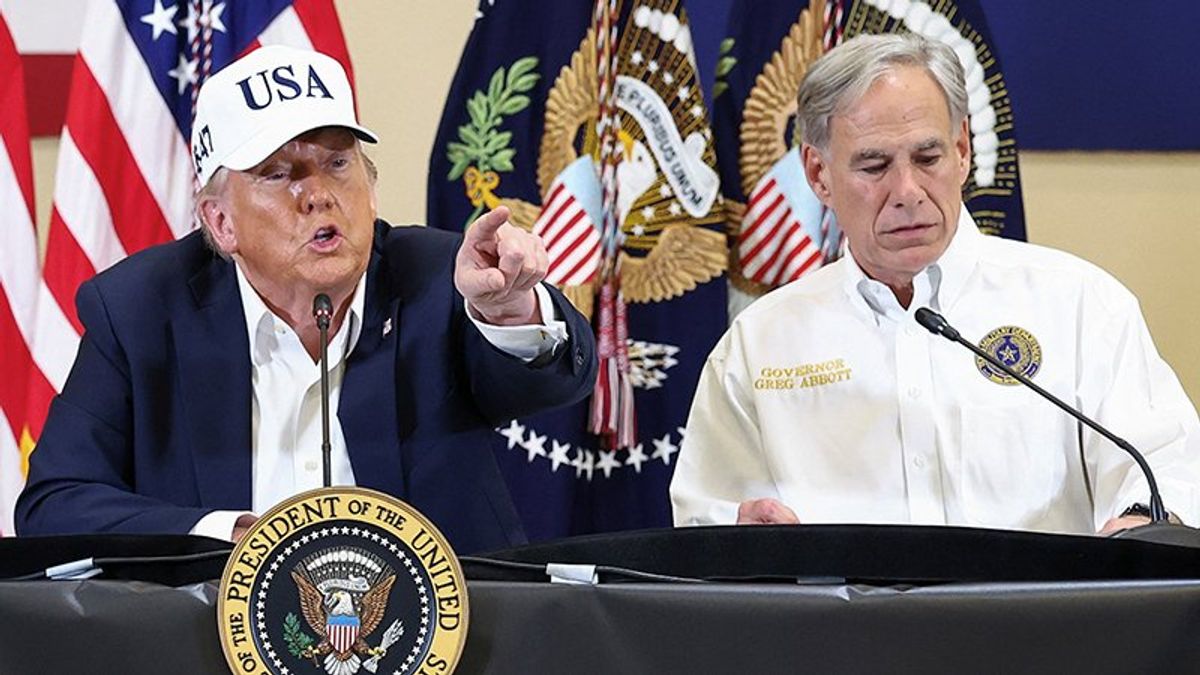
U.S. President Donald Trump and Texas Governor Greg Abbott participate in a roundtable with first responders and local officials, at Hill Country Youth Center, in Kerrville, Texas, U.S., July 11, 2025. REUTERS/Kevin Lamarque
A Texas CBS News reporter asked President Donald Trump about recent revelations that FEMA documents showed emergency alerts about devastating floods were not sent to cell phones as previously indicated.
While the National Oceanic and Atmospheric Administration sent out alerts that would have triggered those with weather radios, key cell phone alerts did not go out until it was too late.
The National Weather Service also sent out its flood warning from the system, known as IPAWS, as early as 1:14 a.m.
"However, weather service forecasters cannot issue instructions on whether to evacuate or wait for rescue; those messages are up to county or city officials," reported NBC 5 News. "The FEMA archive showed that Kerr County did not send any wireless alerts through IPAWS on July 4, when the flooding began."
"Several families we've heard from are obviously upset because they say that those warnings, those alerts, didn't go out in time. And they also say that people could have been saved. What do you say to those families?" the reporter asked.
Trump pivoted to say that "everyone did an incredible job," refusing to address the suggestion of failures.
"This was, I guess, Kristi [Noem] said, a 1 in 500, 1 in 1,000 years" event, Trump claimed. "And I just have admiration for the job that everybody did. There was just admiration.
"Only a bad person would ask a question like that, to be honest with you. I don't know who you are, but only a very evil person would ask a question like that. I think this has been heroism. This has been incredible, really, the job you've all done, it's easy to sit back and say, oh, what could have happened here? There? You know, maybe we could have done something differently. This was a thing that has never happened before, and nobody's ever seen anything — I've never seen anything like this."
The area of Texas where the flood occurred is known as Flash Flood Ally. It has experienced huge floods previously, including one in 1987. It prompted mayors in the past to beg for alert sirens, though it was later decided not to install them.
"I've never seen anything like this," Trump complained. "So, I admire you, and I consider you heroes and heroines. And I think you've done an amazing job."
See the clip below or at the link here.
Sarah K. Burris
July 11, 2025 4:53PM
RAW STORY
U.S. President Donald Trump and Texas Governor Greg Abbott participate in a roundtable with first responders and local officials, at Hill Country Youth Center, in Kerrville, Texas, U.S., July 11, 2025. REUTERS/Kevin Lamarque
A Texas CBS News reporter asked President Donald Trump about recent revelations that FEMA documents showed emergency alerts about devastating floods were not sent to cell phones as previously indicated.
While the National Oceanic and Atmospheric Administration sent out alerts that would have triggered those with weather radios, key cell phone alerts did not go out until it was too late.
The National Weather Service also sent out its flood warning from the system, known as IPAWS, as early as 1:14 a.m.
"However, weather service forecasters cannot issue instructions on whether to evacuate or wait for rescue; those messages are up to county or city officials," reported NBC 5 News. "The FEMA archive showed that Kerr County did not send any wireless alerts through IPAWS on July 4, when the flooding began."
"Several families we've heard from are obviously upset because they say that those warnings, those alerts, didn't go out in time. And they also say that people could have been saved. What do you say to those families?" the reporter asked.
Trump pivoted to say that "everyone did an incredible job," refusing to address the suggestion of failures.
"This was, I guess, Kristi [Noem] said, a 1 in 500, 1 in 1,000 years" event, Trump claimed. "And I just have admiration for the job that everybody did. There was just admiration.
"Only a bad person would ask a question like that, to be honest with you. I don't know who you are, but only a very evil person would ask a question like that. I think this has been heroism. This has been incredible, really, the job you've all done, it's easy to sit back and say, oh, what could have happened here? There? You know, maybe we could have done something differently. This was a thing that has never happened before, and nobody's ever seen anything — I've never seen anything like this."
The area of Texas where the flood occurred is known as Flash Flood Ally. It has experienced huge floods previously, including one in 1987. It prompted mayors in the past to beg for alert sirens, though it was later decided not to install them.
"I've never seen anything like this," Trump complained. "So, I admire you, and I consider you heroes and heroines. And I think you've done an amazing job."
See the clip below or at the link here.
‘Bad talent!’ Jasmine Crockett and ‘left-wing ghouls’ bashed at flood presser
Alexander Willis
July 11, 2025
July 11, 2025
RAW STORY
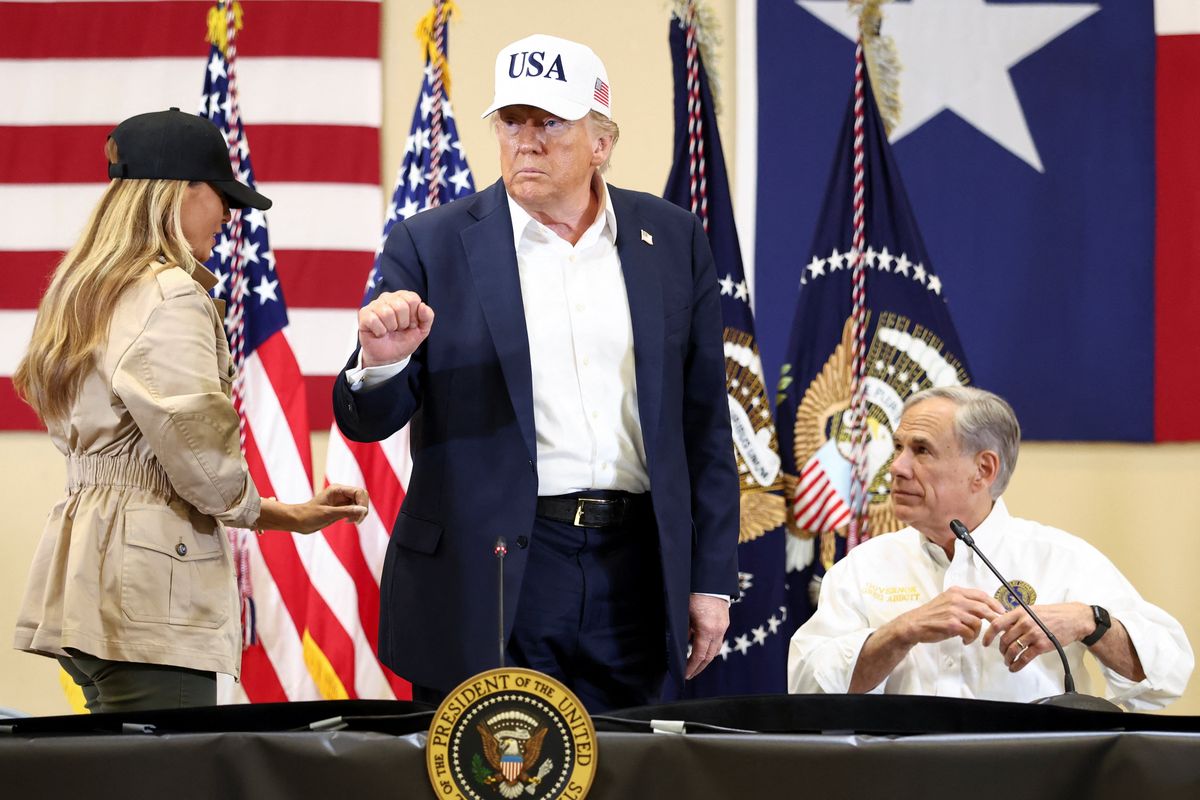
U.S. President Donald Trump, first lady Melania Trump and Texas Governor Greg Abbott participate in a roundtable with first responders and local officials after catastrophic floods, at Hill Country Youth Center, in Kerrville, Texas, U.S., July 11, 2025. REUTERS/Kevin Lamarque
A Texas reporter lashed out Friday at what he called “ghouls on the left” and the “left-wing media” during a news conference on the Texas flood disaster, singling out Rep. Jasmine Crockett (D-TX) in particular.
The conference was headed by President Donald Trump, Gov. Gregg Abbott (R-TX), and a number of other federal and Texas officials and first responders. Phil McGraw, better known as Dr. Phil, also participated in the presser.
“What's been so disheartening recently are these ghouls on the left like Jasmine Crockett and the left-wing media who want to point fingers, play partisan games and fundraise off of this crisis,” the reporter said when selected by Trump for a question.
“What I love about Texas is we come together in a crisis across party lines, ideological lines, so what is your message to these folks on the left who are using this to gain partisan points in viral videos?”
With at least 120 dead and 173 missing from the flood that ravaged central Texas on July 4, a significant number of them children, critics have pressed local and federal officials on what some have described as inadequate warnings for the disaster. Some have blamed the Trump administration’s cuts to federal weather and emergency agencies, while others have labeled it a failure of local officials.
Among those critics has been Crockett, who on Friday signed off on a letter to the Federal Emergency Management Agency and the National Oceanic and Atmospheric Administration demanding information on the agencies’ preparedness and response to the flood.
“The tragic loss of life suffered underscores the urgent need to understand what contributed to this disaster.
“While (the National Weather Service) did issue several flood warning alerts, including one indicating ‘a large and deadly flood wave’ at 5:34 am Friday that urged residents and campers in Kerr County to seek higher ground, there are concerns about the effectiveness of those warnings,” the letter reads.
“Reports suggest that some residents may not have received these messages and others did not fully grasp the seriousness of the flood.”
In response to the reporter’s question, Trump simply argued that it was a matter of “lost confidence” as to why “ghouls on the left” and the “left-wing media” continue to pose tough questions on the flood response.
“They've lost their confidence, they've had a tremendous run of bad talent – I don't say bad luck, I say bad talent – and all they want to do is criticize,” Trump said.
Watch the video below or use this link.
U.S. President Donald Trump, first lady Melania Trump and Texas Governor Greg Abbott participate in a roundtable with first responders and local officials after catastrophic floods, at Hill Country Youth Center, in Kerrville, Texas, U.S., July 11, 2025. REUTERS/Kevin Lamarque
A Texas reporter lashed out Friday at what he called “ghouls on the left” and the “left-wing media” during a news conference on the Texas flood disaster, singling out Rep. Jasmine Crockett (D-TX) in particular.
The conference was headed by President Donald Trump, Gov. Gregg Abbott (R-TX), and a number of other federal and Texas officials and first responders. Phil McGraw, better known as Dr. Phil, also participated in the presser.
“What's been so disheartening recently are these ghouls on the left like Jasmine Crockett and the left-wing media who want to point fingers, play partisan games and fundraise off of this crisis,” the reporter said when selected by Trump for a question.
“What I love about Texas is we come together in a crisis across party lines, ideological lines, so what is your message to these folks on the left who are using this to gain partisan points in viral videos?”
With at least 120 dead and 173 missing from the flood that ravaged central Texas on July 4, a significant number of them children, critics have pressed local and federal officials on what some have described as inadequate warnings for the disaster. Some have blamed the Trump administration’s cuts to federal weather and emergency agencies, while others have labeled it a failure of local officials.
Among those critics has been Crockett, who on Friday signed off on a letter to the Federal Emergency Management Agency and the National Oceanic and Atmospheric Administration demanding information on the agencies’ preparedness and response to the flood.
“The tragic loss of life suffered underscores the urgent need to understand what contributed to this disaster.
“While (the National Weather Service) did issue several flood warning alerts, including one indicating ‘a large and deadly flood wave’ at 5:34 am Friday that urged residents and campers in Kerr County to seek higher ground, there are concerns about the effectiveness of those warnings,” the letter reads.
“Reports suggest that some residents may not have received these messages and others did not fully grasp the seriousness of the flood.”
In response to the reporter’s question, Trump simply argued that it was a matter of “lost confidence” as to why “ghouls on the left” and the “left-wing media” continue to pose tough questions on the flood response.
“They've lost their confidence, they've had a tremendous run of bad talent – I don't say bad luck, I say bad talent – and all they want to do is criticize,” Trump said.
Watch the video below or use this link.

No comments:
Post a Comment