The cruel heat is back as southern Europe slips deeper into summer
Joseph Wilson,Derek Gatopoulos,Trisha Thomas
Thursday 24 July 2025
The Independent

open image in galleryStreet cleaner Raúl Rodriguez rests during a protest over the death of fellow cleaner during a recent heat wave in Barcelona, Spain, Wednesday, July 16, 2025. (AP Photo/Joan Mateu Parra, File) (Joan Mateu Parra)
Southern Europe is grappling with a brutal heatwave this summer, creating a stark divide between air-conditioned comfort and the perilous reality for outdoor workers.
Such labour can be gruelling, even deadly. Last month, a street sweeper in Barcelona died during the extreme heat, and a labour union reports 12 other city cleaners have since suffered heatstroke.
In response, powerful European unions are pushing for tougher regulations to protect the aging workforce from climate change, on what is already the world's fastest-warming continent.
Deadly heat in Barcelona
Hundreds of street cleaners and concerned citizens marched through downtown Barcelona last week to protest the death of Montse Aguilar, a 51-year-old street cleaner who worked even as the city's temperatures hit a June record.
Fellow street sweeper Antonia Rodríguez said at the protest that blistering summers have made her work “unbearable.”
“I have been doing this job for 23 years and each year the heat is worse,” said Rodríguez, 56. “Something has to be done.”
Extreme heat has fueled more than 1,000 excess deaths in Spain so far in June and July, according to the Carlos III Health Institute.
“Climate change is, above all, playing a role in extreme weather events like the heat waves we are experiencing, and is having a big impact in our country,” said Diana Gómez, who heads the institute’s daily mortality observatory.
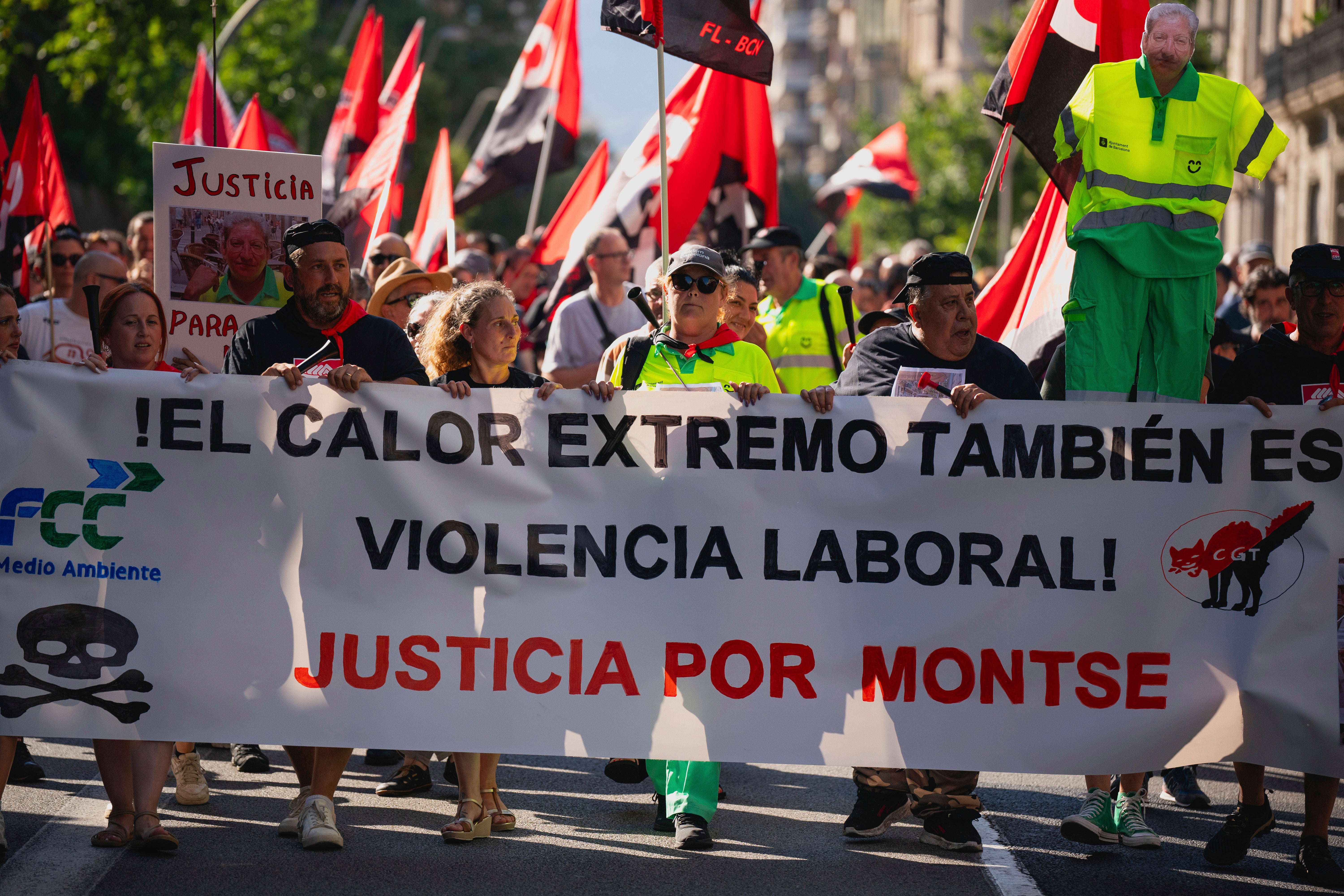
open image in galleryPeople march in Barcelona to protest the death of street cleaner Montse Aguilar during a recent heat wave in Spain, Wednesday, July 16, 2025. The banner in Spanish reads, “Extreme Heat is also Workplace Violence. Justice for Montse." (AP Photo/Joan Mateu Parra, File) (Copyright 2025 The Associated Press. All rights reserved.)
Even before the march, Barcelona’s City Hall issued new rules requiring the four companies contracted to clean its streets to give workers uniforms made of breathable material, a hat and sun cream. When temperatures reach 34 C (93 F), street cleaners now must have hourly water breaks and routes that allow time in the shade. Cleaning work will be suspended when temperatures hit 40 C (104 F).
Protesters said none of the clothing changes have been put into effect and workers are punished for allegedly slacking in the heat. They said supervisors would sanction workers when they took breaks or slowed down.
Workers marched behind a banner reading “Extreme Heat Is Also Workplace Violence!" and demanded better summer clothing and more breaks during the sweltering summers. They complained that they have to buy their own water.
FCC Medio Ambiente, the company that employed the deceased worker, declined to comment on the protesters' complaints. In a previous statement, it offered its condolences to Aguilar's family and said that it trains its staff to work in hot weather.
Emergency measures and a Greek cook
In Greece, regulations for outdoor labor such as construction work and food delivery includes mandatory breaks. Employers are also advised — but not mandated — to adjust shifts to keep workers out of the midday sun.

open image in galleryGrill cook Thomas Siamandas makes traditional souvlaki in a restaurant in the central Monastiraki district during a hot day in Athens on Wednesday, July 16, 2025. (AP Photo/Petros Giannakouris) (Copyright 2025 The Associated Press. All rights reserved)
Greece requires heat-safety inspections during hotter months but the country's largest labor union, the GSEE, is calling for year-round monitoring.
European labor unions and the United Nations’ International Labor Organization are also pushing for a more coordinated international approach to handling the impact of rising temperatures on workers.
"Heat stress is an invisible killer,” the ILO said in a report last year on how heat hurts workers.
It called for countries to increase worker heat protections, saying Europe and Central Asia have experienced the largest spike in excessive worker heat exposure this century.
In Athens, grill cook Thomas Siamandas shaves meat from a spit in the threshold of the famed Bairaktaris Restaurant. He is out of the sun, but the 38 C (100.4 F) temperature recorded on July 16 was even tougher to endure while standing in front of souvlaki burners.
Grill cooks step into air-conditioned rooms when possible and always keep water within reach. Working with a fan pointed at his feet, the 32-year-old said staying cool means knowing when to take a break, before the heat overwhelms you.
“It’s tough, but we take precautions: We sit down when we can, take frequent breaks and stay hydrated. We drink plenty of water — really a lot,” said Siamandas, who has worked at the restaurant for eight years. “You have to find a way to adjust to the conditions.”
The blazing sun in Rome
Massimo De Filippis spends hours in the blazing sun each day sharing the history of vestal virgins, dueling gladiators and powerful emperors as tourists shuffle through Rome’s Colosseum and Forum.
“Honestly, it is tough. I am not going to lie,” the 45-year-old De Filippis said as he wiped sweat from his face. “Many times it is actually dangerous to go into the Roman Forum between noon and 3:30 p.m.”
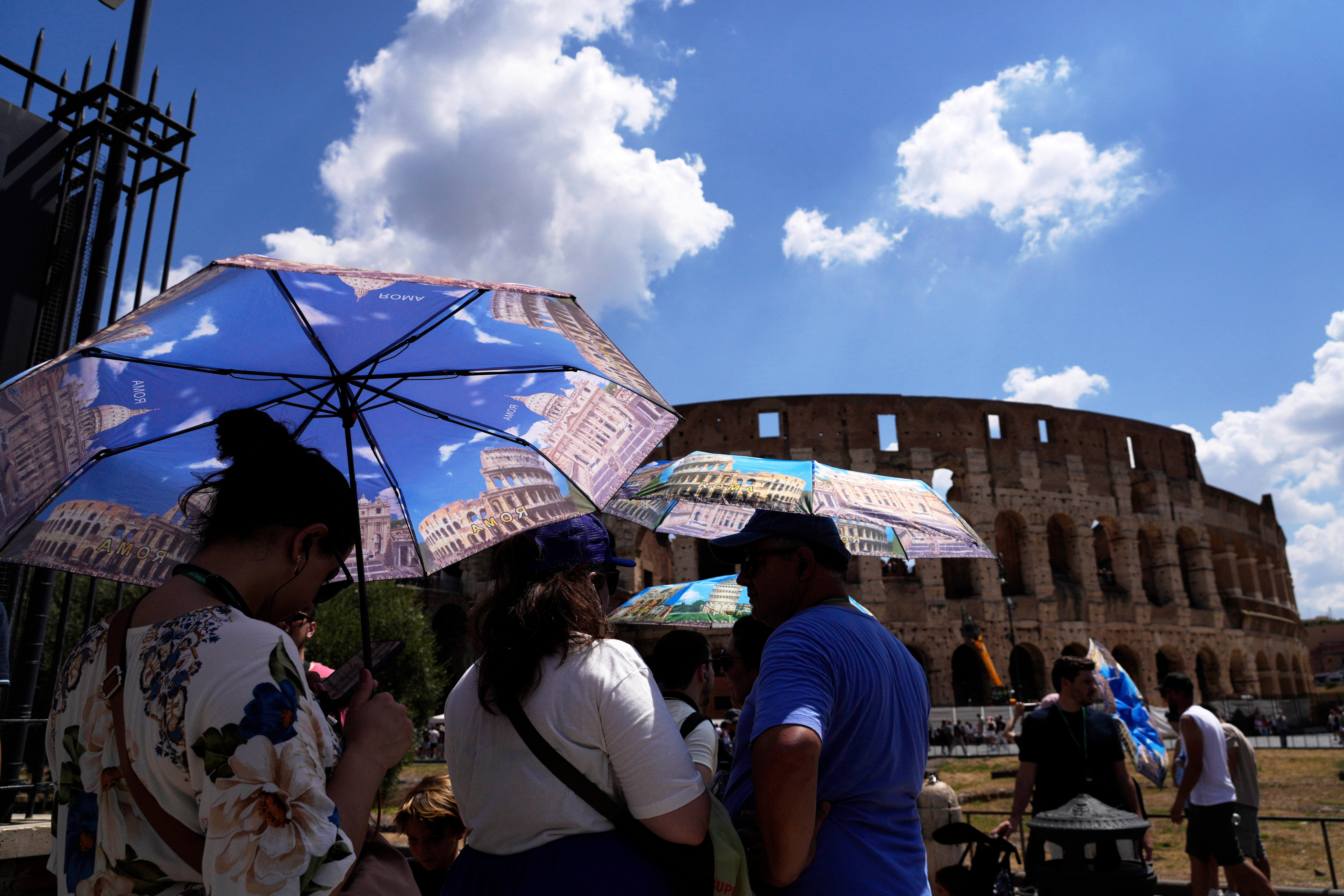
open image in galleryTourists use umbrellas to shelter from the heat as they line up for a tour of the Forum in Rome, on Tuesday, July 22, 2025. (AP Photo/Gregorio Borgia) (Copyright 2025 The Associated Press. All rights reserved.)
At midday on July 22, he led his group down the Forum’s Via Sacra, the central road in ancient Rome. They paused at a fountain to rinse their faces and fill their bottles.
Dehydrated tourists often pass out here in the summer heat, said Francesca Duimich, who represents 300 Roman tour guides in Italy’s national federation, Federagit.
“The Forum is a pit; There is no shade, there is no wind,” Duimich said. “Being there at 1 p.m. or 2 p.m. in the summer heat means you will feel unwell.”
This year, guides have bombarded her with complaints about the heat. In recent weeks, Federagit requested that the state’s Colosseum Archaeological Park, which oversees the Forum, open an hour earlier so tours can get a jump-start before the heat becomes punishing. The request has been to no avail, so far.
The park’s press office said that administrators are working to move the opening up by 30 minutes and will soon schedule visits after sunset.
Thursday 24 July 2025
The Independent
open image in galleryStreet cleaner Raúl Rodriguez rests during a protest over the death of fellow cleaner during a recent heat wave in Barcelona, Spain, Wednesday, July 16, 2025. (AP Photo/Joan Mateu Parra, File) (Joan Mateu Parra)
Southern Europe is grappling with a brutal heatwave this summer, creating a stark divide between air-conditioned comfort and the perilous reality for outdoor workers.
Such labour can be gruelling, even deadly. Last month, a street sweeper in Barcelona died during the extreme heat, and a labour union reports 12 other city cleaners have since suffered heatstroke.
In response, powerful European unions are pushing for tougher regulations to protect the aging workforce from climate change, on what is already the world's fastest-warming continent.
Deadly heat in Barcelona
Hundreds of street cleaners and concerned citizens marched through downtown Barcelona last week to protest the death of Montse Aguilar, a 51-year-old street cleaner who worked even as the city's temperatures hit a June record.
Fellow street sweeper Antonia Rodríguez said at the protest that blistering summers have made her work “unbearable.”
“I have been doing this job for 23 years and each year the heat is worse,” said Rodríguez, 56. “Something has to be done.”
Extreme heat has fueled more than 1,000 excess deaths in Spain so far in June and July, according to the Carlos III Health Institute.
“Climate change is, above all, playing a role in extreme weather events like the heat waves we are experiencing, and is having a big impact in our country,” said Diana Gómez, who heads the institute’s daily mortality observatory.
open image in galleryPeople march in Barcelona to protest the death of street cleaner Montse Aguilar during a recent heat wave in Spain, Wednesday, July 16, 2025. The banner in Spanish reads, “Extreme Heat is also Workplace Violence. Justice for Montse." (AP Photo/Joan Mateu Parra, File) (Copyright 2025 The Associated Press. All rights reserved.)
Even before the march, Barcelona’s City Hall issued new rules requiring the four companies contracted to clean its streets to give workers uniforms made of breathable material, a hat and sun cream. When temperatures reach 34 C (93 F), street cleaners now must have hourly water breaks and routes that allow time in the shade. Cleaning work will be suspended when temperatures hit 40 C (104 F).
Protesters said none of the clothing changes have been put into effect and workers are punished for allegedly slacking in the heat. They said supervisors would sanction workers when they took breaks or slowed down.
Workers marched behind a banner reading “Extreme Heat Is Also Workplace Violence!" and demanded better summer clothing and more breaks during the sweltering summers. They complained that they have to buy their own water.
FCC Medio Ambiente, the company that employed the deceased worker, declined to comment on the protesters' complaints. In a previous statement, it offered its condolences to Aguilar's family and said that it trains its staff to work in hot weather.
Emergency measures and a Greek cook
In Greece, regulations for outdoor labor such as construction work and food delivery includes mandatory breaks. Employers are also advised — but not mandated — to adjust shifts to keep workers out of the midday sun.
open image in galleryGrill cook Thomas Siamandas makes traditional souvlaki in a restaurant in the central Monastiraki district during a hot day in Athens on Wednesday, July 16, 2025. (AP Photo/Petros Giannakouris) (Copyright 2025 The Associated Press. All rights reserved)
Greece requires heat-safety inspections during hotter months but the country's largest labor union, the GSEE, is calling for year-round monitoring.
European labor unions and the United Nations’ International Labor Organization are also pushing for a more coordinated international approach to handling the impact of rising temperatures on workers.
"Heat stress is an invisible killer,” the ILO said in a report last year on how heat hurts workers.
It called for countries to increase worker heat protections, saying Europe and Central Asia have experienced the largest spike in excessive worker heat exposure this century.
In Athens, grill cook Thomas Siamandas shaves meat from a spit in the threshold of the famed Bairaktaris Restaurant. He is out of the sun, but the 38 C (100.4 F) temperature recorded on July 16 was even tougher to endure while standing in front of souvlaki burners.
Grill cooks step into air-conditioned rooms when possible and always keep water within reach. Working with a fan pointed at his feet, the 32-year-old said staying cool means knowing when to take a break, before the heat overwhelms you.
“It’s tough, but we take precautions: We sit down when we can, take frequent breaks and stay hydrated. We drink plenty of water — really a lot,” said Siamandas, who has worked at the restaurant for eight years. “You have to find a way to adjust to the conditions.”
The blazing sun in Rome
Massimo De Filippis spends hours in the blazing sun each day sharing the history of vestal virgins, dueling gladiators and powerful emperors as tourists shuffle through Rome’s Colosseum and Forum.
“Honestly, it is tough. I am not going to lie,” the 45-year-old De Filippis said as he wiped sweat from his face. “Many times it is actually dangerous to go into the Roman Forum between noon and 3:30 p.m.”
open image in galleryTourists use umbrellas to shelter from the heat as they line up for a tour of the Forum in Rome, on Tuesday, July 22, 2025. (AP Photo/Gregorio Borgia) (Copyright 2025 The Associated Press. All rights reserved.)
At midday on July 22, he led his group down the Forum’s Via Sacra, the central road in ancient Rome. They paused at a fountain to rinse their faces and fill their bottles.
Dehydrated tourists often pass out here in the summer heat, said Francesca Duimich, who represents 300 Roman tour guides in Italy’s national federation, Federagit.
“The Forum is a pit; There is no shade, there is no wind,” Duimich said. “Being there at 1 p.m. or 2 p.m. in the summer heat means you will feel unwell.”
This year, guides have bombarded her with complaints about the heat. In recent weeks, Federagit requested that the state’s Colosseum Archaeological Park, which oversees the Forum, open an hour earlier so tours can get a jump-start before the heat becomes punishing. The request has been to no avail, so far.
The park’s press office said that administrators are working to move the opening up by 30 minutes and will soon schedule visits after sunset.
Scorching heat, drought: A new normal for British summers?
‘It’s hard to say this summer has been typical so far when we look at statistics,’ says national meteorological service scientist
Aysu Bicer |24.07.2025 - TRT/AA
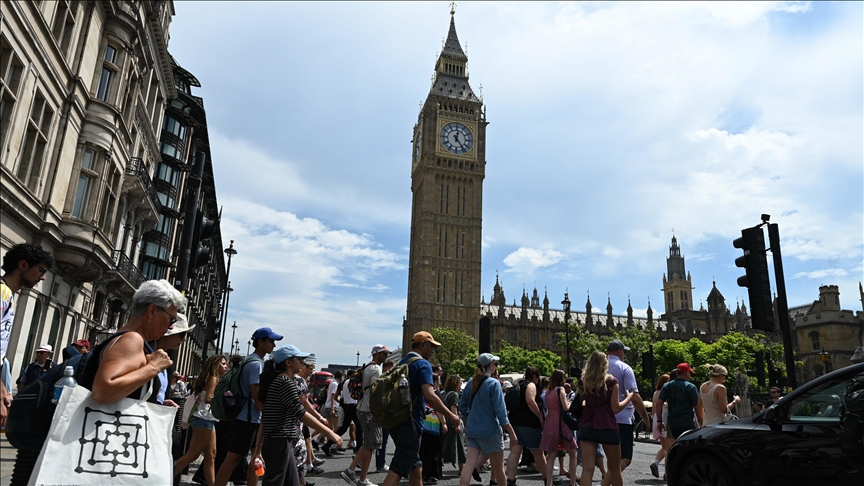
‘It’s hard to say this summer has been typical so far when we look at statistics,’ says national meteorological service scientist
Aysu Bicer |24.07.2025 - TRT/AA
United Kingdom (Photo byRasid Necati Aslım)
LONDON
With record-breaking temperatures, severe drought and a surge in wildfires, the summer of 2025 is shaping up as one of the most extreme in UK history.
After an exceptional spring and a sweltering June, this summer’s first half has underscored a shifting pattern: hotter days, longer dry spells and recurring heat waves are no longer rare outliers but part of the landscape.
“Spring 2025 was exceptional, going down as the UK’s warmest and sunniest on record,” the UK Met Office, the national meteorological service, said.
That heat carried into June, which became the warmest ever in England, and the second warmest for the UK overall in records dating back to 1884.
As of 15 July, the UK’s mean summer temperature was running 1.14C (2.1F) above the long-term average — with England even higher at 1.58C (2.8F). Maximums in England were 2.14C (3.85F) above average.
While the country hasn’t reached its all-time high of 40.3C (104.5F) set in July 2022, the heat has still been punishing. On 1 July, Faversham in Kent recorded the year’s top temperature at 35.8C (96.4F), while London hit 34.7C (94.5F).
“It’s hard to say this summer has been typical so far when we look at the statistics,” said Emily Carlisle, a Met Office climate scientist, in a statement. “Warmth has continued into July, with three heat waves so far this summer and temperatures rising again later this week. There is, of course, still a month-and-a-half of meteorological summer to go, so plenty of time for things to change.”
The dry conditions are just as extreme. England saw its driest January-to-June stretch since 1976, triggering drought alerts in multiple regions.
Wildfire risk has soared. The London Fire Brigade has responded to more than 30 wildfires this year, putting 2025 on track to be the busiest fire season since 2022.
National Resilience data revealed a sharp rise in wildfire incidents across England and Wales — 564 between January and mid-June, a 717% increase from the same period in 2024, and more than double 2022’s count at that time, which ended as the UK’s worst wildfire year on record.
A clear pattern
The UK’s changing climate is charted in the latest State of the UK Climate report, published in the International Journal of Climatology by the Royal Meteorological Society.
The data show steady warming since the 1980s, with extreme temperature days becoming more frequent. The hottest summer days and coldest winter nights are warming at twice the pace of average seasonal temperatures in some regions.
The Met Office said 2024 was the fourth warmest year since 1884 – and 2025 is already on track to surpass it in several categories.
A recent Met Office study found there’s now a 50% chance of the UK hitting 40C (104F) again within the next 12 years — a sharp jump in probability.
With three heat waves already recorded and another warm surge on the way, summer 2025 could become a defining chapter in Britain’s climate history.
LONDON
With record-breaking temperatures, severe drought and a surge in wildfires, the summer of 2025 is shaping up as one of the most extreme in UK history.
After an exceptional spring and a sweltering June, this summer’s first half has underscored a shifting pattern: hotter days, longer dry spells and recurring heat waves are no longer rare outliers but part of the landscape.
“Spring 2025 was exceptional, going down as the UK’s warmest and sunniest on record,” the UK Met Office, the national meteorological service, said.
That heat carried into June, which became the warmest ever in England, and the second warmest for the UK overall in records dating back to 1884.
As of 15 July, the UK’s mean summer temperature was running 1.14C (2.1F) above the long-term average — with England even higher at 1.58C (2.8F). Maximums in England were 2.14C (3.85F) above average.
While the country hasn’t reached its all-time high of 40.3C (104.5F) set in July 2022, the heat has still been punishing. On 1 July, Faversham in Kent recorded the year’s top temperature at 35.8C (96.4F), while London hit 34.7C (94.5F).
“It’s hard to say this summer has been typical so far when we look at the statistics,” said Emily Carlisle, a Met Office climate scientist, in a statement. “Warmth has continued into July, with three heat waves so far this summer and temperatures rising again later this week. There is, of course, still a month-and-a-half of meteorological summer to go, so plenty of time for things to change.”
The dry conditions are just as extreme. England saw its driest January-to-June stretch since 1976, triggering drought alerts in multiple regions.
Wildfire risk has soared. The London Fire Brigade has responded to more than 30 wildfires this year, putting 2025 on track to be the busiest fire season since 2022.
National Resilience data revealed a sharp rise in wildfire incidents across England and Wales — 564 between January and mid-June, a 717% increase from the same period in 2024, and more than double 2022’s count at that time, which ended as the UK’s worst wildfire year on record.
A clear pattern
The UK’s changing climate is charted in the latest State of the UK Climate report, published in the International Journal of Climatology by the Royal Meteorological Society.
The data show steady warming since the 1980s, with extreme temperature days becoming more frequent. The hottest summer days and coldest winter nights are warming at twice the pace of average seasonal temperatures in some regions.
The Met Office said 2024 was the fourth warmest year since 1884 – and 2025 is already on track to surpass it in several categories.
A recent Met Office study found there’s now a 50% chance of the UK hitting 40C (104F) again within the next 12 years — a sharp jump in probability.
With three heat waves already recorded and another warm surge on the way, summer 2025 could become a defining chapter in Britain’s climate history.

No comments:
Post a Comment