SPACE/COSMOS
Africa sees space as 'a means to an end'
For space scientist Temidayo Oniosun, 'space is nothing new in Africa'

ADVERTISEMENT
For Temidayo Oniosun, the story is the same as it ever was: "Space is nothing new in Africa." But the dimensions have changed, said the space scientist and founder of Space in Africa , a think tank in Lagos, Nigeria.
During the early space race in the 1960s, African countries played an important role in the Apollo moon missions, Oniosun told DW. They hosted critical infrastructure, without which, "the missions wouldn't have been possible."
"But nobody talked about that," Oniosun said. "When America sent [NASA astronaut] Neil Armstrong to the moon, it wasn't like, 'This is good for America, and we thank Africa and other regions for their contribution.' But Africa played a role in that. And the reason we tell this story is to provide the context that space isn't a brand new thing in Africa."
What has changed, however, is that African countries don't just host infrastructure these days — they build and own the infrastructure, design and launch satellites, with space technology specific to the continent's needs.
Space science in Africa is 'niche'
According to Oniosun, it's important to understand that "space is a means to an end" in Africa. It is technology that people use to make their lives better.
"These guys are not thinking, 'We want to go to the moon or Mars.' They're thinking, 'I can use this satellite to provide connectivity to my village. I've got flooding issues, drought issues, my farm is not yielding, and I can use this satellite data to improve that.'"
Could space debris endanger the ozone layer again? 07:48
A lot of satellite data is freely available. But African countries have needs that are specific to the equatorial region, and European and other satellite programs often don't cater to those needs.
Olugbenga Olumodimu, a space program manager at the University of Portsmouth in the UK, thinks African space science is "very niche."
"If I try to replicate [what I do here] in Africa, it is not going to work," he told DW. "So, I have to learn the physics of the equator. You need to understand what they do, to make what you know, applicable."
Sometimes it's a matter of using different instruments to measure region-specific data, or positioning a satellite at a particular angle to achieve the best measurements. But ultimately it comes down to the data people in Africa need.
Take, for example, solar storms — or space weather — which is a global threat. A severe solar storm has the potential to knock out national power grids, and that effect may be the same in more than one region at the same time.
Other effects may vary from region to region. In northern latitudes of the planet, solar storms are considered a threat to radio signals, such as communications between airplanes and ground control stations. In Nigeria, solar storms are considered a greater threat to the performance of petroleum pipelines, a major factor in its hydrocarbon economy.
But put both sets of data together and everyone gets a fuller picture of the effects of solar weather.
"If parts of the Earth are not sufficiently covered like other places, then the science is not complete," said Olumodimu. "We work together to make the science effective."
Olumodimu noted there were plans for a collaboration to design a satellite that will measure space-weather effects in the high- and mid-latitudes and in the equatorial region at the same time.
"When we have that sort of data, it is easier to do what we call global science," he said.
In South Africa, meanwhile, the military is also concerned about the effects of solar weather. It shares that data — for instance, with the European Space Agency — which then in turn makes the data available as a global service.
"Such services usually go on for decades," said Thomas Weissenberg, an external relations Africa expert at the European Space Agency. "A solar storm could hit satellites and simply destroy them. It could be the end of many Earth Observation satellites, communication satellites, Starlink and so on."
Europe and Africa have collaborated on space projects for 30 years. In January 2025, the European Commission recommitted with a new Africa-EU Space Partnership Programme worth €100 million ($117 million).
"[Our partnership] has gotten more intensive, especially in the past five to eight years due to developments in Africa and in Europe as well. Geopolitical reasons might play a role as well," Weissenberg told DW.
African Space Agency marks a new chapter
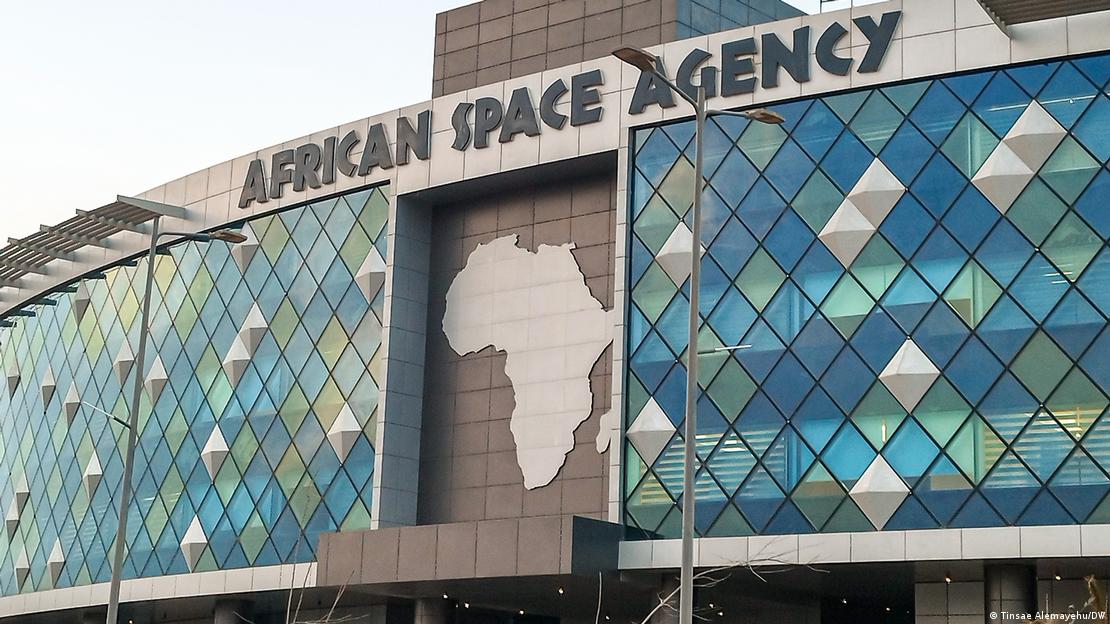
When the Africa Space Agency (AfSA) was inaugurated in April 2025 in Cairo, Egypt, it may well have marked a new chapter in Africa's space story. AfSA aims to bring countries together to work together, share infrastructure and data.
"You've got countries like Egypt, Nigeria, Algeria and South Africa — some of their national space programs are more than two decades old," said Oniosun. "Then you've got relatively young space programs — the Kenyan Space Agency was founded in 2017, Ethiopia and Rwanda. Countries like that are at a different level. Now, everybody is talking with each other."
Olumodimu distinguishes between "spacefaring" and "space-aspiring" countries, without wishing to offend any of the younger space countries, as he added.
"When we started in Nigeria with the first communication satellite, part of the work was done at the Surrey Satellite Centre, UK, and the launch was done from Asia," said Olumodimu. "But right now, there is quite a lot going on within the African continent itself."
It's hoped that AfSA will aid the transfer of knowledge and technology on the African continent, no matter a country's level of expertise. And it seems to be working: everyone is looking to collaborate with Egypt, AfSA's host country.
"Egypt's ambition is to be at the forefront [of space in Africa]," said Olumodimu.
How AfSA's fortunes will develop, is, however, "uncertain," said Weissenberg. "Africa is even more complicated in Europe." Chances are they will succeed — if alone for the fact that they have the backing of China.
"One word on Egypt," said Weissenberg, "they are smart. They launched a strategic partnership with China."
Weissenberg stresses that China built the whole AfSA site, from the buildings to the technical infrastructure. And in return for their investment, "they get control over Africa. It's that simple."
Edited by: Uwe Hessler
Mapping the Universe, faster and with the same accuracy
A new JCAP study tests an “emulator” to reconstruct the large-scale structure of the cosmos
Sissa Medialab
image:
Two ‘fans’ corresponding to the two main areas DESI has observed, above and below the plane of our Milky Way (see this map). DESI is mounted on the U.S. National Science Foundation Nicholas U. Mayall 4-meter Telescope at Kitt Peak National Observatory (KPNO), a Program of NSF NOIRLab. DESI has made the largest 3D map of our Universe to date and uses it to study dark energy. Earth is at the center of the two fans, where bluer points indicate more distant objects. This is a still from an animated rotation of the DESI Year-3 data map.
view moreCredit: DESI Collaboration/DOE/KPNO/NOIRLab/NSF/AURA/R. Proctor https://kpno.noirlab.edu/images/noirlab2512ab/
If you think a galaxy is big, compare it to the size of the Universe: it’s just a tiny dot which, together with a huge number of other tiny dots, forms clusters that aggregate into superclusters, which in turn weave into filaments threaded with voids—an immense 3D skeleton of our Universe.
If that gives you vertigo and you’re wondering how one can understand or even “see” something so vast, the answer is: it isn’t easy. Scientists combine the physics of the Universe with data from astronomical instruments and build theoretical models, such as EFTofLSS (Effective Field Theory of Large-Scale Structure). Fed with observations, these models describe the “cosmic web” statistically and allow its key parameters to be estimated.
Models like EFTofLSS, however, demand a lot of time and computing resources. Since the astronomical datasets at our disposal are growing exponentially, we need ways to lighten the analysis without losing precision. This is why emulators exist: they “imitate” how the models respond, but operate much faster.
Since this is a kind of “shortcut,” what’s the risk of losing accuracy? An international team including, among others, INAF (Italy), The University of Parma (Italy) and the University of Waterloo (Canada) has published in the Journal of Cosmology and Astroparticle Physics (JCAP) a study testing the emulator Effort.jl, which they designed. It shows that Effort.jl delivers essentially the same correctness as the model it imitates—sometimes even finer detail—while running in minutes on a standard laptop instead of a supercomputer.
“Imagine wanting to study the contents of a glass of water at the level of its microscopic components, the individual atoms, or even smaller: in theory you can. But if we wanted to describe in detail what happens when the water moves, the explosive growth of the required calculations makes it practically impossible,” explains Marco Bonici, a researcher at the University of Waterloo and first author of the study. “However, you can encode certain properties at the microscopic level and see their effect at the macroscopic level, namely the movement of the fluid in the glass. This is what an effective field theory does, that is, a model like EFTofLSS, where the water in my example is the Universe on very large scales and the microscopic components are small-scale physical processes.”
The theoretical model statistically explains the structure that gives rise to the data collected: the astronomical observations are fed to the code, which computes a “prediction.” But this requires time and substantial compute. Given today’s data volume—and what is expected from surveys just begun or coming soon (such as DESI, which has already released its first batch of data, and Euclid)—it’s not practical to do this exhaustively every time.
“This is why we now turn to emulators like ours, which can drastically cut time and resources,” Bonici continues. An emulator essentially mimics what the model does: its core is a neural network that learns to associate the input parameters with the model’s already-computed predictions. The network is trained on the model’s outputs and, after training, can generalize to combinations of parameters it hasn’t seen. The emulator doesn’t “understand” the physics itself: it knows the theoretical model’s responses very well and can anticipate what it would output for a new input. Effort.jl’s originality is that it further reduces the training phase by building into the algorithm knowledge we already have about how predictions change when parameters change: instead of making the network “re-learn” these, it uses them from the start. Effort.jl also uses gradients—i.e., “how much and in which direction” predictions change if you tweak a parameter by a tiny amount—another element that helps the emulator learn from far fewer examples, cutting compute needs and allowing it to run on smaller machines.
A tool like this needs extensive validation: if the emulator doesn’t know the physics, how sure are we that its shortcut yields correct answers (i.e., the same ones the model would give)? The newly published study answers exactly this, showing that Effort.jl’s accuracy—on both simulated and real data—is in close agreement with the model. “And in some cases, where with the model you have to trim part of the analysis to speed things up, with Effort.jl we were able to include those missing pieces as well,” Bonici concludes. Effort.jl thus emerges as a valuable ally for analyzing upcoming data releases from experiments like DESI and Euclid, which promise to greatly deepen our knowledge of the Universe on large scales.
The study “Effort.jl: a fast and differentiable emulator for the Effective Field Theory of the Large Scale Structure of the Universe” by Marco Bonici, Guido D’Amico, Julien Bel and Carmelita Carbone is available in the Journal of Cosmology and Astroparticle Physics (JCAP).
Journal
Journal of Cosmology and Astroparticle Physics
Method of Research
Data/statistical analysis
Article Title
Effort.jl: a fast and differentiable emulator for the Effective Field Theory of the Large Scale Structure of the Universe
Article Publication Date
16-Sep-2025
UC3M participates in research to protect astronaut' cardiovascular and ocular health
Parabolic flights supported by the Spanish Space Agency
image:
Research Team
view moreCredit: Ana Díaz Artíles
A pioneering international project led by prominent female scientists, involving research staff from the Universidad Carlos III de Madrid (UC3M) and promoted by the Spanish Space Agency (AEE), has just completed its parabolic flight campaign in Bordeaux (France). Its main objective is to study and counteract the adverse effects of microgravity on the human body, a key challenge for future exploration of the Moon and Mars.
The research is led by Professor Ana Díaz Artiles, from Texas A&M University (TAMU, USA) and honorary professor in the Department of Aerospace Engineering at UC3M. Her team tested an innovative countermeasure to protect the cardiovascular and ocular health of astronauts on long-duration missions. “The results of this research will not only be crucial for the future of human space exploration, but could also have important applications on Earth, such as in the treatment of vascular diseases and cardiovascular rehabilitation,” explains Ana Díaz Artiles.
This project marks a milestone due to its approach and its team members, which include a notable number of women and Spanish participants. Participants include: Sara García Alonso, reserve astronaut for the European Space Agency (ESA); Isabel Vera Trallero, director of the Office of Space and Society at the Spanish Space Agency; and Beatriz Puente-Espada, director of the Aerospace Medicine Training Center (CIMA) of the Air and Space Force. The Spanish team is completed by: Professor Óscar Flores Arias, director of the Department of Aerospace Engineering at UC3M; master's student Huc Pentinat Llurba at TAMU; and the participation of the National Institute of Aerospace Technology (INTA).
Cutting-edge science to counteract the challenges of microgravity
During space missions, the absence of gravity gradients causes a redistribution of body fluids towards the head, which can cause vision problems, increased intracranial pressure, and increased risk of blood clots in the neck. To combat these effects, the team tested a technique called Lower Body Negative Pressure (LBNP), which applies negative pressure to the legs to redistribute fluids back to the lower body and normalize circulation.
“The most interesting thing about this project is that we are evaluating such a promising countermeasure as LBNP in real microgravity conditions. This will allow us to analyze the effectiveness of LBNP in protecting the ocular and cardiovascular health of astronauts, two of the major challenges of long-duration space missions,” says Oscar Flores. In addition to marking a turning point in protecting the health of astronauts, “the validation of the LBNP technique may also open the door to medical applications here on Earth” he adds.
Throughout the parabolic flight, the effectiveness of this technique will be analyzed by measuring blood circulation in the neck and other cardiovascular and ocular parameters. This collaborative effort is an example of global research with renowned partners in the US, such as the University of California, Davis, and the University of Florida. The project is funded by ESA, NASA, TAMU, and Lockheed Martin Corporation, underscoring its international importance.
Method of Research
Experimental study
Subject of Research
People

No comments:
Post a Comment