David Edwards
November 24, 2025
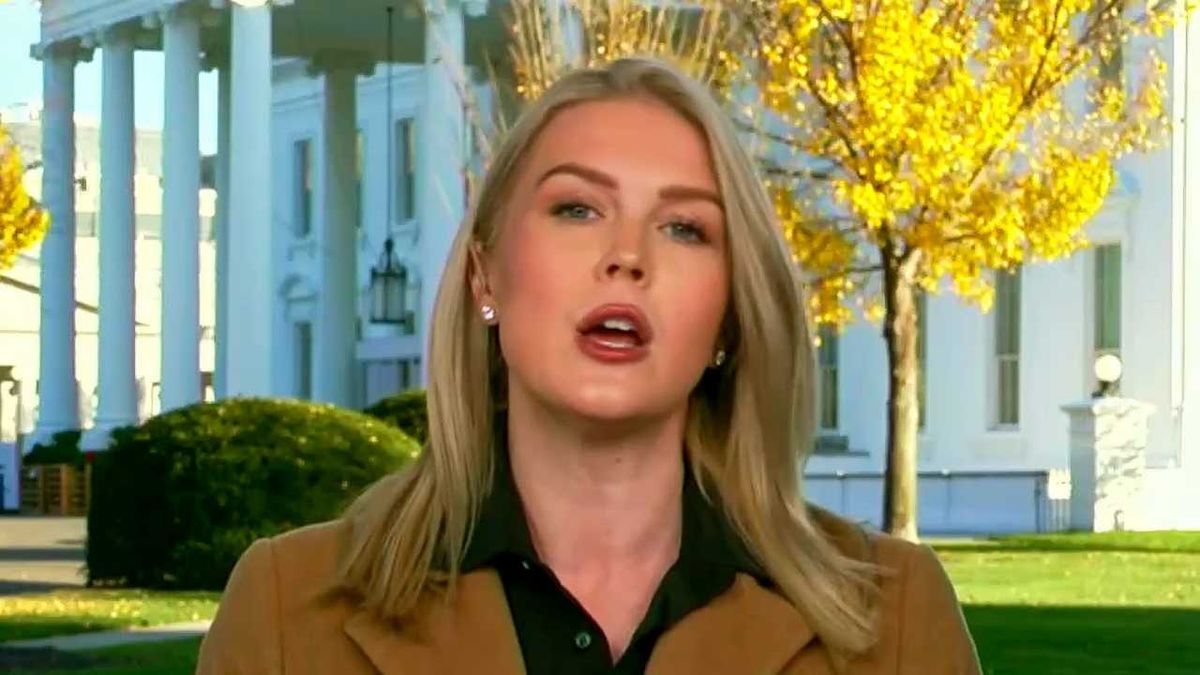
Fox News/screen grab
White House Press Secretary Karoline Leavitt insisted that the United States "can't have" soldiers questioning whether orders are legal after Democrats pointed out that troops have a responsibility not to follow illegal orders.
During a Monday interview on Fox News, Leavitt said Democrats were giving "a wink and a nod to the 1.3 million active duty service members who serve in our United States armed forces and essentially encourage them to defy the orders of their commander-in-chief."
"Not a single order this president or administration has given to our military has ever been illegal, nor will it ever be," she insisted. "This administration respects and abides by the law."
"You can't have a soldier out on the battlefield or conducting a classified order questioning whether that is lawful or whether they should follow through. There must be a chain of command in our military."
Despite Leavitt's claim, the Uniform Code of Military Justice (UCMJ) states that service members can be liable for following unlawful orders, including burglary, murder, assault, rape, and property destruction. The UCMJ also prohibits "all conduct of a nature to bring discredit upon the armed forces, and crimes and offenses."
Pentagon Threatens to Court Martial Democrat Who Warned Troops Against Following Illegal Trump Orders
“Fuck you and your investigation,” replied Sen. Ruben Gallego in defense of fellow Arizona Democratic Sen. Mark Kelly.
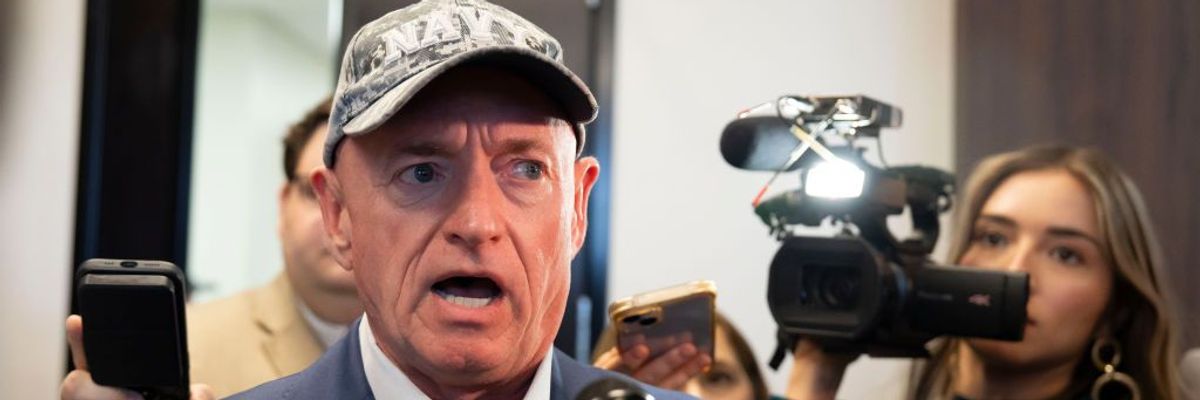
Sen. Mark Kelly (D-AZ) takes questions from press after a town hall at NOAH Cholla Health Center on March 17, 2025 in Scottsdale, Arizona.
(Photo by Rebecca Noble/Getty Images)
Brad Reed
Nov 24, 2025
COMMON DREAMS
The US Department of Defense on Monday announced it was launching an investigation into a Democratic senator who had participating in a video warning active-duty troops to not follow illegal orders given by President Donald Trump.
In a social media post, the DoD said it had “received serious allegations of misconduct” against Sen. Mark Kelly (D-Ariz.), a retired US Navy captain who was one of several Democrats with backgrounds in national defense to speak out against the president potentially giving unlawful orders that pit the US military against American civilians.
As a result of the investigation, the DoD said that Kelly could be recalled to active duty to face potential court-martial proceedings for violating the Uniform Code of Military Justice (UCMJ).
“All servicemembers are reminded that they have a legal obligation under the UCMJ to obey lawful orders and that orders are presumed to be lawful,” the DoD said. “A servicemember’s personal philosophy does not justify or excuse the disobedience of an otherwise lawful order.”
In addition to Kelly, Sen. Elissa Slotkin (D-Mich.) and Reps. Chris Deluzio (D-Penn.), Maggie Goodlander (D-NH), Chrissy Houlahan (D-Md.), and Jason Crow (D-Colo.) appeared in the video.
In a follow-up social media post, Defense Secretary Pete Hegseth attacked the Democrats in the video as the “seditious six” and said that Kelly had been singled out for investigation because he was the only member who was still subject to UCMJ given his status as a retired Naval officer.
“As was announced, the Department is reviewing his statements and actions, which were addressed directly to all troops while explicitly using his rank and service affiliation—lending the appearance of authority to his words,” wrote Hegseth. “Kelly’s conduct brings discredit upon the armed forces and will be addressed appropriately.”
Trump has been calling for the prosecution of the six Democrats who appeared in the video for the last several days, and he even went so far as to say in one Truth Social post they deserve to be executed for “SEDITIOUS BEHAVIOR, punishable by DEATH!”
Shortly after the Pentagon announced its investigation into Kelly, he responded with a lengthy social media post in which he defended his service record and vowed not to back down despite threats from the Trump administration.
“If this is meant to intimidate me and other members of Congress from doing our jobs and holding this administration accountable, it won’t work,” he said. “I’ve given too much to this country to be silenced by bullies who care more about their own power than protecting the Constitution.”
Sen. Ruben Gallego (D-Ariz.) responded on X with a much shorter five-word post that read, “Fuck you and your investigation.”
Matthew Chapman
November 24, 2025

U.S. Defense Secretary Pete Hegseth closes his eyes as he stands by U.S. President Donald Trump (not pictures), in the Oval Office at the White House, in Washington, D.C., U.S., March 21, 2025. REUTERS/Carlos Barria
President Donald Trump's Defense Secretary, Pete Hegseth, has threatened to call up Sen. Mark Kelly (D-AZ) into active military service again, just so he can court-martial him — but even if he goes through with this plan, it is likely to backfire spectacularly, some observers warned on Monday.
Kelly is one of six Democratic lawmakers from a military background who made a joint video reminding active servicemembers that if they are given illegal orders, like to kill unarmed civilians or take over civilian law enforcement in American cities, they have a duty to refuse those orders.
This is clearly outlined in the Uniform Code of Military Justice — but ever since the video came out, Trump and his devotees have falsely claimed these lawmakers are trying to countermand lawful orders, with Trump even calling the video "seditious" and threatening to have them executed.
But Hegseth, who now calls his position "Secretary of War" under an executive order Trump signed, would be wise to just let this go, some commenters noted on social media — because to actually try to prosecute him under military law would not just fail, but give Kelly a massive profile and fundraising boost and possibly even position him as a top-tier presidential candidate in 2028.
"Alternate headline: Pentagon threatens to make Mark Kelly the first Senator to raise $1 billion for their next election," wrote Inside Elections' Jacob Rubashkin.
Erick Erickson, a longtime conservative commentator, agreed: "Thanks to Pete Hegseth, this guy is going to make so much money this coming year as a fundraiser and he’s in prime position now for 2028 over Gavin Newsom."
Kelly, for his part, posted a defiant response on X himself.
"In combat, I had a missile blow up next to my jet and flew through anti-aircraft fire to drop bombs on enemy targets. At NASA, I launched on a rocket, commanded the space shuttle, and was part of the recovery mission that brought home the bodies of my astronaut classmates who died on Columbia. I did all of this in service to this country that I love and has given me so much," wrote Kelly. "If this is meant to intimidate me and other members of Congress from doing our jobs and holding this administration accountable, it won’t work. I’ve given too much to this country to be silenced by bullies who care more about their own power than protecting the Constitution."
Trump’s ‘Unlawful Orders’ Dispute
President Donald Trump is at the center of yet another bitter constitutional crisis. His political adversaries have mounted a concerted campaign urging military personnel to disobey any “illegal orders.” Trump responded to such calls by threatening to prosecute and even execute proponents for engaging in “seditious behavior.” Since the U.S. Constitution designates the president as commander-in-chief of the armed services, Trump is, of course, currently at the top of the military’s chain of command. Defiance by subordinates, he asserted, would constitute treason.
There are numerous important issues at stake. They include the proper extent of the president’s powers under the Constitution, preserving civilian control of the military, the nature of the oath that military personnel take to protect and defend the Constitution, and the appropriate remedy if it appears that the president as commander-in-chief has given an unlawful order.
According to the Washington Post, Trump’s wrath apparently was triggered by a video organized by Sen. Elissa Slotkin (D-Michigan), a former CIA analyst. It features Slotkin and other lawmakers (many of whom are military veterans) who contend that “threats to our Constitution aren’t just coming from abroad, but from right here at home.” They add bluntly: “Our laws are clear. You can refuse illegal orders.”
It was not entirely clear which specific orders upset the lawmakers, but the video came out right after the Trump administration authorized military strikes against alleged drug-trafficking boats in the Caribbean and Pacific, threatened military action in Venezuela, and deployed the National Guard into U.S. cities — actions which have sparked legal challenges and widespread concerns.
Slotkin and other critics contend that enlistees in the military take an oath to obey the Constitution, not the commander-in-chief or any other official. That point is true to some extent, but the concept of “unlawful orders” is not objective or self-defining. Even the oath of enlistment itself is somewhat murky. Personnel taking the oath swear both to “support and defend the Constitution of the United States against all enemies” and to “obey the orders of the President of the United States and the orders of the officers appointed over me.” Military officers swear the oath of commissioned officers, which contains very similar language.
The oaths do not directly address the problem of how to deal with a situation when an order from the president or another military official might violate the Constitution. The Uniform Code of Military Justice (UCMJ) requires members of the armed services to obey all lawful orders but also obligates them to disobey any unlawful order. Those twin requirements would seem to create a conceptual mess for anyone not having a law degree and an extensive background in the specifics of military law.
The language of the UCMJ and other relevant statutes also seems to leave a person in the military adrift about what exactly to do if they conclude that an order is indeed unlawful. If the individual disobeys an order that authorities later determine to be lawful, they risk being court martialed. Conversely, if one abides by an unlawful order, that person might be deemed to have violated the oath to protect and defend the Constitution.
Probably the best course among a set of highly imperfect ones facing a member of the military who believes that an order is unlawful is to resign and then publicly state the reasons for refusing to execute the order. That course would at least be honorable, albeit somewhat perilous. Refusing to implement an order, but staying on in one’s post to sabotage the president’s policy is both dangerously disruptive and dishonorable.
As a society, America also faces a nasty dilemma. The danger certainly exists that a rogue president could negate important features of democratic rule and establish a dictatorship. Indeed, many of Trump’s opponents allege that he attempted to stage an executive coup on January 6, 2021, when his supporters rioted and penetrated the U.S. Capitol. His critics now contend that he is once again trying to acquire dictatorial powers.
If that allegation ultimately proves to be true, history likely would praise any military leaders who impeded or defied his attempt to become a dictator. But such a dire scenario is far from indisputable. Trump certainly has expanded executive power in dangerous and unhealthy ways from the standpoint of civil liberties and constitutional norms. However, many of his predecessors committed similar offenses and set numerous worrisome precedents. Yet most of the critics who excoriate Trump for his conduct either remained silent or explicitly endorsed earlier episodes. For example, a plethora of critics denounce the administration for attacking boats suspected of carrying drugs out of Venezuela and considering a regime-change war to oust that country’s leftist dictator. But most of those self-proclaimed guardians of the Constitution were conspicuously silent about or even supported Washington’s equally illicit regime-change crusades in such places as Iraq, Libya, Syria, and Ukraine.
Moreover, if the allegation that Trump is trying to establish a dictatorship proves to be bogus, encouraging military figures to defy the president’s orders risks creating chaos in the chain of command and badly weakening the military as a reliable institution. Worse, such disobedience undermines the core constitutional principle of civilian control of the military. America’s founders wisely designated an elected civilian official to the commander-in-chief of the military.
Do we really want members of the military, especially high-ranking officers, deciding whether or not to obey an order from the commander-in-chief? Embracing such a mentality entails the inherent risk of encouraging military leaders to substitute their judgment for that of the president. Down that path lies an enhanced risk of a coup by the military elite.
Dr. Ted Galen Carpenter is a senior fellow at the Randolph Bourne Institute and the Libertarian Institute. He is also a contributing editor to National Security Journal and The American Conservative. He also served in various senior policy positions during a 37-year career at the Cato Institute. Dr. Carpenter is the author of 13 books and more than 1,600 articles on defense, foreign policy and civil liberties issues. His latest book is Unreliable Watchdog: The News Media and U.S. Foreign Policy (2022).

No comments:
Post a Comment