
Venezuela Under Siege: A Hundred Deaths at Sea – Hundreds of Thousands by Sanctions
Most of the world looks on in disbelief at the now-routine murders on the high seas off Venezuela’s coast – serial killings that the newly minted War Department calls Operation Southern Spear.
On October 31, UN High Commissioner for Human Rights Volker Türk condemned the attacks, saying that the “mounting human costs are unacceptable.” The People’s Social Summit in Colombia (November 8-9) excoriated Washington. Four days later in Caracas, a meeting of jurists from 35 countries denounced the “homicidal rampage.” The Military Law Task Force of the National Lawyers Guild charged “egregious war crimes and violations of international human rights, maritime, and military law.”
Even The New York Times, an outlet that is not squeamish about US atrocities, described Washington’s flimsy drug-interdiction rationale as being “at odds with reality.”
The notion that the US – the world’s leading consumer of illegal narcotics, the major launderer of trafficking profits, and the cartels’ favored gun runner – is concerned about the drug plague is ludicrous.
In reality, Venezuela is essentially free of drug production and processing – no coca, no marijuana, and certainly no fentanyl – according to the authoritative United Nations World Drug Report 2025. The European Union’s assessment of global drug sources does not even mention Venezuela.
Most inconveniently for Mr. Trump, the US Drug Enforcement Agency (DEA) 2025 National Drug Threat Assessment does not list Venezuela as a cocaine producer and only as a very minor transit country. Nor is Venezuelan President Nicolás Maduro cited as a drug trafficker.
The State Department is designating the so called Cartel de los Soles, allegedly headed by Maduro, as a Foreign Terrorist Organization (FTO), However, the entity is nowhere to be found in the DEA assessment for the simple reason that it does not exist.
Meanwhile, the body count from the killing spree is nearing one hundred, yet not an ounce of narcotics has been found. In contrast, the Venezuelan government has seized 64 tons. Clearly Washington’s intent is not drug interdiction but regime change.
Sanctions kill
As horrific as the slaughter by direct US military violence against Venezuela may be, a far greater contributor to excess deaths has received scant media attention. The toll from sanctions is well over a hundred-fold larger.
Sanctions are not an alternative to war but a way of waging war with a less overt means of violence – but deadly, nonetheless.
Sanctions, more properly called illegal unilateral coercive measures, are as lethal as the missiles Washington rains down on small boats in the southern Caribbean and the Pacific from Ecuador to Mexico.
Economists Mark Weisbrot and Jeffrey Sachs demonstrated that US sanctions imposed 2017-2018 drastically worsened Venezuela’s economic crisis and directly contributed to an estimated 40,000 excess deaths.
By 2020, former UN Special Rapporteur Alfred de Zayas estimated a death toll of over 100,000. An expert in international law, de Zayas argues that sanctions function as collective punishment, harming civilians rather than government officials.
Washington is now escalating its regime-change offensive – while maintaining the sanctions – precisely because Venezuelans have successfully resisted the punitive measures.
Sanctions disproportionately kill children
A peer-reviewed scientific report in The Lancet reveals that a disproportionate number of the sanction’s victims globally are children under the age of five. In fact, the study finds that more human life is extinguished by sanctions than by open warfare.
The SanctionsKill! Campaign describes itself as an activist project to expose the human cost of sanctions and what can be done to end them. They are inviting health workers to sign a letter to the US Congress and the executive branch to end these child-killing sanctions.
Drawing from The Lancet study, the health workers’ letter details how sanctions are particularly deadly for small children by:
- Provoking increases in water-borne illnesses and diarrheal diseases
- Causing low birth weight
- Exacerbating hunger and malnutrition
- Denying lifesaving cancer care and organ transplants
- Obstructing access to and import of antibiotics and other common medicines
- Hindering sanctioned countries from receiving assistance during natural disasters
Among the signatories are Margaret Flowers, MD, a pediatrician and long-time health reform advocate; professor emeritus Amy Hagopian, PhD, at the University of Washington and former chair, International Health Section, American Public Health Association; internist Nidal Jboor, co-founder of Doctors Against Genocide; and pediatrician Ana Malinow, National Single Payer leader.
Others include health policy professor Claudia Chaufan, MD and PhD, York University; child and adolescent psychiatrist Claire M. Cohen, MD, National Single Payer, PNHP; and Kate Sugarman, MD, Georgetown Law School and George Washington School of Medicine.
Their letter concludes that there is a clear consensus in the literature that broad unilateral economic sanctions have devastating health and humanitarian consequences for civilian populations: “This is a global public health crisis caused by US government policy. We implore you to fulfill your inescapable obligation to end it…Imposing such collective punishment on the innocent is morally reprehensible.”
Sanctions and slaughter
Blogger Caitlin Johnstone quips: “civilized nations kill with sanctions.” That the US kills by both sanctions and open military force does not prove her wrong. Rather, it demonstrates that today’s US empire is not civilized.
Because open warfare is more dramatic than unilateral coercive measures, there is a danger that child-killing sanctions are becoming normalized.
Indeed, this form of hybrid warfare by the US impacts roughly one-quarter of humanity. History shows – as in the case of the 1961 John F. Kennedy sanctions against Cuba – that once imposed, sanction regimes are politically difficult to end.
The campaign against unilateral coercive measures is as central to the struggle for peace as opposition to overt military aggression. Sanctions are not a benign substitute for war; they are an additional mechanism of lethal collective punishment.
PS: The health-workers’ letter will not be submitted until early 2026, so health professionals of all disciplines still have time to sign on.
Roger D. Harris is a founding member of the Venezuela Solidarity Network and is with the Task Force on the Americas and the SanctionsKill! Campaign.
Between Invasion & Diplomacy: Trump’s Options With Venezuela

At a press conference on November 17, US President Donald Trump stated that he does not rule out using his armed forces in Venezuela. This military buildup has involved the Pentagon deploying thousands of soldiers to the Caribbean Sea and to countries collaborating with Washington in the so-called Southern Spear military operation. Most recently, the USS Gerald R. Ford, the largest aircraft carrier in the United States, arrived in the Caribbean to, according to the Pentagon, “combat transnational threats”.
The Trump administration claims that a large amount of the drugs entering the United States comes from Venezuela, whose government is allegedly part of a criminal structure called the “Cartel of the Suns”.
Caracas has flatly denied these accusations and claimed that they are part of a justification to overthrow the Venezuelan government (which controls the world’s largest oil reserves) and thus force a change of direction in the country that is aligned with Washington’s economic and geopolitical interests.
Washington insists on its accusations
On November 16, the US State Department announced that it will designate the Cartel of the Suns (Cartel de los Soles) a foreign terrorist organization. Defense Secretary Marco Rubio stated: “The Cartel of the Suns, along with other designated foreign terrorist organizations, including the Aragua Train and the Sinaloa Cartel, are responsible for terrorist violence throughout the hemisphere, as well as drug trafficking to the United States and Europe.”
According to US authorities, this designation gives the US military carte blanche to attack the assets and infrastructure of what they consider to be part of the Cartel de los Soles, despite the fact that a large number of international law experts argue that this is not sufficient to legally justify an attack outside its borders.
Despite these warnings, the Trump administration has already launched attacks on small boats in the Caribbean Sea that, according to Washington, were carrying drugs to the United States, although no reliable evidence has yet been presented to prove this. Dozens of deaths have been reported so far.
The big question arising from the recent military and administrative maneuvers by the United States is whether Washington will dare to attack Venezuelan territory on the grounds that it is an attack to destroy a terrorist organization. For the moment, Trump has moved forward with these measures, although he has been cautious in stating that the attack will take place.
Trump says he will speak with Maduro soon
While the Trump administration increases pressure on Venezuela, even authorizing covert actions in the Caribbean country according to the New York Times, it also claims that there may be an open channel of communication with Caracas.
This was seemingly confirmed at the November 17 press conference, when, in response to questions from reporters about possible communication with Maduro, Trump said, “At some point, I will talk to him.”
Maduro’s response
In response to these statements, the Venezuelan president reacted by saying that the conversation should take place: “Only through diplomacy can differences be resolved … Anyone who wants to talk to Venezuela will talk face to face, but the Venezuelan people cannot be allowed to be massacred.”
Maduro warned that one of the consequences of a possible military invasion of Venezuela would be the loss of legitimacy of the Trump administration: “A war against Venezuela would be the political end of his leadership and his name. [Some people are trying to push Trump to] make the most serious mistake of his entire life.” He also said that public opinion in the United States is increasingly rejecting a possible military intervention in South America.
For now, Washington wants to maintain all options available when negotiating with Maduro’s government, whether through military or diplomatic means. Thus, Trump is deploying his military and intelligence assets in South America while keeping the lines of communication open with Maduro. For its part, the Venezuelan government is betting on diplomacy while preparing for a possible military invasion that would seek to end more than 25 years of Chavista rule, although such an operation could have unforeseen effects in the region, even for Washington.
Courtesy: Peoples Dispatch
The US Military is No Answer to Narcotraffickers
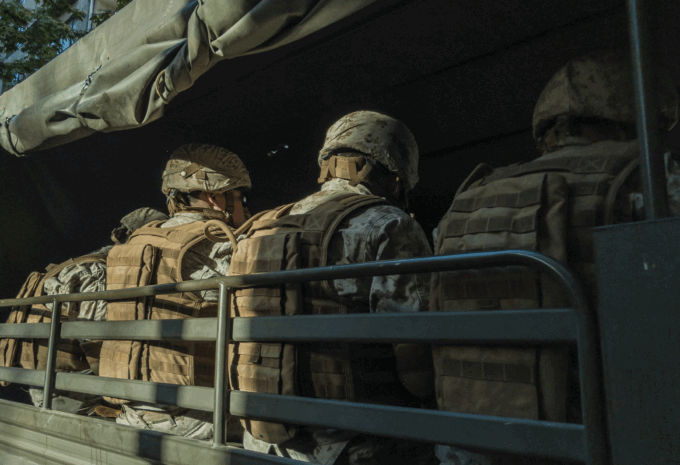
Photo by Diego González
Ecuador, once one of the most peaceful countries in Latin America, is now one of its most dangerous. The murder rate in 2020 was 7.7 homicides per 100,000 people. That was roughly comparable to the United States where it was 6.4 that year. In nearby Brazil, on the other hand, it was 22.3.
By 2023, Ecuador’s homicide rate had leapfrogged over its neighbors to an astounding 46 per 100,000. In a mere three years, the number of murders had increased six-fold.
The reason: narcotraffickers. Ecuador had become a convenient transshipment hub, and various gangs were warring over territory, particularly in coastal cities.
In 2023, in a presidential election that featured the assassination of one of the candidates, Ecuadorians voted in Daniel Noboa, an undistinguished but telegenic conservative politician who promised an iron-fist approach to fighting drug kingpins. His tactics boiled down to unleashing the military to attack specific gangs. However, as Tiziano Breda points out in a report for ACLED, “the same measures that contributed to reining in violence in the first months of 2024—increased military pressure in prisons and on the streets—had the unintended consequence of further fostering intra-gang power struggles and fragmentation.”
As a result, homicides in Ecuador have superseded even the totals for 2023, with the expected rate rising to 50 per 100,000 in 2025.
All of which makes the result of the recent referendum all the more remarkable.
Last week, Ecuadorians rejected all four of the proposals coming from the Noboa government. In addition to preserving the “rights of nature” provision of their constitution—by rejecting a constitutional overhaul—Ecuadorians said no to foreign military bases. The Trump administration was practically salivating at the prospect of returning to a U.S. base in Ecuador that the military had been kicked out of in 2009 when then-president Rafael Correa let the lease expire.
Even in a country where people are dying left and right, voters overwhelmingly opposed any outside military intervention to address the problem of narcotraffickers. The national government’s own militarized response has failed. Voters reasoned that U.S. intervention would only make things worse.
It’s a powerful statement of popular sovereignty at a time of executive overreach (by Noboa) and an expanded war on drugs (by Trump). “We respect the will of the Ecuadorian people,” Noboa commented on X when the results had come in.
Trump, however, has shown no interest in respecting the will of any people.
Plan Mexico
The Trump push for regime change in Venezuela is only part of a larger effort to expand the U.S. military footprint in the Western hemisphere. With Venezuela, Washington is moving against an adversary of 25 years.
With Mexico, however, Washington is confronting an ally of even longer standing. In the past, the United States has assisted Mexican army and police in their battle with drug lords. Direct intervention is something different. Given opposition from the Mexican government, Trump is planning to operate independently in the country.
According to administration sources:
Under the new mission being planned, U.S. troops in Mexico would mainly use drone strikes to hit drug labs and cartel members and leaders, the two current U.S. officials and two former U.S. officials said. Some of the drones that special forces would use require operators to be on the ground to use them effectively and safely…
It seems likely that the administration will wait to see how the operation in Venezuela proceeds before initiating something in Mexico.
Meanwhile, Mexico has agreed to conduct its own interdiction of suspected drug shipments at sea. It’s a marriage of convenience: Mexico wants to prevent the Trump administration from indiscriminately attacking ships in the waters off the country, and Trump wants countries in the region to shoulder more of the burden of this “drug war.”
This is how Trump’s former Secretary of Defense Mark Esper applies lipstick to this particular pig:
The United States is sending a clear signal that it will not tolerate bad behavior in its hemisphere. While some measures are controversial, if not legally dubious, they are part of a broader truth: Regional security demands not only American strength and focus, but also shared action and responsibility by our partners.
Certainly, countries in the region could do a better job dealing with narcotraffickers. But this is a question of law enforcement, not lawbreaking. The U.S. military is not a responsible partner in addressing “bad behavior” precisely because it is engaging in seriously bad behavior itself. The strikes against boats around Venezuela amount to extrajudicial murder, and those executing the policy might one day face indictment by the International Criminal Court. Any intervention in Mexico, against that government’s expressed wishes, would be a violation of sovereignty no different (in kind) from Russia’s “self-defense” rationale for invading Ukraine.
Trump’s Larger Strategy
Trump wants complete freedom of movement in this hemisphere. It’s not exactly a sphere-of-influences approach, since he frankly wants access, minerals, and privileged trade relations everywhere.
But Latin America is close, and the United States has a rich and noxious history of intervention in the region on which Trump can build. His administration has been beefing up its military presence in Puerto Rico as a staging area. In Panama, it established over the summer a new jungle warfare school at a U.S. military base abandoned 25 years ago. According to ABC News,
By August, the military had set up the “Combined Jungle Operations Training Course” with Marines and Panamanian forces training as part of a pilot program. A military spokesperson said there have since been 46 graduates of the three-week course: 18 Marines, one Army soldier and 27 personnel from Panama’s National Aeronaval Service, National Border Service and National Police.
Last month, the United States began stationing combat aircraft in El Salvador. Because of Trump’s immigration policies, the Honduran government threatened to close down the U.S. military base that hosts the Southern Command. But that hasn’t stopped U.S. forces from creating a new Combined Joint Operation Center at the base to coordinate with the Honduran military and other entities.
The military is only a means to an end—of transforming the politics of the hemisphere. Trump has lavished $20 million to support his buddy Javier Milei, the far-right leader in Argentina, a cash infusion that gave his party a boost in the mid-term elections last month. Trumps has tried to use additional tariffs to keep his Brazilian buddy Jair Bolsonaro out of jail for his attempted coup, presumably so that he could return to power just the way Trump has. He hosted Daniel Noboa at Mar-a-Lago before the Ecuadorian election last spring to convey the message that the conservative politician had the ear of the American president. Trump wants Xiomara Castro’s successor to lose the elections in Honduras at the end of the month, the far-right Jose Antonio Kast to dislodge the left in Chile’s presidential runoff next month, and a comparable rightist to replace Gustavo Petro in Colombia next year.
If Trump hates having a democratic socialist, Zohran Mamdani, in his backyard of New York, it’s even worse to have them leading countries in America’s backyard of Latin America. The “drug war”—on top of the deportation of hundreds of thousands of Venezuelans, Hondurans, and Ecuadorians—is a lever that the United States can use to impose MAGA throughout Latin America. More money and power for militaries in the region increase the likelihood that generals there will revive the “good old days” when coups were commonplace.
The United States has an addiction problem—opioids, cocaine, meth—that has been driving supply. Having slashed addiction treatment funding and contributed to worsening the economic conditions that fuel addiction, Trump is now entirely focused on the quixotic mission of suppressing this supply.
The president, too, has addictions far more dangerous than fast-food burgers. He is addicted to the expansion of U.S. power and the consolidation of his own. He won’t voluntarily seek treatment. Only the voters can force him into rehab.

No comments:
Post a Comment