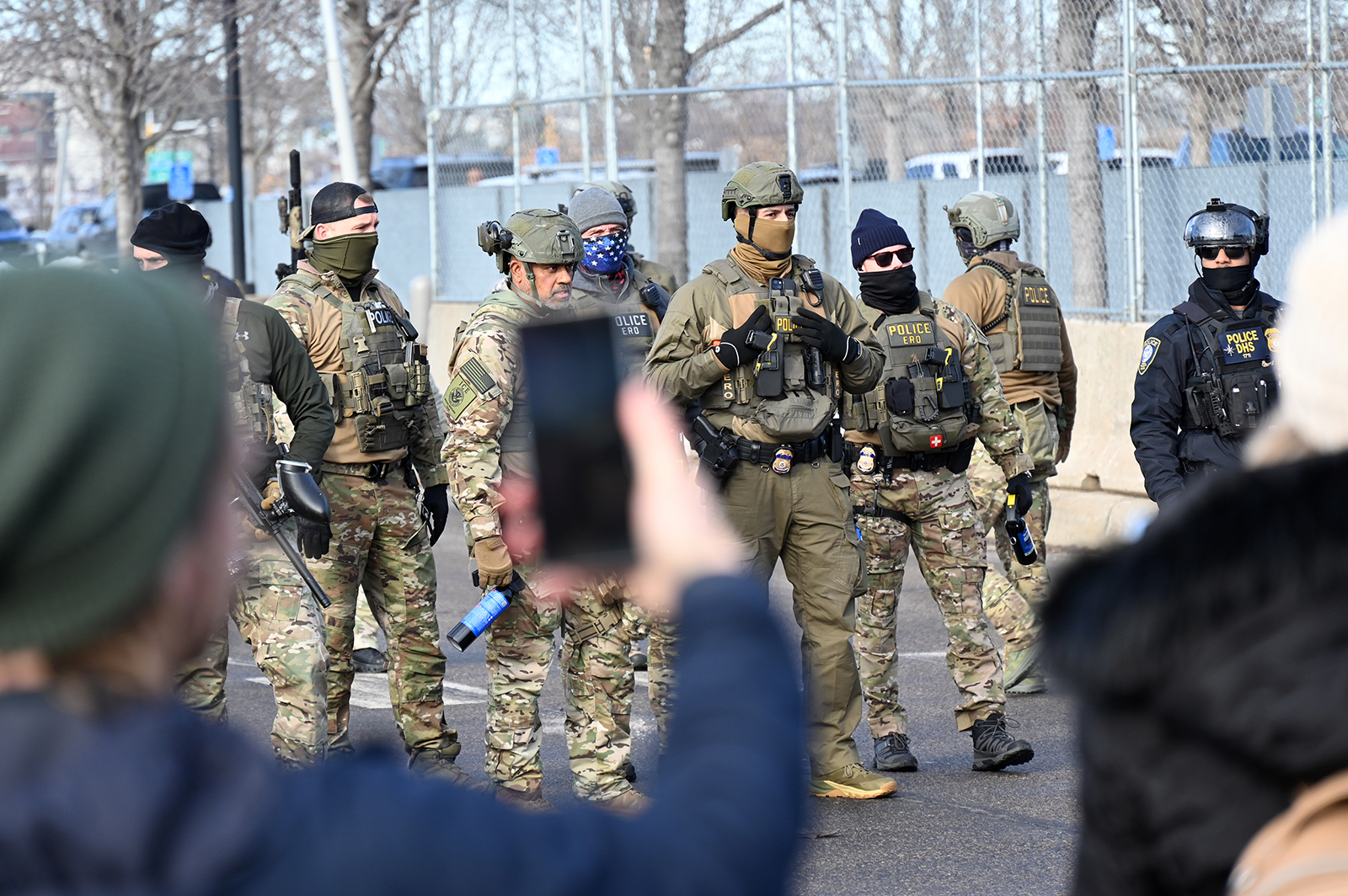
(RNS) — As tensions in Minneapolis continue between residents, federal agents and protesters, the Rev. Stacey Smith, an African Methodist Episcopal Church presiding elder, said Black churches are taking action to address complex needs in the Twin Cities area.
“We recognize that we are in profound crisis,” said the supervisor of 10 AME churches in Minneapolis and St. Paul. “And when you’re in profound crisis, it’s like putting your finger in a dike, and another hole opens up, and you have to put your finger over here.”
Black faith leaders are taking steps to aid Minneapolis residents who have seen an influx of federal officers in their city and are joining calls for new legislation to increase their accountability. A week after the shooting death of Renee Good and more than five years after the death of George Floyd, each at the hands of law enforcement, some are seeking to defuse the tensions between protesters and Immigration and Customs Enforcement agents or between agents and the people they seek to detain.
On Thursday (Jan. 15), Smith and other Twin Cities-area AME Church officials issued a statement, saying Good’s death “never should have happened,” and listed more than a dozen ways they have tried to meet community needs there, including being present on the streets or at the state capital, bringing food to families that are fearful of leaving their homes, or “intentionally patronizing immigrant-owned businesses harmed by ICE operations.”

The Rev. Stacey Smith. (Courtesy photo)
Smith said AME church members have long supported such businesses, but it has been particularly important to help them in recent weeks.
“These are legal citizens of our country, and their businesses are being targeted, and they are being harassed,” she said. “These people have to live, they have to eat, they have to pay bills. They have to do all those things, too. So it’s important for us to support those communities and to allow them to know that they have the community behind them as well.”
RELATED: In Minneapolis, George Floyd-era faith networks reignite after Renee Good’s killing by ICE
Smith is also collaborating with the Rev. Al Sharpton’s National Action Network on plans for an upcoming vigil in Minneapolis to honor Good’s memory.
The Rev. Jerry McAfee, pastor of New Salem Missionary Baptist Church in North Minneapolis, describes his church as having “boots on the ground,” in the streets, seeking to defuse tensions. However, he urged caution.
“Normally what our group would do is be between ICE, the police and the protesters,” said McAfee, former president of the Minnesota Baptist State Convention. “What we’ve consistently tried to tell people is, ‘Protest all you want, but what we don’t want you to do is agitate and provoke to where our people get hurt.’”
He also said he has begun conversations with leaders of the local Somali community that involve “hard questions,” like whether someone in the country illegally should leave instead of hiding from federal authorities.

The Rev. Jerry McAfee. (Courtesy photo)
“If you know your papers ain’t right, and you know if they catch you, they’re going to take you, or your kids are just going be left,” he said he suggested in a Thursday meeting, “would it not make better sense for us to have a conversation about another action plan that could help get you to a place safe, as well as your kids, to where you’re not in danger?”
And as tensions continue in Minneapolis, some Black faith leaders across the country are calling for state and national legislators to pass laws that limit some of the activities of divisions of the Department of Homeland Security, such as ICE.
The Rev. Boise Kimber, president of the National Baptist Convention U.S.A., on Wednesday urged leaders of his historically Black denomination to call on cities and states to follow California Gov. Gavin Newsom’s lead and enact laws that prevent ICE and other law enforcement from wearing face masks, comparing them to members of the white supremacist Ku Klux Klan who covered their heads as they terrorized Black people.
“When you go back home, you go back home sharing with your pastors and sharing with the leaders that we no longer will support you if you do not come out with legislation — saying to your mayor, saying to your chief, saying to this state legislator and governor, take the mask off,” Kimber said at a news conference during the denomination’s midwinter meeting in Florida.
Both Smith and McAfee said they agree with passing such legislation. “Some of them need to be identified because here’s the reality: How do you ramp up ICE as quickly as it has been ramped up and safeguard against bigots being part of ICE?” McAfee said.
And on Thursday, a wider coalition of 74 faith, civil rights and advocacy organizations signed onto a letter urging Congress to take steps to reduce “this Administration’s ongoing, lawless campaign that is terrorizing American communities.” The NAACP, which signed the letter, noted it was sent in the wake of not only Good’s death but also the killing of another U.S. citizen, Keith Porter Jr., who was shot by an off-duty ICE officer on New Year’s Eve in Carson, California.
The letter, spearheaded by UnidosUs, another civil rights organization, also included signatories from the Sikh American Legal Defense and Education Fund, the United Church of Christ, and Faith in Action East Bay in Oakland, California. Among its demands were banning the use of masks by federal agents and forbidding military members and resources from being deployed for domestic policing operations and immigration enforcement.
Two Episcopal bishops say clergy may have to put 'bodies on the line' to resist ICE
(RNS) — Last Friday (Jan. 9), the Rt. Rev. A. Robert Hirschfeld, the Episcopal bishop of New Hampshire, stepped in front of a microphone under a tent erected outside the Statehouse in Concord. He looked out at the small crowd that assembled in the rain for a vigil to mourn Renee Good, the 37-year-old mother killed by an Immigration and Customs Enforcement officer days earlier, and began to offer a closing prayer.
But Hirschfeld, who told Religion News Service he did not have prepared remarks, suddenly launched into something closer to a short sermon.
“We are entering a new era of martyrdom,” he said, framing Good — who family members have said was Christian — as a martyr. He rattled off other examples such as Óscar Romero, the Catholic archbishop who was killed in El Salvador in 1980. He also mentioned local hero Jonathan Daniels, a white Episcopal seminarian and civil rights activist who was killed in 1965 while shielding a Black girl from a shotgun blast fired by a racist.
Faith leaders of today, Hirschfeld said, may end up in similar situations as they push back against the actions of federal immigration agents in cities across the country.
“I have told the clergy of the Episcopal Diocese of New Hampshire that we may be entering into that same witness,” he said. “I’ve asked them to get their affairs in order, to make sure they have their wills written. Because it may be that now is no longer the time for statements, but for us — with our bodies — to stand between the powers of this world and the most vulnerable.”
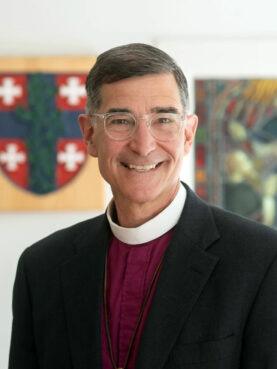
The Rt. Rev. A. Robert Hirschfeld. (Photo by Joanne Smith)
The crowd at the assembly was hardly sprawling, but Hirschfeld’s remarks were filmed, clipped and shared widely on social media. Amplified by algorithms and word of mouth, his message was heralded by critics of President Donald Trump’s mass deportation efforts, as well as by faith leaders who have been protesting Department of Homeland Security agents — sometimes being injured or arrested while doing so — for nearly a year.
And while Hirschfeld’s comments were off-the-cuff, his sentiment seems to be shared by many of his fellow Episcopalians, including bishops in places where DHS agents have shown up in force, such as Minneapolis.
In an interview with RNS, Hirschfeld said the attention given to his message was something of a shock. He said he has issued similar warnings to clergy for years, such as when fellow priests and bishops gathered to push for gun control legislation. And he stressed that whenever he broaches the subject, he’s referring to a tragic situation that may occur — not one that faith leaders should seek out.
“I’m not telling clergy, ‘Go find a rifle to stand in front of,’” Hirschfeld said. “I’m not saying, ‘Go look for a way to martyr yourself.’ All I’m saying is, when we put on those garments of our Christian faith, they are not always welcomed in this society. Those virtues and those postures in this world can be met with rage and even violence.“
But he has found himself invoking the idea more often in recent months, especially in reference to the actions of the Trump administration. That was the context, he said, in October, when his diocese hosted a clergy conference with priests from across the region. There, he communicated to priests that “It’s not too much to say we should have our wills in order in case we’re met with violence.”
The room, he said, reacted with surprise. “There was a little gasp,” he said. “And then there was, ‘Oh, well, maybe I should be doing that anyway.’”
Indeed, there is a long history of faith leaders who participate in protests preparing for the worst. In a 2020 documentary, the late Georgia congressman and civil rights icon John Lewis recalled eating Chinese food shortly before embarking on a trip in the 1960s as a Freedom Rider seeking equal rights for Black Southerners.
“Growing up in rural Alabama, I never had Chinese food before,” Lewis said. “But someone that evening said, ‘You should eat well because this might be like the Last Supper.’”
Other faith leaders have also linked civil rights leaders and religious people killed while advocating for a cause to Good, who has ties to the Presbyterian tradition. On Monday, the Presbyterian Church (USA)’s Office of Public Witness released a statement lamenting Good’s killing and lauding her as someone who “put herself in harm’s way not out of any desire to do harm, but to observe and bear witness to the actions of ICE.”
Like Hirschfeld, the office compared Good to figures such as the Rev. Martin Luther King Jr. and the four Catholic nuns and missionaries who were abducted and killed in El Salvador in 1980 for standing alongside the Salvadoran citizens.
“(Good’s) story is a testament to the power of the Presbyterian mission and a challenge to our conscience,” the statement read.
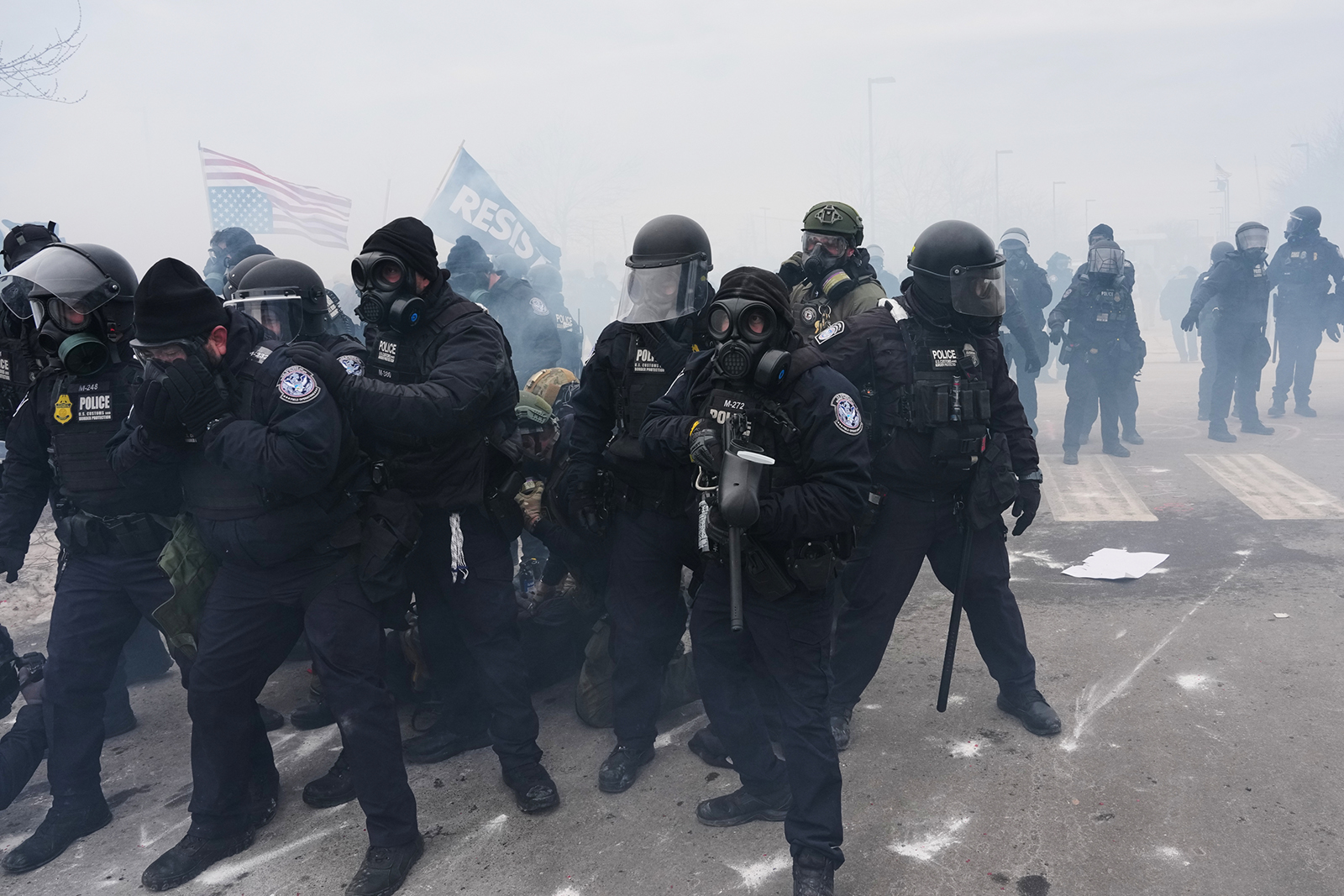
Some religious leaders have praised Trump’s mass deportation efforts. But religious pushback has been widespread, and while no clergy have been killed in the past year while protesting DHS agents in the U.S., many have been met with violence. The Rev. David Black, a Presbyterian minister, made headlines after he was shot in the head with pepper balls last September while praying outside of a DHS facility in Illinois. Several other clergy were also hit with pepper balls and tear gas launched by DHS agents while protesting outside that same facility, and the Rev. Jorge Bautista, a United Church of Christ minister, was shot in the face with a pepper round fired by a DHS officer during a protest in California last fall.
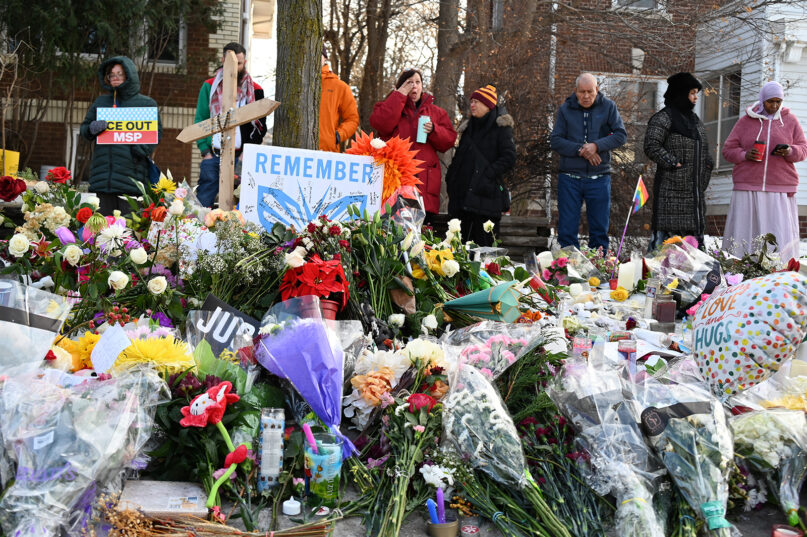
People gather around a makeshift memorial honoring Renee Good, who was fatally shot by an Immigration and Customs Enforcement officer, near the site of the shooting in Minneapolis, Jan. 9, 2026. (RNS photo/Jack Jenkins)
Several faith leaders have been arrested while protesting immigration enforcement, and when clergy rushed to the scene of Good’s shooting last week, at least two pastors — a Unitarian Universalist minister and a UCC minister — were forced to dodge or were even hit with pepper spray or pepper rounds fired at protesters by DHS agents.
And since October of last year, nearly 290 faith leaders from the Chicago area have signed a letter voicing firm opposition to ICE’s actions and declaring that they “accept that following Christ’s example may mean we are mocked and assaulted, opposed and even arrested.”
Hirschfeld said he was thinking about these examples when he made his viral remarks — which were echoed by the Rt. Rev. Craig Loya, the Episcopal bishop of Minnesota, this week. Loya had been at a contemplative bishops’ retreat with Hirschfeld when the news of Good’s shooting came, and the Minnesota prelate told RNS that recent days have been “incredibly painful” for the churches he serves — especially congregations with large immigrant populations.
Even so, the church is called to take a stand, he said.
“I agree wholeheartedly with my colleague Bishop Hirschfeld’s comments,” Loya said. “This may be a time when we are called to put our own bodies on the line, to stand with those who are marginalized and targeted in this moment.”
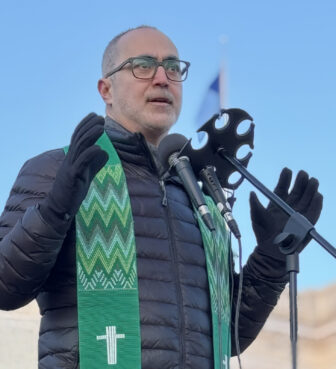
Episcopal Bishop Craig Loya speaks at a vigil outside the Minnesota Capitol in response to the killing of Renee Good, Jan. 9, 2026. (Photo by Gnube/Wikimedia/Creative Commons)
Loya said that in his diocese, standing with immigrants has meant clergy participating in demonstrations. Last Friday, a group of four Episcopal priests stood together at a vigil for Good outside the Minnesota Capitol in St. Paul, among them the Rev. Ramona Scarpace, rector of St. Paul’s Church on Lake of the Isles.
“As followers of Jesus, we’re called at our core to stand with the oppressed, to stand with those who have been wronged, to stand with a grieving community of people who are deeply sad and whose hearts are broken by the death of Renee Good,” Scarpace said.
Resistance was also the theme of a prayer offered by the Most Rev. Sean W. Rowe, the presiding bishop of the Episcopal Church, during an online vigil this week that also included Loya.
“We keep resisting, advocating, bearing witness and repairing the breach,” Rowe said. “We keep sheltering and caring for those among us who are immigrants and refugees because they are beloved by God, and without them, we cannot fully be the church.”
Loya stressed that standing with immigrants has also meant churches providing food and other resources to immigrant families afraid to leave their homes, and establishing a fund specifically to aid immigrants in the diocese who need help paying for things such as legal services. The idea, Loya argued, is for fellow Episcopalians to “resist the forces that are breaking down beloved children of God” — referring to the influx of federal agents into the city — but do so in ways that are rooted in love.
“We will not meet cruelty with cruelty,” he said. “We will disrupt anger with love. We will agitate the forces of oppression with the power of love. From our perspective, that is neither weakness nor resignation, but it grows out of our firm conviction that there is no force in the universe that is more powerful or irresistible than the power of God’s love.”
Similar sentiments may soon be heard elsewhere. The Episcopal Diocese of Maine shared Hirschfeld’s remarks on its Facebook page earlier this week, calling it a “powerful message.” A day later, news broke that DHS may soon launch an immigration enforcement effort in the city of Lewiston, Maine, home to a large population of Somali Americans — a group the administration has targeted.
And while Hirschfeld acknowledged his New Hampshire diocese has yet to become a hub of ICE activity, he noted locals have recently rallied to oppose a proposed DHS immigrant processing center in Merrimack. The far-reaching scope of Trump’s mass deportation effort, he said, is part of what animated his comments — and perhaps why it resonated so widely.
“My words were meant to be words of encouragement and solidarity,” he said. “We’re in this together.”

No comments:
Post a Comment