Immigrant Rights Advocates Say Trump’s First Year Was “Much Worse” Than Expected
“Trump wants us to hang our heads and give up, but that’s not happening,” says organizer Rossy Alfaro.
By Derek Seidman ,
January 17, 2026
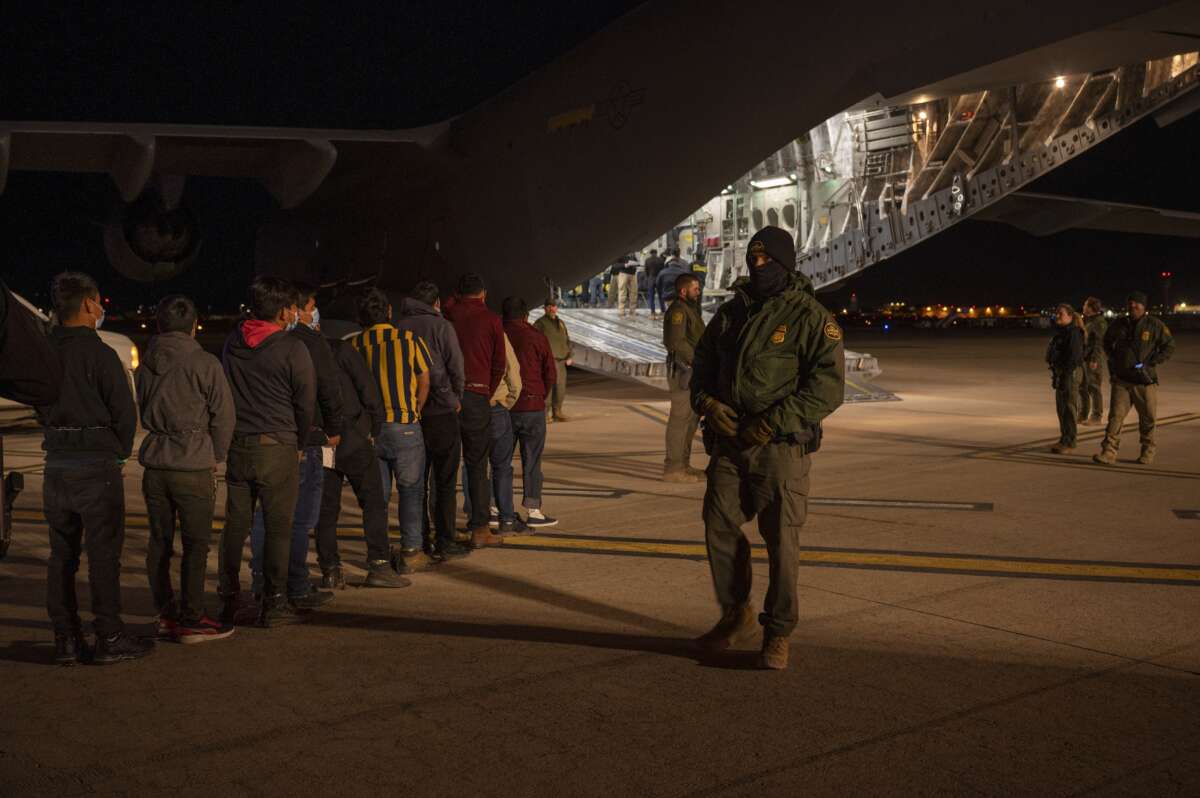
U.S. Customs and Border Protection Agents watch immigrants board a deportation flight at the Tucson International Airport, in Tucson, Arizona, on January 23, 2025.
Department of Defense photo by Senior Airman Devlin Bishop
Donald Trump rode to reelection with racist attacks on immigrants and refugees and promising mass deportations. The first year of his second term was filled with heartbreak, trauma, and fear as his administration escalated its assault on immigrant communities: separating families, occupying cities, targeting workers, and expanding deportations. Immigration and Customs Enforcement (ICE) is using its bloated budget to recruit among Trump’s far right base. This comes amid ICE’s horrific killing of Renée Nicole Good in Minneapolis, staunchly defended by the Trump administration.
At the same time, we’ve seen inspiring community resistance to ICE and Trump across the U.S. Rapid response networks have grown. Teacher unions are defending immigrant students and families. There is growing mass resistance to ICE from Los Angeles to Chicago to Minneapolis.
A year ago, Truthout spoke to several community and farmworker organizations about how they were preparing for the second Trump administration. We reached out to some of those participants again to reflect on the past year in a new roundtable interview. They discuss the anguish of the past year and the challenges immigrant communities have faced, as well as how organizers are proactively responding and what’s keeping people motivated and inspired.
Rossy Alfaro is a former dairy worker in Vermont and organizer with Migrant Justice, which organizes dairy farmworkers in Vermont and oversees the worker-driven Milk with Dignity campaign. María Carrasco is a longtime volunteer with Derechos Humanos, a grassroots organization supporting migrant rights in Tucson, Arizona, and she is closely involved with the group’s rapid response work. Jeannie Economos is the longtime pesticide safety and environmental health project coordinator for the Farmworker Association of Florida, which has organized farmworkers for over four decades.
Note: These interviews took place in December 2025 and were conducted separately and edited into a roundtable format afterward. Alfaro’s interview was done with interpretation provided by Migrant Justice.
Related Story
When ICE Comes Calling, Rapid Community Responses Can Make a Difference
Is your community ready to fight deportations? Here’s how people in New York, New Jersey and Arizona are organizing. By Derek Seidman , Truthout February 3, 2025
Derek Seidman: A year ago, we discussed how you were approaching the new Trump administration. How has the past year been for your community and organizing efforts?
Jeannie Economos: It’s much worse than we expected. The tactics they’re using are very disturbing. Children are being ripped apart from their parents. It’s causing chaos and heartbreak and mental health issues. The community is traumatized. ICE is waiting for people at courthouses and even schools and is intimidating people by wearing masks and dragging people out of their cars. It’s terrible. This is unprecedented.
“The tactics they’re using are very disturbing. Children are being ripped apart from their parents.”
María Carrasco: We’ve seen so many things already. Bounty hunters are out there doing a lot of damage. Many racist people got jobs with ICE and they don’t respect human rights. Sometimes they’re really violent when they arrest people. Every day it’s becoming more dangerous, and this is barely the beginning, because ICE is receiving more money.
They’ve detained a lot of workers we know. Their families come to our meetings. It’s heartbreaking how the kids whose parents are in detention are suffering. We’re traumatizing them. I’m so worried about that.
So many people are missing in the system. We can’t find them. I try to calm down the families. They call me and they’re desperate. There are a lot of Venezuelans being taken. They’re being picked up and deported even though they’re refugees and have all their paperwork.
Rossy Alfaro: It’s had a huge impact on our community. The attacks have been so extreme. Even though we knew what was coming, you can’t really be prepared for it being so intense. So there’s a certain amount of panic in the farmworker community. People are feeling terrorized.
“So many people are missing in the system. We can’t find them.”
At the same time, people are really resolute, especially within our farmworker community here in Vermont. We fought hard for the protections that we’ve won, and we’re going to fight to retain them.
Can you discuss more what the administration’s escalating attacks on immigrants has meant for farmworker communities?
Economos: Things were difficult over a year ago with all the anti-immigrant sentiment and rhetoric, but that looks good compared to what we are seeing now, especially some of the tactics they’re using against the immigrant population. Before, farmworkers were afraid to file complaints for workplace violations, but now they’re afraid to go to work at all. Of course, some people still go to work, but they’re taking a risk. Some farmers have planted fewer crops because they are worried they won’t find enough workers to harvest. It’s causing chaos in agriculture.
“Before, farmworkers were afraid to file complaints for workplace violations, but now they’re afraid to go to work at all.”
Many employers in Florida are implementing E-Verify, a system which tracks immigration status, which means a lot of people won’t get jobs. So they end up in the underground economy working for unscrupulous employers who exploit them and commit wage theft because they’re undocumented and they know they’re very vulnerable.
In November, ICE stopped a bus of farmworkers near Immokalee. They were mostly women and asylum seekers going to work, just trying to take care of their families. They dragged them from the bus. Who will take care of their kids? Along with the fear, how do you go about your daily life with so much uncertainty? It’s terrifying. Some farmworkers are leaving the country.
Alfaro: In April 2025, Border Patrol detained eight farmworkers at a farm where workers had really begun to organize and stand up for their rights. This had a big impact. People felt fear and no longer wanted to speak out and organize. Some stopped going out to get groceries. People are just now feeling enough courage to start organizing again.
Migrant Justice spoke with the detained workers and their families and we launched a public campaign. We had marches and rallies, and thousands of people signed our petition calling for their release. This had a huge impact. The workers being held behind bars knew that they weren’t alone and they knew that the community was behind them.
How has your organization responded over the past year to the Trump administration’s intensified attacks?
Alfaro: We’ve really focused on educating people about their rights and how to prepare for potential encounters with federal agents and minimize risk in those situations. We’ve been building a system of support through our rapid response network so people can respond when there’s a detention happening. We have people trained on how to intervene to defend a person’s rights when they see an arrest — though it’s difficult to respond in time in rural areas.
We have people trained to go observe anytime there’s a rumor about ICE or Border Patrol in an area. That lets us differentiate fact from fiction and helps with that sense of panic that the community feels. This rapid response network has been important for our community, because we haven’t felt so alone. There are people here in Vermont who have our backs.
Economos: We have five offices in Florida. We’ve been doing Know Your Rights trainings with workers across the state. We’ve been handing out red cards in the fields. Some employers have actually asked us to do Know Your Rights trainings for their workers, which is unusual. Some local businesses have put up signs saying they’re a safe place for immigrants.
We’ve been working in coalition with other organizations locally, statewide, and nationally. We have a rapid response group. We’re keeping track of detentions and deportations. We hope to publish a report on this soon.
We were lucky to escape any hurricanes this [past] year. We’ve been really worried about what to tell people if there’s an evacuation order or they need to find shelter. We’ve been contacting local governments about their policies around sheltering undocumented workers. We’re trying to protect people. How can people go to shelters if there is no guarantee that ICE won’t target them there? There’s so much fear and uncertainty.
Carrasco: There are so many groups organizing in Tucson. It’s getting bigger and bigger. People are really pissed off. The more they try to oppress us, the more people are coming out.
We tell people to take out their phone and start recording if someone’s being detained. It’s our right. We keep eight feet away from them. As soon as someone starts recording, ICE wants to go hide. They’ll be less violent toward people. They don’t want to be recorded, because they know sooner or later, we’re going to take them to court. We’ve been cataloging their cars and license plates.
We’re just so mad. These ICE agents don’t even show their faces. They kick us and do whatever they want. They’re the criminals. We have the right to protest.
A lady from Chicago is sending me whistles and offered to train us on how to respond to tear gas. But big cities like that are different from Tucson. They’re crunched up, so when ICE shows up, people pour out together. It’s difficult in Tucson because our city is so spread out, and we’re so close to the border, so it’s more militarized.
Can you talk about your hotline in Tucson?
Carrasco: Some days the phone is ringing off the hook. Just now, while we’re talking, I received three calls. We get a lot of calls in the morning because ICE is getting people on their way to work. This is every day. They’re not criminals. They’re workers.
“They’re dehumanizing people and stealing their wages.”
We’re trying to help people get lawyers. We try to help as many people as we can. Every day is a different story. One worker called us last month. A guy hired him and exploited him and then brought him to ICE. Those are the kinds of abuses we’re seeing. They’re dehumanizing people and stealing their wages.
After the Taco Giro raids here, I got 48 calls. People wanted to join our meetings and our rapid response network. Even though we’re in a really bad situation, people who never helped before are coming out to defend the community. There’s hope out there.
We need people to have our number and call us if you see anything. Call me every time. We have more than 200 people who are ready to come out.
Rossy, you were personally impacted this past year. Can you talk about that?
Alfaro: This is really difficult for me to talk about. My family members, Nacho and Heidi, were detained by Border Patrol and then held in ICE detention for a month. They were detained completely in violation of their rights, and it was done very violently. Their window was shattered, and they were pulled out of the car.
They both knew their rights. They refused to provide any information about themselves to those immigration agents. The agents took them in without any cause. But that also gave them the ability to challenge their detention on legal grounds and helped get them released, because they could show there was an unlawful arrest.
My son and I suffered terribly from all the stress and sadness of having our family separated. They were held for several weeks. But they trusted their community to fight for them. They have very high profiles as community leaders and as fighters for human rights. That faith that the community would fight for their release sustained them during those months in detention, until they ultimately came home.
Have you seen any victories this past year that you want to lift up?
Alfaro: One victory we’re most proud of is the passage of the Housing Access for Immigrant Families Act, which makes it easier for immigrant families to find housing in the state. We campaigned for this and won it last year. For farmworkers especially, having access to housing that’s not associated with your job really opens up opportunities.
Also, the Education Equity law we won that went into effect this year allows undocumented students to attend university and pay the same rate and receive the same financial aid as their classmates who were born here. My daughter is one of the students benefiting from that. She’s able to go to college because of this law that we fought for and that she helped get passed.
Amid the challenges and heartbreak of this past year, what is keeping you motivated or even hopeful?
Economos: All I can say is I’m more committed than ever. There’s no way that we can turn our backs now. It’s personal, too. A community member who’s on our leadership committee — her nephew was sent to Alligator Alcatraz. When you know people, you feel their pain and it makes you more committed than ever before.
Seeing what other people are doing — young people, students standing in front of ICE or blocking a road, pastors going to immigration court to try and protect people; seeing the risks people are taking, just an outpouring of resistance around the country to what’s happening — that’s inspiring.
“People who’ve never protested are coming out to defend our community.”
Carrasco: People are waking up. People who’ve never protested are coming out to defend our community. A really old lady called me the other day. She was so mad. She wanted to join us. Even white people want to join us — people who are less afraid and who’ve never been active in the community, but who are waking up to what’s happening.
I’m hopeful. People are always calling me to help. Our communities are coming together and they’re defending each other every day. We’ll keep working and defending our communities regardless of what they do to us.
Alfaro: Trump wants us to hang our heads and give up, but that’s not happening. These experiences fill us with anger and rage, and the only way to release that anger is by organizing with a community to fight for your rights. The terrible experiences that we’ve had are the fuel we’re now using to fight even harder for the rights of our community.

No comments:
Post a Comment