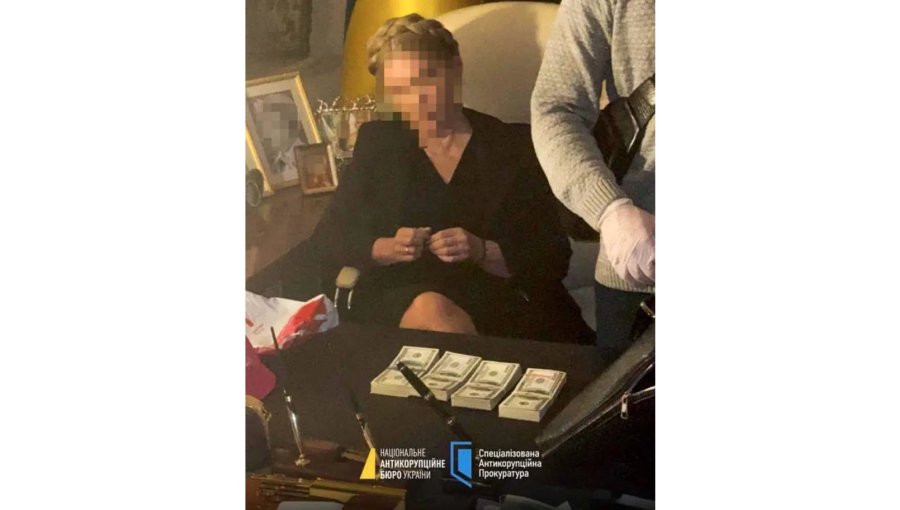
Orange Revolution firebrand Yulia Tymoshenko’s sudden re-emergence at the centre of Ukraine’s political scene after she was caught up in a vote-selling scandal has seen her return to the heart of Ukrainian politics.
“The Tymoshenko scandal reflects the fact that the centre of Ukrainian politics is once again shifting to parliament,” wrote political analyst Konstantin Skorkin in a recent commentary for Carnegie Endowment for International Peace. “The fight for parliamentary deputies’ votes is heating up again, and Ukraine’s domestic political crisis is entering a new phase.”
Once a dominant figure in Ukraine’s early post-independence years, Tymoshenko’s career trajectory mirrored the country’s own political evolution. She was a successful businessperson in the 1990s, earning a fortune from gas trading at a time when she also severed as Ukraine’s gas minister, earning her the moniker “the gas princess.”
Then she moved into politics thanks to her association with prime minister and now convicted criminal Pavlo Lazarenko. She became a fixture in the opposition during the Kuchma and Yanukovych presidencies, before she and her trademark crown braid became an icon of the Orange Revolution. In the new post revolution government she achieved her political pinnacle, twice serving as prime minister and imprisoned on two occasions. Yet after she was released from jail after the EuroMaidan revolution in 2014 she political star set and she became the largely irrelevant head of a small Rada fraction, the Fatherland Party that hold less than a dozen seats in parliament. She ran in the 2019 presidential elections but came a distant third to the now Ukrainian president, Volodymyr Zelenskiy. Since then Zelenskiy’s Servant of the People party has held an absolute majority in parliament and dominates domestic politics.
Following Russia’s full-scale invasion in 2022, Tymoshenko struggled to find footing in Ukraine’s wartime consensus. “She became critical of the government, condemning the new mobilisation law and the restrictions on consular services for Ukrainians abroad,” Skorkin observed. Adopting the socially conservative platform, styling herself as a Ukrainian Trump, Tymoshenko positioned herself as a populist voice against liberal reforms, opposing cannabis legalisation and what she termed a “gender agenda.”
In the summer of 2025, she led a campaign to curtail the powers of Ukraine’s anti-corruption bodies, branding the National Anti-Corruption Bureau (NABU) that is now investigating her for vote-buying as an agent of “external control.” She supported Zelenskiy’s controversial attempt to gut Ukraine’s anti-corruption reforms on July 22 with Law 21414, which sparked the first anti-government demonstrations since the start of the war with Russia.
Her refusal to support legislation restoring NABU’s authority following presidential intervention drew accusations of obstructionism. “Tymoshenko’s reaction came across as a case of sour grapes among the old elites,” Skorkin wrote, “unhappy with real efforts to fight the corruption that had long plagued the country.”
But when she was accused of corruption, accompanied by some very damning video and audio tapes, released by NABU, she hit back by accusing Zelenskiy personally of corruption – a sentiment that will resonate with voters. In the tapes, a voice alleged to be Tymoshenko’s offers deputies $10,000 per month for their votes and speaks of plans to “overthrow the majority.”
The recent charges against Tymoshenko—bribery and attempted vote-buying—come amid what Skorkin described as “a large-scale purge of the elites,” triggered by the publication of the so-called Mindich tapes in late 2025 that are at the centre of the Energoatom corruption scandal. Investigations have already reached members of the ruling party, including Zelensky’s associate Yuriy Kisel.
Her apparent goal, according to Skorkin, was to undermine Zelensky’s single-party control of the Verkhovna Rada, which has been showing signs of fragmentation. “The opposition wants to drive a deeper wedge into this cracked monolith,” Skorkin wrote, pointing to a failed vote on a proposed reshuffle and growing speculation of a “parliamentary coup” that could curtail presidential powers.
In line with the charges, Tymoshenko has been barred from leaving the Kyiv region and from communicating with 66 deputies. Bail has been set at UAH33mn ($760,000). Yet typically for the grandstanding Tymoshenko, even under legal pressure she used the court hearing as a political platform. “Trials and imprisonment have helped Tymoshenko rise to the top of Ukrainian politics on more than one occasion,” Skorkin noted.
Whether that strategy can succeed again is uncertain. “It will be difficult to repeat those past successes given how much time has passed and how much the country has changed since then,” Skorkin concluded. “Still, the Tymoshenko case demonstrates that the anti-corruption earthquake last fall has sent such powerful shock waves through Ukrainian politics that it has brought to the surface those who dwelt in its depths—those who may yet play a role in a battle in which they had already been written off.”

No comments:
Post a Comment