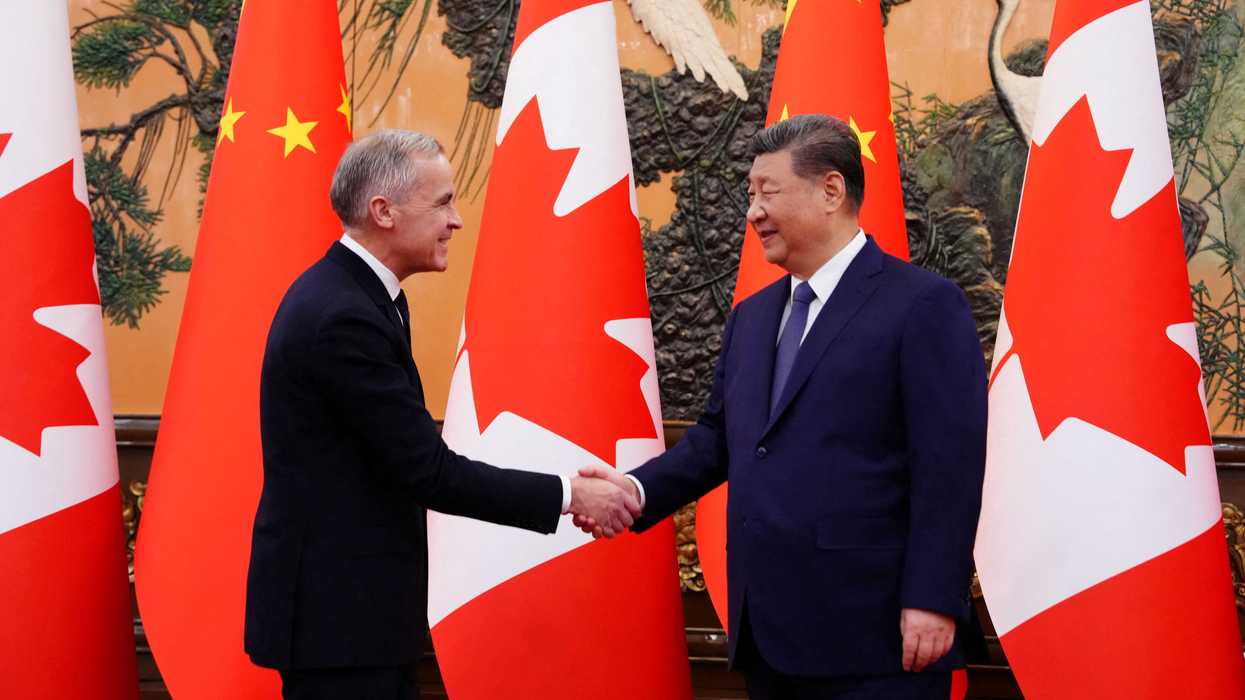
Canadian Prime Minister Mark Carney shakes hands with President of China Xi Jinping at the Great Hall of the People in Beijing, China on Friday, Jan. 16, 2026.
For many years, Canada and the United States enjoyed a mutually beneficial relationship. Canadian visitors spent money in Seattle and Boston; U.S tourists patronized businesses in Montreal, Toronto and Vancouver. And Americans in real estate spent a lot of money on the building and construction materials imported from Canada.
But during U.S. President Donald Trump's nonconsecutive second term, his policies have been a persistent source of frustration for Canada — from tariffs to Trump wanting its neighbor to the north to become "the 51st state." Canadian Prime Minister Mark Carney is adamant in saying that Canada is a sovereign nation that has zero desire to become part of the United States.
Now, according to the Associated Press (AP), tensions between Trump and Canada are pushing Carney closer to Mainland China.
AP journalists Ken Moritsugu and Rob Gillies, in an article published on Friday, January 16, report, "Breaking with the United States, Canada has agreed to cut its 100% tariff on Chinese electric cars in return for lower tariffs on Canadian farm products, Prime Minister Mark Carney said Friday. Carney made the announcement after two days of meetings with Chinese leaders. He said there would be an initial annual cap of 49,000 vehicles on Chinese EV exports to Canada, growing to about 70,000 over five years. China will reduce its total tariff on canola seeds, a major Canadian export, from 84 percent to about 15 percent, he told reporters."
At a press conference, Carney explained, "Our relationship has progressed in recent months with China. It is more predictable, and you see results coming from that."
Canada's new arrangement with China is generating a lot of reactions on X, formerly Twitter.
Bloomberg News' Joe Weisenthal, tweeting AP's article, commented, "Wow there it is."
Tech reporter Eric Okafor tweeted images of a car and posted, "D---! Canadians about to enjoy this baby without breaking the bank."
Television journalist Brian Fantana posted, "I hope Canada know what they are doing… look how it turned out for Europe… they are banning Chinese evs and cars!"
Jeanette Sautnert, Canadian ambassador to Lithuania, described the new arrangement as "excellent news" for Canada, adding, "Canadian agricultural products to be tariff free in China Reduction on tariffs from 100% To 6.1% for Chinese EVs."
Politico's Adam Wren noted the effect Trump's tariffs are having in a border state: Michigan, posting, "Trump’s signature tariffs are still roiling one of the most closely watched midterm states in 2026. I went to the Detroit Auto Show, where the Trump administration is dispatching three Cabinet members tomorrow, and wrote about the tension between tariffs and affordability."Investor David Lee tweeted
, "Mark Carney: Canada will allow up to 49,000 Chinese EV into Canadian market at 6.1% tariff rate Canadians can now enjoy low cost high value Chinese EV This is massive for Canadian auto market China is also opening up market for Canadian agricultural products including canola seed."
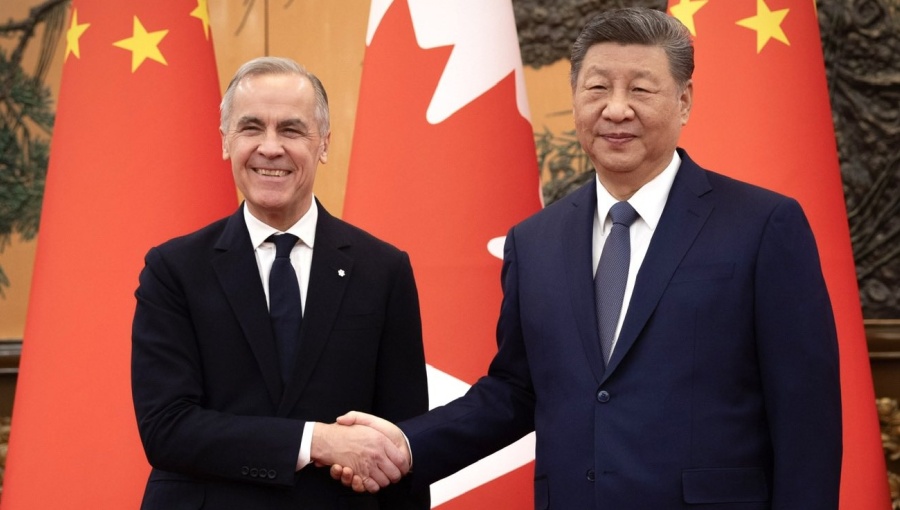
China and Canada have agreed to scale back tariffs following a closely watched meeting in Beijing between President Xi Jinping and Prime Minister Mark Carney, signalling a tentative reset in relations after several years of strain.
As a result, Beijing will now slash duties on Canadian canola oil from 85% to 15% starting in March according to the BBC. In return, Canada will also use a most-favoured-nation tariff rate of 6.1% to a limited number of Chinese electric vehicles (EVs). The agreement marks the most significant breakthrough between the two sides since their relationship deteriorated in the late 2010s, and is largely seen as a reflection of the issues both are having with the US.
For Carney, the first Canadian leader to visit China in almost a decade, the deal supports his broader push to diversify trade away from the US amid continuing uncertainty over American tariff policy. The easing of tensions with Beijing also opens the door to a limited revival of Chinese investment in Canada, a prospect closely watched in Washington.
The BBC adds that the agreement follows a prolonged trade dispute. In 2024, Canada imposed steep tariffs on Chinese electric vehicles, mirroring measures taken by the US. Beijing responded by levying duties on more than $2bn of Canadian agricultural and food exports, including canola products, contributing to a sharp fall in Chinese imports from Canada last year.
As part of the new framework, Canada will allow up to 49,000 Chinese EVs to enter at the lower tariff rate, reflecting domestic concerns about an influx of cheaper imports. China will also reduce duties on other Canadian exports such as lobsters, crabs and peas.
Beyond tariffs, the visit underscored a more pragmatic tone on both sides. Carney has emphasised the need for clear boundaries in the relationship, particularly on issues such as human rights, election interference and geopolitical tensions, while still pursuing cooperation where interests align. Chinese officials, for their part, have sought to present Beijing as a stable and predictable partner at a time of global trade fragmentation.
China is Canada’s second-largest trading partner, though trade volumes remain far below those with the US. During his trip, Carney met senior executives from major Chinese companies and oversaw the signing of several agreements covering energy and trade cooperation.
Dmytro Hubenko | Mahima Kapoor
Chinese President Xi Jinping welcomed Carney after years of diplomatic tensions between Ottawa and Beijing, as both countries move to rebuild ties amid US tariff pressures.

Canada's Prime Minister Mark Carney, left, meets with Chinese President Xi Jinping at the Great Hall of the People in Beijing Both China and Canada are looking to strengthen trade ties amid Trump's tariffs
Ottawa and Beijing are forging a new strategic partnership which will yield "historic" gains for both nations, Canada's Prime Minister Mark Carney told China's President Xi Jinping on Friday.
Carney made the comments in Beijing while on a visit to rebuild ties with its second-largest trading partner after the United States.
"It is important to start this new strategic partnership at a time of division," Carney told Xi. He urged the nations focus on areas that can bring "historic gains" for both, such as agriculture, agri-food, energy, and finance.
"That is where I believe we can make immediate and sustained progress," he added.

Xi welcomed Carney and his delegation to Beijing, saying Canada-China relations were on the mend after their last meeting at a summit in October.
"It can be said that our meeting last year opened a new chapter in turning China-Canada relations toward improvement," Xi told Carney.
"The healthy and stable development of China-Canada relations serves the common interests of our two countries," he said
Carney and Xi reach deal to reduce tariffs
After meeting in Beijing, Carney announced a preliminary deal with Xi that would see tariffs on products from both countries reduced, with Canada agreeing to cut its 100% tariff on Chinese electric cars in return for lower tariffs on Canadian farm products.
"By March the first, Canada expects that China will lower tariffs on Canadian canola seed. The combined rate of approximately 15%... this change represents a significant drop from the current combined tariff levels of 84%," the Canadian leader announced.
Carney added that Canada has agreed to allow up to 49,000 Chinese electric vehicles into the country, applying the most favoured nation tariff rate of 6.1%. "This is a return to levels prior to recent trade frictions, but under an agreement that promises much more for Canadians," he explained.
The government of former Prime Minister Justin Trudeau imposed a 100% tariff on Chinese electric vehicles in 2024, in line with similar penalties imposed by the US.
Carney also said that China will allow Canadian visitors to enter the country without a visa.
In response to media queries as to whether China was a more predictable and reliable partner than the United States, Carney said, "In terms of the way our relationship has progressed in recent months with China, it is more predictable, and you see results coming from that.
Canada and China edge closer amid Trump tariffs
Carney is the first Canadian prime minister to visit China since 2017.
Ties between the two nations had soured when Huawei's Chief Financial Officer Meng Wanzhou was arrested in Vancouver in 2018.
The tensions triggered retaliatory detentions, mutual tariffs and disputes over human rights and allegations of electoral interference.
Carney's trip comes after months of diplomacy to resolve earlier tensions, amid Ottawa's efforts to diversify trade amid tariffs from the US.
China, also hit by US tariffs, has been strengthening ties with the Group of Seven (G7) nations — traditionally in the sphere of US influence.
China has been strengthening its exports in markets other than the US. Beijing has been banking on trade to drive the economy amid a prolonged property slump and sluggish demand at home.
Edited by: Kieran Burke
Dmytro Hubenko Dmytro covers stories in DW's newsroom from around the world with a particular focus on Ukraine.
Mahima Kapoor Digital journalist based in New Delhi

No comments:
Post a Comment