Victory on Starvation’s Edge: Palestine Action Strikers Shame the UK, Echoing Bobby Sands’ Unbroken Will
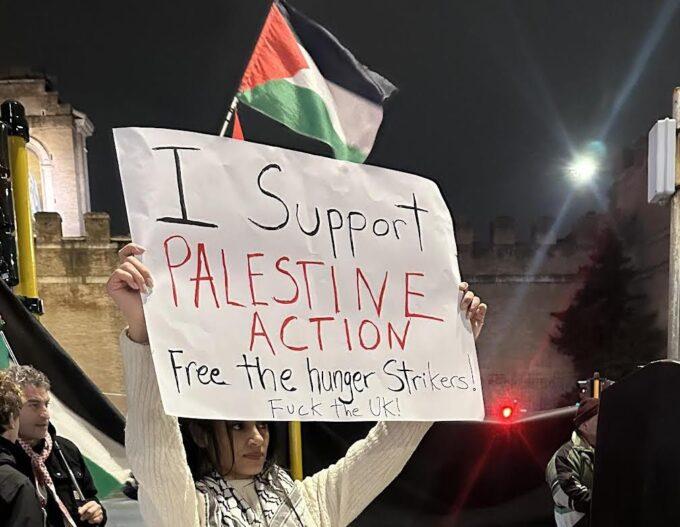
Photograph by Michael Leonardi
In a defiant stand that has shaken the corridors of British power, the imprisoned activists of Palestine Action have suspended their grueling hunger strike after forcing a major concession from the UK government. As of January 14, 2026 the last holdouts, including Heba Muraisi after 73 days without food, Kamran Ahmed at 66 days, and Lewie Chiaramello (who alternated days due to Type 1 diabetes), declared victory. They ended the protest upon news that Elbit Systems UK — Israel’s largest arms manufacturer — was denied a £2 billion Ministry of Defence contract for training British troops. They joined four others who had already paused their strikes — Teuta Hoxha, Jon Cink, Qesser Zuhrah, and Amu Gib — bringing the total to seven who stared down death to expose complicity in genocide.
This is no mere pause; it is a tactical triumph in the war against apartheid’s enablers. The strikers, part of the “Filton 24” arrested in November 2024 for allegedly storming and vandalizing an Elbit site near Bristol, had demanded immediate bail, unrestricted communications, reversal of Palestine Action’s terrorist designation, and the closure of all 16 Elbit UK sites. They began their action on Balfour Day — November 2, 2025 — a deliberate rebuke to Britain’s original sin in partitioning Palestine. Facing pre-trial detention that could stretch 18 months or more, they weaponized their bodies against a system that jails dissenters while arming colonialism and genocide.
Their resolve echoes the ghosts of Long Kesh, where Bobby Sands and his IRA comrades waged a similar battle against British imperialism in 1981. Sands perished after 66 days, his death igniting global fury and propelling the Irish struggle forward. A previous CounterPunch article linked Sands to these modern resisters, framing hunger strikes as the ultimate indictment of empire’s cruelty — turning the oppressed into mirrors that force the world to confront its hypocrisy. Here, Muraisi surpassed Sands’ endurance, her labored breaths a testament to unbreakable Palestinian sumud (steadfastness). Like the IRA ten who died demanding political prisoner status, these strikers exposed the farce of “justice” under occupation’s allies. The UK government’s silence — despite pleas from dozens of global intellectuals, former hunger strikers from Palestine, Ireland, and Guantánamo, and even Human Rights Watch — was deafening until international pressure cracked the facade.
But let’s dismantle the absurdity at the heart of this saga: the UK’s designation of Palestine Action as a “terrorist organization” in July 2025. This Orwellian label, imposed under the Terrorism Act 2000 after activists spray-painted RAF planes at Brize Norton, criminalizes membership, support, or even wearing clothing that might “arouse suspicion.” It is a blatant misuse of counter-terror laws to crush nonviolent direct action against genocide enablers. UN Human Rights Chief Volker Türk condemned it as “disproportionate and unnecessary,” noting that the broad definition of terrorism now includes property damage aimed at influencing policy, while ignoring Israel’s state terror in Gaza. A declassified intelligence report even admitted most of Palestine Action’s activities “would not be classified as terrorism,” yet the ban proceeded, backed by 385 MPs against a mere 26. Amnesty International, Liberty (National Council of Civil Liberties UK), and the UN decried it as an assault on free speech, but Keir Starmer’s regime, ever the loyal lapdog to Zionist interests, pressed on, proscribing the group alongside neo-Nazis like the “Maniac Murder Cult” that has tried to violently target the jewish community with violent anti-semetic attacks.
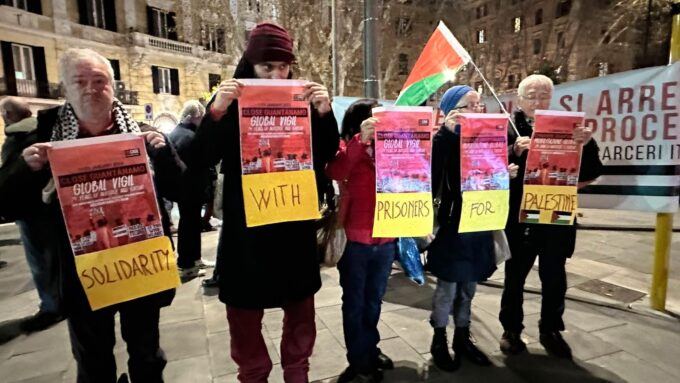
Photograph by Michael Leonardi
The International Bar Association has joined the chorus of condemnation, describing the proscription as “a major and dangerous shift in the law.” Human rights barrister and former Liberty director Martha Spurrier called it an “exaggerated response,” arguing that “for Palestine Action to be proscribed primarily for their protests that cause damage to property (and property that falls squarely within the target of their protest, not random or untargeted public infrastructure, for example) is a major and dangerous shift in the law.” Toby Cadman, a member of the IBA War Crimes Committee Advisory Board, added that the measure is being used “as a blunt instrument to silence certain voices on Palestine at a moment when public opinion and government policy are sharply at odds,” warning that broadening terrorism powers “to silence disruptive but non-lethal protest movements” is an “alarming rationale in a democracy” that effectively redefines acts of protest and civil disobedience as security threats.
This farce is not isolated; it is the empire’s playbook to delegitimize resistance. Palestine Action’s “crimes”? Disrupting Elbit’s blood-soaked supply chain, which arms Israel’s apartheid and genocide machine. While the real terrorists — bombing Gaza’s children, razing homes and starving millions — receive billion-pound deals and diplomatic cover. The ban has only fueled radicalization, as critics warn, eroding trust in a “democracy” that jails protesters while exporting death.
Yesterday’s announcement of the contract denial came on the heels of intense international solidarity actions and growing media attention that had been building pressure for days. Coordinated protests around the world, explicitly called as part of a global escalation in solidarity with the hunger strikers and ahead of any decision on the £2 billion deal, sent a clear message: continued complicity with Elbit and the death of any of the hunger strikers would carry a heavy political and reputational cost.
In Italy, hundreds of people, including many highschool students took to the streets in Rome and Milan, representative of a much broader movement across Europe. In Rome, a vibrant and colorful crowd converged at the UK Embassy near Porta Pia, waving Palestinian flags, chanting for a Free Palestine and denouncing the UK, Europe, the United States and Italy’s continued complicity in genocide, their energy a rebuke to Meloni’s pro-Israel regime. Palestinian student leader Maya Issa called attention to the growing repression in Italy targeting detained Palestinian activists stating: “we will not be silent in the face of the ongoing genocide in Gaza and the continued complicity of the Italian government. We will continue to resist and not be intimidated”. Milan saw similar determination at the British Consulate, well-attended by students and workers demanding sanctions and an embargo. These actions, together with demonstrations in dozens of cities globally, underscored the growing rejection of Zionist propaganda and helped tip the scales against the Elbit contract.
While the suspension marks a historic win, the strikers’ ordeal is far from over. Heba Muraisi and Kamran Ahmed remain in extremely precarious health. After 73 and 66 days of starvation, respectively, the refeeding process is fraught with danger—refeeding syndrome, organ damage, and long-term complications are very real risks. Both have been back and forth between prison and emergency hospitalization and under close medical supervision; their bodies have been pushed to the absolute limit, and full recovery will take months, if not longer. Meanwhile, one holdout, Umer Khalid, has resumed his hunger strike and continues on Day 6, embodying the unbreakable sumud that refuses to yield even as the majority step back from the brink.
From Sands’ cell to these British prisons, history teaches that empires crumble under such unbreakable will. The strikers’ victory is a crack in the wall — proof that direct action, amplified by global solidarity, works. But the fight rages on: Elbit still operates, Gaza bleeds, and the West continues to arm and normalise Israel’s genocide. It is time to escalate—boycott, divest, sanction, and dismantle the genocidal apartheid machine. As the Palestinian BDS National Committee urges: “Our future depends on your solidarity, your organization, your pressure.” Honor these resisters by making complicity impossible. Free Palestine, from the river to the sea.
Michael Leonardi lives in Italy and can be reached at michaeleleonardi@gmail.com
Silencing Dissent
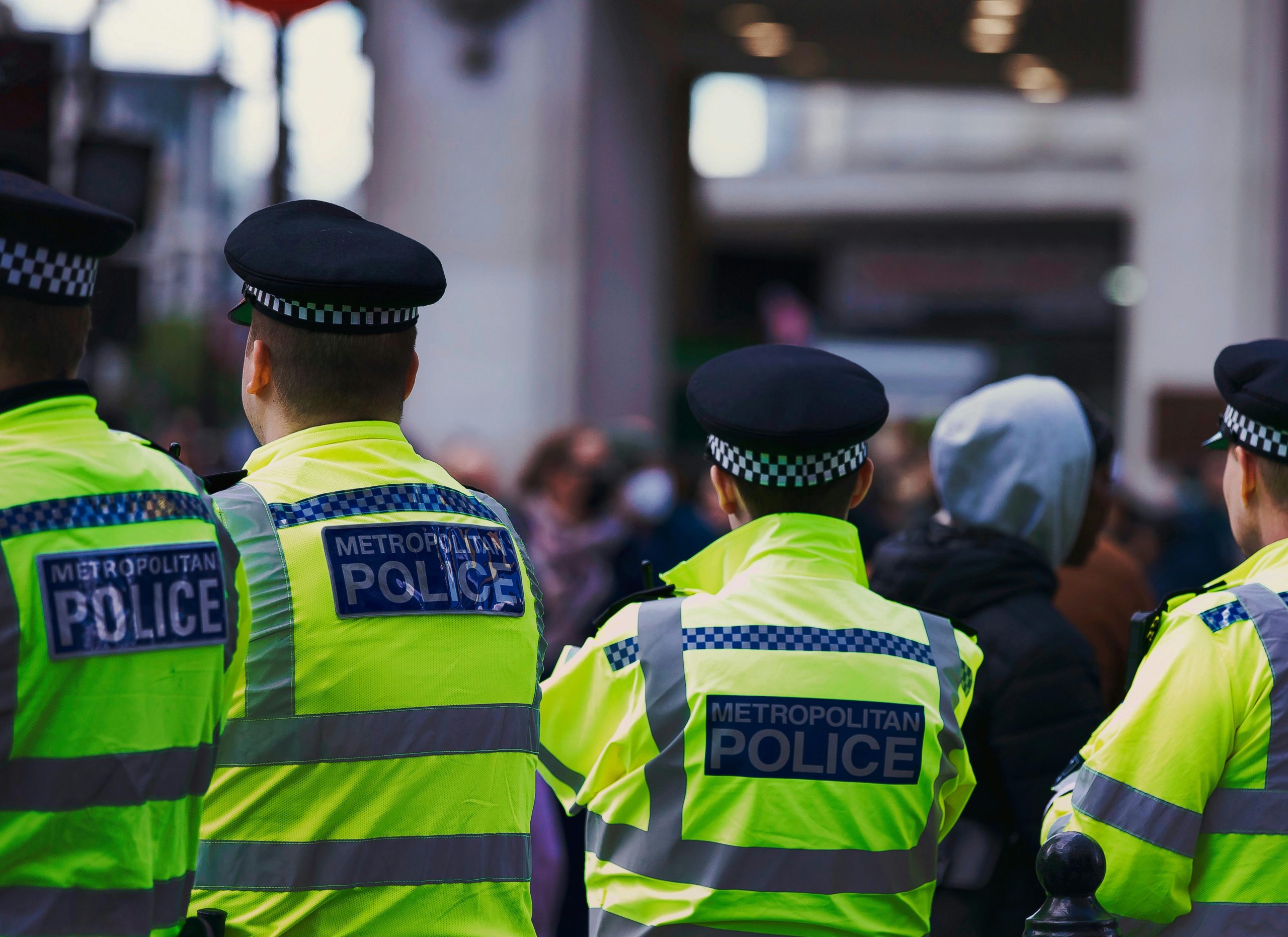
Despite government ministers’ commitment to phasing out animal testing, Labour now intends to criminalise protests outside animal breeding and testing facilities — a move that will undermine British democracy.
It might feel a long time ago now, but at the last election, while many criticised Labour’s offer as too vague or limited, there was no denying a genuine appetite for something new. Whether people voted to see the back of the Conservatives or in hope of something better, the direction of travel was unmistakable. And that near-universal sense of fatigue with the Tories did not come about because the public felt its government wasn’t authoritarian or overbearing enough.
Nobody voted Labour because they wanted a digital ID, and there was no mention in our manifesto of limiting jury trials. Similarly, if the public were clamouring to have fewer rights to protest, the Conservatives’ track record might have been more of a voter winner.
Today, the government appears set on taking a further step in the wrong direction with its plans to criminalise protest sites linked to animal testing. The legislation builds on the same Public Order Act Labour opposed in opposition — redefining ‘life sciences infrastructure’, including animal testing facilities, as ‘key national infrastructure’. This could see animal welfare activists jailed for up to a year or hit with unlimited fines for protesting facilities the government itself wants to see phased out. Ministers backed plans to accelerate the end of animal testing just two months ago.
I welcomed the government’s animal welfare strategy released over Christmas. Banning trail hunting demonstrated action on a manifesto pledge and a willingness to take on vested interests, while standing with a public that overwhelmingly supports animal welfare. This misstep on animal testing highlights a dysfunctional trend in government: positive steps in one area of policy, immediately undermined by competing priorities in another.
It’s so disappointing that many of the same animal-loving constituents who joined me in celebrating our animal welfare strategy are now contacting me, outraged that a Labour government is seeking to criminalise them. The proposals fail to stand up to the most rudimentary scrutiny; there is no legislative gap to fill. Existing laws already provide robust protections against actual criminal activity.
The powers within the Public Order Act, designed for airports, major roads, and utilities, were never intended to cover these private, often US-owned companies. Treating them as equivalent to national infrastructure shields private profits from legitimate dissent, placing corporate interests above the right to protest. What’s worse, the government had initially attempted to pass these measures without proper parliamentary scrutiny or a vote for all MPs.
With further plans on the horizon to restrict protests drawing condemnation from civil society groups, including the Palestine Solidarity Campaign, Greenpeace, and the Trade Union Congress, the message is clear: animal welfare protesters are today’s target, and if the slide against the right to free assembly that began under the last government isn’t halted, tomorrow it will be others.
Protest is a fundamental pillar of our democracy; for millions of people, it is their most powerful lever outside the election cycle to make their voices heard. It is authentically democratic. While corporate interests haunt the corridors of power and pollute politics around the world, the power to organise collectively is one of the most potent tools working people hold in the perennial tug-of-war against wealth and power in our society.
One of my first responsibilities as a backbench MP is to uphold the civil liberties and rights of my constituents. As a Labour MP, the responsibility to defend ordinary people’s ability to make themselves heard is even greater. Movements, from the Chartists and the Anti-Apartheid struggle to the anti-war movement, Black Lives Matter, and the pro-Palestine campaign, do not exist in a vacuum. They form part of the fabric underpinning the broad left in this country — arenas of struggle for a better world, schools of activism, and shaping our national debate outside the clutches of media barons and corporate interests.
The stakes in British politics have scarcely been higher: we are potentially facing the most right-wing government in my lifetime, a climate catastrophe, gross inequality, and low wages. The list goes on and on. A Labour government should deepen democracy, expand people’s power, and recognise where its true strength lies. Shielding the powerful from dissent only strengthens our opponents. By curtailing the right to protest, we risk laying the foundations for a more authoritarian and less democratic state. That’s not the job of the Labour Party.

No comments:
Post a Comment