US President Donald Trump threatens to deploy military forces to quell protests in Minnesota, as tensions run high over the role of ICE officers in the city.

US President Donald Trump Thursday threatened to deploy US military forces to respond to protests in Minnesota, writing that he would "institute the Insurrection Act" if the situation deteriorated in a social media post.
"If the corrupt politicians of Minnesota don’t obey the law and stop the professional agitators and insurrectionists from attacking the Patriots of I.C.E., who are only trying to do their job, I will institute the INSURRECTION ACT," Trump wrote on Truth Social.
Tensions escalated in Minneapolis on Wednesday night when a federal officer shot and injured a man in the leg after he attacked officers with a shovel and a broom during a targeted traffic stop.
The incident came a week after an American woman, Renee Nicole Good, was killed by an Immigration and Customs Enforcement (ICE) officer in the same city, sparking protests across major US cities.
What is the Insurrection Act?
The Insurrection Act of 1807 allows the US president to deploy the military or federalize National Guard troops to enforce the law, specifically in the face of rebellion or other domestic instances of violence.
The modern-day Insurrection Act is an amalgamation of statutes passed between 1792 and 1871 outlining the role of US military forces in domestic law enforcement.
The law has been sparingly used and was last invoked in 1993 by President George H.W. Bush to quell riots in Los Angeles after local officials requested assistance.
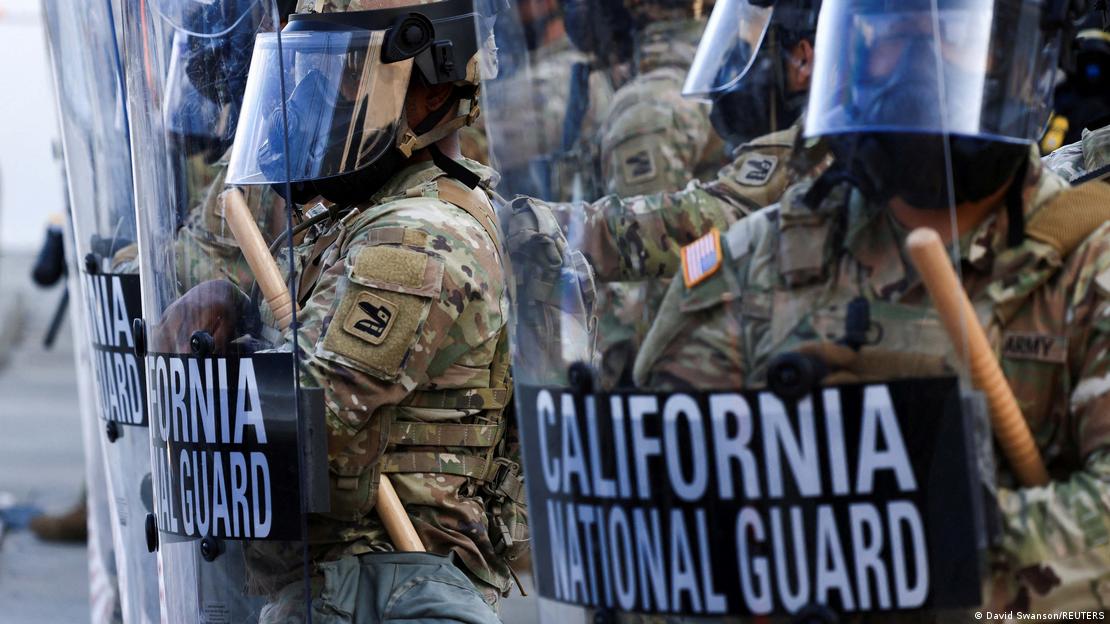
Trump sparked backlash when he sent National Guard troops to Los Angeles last June, without the governor's request or support, as part of his efforts to clamp down on immigration.
He also sent federal troops to Washington, DC, and Memphis, Tennessee, and ordered the deployment of troops to Chicago and Portland. But his push to deploy National Guard troops faced numerous legal challenges.
Ultimately, in December, the Supreme Court ruled that Trump could not deploy troops in the Chicago area over the objections of Illinois officials.
Trump said on January 1 he was backing down from his efforts to deploy the National Guard to the Democratic-led cities of Chicago, Los Angeles and Portland for now, without mentioning the ruling.
Edited by: Louis Oelofse

Roshni Majumdar Roshni is an editor and a writer at DW's online breaking news desk.
ICE Puts All of Us in Danger
January 16, 2026
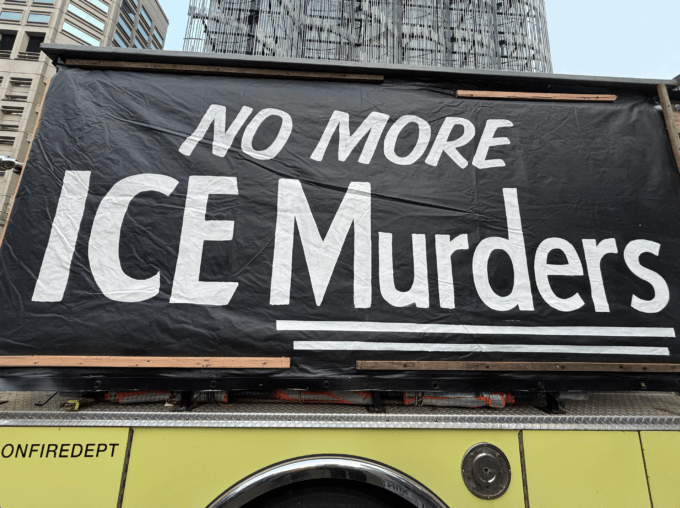
Photograph by Nathaniel St. Clair
On January 7, an Immigration and Customs Enforcement (ICE) agent fatally shot Renee Good in Minneapolis — a city long enriched by immigrants and now under assault from thousands of ICE and Customs and Border Protection agents.
Good, a 37-year-old poet and mother of three, was driving alongside her wife, Becca. They were observing an ICE raid in their community. “We stopped to support our neighbors. We had whistles. They had guns,” said Becca.
Sadly, at least three other people have been killed by ICE officers in the last five months, according to The Marshall Project.
Among them was Silverio Villegas González, a 38-year-old father and cook originally from Mexico, who was fatally shot during a traffic stop in a Chicago suburb. Keith Porter Jr., a 43-year-old father of two — and, like Good, a U.S. citizen — was shot and killed by an off-duty ICE agent on New Year’s Eve in Los Angeles.
While the families of all these victims await justice, the violence continues. ICE agents have shot at least nine people in their vehicles since September. The Department of Homeland Security has routinely invoked “self-defense” to justify these shootings, despite video and witnesses repeatedly contradicting their accounts.
From Los Angeles to Washington D.C., Chicago, Memphis, New Orleans, Portland, Charlotte, and now Minneapolis, violence has followed wherever Trump has dispatched immigration agents in the name of “public safety.”
On the same day Good was murdered, ICE conducted a raid at a nearby Minneapolis high school, reportedly tackling a teacher and harassing students. The next day, ICE agents in Robbinsdale, Minnesota forcibly detained a U.S. citizen and Red Lake Nation descendant for no apparent reason. Stories of new outrages emerge almost daily.
And last fall, federal agents descended from Black Hawk helicopters in a midnight raid of an apartment building in Chicago, detaining all its residents, including children. (That’s in addition to killing Villegas González — and shooting another person five times.)
This escalating violence is an outgrowth of ICE’s appalling treatment of immigrants. Across the country, people have been rounded up, thrown in deadly prisons, and ripped from their families — a trend that has sharply escalated under Trump.
Thousands of masked agents in unmarked cars — equipped with military-grade weapons and the latest surveillance technology— treat cities like war zones while executing raids at workplaces, places of worship, and schools.
Citizens and non-citizens alike have been racially profiled and kidnapped at courthouses and off the streets without warrants or probable cause. Trump has also used ICE to attack free speech, abducting and jailing students like Mahmoud Khalil, Mohsen Mahdawi, and Rümeysa Öztürk who spoke out against the Gaza genocide.
In addition to the shootings, 32 people died in ICE custody last year alone — and as of this writing, four more people have died in custody so far this January.
Abysmal conditions in ICE prisons, including medical neglect, have resulted in these tragic and avoidable deaths, leaving families shattered and still searching for answers. Nearly 69,000 people are currently being held in ICE prisons, the vast majority of them without a criminal record. According to ProPublica, ICE also detained over 170 U.S. citizens last year.
ICE has repeatedly denied members of Congress entry to its detention facilities, interfering with Congress’s constitutional oversight authority. Still, Congress enables ICE’s abuses through billions in funding increases. ICE’s $14 billion annual budget for detentions alone, note Lindsay Koshgarian and Sarah Lazare, is more than the total military spending of 124 countries.
Across the country, more communities are responding to our nation’s descent into lawlessness by uniting around our shared humanity and demanding justice. A recent poll shows, for the first time, net positive support — including among self-described moderates — for abolishing ICE.
These Americans understand that no one is safe as long as ICE still exists, operates with impunity, and terrorizes communities. How many more deaths will it take for Congress to hold this agency accountable?
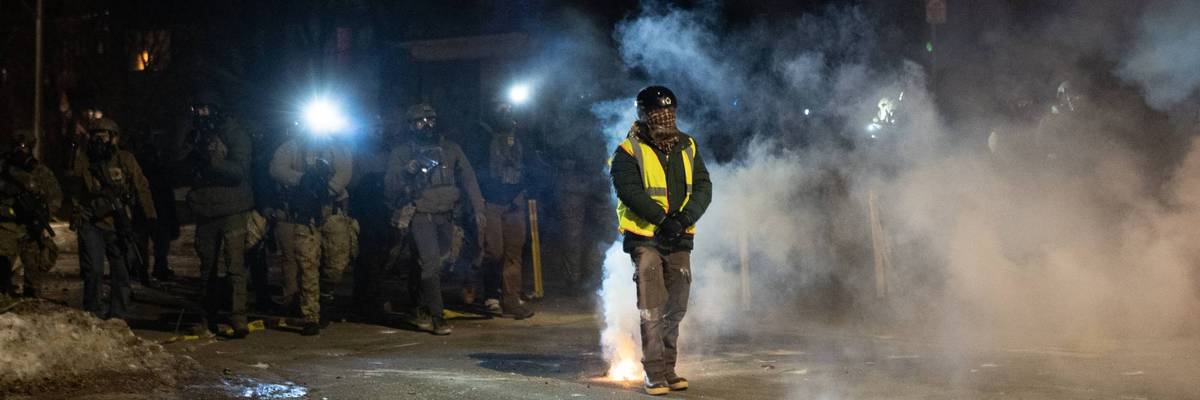
A protester stood his ground on January 14, 2025 as federal officers moved to push protesters from an intersection in Minneapolis.
(Photo by Jeff Wheeler/The Minnesota Star Tribune/Getty Images)
Julia Conley
Jan 15, 2026
COMMON DREAMS
President Donald Trump and other White House officials have sought to portray protesters against their mass deportation campaign, including in Minneapolis, as out of control and violent—but in condemning the president’s threat to invoke to Insurrection Act in order to crack down on growing dissent, a top civil liberties group Thursday said it’s clear where the danger to public safety is coming from.
“The real risk to people’s safety comes from [US Immigration and Customs Enforcement] and other federal agents’ violence against our communities,” said Hina Shamsi, director of the ACLU’s National Security Project. “What’s needed now is not federal escalation, but deescalation.”
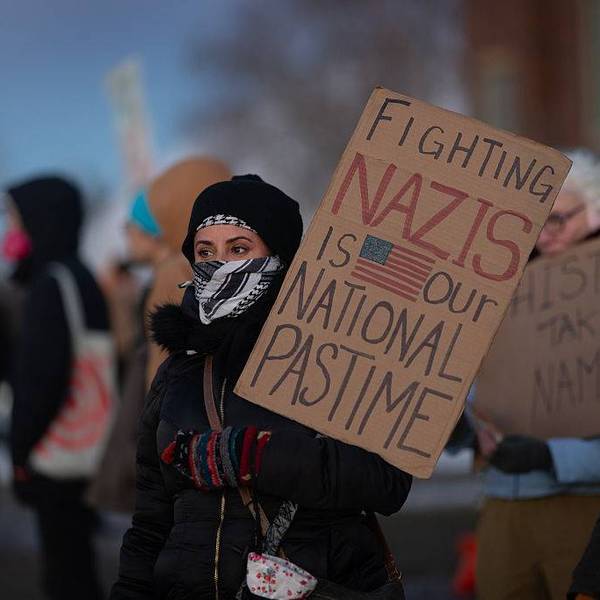
Instead, Trump said Thursday morning—hours after a federal agent shot and wounded a man during a traffic stop in Minneapolis and a week after Renee Good was killed by an ICE agent—officials in Minnesota must “stop the professional agitators and insurrectionists from attacking the Patriots of ICE who are only trying to do their job.”
Trump officials have provided no evidence that protesters in Minneapolis or elsewhere are “professional agitators” rather than grassroots community members who have banded together to protect their neighborhoods.
The president didn’t detail how he believes officials in the state could bar residents from protesting ICE or observing and filming their violent arrests—which, as Department of Homeland Security officials on the ground recently reminded agents, are protected activities under the First Amendment and other statutes—but said if they didn’t do so he would invoke the Insurrection Act.
Invoking the law would allow Trump to deploy US military troops to Minneapolis for law enforcement purposes. The president—who has been accused of inciting an attempted insurrection on January 6, 2021 after losing the 2020 election—has threatened to use the Insurrection Act at other times to clamp down on protests against his anti-immigration agenda. The law is rarely used and was last invoked in 1992 by President George H.W. Bush during riots in Los Angeles.
“It’s hard to think of another instance in which a president would deploy troops to enable further federal deprivation of people’s rights.”
Shamsi said that “invoking the Insurrection Act is unnecessary, irresponsible, and dangerous.”
“President Trump is continuing to stoke fear in a situation his administration created by unleashing lawless, armed federal agents against our communities,” she said. “It’s hard to think of another instance in which a president would deploy troops to enable further federal deprivation of people’s rights.”
Even if Trump were to send the US military to Minneapolis or other cities, Shamsi issued a reminder that “no matter what uniform they wear, armed federal agents and military troops are bound by our constitutional rights to peaceful assembly, freedom of speech, and due process. If troops or federal agents violate these boundaries, they and their leadership must be held accountable.”

No comments:
Post a Comment