It’s possible that I shall make an ass of myself. But in that case one can always get out of it with a little dialectic. I have, of course, so worded my proposition as to be right either way (K.Marx, Letter to F.Engels on the Indian Mutiny)
Sunday, January 18, 2026
CU
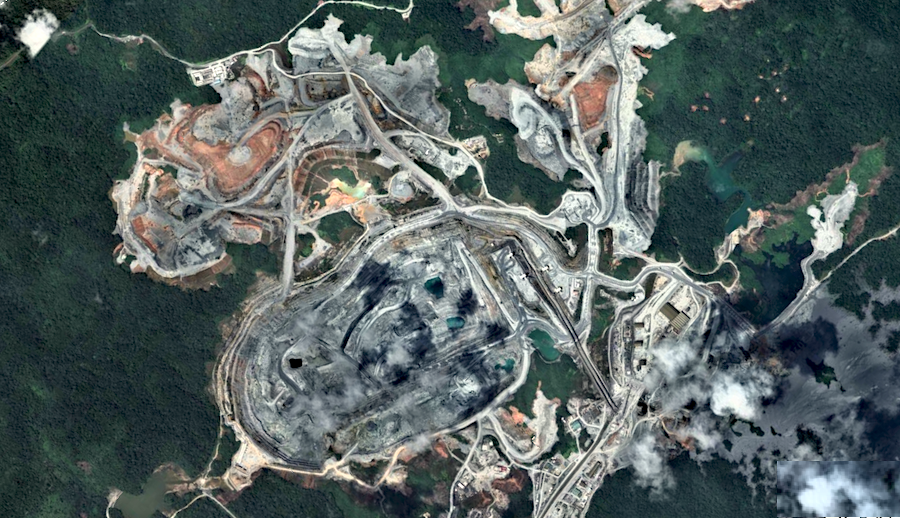
First Quantum nears stockpile processing at Cobre Panama copper mine
Bird’s-eye view of Cobre Panama mine. (Image: Google Earth.)
First Quantum Minerals (TSX: FM) welcomed Panama President Jose Raul Mulino’s plan to allow the removal and processing of stockpiled ore at its shuttered Cobre Panama copper mine, calling it a step toward stabilizing the site while discussions continue on its long-term future.
The Canadian miner said the government began executing a care and maintenance plan last year in preparation for processing about 38 million tonnes of ore mined before operations were suspended in 2023.
The stockpile is expected to yield about 70,000 tonnes of copper, with proceeds from concentrate sales helping offset preservation and maintenance costs in 2026, depending on regulatory timing.
Chief executive Tristan Pascall said the forthcoming permit is a positive development but does not amount to a reopening of the mine, adding that First Quantum remains committed to dialogue to resolve the dispute.
The company said it had revised its copper production guidance for the next two years. It nows expects to generate 375,000 to 435,000 tonnes of copper this year; 410,000 to 470,000 tonnes in 2027 and 430,000 to 490,000 tonnes in 2028.
BMO Metals analyst Matt Murphy said the bank sees the guidance adjustments as “a modest negative”, as First Quantum’s 2026 copper production guidance was reduced by about 15,000 tonnes. He noted the market may take some comfort in the likelihood that the miner could begin processing stockpiled ore at Cobre Panama in the coming months.
Murphy added that while 2027 guidance was also lowered by 20,000 tonnes, the 2028 production range represents a 20,000-tonne year-over-year increase.
Initial actions
The Mulino administration last year began taking steps to extract value from the idled mine, delivering key measures by the fourth quarter that included royalty payments, the launch of an independent audit and a partial restart of on-site power generation.
Authorities also sold more than 122,000 tonnes of copper concentrate stored at the site, generating nearly $30 million in royalties that were directed to public works such as health centre upgrades, school expansions, road repairs and improvements to water and electrical systems.
The plan allowed for the restart of the mine’s power plant, with the first 150-megawatt unit commissioned in the fourth quarter and reaching design capacity. The plant is now operating at an average of about 120 MW to support preservation activities and supply Panama’s national grid, while a second 150 MW unit is scheduled to be commissioned this month.
First Quantum and government officials said removing, processing and exporting the stockpiled ore would reduce environmental and operational risks linked to long-term storage, including the potential for acid rock drainage, while providing feed for the tailings management facility.
Timeline
On a preliminary timeline, processing could begin about three months after formal regulatory approval and take roughly one year to complete.
The work is expected to provide an economic boost, adding about 700 direct jobs to the current workforce of roughly 1,600, alongside indirect employment in transportation, logistics, equipment supply and food services.
Pascall said the company supports the President’s call for transparency and engagement and remains committed to dialogue to achieve an amicable and durable resolution at Cobre Panama for Panama and its people.
First Quantum said all activities will be carried out in coordination with the government and in strict compliance with the approved plan.
The mine once supplied about 1% of global copper production, and its closure has weighed on both Panama’s economy and First Quantum’s financial performance. Before the shutdown, Cobre Panama produced 350,000 tonnes of copper in 2022, accounting for about 5% of Panama’s GDP. According to the company, would have delivered $1 billion to the treasury and $2 billion to local suppliers if operations had continued.
Mulino said earlier this week the government aims to decide on the mine’s future by June.
First Quantum is scheduled to release its fourth-quarter and full-year 2025 financial and operating results on Feb. 10, after the close of trading in Toronto.
First Quantum backs Panama’s plan to allow stockpile processing at shuttered copper mine
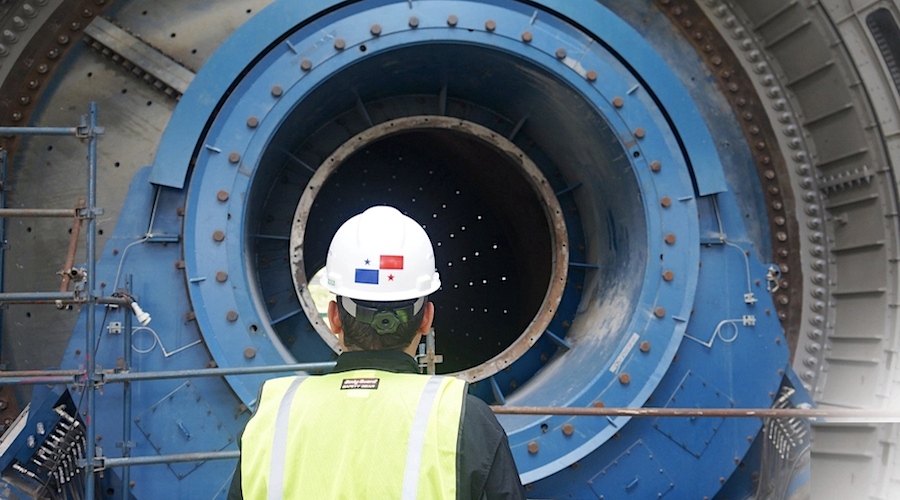
Cobre Panama mine was First Quantum Minerals’ largest copper operation. (Image courtesy of Cobre Panama.)
Canadian miner First Quantum Minerals (TSX: FM) on Thursday welcomed Panama President Jose Raul Mulino’s plan, announced early this month, to allow the removal and processing of stockpiled ore at its shuttered Cobre Panama copper mine.
The company said processing of the ore stockpiles will allow it to mitigate the environmental and operational risks associated with acid rock drainage and ensure a supply of feed material to the leftover, or tailings, management facility.
First Quantum is awaiting formal approvals to carry out these activities in coordination with the Panama government.
The Cobre Panama mine, one of the world’s largest open-pit copper deposits, was closed in 2023 following protests from local residents over tax contributions and environmental impacts.
The processing of stockpiles does not constitute reopening the mine, and will not require any new extraction, drilling or blasting, the company said in a statement.
The mine formerly provided 1% of the global copper supply, and its closure has had an impact on both Panama’s and First Quantum’s financial prospects.
Earlier on Thursday, Mulino said the government aims to make a decision on the future of the copper mine by June.
(Reporting by Pooja Menon in Bengaluru; Editing by Sahal Muhammed)
Ivanhoe meets 2025 output targets as Kamoa-Kakula smelter ramps up
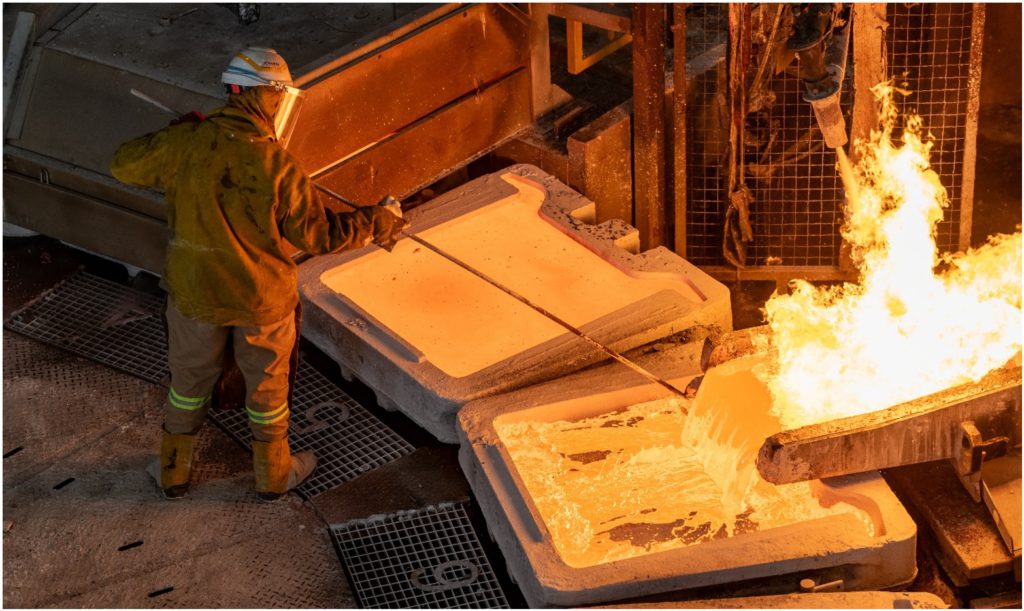
A smelter operator takes a sample while 99.7%-pure copper anodes are poured and cast at the Kamoa-Kakula copper smelter. Credit: Ivanhoe Mines
Ivanhoe Mines said on Thursday it met its 2025 output targets at the Kamoa-Kakula copper complex and Kipushi zinc mine in Congo and issued guidance pointing to a steady recovery after a year of disruptions and a pivotal smelter ramp‑up.
Kamoa‑Kakula is widely viewed as one of the world’s most significant new copper sources, making details of Canadian miner Ivanhoe’s 2025 output and steady 2026 targets critical in a market facing tight supply and slow project growth.
The mine’s ability to hold production within guidance, alongside the ramp‑up of its new smelter, reinforces Ivanhoe’s rising influence in the copper sector, while record output at Kipushi underscores its growing weight in zinc.
Kamoa-Kakula spent 2025 tackling water inflows that restricted access to higher‑grade ore and weighed on recoveries, forcing a staged de-watering push.
Ivanhoe said Kamoa-Kakula delivered 388,838 metric tons of copper in concentrate in 2025, landing within its 380,000–420,000 ton guidance range.
The result reflected record throughput from the Phase 3 concentrator and the early benefits of destocking as the mine transitions to on‑site smelting.
Ivanhoe reaffirmed 2026 copper output guidance at 380,000–420,000 tons, saying production should strengthen as underground dewatering progresses and higher‑grade areas become accessible.
A key milestone for the complex was the late‑2025 start‑up of Africa’s largest copper smelter, which the company said is now averaging 500 tons per day of 99.7%‑pure copper anodes.
First exports are expected imminently, it said.
Ivanhoe said the ramp‑up would cut logistics costs by more than halving the tons of material transported per unit of copper, while generating new revenue streams through sulphuric acid production.
Kamoa-Kakula’s 2026 copper sales are expected to be 20,000 tons higher than production as the inventory of unsold copper concentrate is destocked, mainly during the first half of the year, the results showed.
At Kipushi, Ivanhoe reported a record 203,168 tons of zinc in concentrate in 2025, achieving guidance after a strong second‑half recovery supported by improved power stability and a de-bottlenecking program completed ahead of schedule.
Ivanhoe set 2026 zinc guidance at 240,000–290,000 tons, adding that December production alone implied an annualized run rate exceeding 270,000 tons.
(By Maxwell Akalaare Adombila; Editing by Alexander Smith)
Codelco submits $1.3B plan to prolong Radomiro Tomic mine life to 2058
Chile’s state-run miner Codelco, the world’s largest copper producer, on Tuesday submitted a $1.3 billion continuity project to Chile’s environmental authority to request an extension of its leaching operations at its Radomiro Tomic mine until 2058.
The proposal aims to boost the mine’s capacity to an average of 725,000 tonnes per day, up from its current level of 675,000 daily tonnes, requiring pit expansion and new waste dumps and ore stockpile areas.
The plan seeks to extend the operation of the mine’s chlorinated leaching process at an average annual rate of 154,000 tons per day.
Leaching is a method of extracting metals and minerals from rock using liquid chemicals instead of melting or crushing.
The project also seeks to provide operational continuity to its waste treatment and dumping line, which uses chemical solutions to extract copper from ore rather than smelting.
Plans include expanding support facilities and installing a hydraulic barrier system with four wells to control water infiltration in the industrial area.
The project includes truck transport of 20,000 daily tons of ore or waste per year to Codelco’s Chuquicamata facility over the next 10 years.
Codelco’s Radomiro Tomic mine is one of the company’s three most prominent mines in Chile.
(By Fabian Cambero; Editing by Natalia Siniawski)
Codelco gets environmental permit for $2.8B Ministro Hales mine extension
Chilean state-run miner Codelco said on Wednesday it had received environmental approval to extend the life of its Ministro Hales copper mine until 2054, a project that will require an investment of $2.8 billion.
The world’s largest copper producer said the initiative will allow the mine to increase production to 200,000 tons per year, up from the current 170,000 tons.
(By Fabian Cambero; Editing by Sarah Morland)
Sandvik partners with Vale Base Metals for autonomous surface drill fleet expansions
Sandvik will supply 16 surface drills with AutoMine readiness for Vale Base Metals’ copper operations in Brazil.
The orders include nine Sandvik DR416i rotary blasthole drill rigs and seven Leopard DI650i down-the-hole (DTH) drill rigs, as well as multi-year service and rock tools supply. The rigs will be equipped for fully autonomous drilling with Sandvik’s industry-leading AutoMine system.
Sandvik DR416i is a powerful and technologically advanced drill rig, designed for drilling rotary from 269.9 to 406.4 millimeters (10.625 to 16 inches). The Leopard DI650i is a self-contained, crawler-mounted, intelligent DTH drill rig for demanding high-capacity production drilling and pre-split, covering hole diameters from 115 to 203 millimeters (4.5 to 9 inches).
AutoMine is the most advanced level of automation and includes the AutoCycle capabilities. The AutoCycle enables fully autonomous operation of the surface drilling fleet, allowing multiple drill rigs to be operated from a remote-control room. This enhances operational safety, increases productivity and improves fleet utilization.
The equipment will be used at the Salobo and Sossego operations. Located in Canaã dos Carajás, southeastern Pará, the Sossego mine complex was inaugurated in 2004 as Vale’s first copper operation. The Salobo mining complex is located in Marabá, also in southeastern Pará. It holds the largest copper mineral reserve in Brazil.
“We’re excited to grow our surface partnership with Vale Base Metals, where we will provide our latest technologies and collaborate to optimize productivity and cost efficiencies,” said Mats Eriksson, president of mining at Sandvik.
“This achievement also marks a significant milestone for Sandvik … demonstrating our ability to deliver a comprehensive portfolio of surface solutions across all divisions. Our journey with Vale Base Metals began in 2021 with the initial DR416i trial at the Sossego mine.”
The orders were mostly booked in the second and third quarters of 2025, with the remainder in 2026.
Deliveries of the Sandvik DR416i rotary rigs began in the fourth quarter and will continue into Q2 2027. Four DI650i rigs will be delivered this year, and the final three in 2029.

 A smelter operator takes a sample while 99.7%-pure copper anodes are poured and cast at the Kamoa-Kakula copper smelter. Credit: Ivanhoe Mines
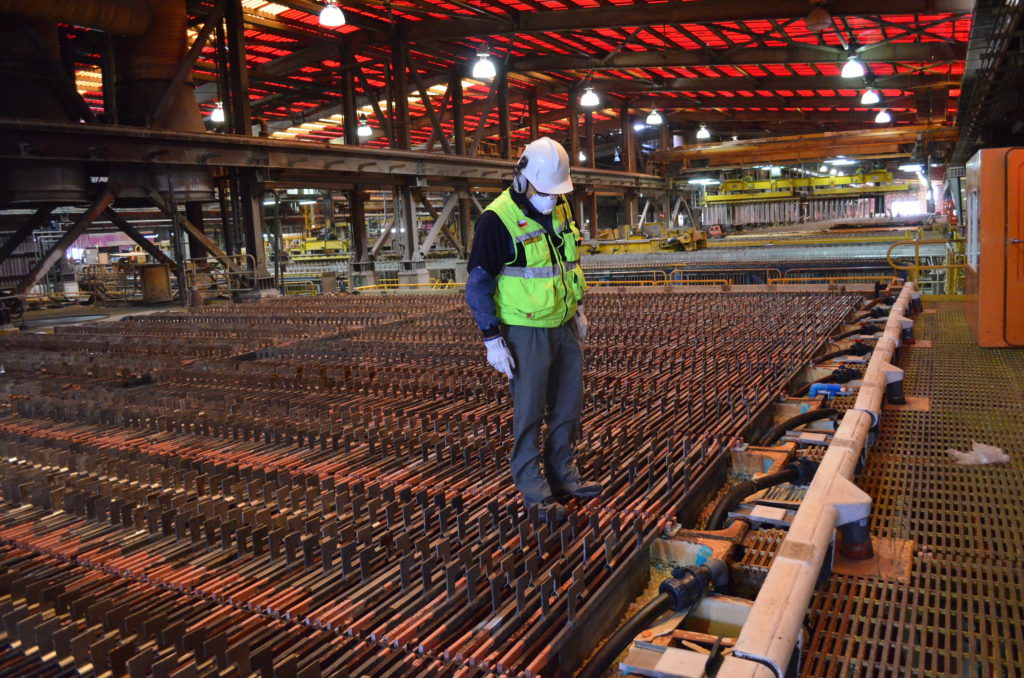 EW plant at Radomiro Tomic. Credit: Codelco | Flickr
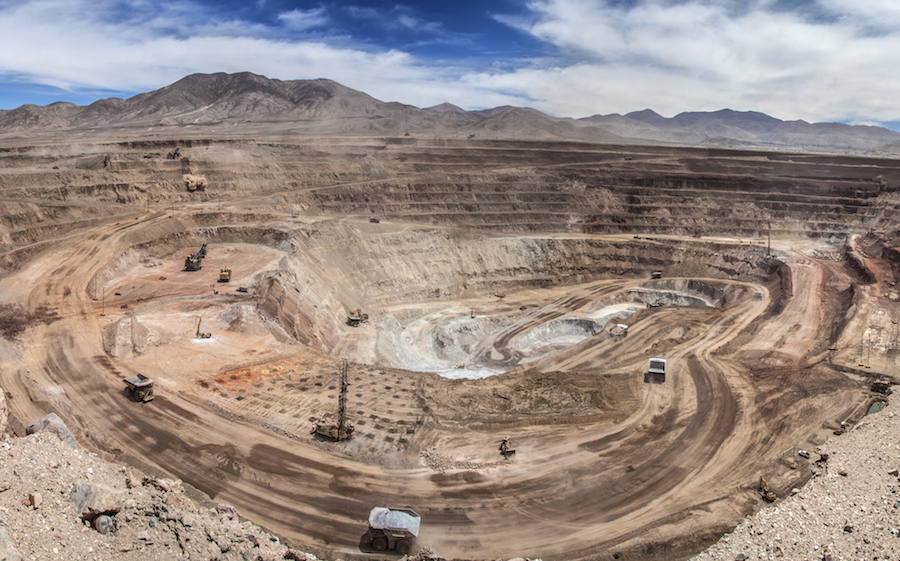 Chile’s Ministro Hales mine. (Courtesy of Codelco via Flickr)
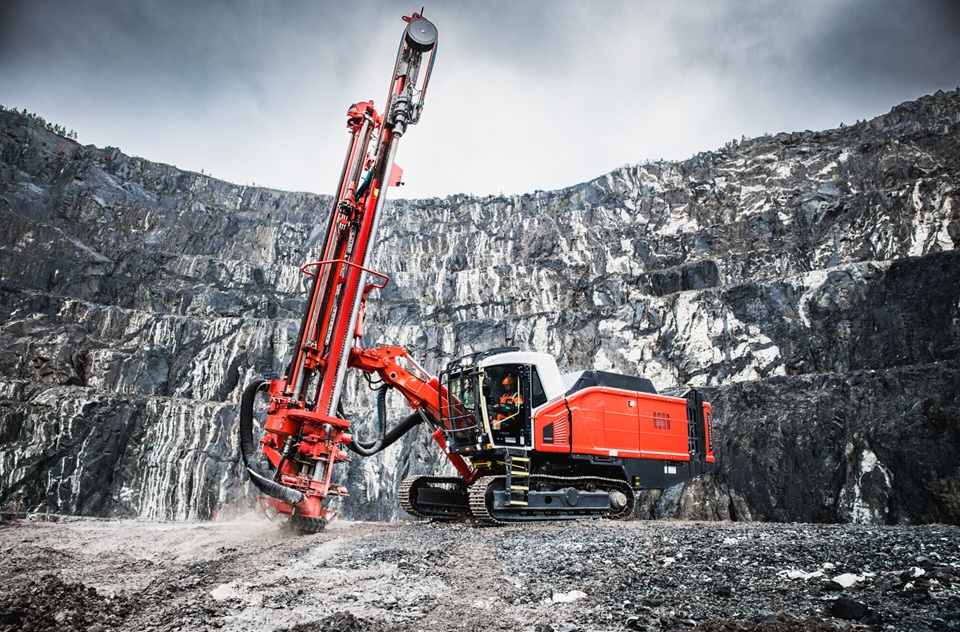 Di650i-leopard. Image: Sandvik.

No comments:
Post a Comment