What does victory look like? Serbia’s Gen Z’s search for an endgame
JANUARY 19, 2026
By Dragica Felja, Jelisaveta Djordjevic-Ristanovic and Jelena Pavic
Fourteen months have passed since the collapse of the concrete canopy at the newly refurbished train station in Novi Sad, Serbia – a disaster that claimed 16 lives and seriously injured another. For many citizens, the tragedy was not an isolated incident but a symbol of deeper systemic failures, sparking a wave of mass protests across the country. As Novi Sad-based journalist, Igor Mihaljevic, declared in its aftermath: “What happened in Novi Sad was not a tragedy, it was a crime.”
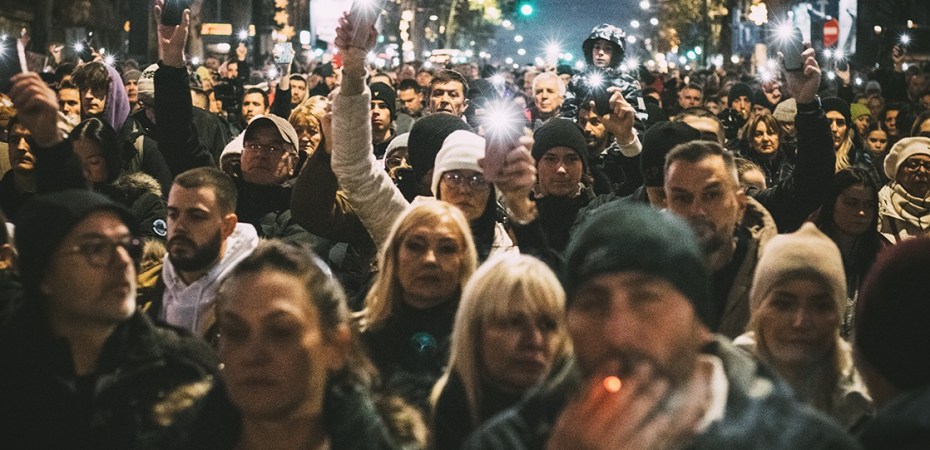
What made the uprising striking was that it began with those whom society least expected to lead it. For years, Generation Z had been overlooked as apolitical, absorbed in their phones, scrolling through social media and supposedly detached from public life. Yet it was precisely this generation that first refused to accept the official narrative of the station collapse and the broader culture of impunity it represented. What many had mistaken for apathy revealed itself as a different kind of political literacy, one shaped by digital fluency, rapid information‑sharing, scepticism toward authority, and a refusal to normalise corruption.
Their emergence at the forefront of the protests shattered long‑held stereotypes and signalled that a new, highly networked civic force had entered Serbia’s political landscape. As Marija Petrovic, a student from the Faculty of Agriculture in Novi Sad observes, this mobilisation has already begun to reshape her generation’s priorities: “Protests are leading to a noticeable higher interest in politics amongst Gen Z, compared to a few years ago, placing the fight against nepotism and corruption, as well as support for the rule of law, among their top priorities. Gen Z, as the first true digital generation, has also become the first generation to staunchly oppose cults of personality, something that had persisted for decades.’”
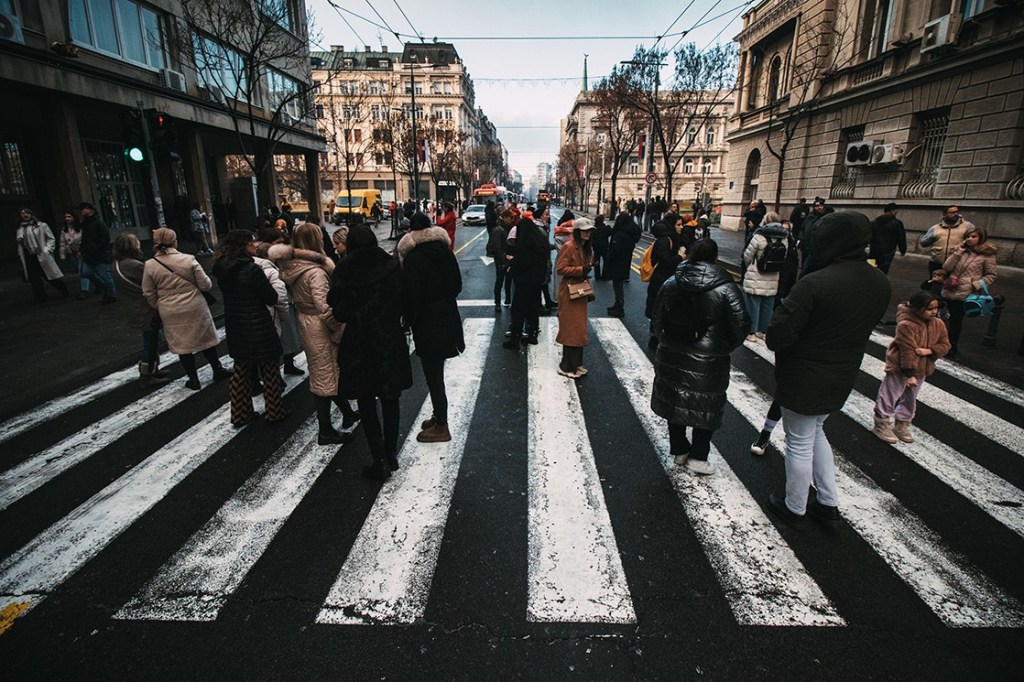
Drawing on this digital‑first organising power, Gen Z students were the first to translate outrage into action. In the aftermath of the canopy collapse, they staged silent vigils and road blockades known as ‘Zastani Srbijo’ (Serbia Stop), actions that quickly set the tone for broader civic resistance. Their peaceful gatherings were met with intimidation, violence, and arrests, exposing the state’s unwillingness to confront its own failures.
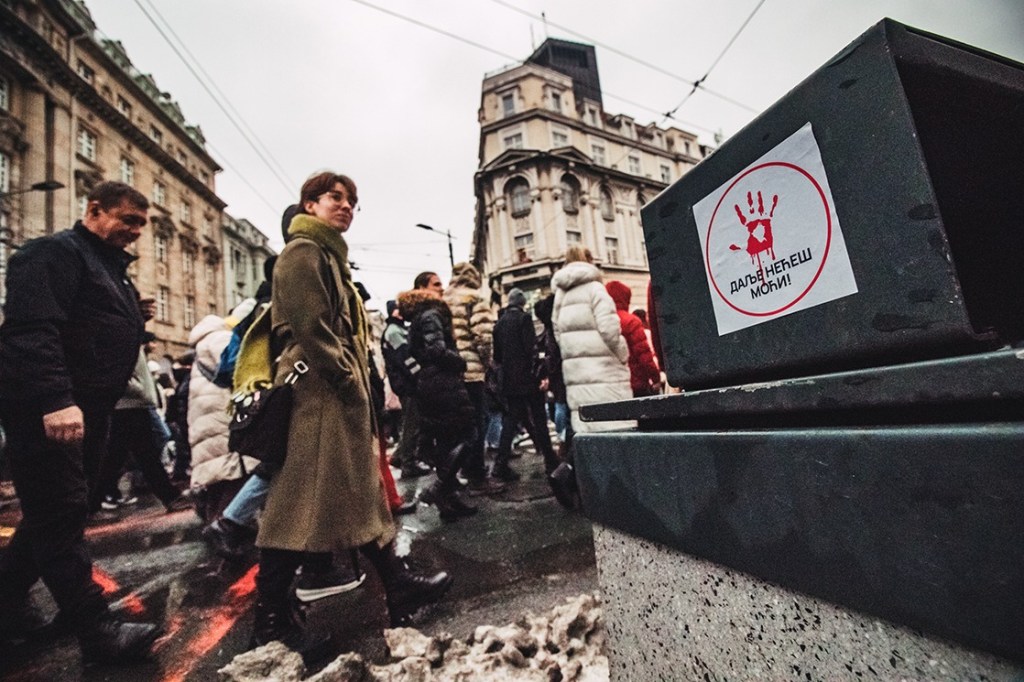
One message in particular – ‘Ruke su vam krvave’ (Your hands are bloody) became the defining symbol of the movement. Paired with red handprint imagery, it marked both a memorial to the victims and a direct accusation against those in power. Chanted at vigils and painted across public spaces, the phrase captured the moral clarity and uncompromising stance that Gen Z brought to the protests.
As repression intensified, this same generation pushed the movement into a more organised and strategic phase. Students began blocking university buildings and forming horizontal, leaderless assemblies known as plenums which embodied their distrust of traditional hierarchies and their commitment to collective decision‑making. Their clarity of purpose, focused on systemic change rather than individual politicians, resonated widely across Serbian society.
When the president attempted to draw them into a dialogue, they responded with a single sentence – “Nisi nadležan” (You are not in charge of this). The phrase, which quickly spread through the protests, captured growing frustration with what many saw as the president’s influence over institutions meant to operate independently. For many, it was not just a legal correction but a symbolic act of civic resistance, aimed at restoring institutional integrity and the rule of law.
Within weeks, the protests spread beyond university campuses to city squares and rural towns. By December 2024, over 100,000 people gathered in Serbian capital Belgrade, and by March 2025, more than 300,000 filled its streets in what became Serbia’s largest protest in modern history. Students took the lead in organising and overseeing the protest that day, demonstrating extraordinary coordination, foresight, and a willingness to put their own safety on the line.
Images later surfaced showing emergency contact numbers and blood types scrawled on their arms – a haunting testament to the ever-present threat of state violence in Serbia. It was during this protest, that a banned sonic weapon, known as a Long Range Acoustic Device (LRAD), was used to disrupt a silent vigil, causing panic and a stampede. The government denied they used this weapon, but international scrutiny followed and multiple independent reports strongly suggest that a banned sonic weapon was used during the Belgrade protest, despite official denials.
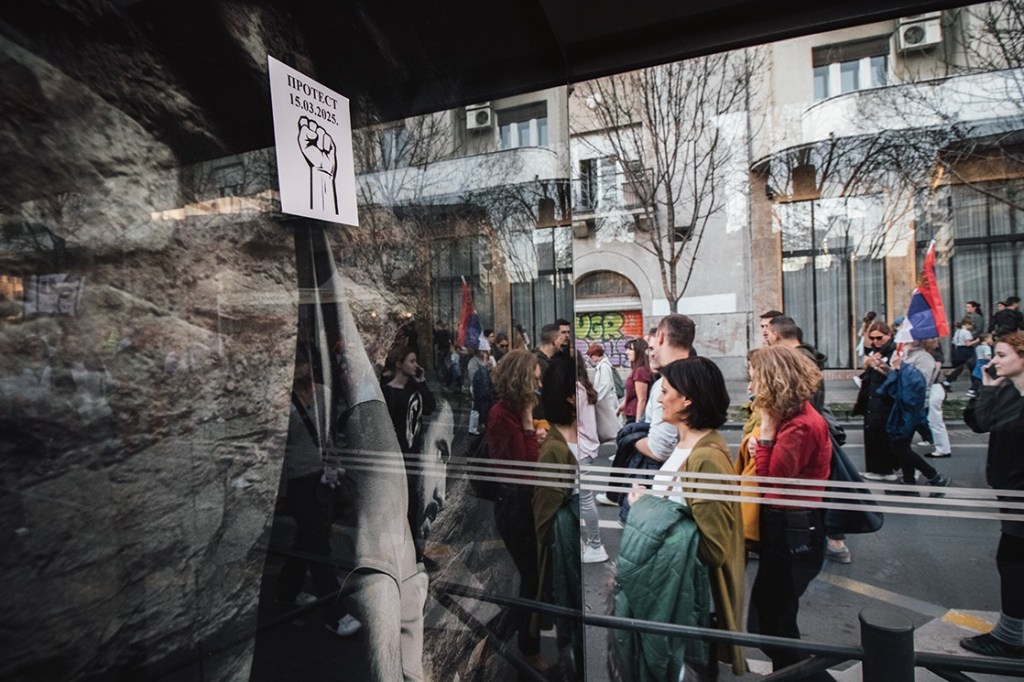
From February to the end of September 2025 more than 10,700 protests took place across more than 630 communities and 1,200 local community assemblies. Whilst largely peaceful, they were often met with disproportionate force by state authorities. Numerous footage showed evidence of riot police deploying tear gas and stun grenades in densely populated areas, including near schools and hospitals. Arbitrary arrests (of students, ordinary citizens and in some cases minors) became commonplace and many of them were held without charge, in custody or house arrest for a long time before official trials.
Surveillance of student organisers, journalists, human rights activists or opposition-party politicians intensified, with reports of phone tapping, online harassment, and physical intimidation. Serbia’s Higher Public Prosecutor’s Office was implicated in politically motivated prosecutions targeting student activists and opposition figures, while pro-government media and security agencies played a central role in smear campaigns and unlawful surveillance.
Increasingly, Serbian state universities also faced mounting pressure to align with government priorities, with appointments and dismissals increasingly tied to political loyalty rather than academic merit. Students and staff who criticised state policies reported disciplinary measures, surveillance on campus, and the withdrawal of institutional support for independent initiatives. Funding decisions have been routinely used as leverage, rewarding compliant faculties while marginalising those seen as centres of dissent.
Particularly alarming was the gendered nature of the repression. Young women were disproportionately targeted, especially in the early days of the protest. In one widely reported case, a 22-year-old woman suffered a fractured jaw after being violently assaulted by a private security guard outside the ruling party’s headquarters. Her only “offence” was placing a protest sticker on a public bin. In another incident, a university student arrested during a peaceful demonstration reported being threatened with rape by the commanding officer while in detention, a tactic seemingly aimed at silencing and terrorising women who dare to speak out.
These were not isolated cases but part of a broader pattern of intimidation, humiliation, and physical violence that became a hallmark of the state’s response to dissent. The cumulative effect has been a chilling atmosphere in which civic participation is increasingly criminalised, and the cost of protest is borne most heavily by the young and the outspoken. One parent, whose child was among the protesters, expressed deep concern: “What frightens me most is the thought that one of these brave young people might lose their life fighting for justice, while we stand behind them. It should be us taking the risks, standing at the front.”
International pressure mounts as Serbia rejects calls for accountability
In response to sustained student protests and escalating police violence, in October 2025, the European Parliament adopted a resolution denouncing state repression and calling for accountability, safeguards for civil rights, and independent investigations. The resolution called for tying EU financial assistance to demonstrable progress on reforms and even raised the possibility of suspending funds if the Serbian government fails to meet essential democratic standards.
But instead of initiating independent investigations or addressing the documented abuses, Serbian government officials dismissed the resolution as politically motivated interference, reinforcing a long‑standing pattern of rejecting external scrutiny. Civil society organisations, student groups, and independent media continued to document violations, but without cooperation from state institutions their efforts remain largely symbolic. The result is a widening gap between European expectations of democratic safeguards and Serbia’s entrenched practices of impunity, where international criticism raises visibility but does not translate into concrete protections for citizens.
Alongside the European Parliament resolution, Serbia is also coming under growing pressure from Washington. The United States is preparing sanctions against the Oil Industry of Serbia (NIS), whose ownership links to Russia’s Gazprom Neft have long raised concerns. Although repeatedly delayed, the sanctions highlight Washington’s increasing unease about Serbia’s political direction and its continued alignment with Russian‑controlled energy structures.
In contrast to the mounting pressure from Brussels and Washington, the UK has taken a noticeably different path. Reporting by the Guardian highlighted how the UK government scaled back a number of overseas democracy‑support and governance programmes, including initiatives in the Western Balkans that had previously helped counter malign foreign influence. The cuts affected projects aimed at strengthening independent media, supporting civil society, and improving institutional resilience – areas long recognised as vulnerable to Russian political and informational influence, particularly in Serbia.
400,000 Signatures, zero answers: why students are marching again
In a striking display of public mobilisation, in December 2025, students launched a support initiative that gathered more than 400,000 signatures in a single day. The initiative was a nationwide petition demanding early parliamentary elections and formal public support for the student movement.
As the authorities remained silent, reinforcing the sense of institutional paralysis, the student movement shifted toward its next step, announced on the protest that took place on 17th January 2026. Building on the momentum generated by the signature campaign, organisers framed the upcoming rally as the beginning of a new phase in their struggle. The protest was designed not only as a public gathering but as a platform for outlining mechanisms of accountability and renewing calls for institutional reform.
As Petrovic, who has been active in the student movement explained, this next phase is driven by a renewed commitment to the kind of society students want to build: “One of the main things driving the student movement is the will to live in a fairer society, where corruption is recognised as an issue, the rule of law is seen as a priority, and no one’s life is dictated by party membership or nepotism. Most students want to live in Serbia, and hence there is a level of tenacity not seen for a long time, because we refuse to be driven out of our homes. We are not scared, as shown by our relentless actions despite all attempts at intimidation, including police brutality. They rule through fear. Take that away from them, and you largely turn them into a paper tiger.”
Dragica Felja, Jelisaveta Djordjevic-Ristanovic and Jelena Pavic are three Serbian nationals who were active in the student protest movement of the 1990s. One now lives in the diaspora, while two remain in Serbia. Drawing on their lived experience and long-standing civic engagement, they reflect on the legacy of protest and the resurgence of grassroots resistance. They wrote a shorter piece about Serbian protest, published in The Big Issue, in February 2025.
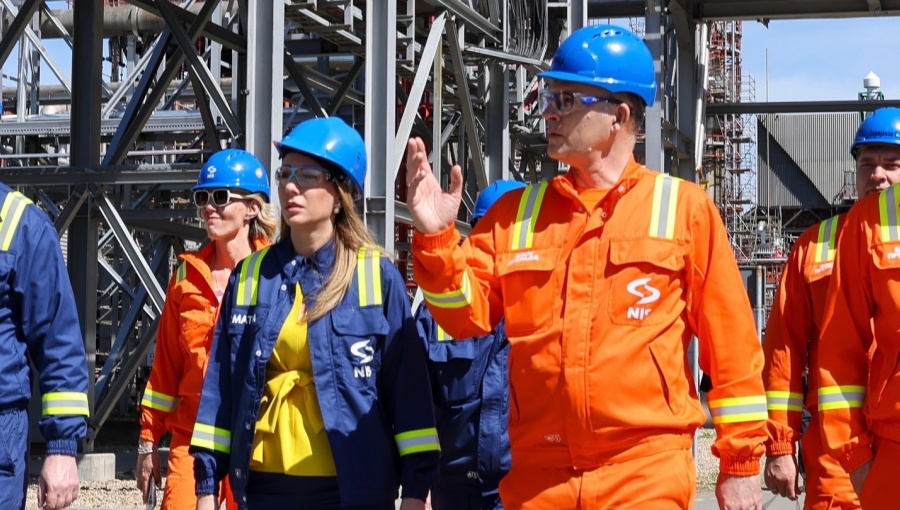
Serbia’s majority Russian-owned oil company NIS has restarted oil processing at its Pancevo refinery after securing a temporary waiver from US sanctions, Serbia’s energy minister said on January 18.
Production of petroleum derivatives resumed after an almost two-month halt, Energy Minister Dubravka Djedovic Handanovic said in a post on Instagram, adding that the first Euro diesel produced following the restart would reach fuel stations from January 27.
NIS was forced to suspend operations in December after US sanctions imposed in October over Russia’s war in Ukraine restricted its access to crude oil. The measures target Russia’s energy sector and apply to companies with majority Russian ownership.
Russian entities control 56.15% of NIS, with Gazprom Neft holding about 44.9% and Gazprom owning 11.3% via the St. Petersburg-based company Intelligence. The Serbian government holds roughly 29.9%, with the remainder owned by minority shareholders.
The refinery restart follows the granting of a temporary licence by the US Treasury Department’s Office of Foreign Assets Control (OFAC) on December 31, allowing NIS to import crude oil, resume processing and conduct transactions needed to maintain supply security until January 23.
“After almost two months of break, production at the Pancevo refinery began today,” Djedovic Handanovic said, adding that around 2,000 employees were involved in restarting operations.
NIS operates Serbia’s only oil refinery, located near Belgrade, and supplies about 80% of the country’s domestic fuel demand. Crude oil deliveries to the refinery resumed earlier this week via Croatia’s JANAF pipeline following the announcement of the special US licence.
The sanctions waiver comes as NIS negotiates the sale of the Russian-held stakes to comply with US requirements. The company has until March 24 to reach a divestment agreement.
Hungary’s oil and gas group MOL is in advanced talks to acquire a majority stake in NIS. Hungarian Foreign Minister Peter Szijjarto said last week, on January 15, that negotiations with Gazprom were progressing well and that an initial agreement could be signed in the coming days, after which the deal would be submitted to OFAC for approval.
President Aleksandar Vucic said on January 18 that Serbia expects to submit the key terms of a future ownership agreement to OFAC by January 20 at the latest, in order to secure an extension of NIS’s operating licence beyond January 23.
“We do not yet have an agreement, but I believe it will be reached,” Vucic told TV Informer.
In addition to MOL, Abu Dhabi National Oil Company (ADNOC) has expressed interest in a potential partnership in NIS.

No comments:
Post a Comment