Sunday, January 11, 2026


Internal Dissent, High-Profile Resignations, and Donor Anxiety Have Shaken the Heritage Foundation


HeritageFoundationscarnage.png

Resignations, Rebellion, and a Right-Wing Rift: Heritage Implodes Over Carlson–Fuentes Affair

Folks—let me have your attention for a moment.
Because I’ve been hearing some rumbling, some grumbling, a downright thundering from deep inside one of Washington’s most conservative policy halls.
Yes sir, trouble.
Trouble with a capital T, and that rhymes with C, that stands for Carlson, and that stands for controversy. (With apologies to Meredith Wilson)

Yes, sir, there’s trouble at the Heritage Foundation—real trouble. How deep the rift runs is still an open question, but one thing’s clear: Heritage, the powerful and heavily funded right-wing think tank that brought America Project 2025, is grappling with a very public, very internal crack-up. It’s a foundational kerfuffle, a battle that’s anything but civil.

Since its founding in 1973, Heritage has served as the one of the most important intellectual command centers of the conservative movement. It helped shape Ronald Reagan’s governing blueprint and, decades later, supplied Donald Trump with the ideological scaffolding he used to reshape the federal government. Now the same institution that has spent half a century defining the right is being shaken from within—over Tucker Carlson’s decision to hand a megaphone to white supremacist and Holocaust denier Nick Fuentes.

The current troubles was kicked off when Heritage President Kevin Roberts’ defended Tucker Carlson’s super-softball interview with Fuentes. In a video statement, Roberts called Carlson “a close friend of the Heritage Foundation,” and denounced what he described as a “venomous coalition” and the “globalist class” attacking Carlson. Roberts’ defense delighted Fuentes, but caused several Heritage staff members to resign.

Senior Heritage fellows — including Stephen Moore, Christopher DeMuth, and Adam Mossoff — resigned. Mark Goldfeder stepped down from the foundation’s National Task Force to Combat Antisemitism, saying he “cannot serve under someone who thinks Nazis are worth debating.” Newsmax reported that, the think tank’s antisemitism task force, Project Esther, left Heritage after more than a dozen additional members or advisers quit.

Although Roberts later walked back parts of his statement, he has refused to criticize or distance himself — or Heritage — from Carlson’s repeated amplification of antisemitic narratives.

Princeton University professor Robert P. George, a prominent legal scholar, philosopher, and longtime conservative intellectual, resigned from Heritage’s board. “I have resigned from the board of the Heritage Foundation,” George wrote. “I could not remain without a full retraction of the video released by Kevin Roberts, speaking for and in the name of Heritage, on October 30th. Although Kevin publicly apologized for some of what he said in the video, he could not offer a full retraction of its content. So, we reached an impasse.”

George said he hoped Heritage would remain faithful to “the moral principles of the Judeo-Christian tradition” and to the conviction that every human being is “created equal” and endowed with “unalienable rights.”

The Heritage Foundation was “the brain of the conservative movement”, Fuentes recently told his viewers, whose work is “sort of like gospel for [Republicans] in the US Congress. It’s a big deal.” Groyperism, Fuentes argued, was now “inside the institutions.”

According to the Institute for Strategic Dialogue, “The Groyper movement is a loose network of white nationalist activists and internet trolls who gravitate around several key online influencers. Their goal is to push and normalize white nationalist ideas within mainstream conservatism.

“Self-named after the ‘Groyper’ toad image, which became popular as an explicitly racist coded variation of the Pepe the Frog meme often affiliated with the ‘alt-right’, the Groypers emerged offline as a movement in 2019 and followed the decline of the alt-right. Initially followers of the ‘America First’ podcast host Nick Fuentes, they describe themselves as ‘American nationalists‘ and hold similar beliefs to the alt-right.

“Groypers represent a new momentum within American white nationalism. They have a particular focus on capturing members of Generation Z, and in portraying themselves as American Christian nationalists, hope to attract disaffected conservatives by exploiting schisms and grievances within mainstream conservatism.”

On a recent episode of C-SPAN’s “Ceasefire” with Politico’s Dasha Burns, Robert P. George put it this way:  “Sometimes one finds one’s self in a situation where it’s impossible to go along with something that one’s friends and colleagues and comrades are proposing, or promoting, or going along with.”

Internal dissent, high-profile resignations, and reports of donor anxiety have undeniably shaken the Heritage Foundation, raising the prospect that one of the right’s most influential think tanks could emerge fractured or weakened. Its public credibility—especially on issues of antisemitism and extremism—has taken a hit. Yet, as of this writing, there is no evidence that Heritage has lost real influence inside the White House or among Republican lawmakers. My bet? Heritage will weather this storm. It will regroup, refill its coffers, and continue serving as the intellectual engine of the conservative movement, just as it has since 1973.

Bill Berkowitz is a longtime observer of the conservative movement. Read other articles by Bill.
A Lawless Presidency


by Andrew P. Napolitano | Jan 9, 2026 | ANTIWAR.COM


The United States invasion of Venezuela and kidnapping of Nicolas Maduro, the domestically recognized Venezuelan president, violated the U.S. Constitution and international law.

The Constitution makes clear that only Congress can authorize a foreign invasion. In the pre-World War II era, Congress declared war on countries that attacked the U.S. or were allied with those that did, and those declarations expired upon the surrender by legal authorities in the targeted countries.

In the post-9/11 era, Congress has chosen to authorize the use of military force, without providing for a trigger that would terminate the authorization. Indeed, just last month, Congress rescinded George W. Bush-era military authorizations that had been used by Presidents Barack Obama and Donald Trump to target groups not even in existence at the time of the authorizations.

But, as morally deficient as the authorizations were, they were at least constitutionally sound, as they were the product of presidential requests and congressional deliberations and authorizations. We now know that at least two of these were fraudulent — the administration lied to Congress and to the United Nations. But, again, at least it fomented debate and recognized its obligations under the Constitution and the U.N. Charter to seek approval before invading a foreign country.

The Charter is a treaty, drafted by U.S. officials in the aftermath of World War II and ratified by the Senate. Under the Constitution, treaties are, like the Constitution itself, the supreme law of the land.

President Donald Trump violated his sworn and paramount obligations to preserve, protect and defend the Constitution when he ordered his invasion of Venezuela without congressional authorization and when he attacked a member state of the U.N. without U.N. authorization.

James Madison himself argued at the Constitutional Convention that if a president could both declare war and wage war, he’d be a prince; not unlike the British monarch from whose authority the 13 colonies had just seceded. And the American drafters of the U.N. Charter, indeed American senators who voted to ratify it, understood that its very purpose was to prevent unlawful and morally unjustified attacks by one member nation upon another.

When he was asked after the troops had seized President Maduro why the administration had not complied with the Constitution and sought congressional approval for the invasion, Secretary of State Marco Rubio gave laughable answers. First, he said the Maduro extraction was not an invasion. OK, an armada of ships, assault helicopters, hundreds of troops, 80 deaths and two kidnappings in a foreign land is not an invasion, but the sale of cocaine to willing American buyers is?

Then he said Congress cannot be trusted. Congress is a coequal branch of the federal government — under the Constitution, the first among equals.

Then he said that the Trump administration faced an emergency. Federal law defines an emergency as a sudden and unexpected event likely to have a deleterious effect on national security or economic prosperity. There was no emergency last weekend.

Why is it wrong for the president to violate the Constitution?

For starters, he took an oath to preserve, protect and defend it. It is the source of his governmental powers. The Supreme Court has ruled that all federal power comes from the Constitution and from nowhere else. This is manifested in the 10th Amendment, which commands that governmental powers not delegated in the Constitution to the federal government do not lie dormant awaiting a federal capture, rather they remain in the people or the states. This is at least the Madisonian view of constitutional government.

Its opposite is the Wilsonian view — after that pseudo-constitutional law professor in the White House, Woodrow Wilson — which holds that the federal government can address any national problem, foreign or domestic, for which it has sufficient political support, except for the express prohibitions imposed upon it in the Constitution. Sadly, every president since Wilson has been a Wilsonian.

Trump acknowledged that the events of last weekend constituted an American “attack on sovereignty.” This, of course, defies the statements of Trump’s attorney general, who has instructed her prosecutors to claim that this was a simple arrest of a fugitive from justice.

She must have a perverse view of justice, the essence of which is fairness. Is it fair for the CIA to engage in drug trafficking and then help prosecute the heads of state in which the trafficking occurs when they look the other way? Is it fair for the president to claim with a straight but exhausted face that the U.S. “owns” the oil in the earth under Venezuela? Is it fair for the federal government, which can’t deliver the mail, to “run Venezuela” as Trump claimed several times last week?

These questions are couched as moral inquiries, but they all bring us back to the Constitution. In the post-9/11 years, presidential power has expanded and congressional power has shrunk. This was not achieved by amending the Constitution, rather by Congress looking the other way as presidents killed and Congress hoped for popularly approved outcomes.

The result has been the catastrophe we all witnessed in Caracas. Eighty people were murdered by U.S. troops in order to capture scapegoats for CIA drug trafficking and satiate the American lust for other people’s oil.

There is simply no legal defense to this. Trump’s own director of national intelligence — no doubt the first defense witness at Maduro’s trial — stated in March of last year that Venezuela is not a supplier of fentanyl or cocaine to the United States; and the U.S. is out of the regime change business. And Trump’s own Drug Enforcement Administration, whose agents accompanied U.S. troops in their invasion, has said the same about Venezuela.

The American invasion of Venezuela is a body blow to the Constitution. It reveals what many of us have feared — a might-makes-right presidency, a lawless, impulsive authoritarian machine that recognizes no legal or moral limits to its powers — abroad or at home.


Andrew P. Napolitano, a former judge of the Superior Court of New Jersey, is the senior judicial analyst at Fox News Channel. Judge Napolitano has written seven books on the US Constitution. The most recent is Suicide Pact: The Radical Expansion of Presidential Powers and the Lethal Threat to American Liberty. To find out more about Judge Napolitano and to read features by other Creators Syndicate writers and cartoonists, visit www.creators.com
COPYRIGHT 2025 ANDREW P. NAPOLITANO – DISTRIBUTED BY CREATORS.COM

The Politics of Premature Adjudication: The Bondi Royal Commission


Royal commissions are often held to confirm the obvious and squeak for modest change. They offer no binding remedies, have no compellable powers against the government of the day, and can, despite claiming to be independent, be susceptible to interest groups. They are also expensive, laborious, often lengthy, and serve as a pacifying agent, absorbing pressure and enabling the governors of the day to delay action. Scott Prasser, a scholar long versed in the pitfalls of public administration, suggests that such commissions “are most effective when the central problem is a deficit of legitimacy rather than a deficit of information.”

The hankering, bleating insistence on holding a royal commission into the Bondi Beach attack last December, a vicious shooting attack on those celebrating Hanukkah, leaving sixteen dead, including one of the shooters, is not free of the usual criticisms.

Australian Prime Minister Anthony Albanese initially resisted it, opting for an Independent Review into Australia’s federal law enforcement and intelligence agencies, to be led by former domestic intelligence director-general Dennis Richardson. The review’s primary focus is on the Australian Security Intelligence Organisation and Australian Federal Police in terms of performance, appropriate powers, systems, processes, and procedures, including information-sharing protocols.

Albanese’s resistance to a commonwealth royal commission was also in part because the New South Wales government was already running its own version, one that the Albanese government promised it would support with necessary resources and heft. But the PM, not exactly burning with conviction, showed that he was for turning. After much bleating and many open letters by public figures from politics to sports, Albanese announced the creation of Royal Commission on Antisemitism and Social Cohesion to be led by former High Court Justice Virginia Bell.

Even in its infancy, the commission is already facing problems. Certain public figures in the Australian Jewish community were hoping for a sympathetic, possibly even philosemitic voice to steer it. The question was not whether the appointee would be sympathetic to the evidence but sympathetic, even partial, regarding the sentiments of an interest group. In other words, any sense of objective fairness or stern distance from the subject matter would be a secondary consideration.

Showing his specific, parochial understanding of how such a commission would work, NSW Jewish Board of Deputies president David Ossip told The Australian Financial Review that it was “the time to deliver more unity, not less” after “two long years of division in Australia”. This meant finding consensus on the choice of royal commissioner, a crude way of saying that the most appropriate person would need the seal of approval from members of the Australian Jewish community. “The royal commission, which will examine what led to the worst terrorist attack in our nation’s history and the crisis of antisemitism, must have the confidence of the Jewish community.”

It’s hard not to read more into this, suggesting that Ossip confuses consensus with tinkering, slanting, and premature adjudication. As long as the lobby agrees, then there will be consensus, followed by the appropriate findings.  The president of the Zionist Federation, Jeremy Leibler, is even more direct, bringing a dose of identity politics into play: “Any royal commission must be structured, in terms of reference and the identity of the commissioner, [in such a way that it] has to have the confidence of the community most affected by the attack, which is the Jewish community, as well as the broader community, in order to achieve its purpose.”

Without a foundation, the choice of commissioner has come in for some castigation. Albanese, moaned former Coalition treasurer Josh Frydenberg, “has been told directly by leaders of the Jewish community that they have serious concerns” regarding Bell. “After more than two years of unprecedented hate, harassment and violence directed towards the Jewish community, culminating in Australia’s deadliest terrorist attack at Bondi Beach it is unthinkable the Prime Minister would choose a commissioner that did not have the total confidence of the Jewish community.” Appoint, appealed Frydenberg, “the right Commissioner whose leadership will provide the answers and solutions our country so urgently needs.”

This begs a troubling question. What would an appropriate commissioner for Frydenberg be?  One approved by Israeli Prime Minister Benjamin Netanyahu? A figure who openly embraced the definition of antisemitism arrived at by the International Holocaust Remembrance Alliance?  One who had rejected the view, one accepted by the UN Independent International Commission of Inquiry on the Occupied Palestinian Territory, along with a bevy of civil society and human rights organisations, including the Israeli-based B’Tselem, that Israeli actions in Gaza have been genocidal?

report by the ABC, attempting to identify those shadowy concerns regarding Bell’s appointment, cites perceptions that “she was associated with the political left.” There was also a “lack of trust between the community and the Albanese government as a contributing factor in the fear that his eventual royal commissioner pick would not examine elements of the antisemitism issue important to them.”

A bureaucratic, costly bonanza is in the offing. To Richardson’s review will be added the federal royal commission linking arms, presumably, with the NSW royal commission. There will be duplication galore. The premature adjudicators will be hoping for favourable findings to further trim the wilting tree of free speech in Australia while muzzling criticism of Israel’s policies against the Palestinians.

Binoy Kampmark was a Commonwealth Scholar at Selwyn College, Cambridge. He lectures at RMIT University, Melbourne. Email: bkampmark@gmail.comRead other articles by Binoy.
Poland

Valeo Poland - a first success

Saturday 10 January 2026, by NPA Auto Critique

\

Valeo workers in Poland have secured pay rises and commitments on working conditions. This initial success demonstrates the effectiveness of collective action and international solidarity.

The strike launched on 20 November 2025 by workers at Valeo’s factories in Chrzanów, Trzebinia and MysÅ‚owice in Poland was suspended on 24 November after Valeo management promised to enter into discussions on the demands put forward by the August 80 union and the factory workers. These negotiations took place, a first for a management team that had previously refused to engage in any discussion with the majority union, August 80.


Up to 10% wage increases

A memorandum of understanding was signed on 23 December 2025. It provides for significant wage increases of up to 10% of the average wage in the factory. Not insignificant for a first strike in this factory! In addition, the August 80 union, together with the factory workers, obtained commitments to improve working conditions, which should be monitored by the local labour inspectorate.
Solidarity is just the beginning!

During the November strike, Polish workers at Valeo requested and received support in France from the unions of this major global automotive supplier. Most of Valeo’s unions responded: SUD, CGT, FO and CGC. Unfortunately, this support was limited to statements, press releases and the presence of union officials on 26 November with the delegation of Polish workers who had come to Paris to defend their cause. For the Polish workers, this was an encouragement in their struggle, which helped them in their initial discussions in Paris with Valeo’s central management.

This support was expressed following initiatives taken by the Polish trade union August 80. It is an example that should be continued through effective solidarity between workers, starting with their trade union teams, at Valeo here in France and at all its subsidiaries throughout Europe and the rest of the world.

6 January 2026

Translated by International Viewpoint from l’Anticapitaliste.


Portfolio


Attached documentsvaleo-poland-a-first-success_a9357-2.pdf (PDF - 980.1 KiB)
Extraction PDF [->article9357]

NPA Auto Critique
NPA Auto Critique: NPA (former) carworkers.

Japan’s Remilitarization is a Danger to the World


Japanese PM Sanae Takaichi stunned the world when she declared publicly in the Japanese legislature, that a Taiwan contingency could constitute a “survival threatening situation” that would allow Japanese military intervention in “collective defense”.

Words matter. Especially when they are words with legal force, uttered in an official capacity.

These words are legal terms of art that authorize the aggressive use of the military according to Clause 4 of Japan’s Peace and Security Act of 2015.

Applied to Taiwan, it allows expeditionary military force against China.  Since Japan acknowledges the one-China policy in the Sino-Japanese Joint Statement, this would constitute a violation of international law. In fact, it would be war of aggression.

Alternatively, if we adhere to the legal fiction that the Japanese military is only defensive, Takaichi has stated that its defensive perimeter extends to Taiwan–nonsense, given that Japan surrendered colonial control in 1945.

If we put the shoe on the other foot—if any third country had said that the domestic affairs of another country’s internal provinces were a survival-threatening issue, we would all recognize it as a belligerent, casus belli pretext.

To permit an external state to assert such a statement against another sovereign state without consequence would render nationhood—the backbone of international law—meaningless.

Japan’s Deadly Rap Sheet

Japan’s ruling  Liberal Democratic Party (LDP) was constituted from a coalition of organized crime, military-industrial tycoons, and war criminals, funded by the US CIA.

The LDP was constituted to implant an anti-communist, US quisling government in Japan.  Since its inception it has been staunchly subservient, but also quietly and insistently revisionist.  It has evinced little regret for Japan’s Imperial violence, and ruling factions have held hawkish aspirations to re-establish Japan as a military power. It has held power almost continuously since1955–effectively one party political rule.

Kishi Nobusuke, war criminal, LDP founder, and prime minister (1957-1960), dreamed of remilitarizing Japan.  In 2015, his grandson, Shinzo Abe achieved his dream: he disabled the Japanese Peace constitution, authorizing it to wage war in “collective defense” anytime it encountered a “survival threatening situation”.

Japan used this term in 1894, 1931, 1937, 1941 when it initiated aggressive war.  It is the tried-and-true casus belli excuse. But Takaichi did Abe one better–she let the cat out of the bag: she let the world know that this clause is actually a plan for war of aggression against China

The Apple and the Tree

Prime Minister Takaichi was mentored by former prime minister Shinzo Abe.  She belonged to Abe’s Seiwa faction of the LDP, the ultra-nationalist, far-right faction that envisions a return to authoritarian, monarchical rule with an unleashed military.

The Prime Minister is also a member of Nippon Kaigi, the ultra-right group that dreams of reconstituting the Japanese Empire.

Nippon Kaigi denies the atrocities of Unit 731, the Nanjing massacre, the comfort women, and the slave state of Manchukuo. It asserts that Japanese imperialism was a benign attempt to create an “Asian co-prosperity sphere”.

Nothing demonstrates the continuity of this revisionist imperial ideology more clearly than Yasukuni shrine, where Takaichi has been a frequent visitor.

Yasukuni shrine was created by the Meiji Emperor as a temporal Valhalla to reward loyal troops who sacrificed themselves for the Emperor. According to State Shinto mythology, it deifies the kami (spirits) of troops to honor their sacrifices. As such it rehabilitates and sanctifies 1066 convicted war criminals: at Yasukuni, they are not criminals but Gods to worship.

“Long live the Emperor! I’ll meet you at Yasukuni shrine” was the shout of Japanese Imperial Troops before entering battle. Yasukuni is the place where the flame of unrepentant, genocidal militarism is kept alive and consecrated.

Given this, visiting Yasukuni shrine is to intentionally glorify the criminality of the Japanese Empire—an insult to the conscience of the world. It is a middle finger to humanity and human suffering.

Geopolitical Considerations

It is impossible to consider these things in only a domestic light: Japan is a US client state: it surrendered to the US, its constitution was written by the US, its ruling party put into power by the US, and its economy has been manipulated by the US (for example, during the Plaza accords). It is currently militarily occupied by 53,000 US troops with 70 bases.

As the US prepares and escalates incrementally and unmistakably for war with China, Japan is the critical force multiplier: prime minister Nakasone famously referred to Japan as an “unsinkable aircraft carrier” for the US.

In fact, Japan has always colluded in US wars: as a bombing/logistics platform during the Korean and Vietnam wars, and then as an active, boots-on-the-ground partner in later wars.

War against China will be the final chapter of Japanese remilitarization: Japan will provide military muscle, provision key military supply chains and do shipbuilding and battle repair.

This is why the Obama-Biden administration pulled South Korea into a trilateral military alliance with Japan and the US (JAKUS), why Japan is a member of the QUAD, why it has a US space force base and a NATO liaison office, and why the US is actively taking control of Japanese military through a joint command structure similar to South Korea’s.

All this has been signaled and telegraphed.  For example, Japan is militarizing the islands closest to Taiwan province with offensive missiles. This aligns with the CSIS war games study that concluded Japanese participation is essential: Japan is the military linchpin for war.

This also dovetails with Japan’s doubling of its military budget, now amounting to 7.5% of the government’s budget.  The contradictions of a “pacifist” country with a military budget larger than that of 182 countries–should make everyone pause. If budgets are moral statements, then moral depravity is the only conclusion to draw from such an appropriation: the former continental genocidaire is rearming for war.

Likewise, intimations that it will abandon its non-nuclear position are also worrisome.  This, in combination with high-level US discourse to use tactical nuclear weapons in case of war with China, render these positions politically terrifying. The US’s recently announced plan to create a new class of battleships with sea-launched nuclear cruise missiles is also a horrifying addition to this escalation.

Subcontracting for US war

These things signal that Takaichi’s statement is not a personal lapsus, but an expression of deep-rooted Japanese intentions that dovetail with the US agenda: using Japan to contain and fight China.

Undersecretary Elbridge Colby’s recent demand in July that Japan clarify its position in the case of the Taiwan contingency underlines this US agenda clearly.

Historically, no other country fits the subcontracting requirements as well as Japan:  Japan has waged aggressive war against China in 1592-1598, 1894-1895, 1931-1937, 1937-1945. In the most recent war, 35 million Chinese were casualties of Japanese violence.

No opprobrium is too strong for the former Imperial genocidaire of Asia rearming for aggressive war. Even those who seek to harness and use this militarism against China, may ultimately come to regret this, if past history is any indication.  A loose cannon is a danger to all.  A nuclear-armed Japan with a history of unbridled atrocity is a global threat.

China seeks win-win, mutually beneficial relations with everyone, a community with a shared future for mankind. It has put forward concrete proposals and institutions to realize this difficult, but necessary historic vision. This is the only way for peace and stability, the only way forward for the world.  The entire world needs to come together to condemn—and stop—Japan’s accelerating militarism: for most of Asia, Japan’s remilitarization is the real survival threatening situation.

  • A version of this article was published in the Beijing Review.
K.J. Noh is a long time activist, writer, and teacher. He is a member of Veterans for Peace and works on global justice issues. Read other articles by K.J..
Ex-Reagan official trashes Trump devotee for defending administration’s 'crony capitalism'


Bill Ackman, Image via screengrab/CNBC.


Sarah K. Burris
January 11, 2026 
ALTERNET

American hedge fund manager and billionaire Bill Ackman took to X on Saturday to comment on President Donald Trump's claim that he would cap all credit card interest rates at 10 percent as of Jan. 20, 2026. However, a former Ronald Reagan Cabinet secretary encouraged Ackman to stop sucking up to Trump.

"I think President @realDonaldTrump’s goal of reducing credit card interest rates is a worthy and important one. My concern about capping rates at 10 percent is that doing so will inevitably cause millions of Americans to have their cards cancelled as credit card companies lose the ability to adequately price subprime credit risk," Ackman wrote.

"Consumers denied credit cards will be forced to turn to loan sharks whose rates and terms will be vastly worse for borrowers. While 20 percent or more is a high rate, loan sharks can charge multiples of these rates, and the cost of default can be physical harm or worse," Ackman continued.

There is currently no federal cap on credit card interest rates, and a Forbes reporter last year reported that the average interest rate was 28.6 percent. Trump suggested the idea during the campaign, but in his first year did nothing to make it happen. So, Sens. Bernie Sanders (I-Vt.) and Josh Hawley (R-Mo.) proposed legislation on the matter in Feb. 2025. It was never passed.

Ackman swears he has no credit card investments, so he isn't an "expert," but the market for cards seems "highly competitive."

"The best way to bring down rates would be to make it more competitive by making the regulatory regime more conducive to new entrants and new technologies. I commend the President for his focus on affordability for all Americans. Mortgage spreads and rates are coming down significantly due it his actions. Finding a way to bring down credit card rates without taking credit away from many Americans would have a very positive impact on the most disadvantaged Americans," he claimed.

David Stockman, who was Reagan's Secretary of the Office of Management and Budget during the first term, told Ackman, "stop kissing his a——."

"When it comes to economics he's an unhinged whirligig of statist humbug, hoo-doo and ham-handed hammering of free markets and economic liberty," Stockman said, bashing 

"The very idea of government intervention in the credit card market is neither 'worthy' nor 'important.' It's just a stupid attempt to address the real affordability problem that is caused by massive deficits and endless money-printing at the Fed — both of which the Donald wants more of. The truth is, there is absolutely nothing redeeming about the dog's breakfast of protectionism, easy money, Keynesian deficits and crony capitalism that passes for Trump-O-Nomics," he closed.
Whatever Socialism’s Sins, It’s Capitalism That Threatens Life on Earth

The question is no longer whether this system is failing us, but whether we are willing to confront the power structures that depend on that failure.


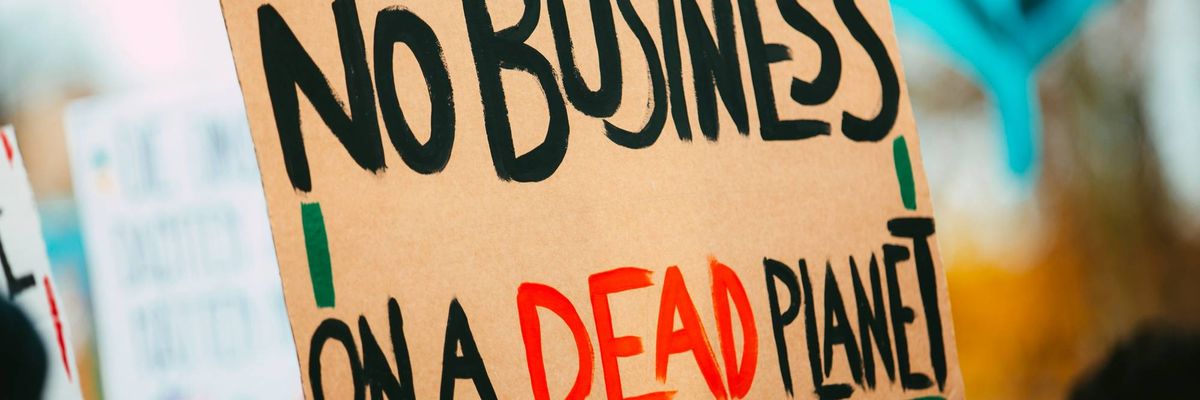
A demonstrator holds a sign reading, “No business on a dead planet.”
(Photo by Markus Spiske on Unsplash)

Simon Whalley
Jan 11, 2026
Common Dreams


Socialism destroyed Venezuela. This is the claim being made by many. According to the Manhattan Institute, corruption was not to blame, mismanagement was not to blame, falling oil prices were not to blame, and US sanctions were also not to blame. No—they argue the single cause of Venezuela’s plight was socialism. The big bad bogeyman we have all been taught to fear.

It is widely argued that growth in socialist economies is lower than in capitalist economies. This argument dominates mainstream economic discourse. We can see it with our own eyes. Of course, the citizens of the capitalist United States have higher standards of living. Of course the citizens of Europe have more cars, and Chinese citizens have more gadgets. We know all this. But we no longer live solely in capitalist economies. Today we are living under the machinations of the billionaire class. We live in a rampant capitalist fever dream that is doing so much more damage than socialism ever will.

While socialism, in a few nations on Earth, has lowered the standard of living for a few hundred million human beings, capitalism is destroying any chance of a peaceful and abundant future for all species on our incredible planet. Our atmosphere is full of carbon dioxide that is in geological terms warming our home at an unprecedented rate that threatens the very survival of our species. Every year, 7 million people die from breathing polluted air. I say “murdered” is the better word—because we could stop it. We know it is happening, and we know the cause, so manslaughter doesn’t do it justice. And what we see is only the smoke; the real fire is much larger.

Since the industrial revolution we have destroyed 1.5 billion hectares of forest. This is an area 1.5 times the size of the US. In the last 10 years alone, we have cleared an area of land equal to that of Central America. Animal populations have declined by 73% since the 1970s. Our rivers are full of shit, yet void of life. Our oceans will soon be home to more plastic than fish. Humans and the animals we breed to kill make up 95% of the world’s mammalian biomass. Around 70% of the world’s bird biomass is now made up of domesticated poultry bred for human consumption.

The leader of Venezuela was just hauled out of bed and jailed for failing his people. Well, I would suggest that the leaders of the “free” world are also failing their people, but who is going to haul President Donald Trump out of his gold-plated corporate-sponsored bed?

Due to climate change, primarily driven by the burning of fossil fuels for economic growth and animal agriculture, which reduces our ability to draw down carbon naturally, we are beginning to see the outcomes of unregulated growth. Erratic weather conditions in Russia, Ukraine, the UK, China, Mozambique, Pakistan, Canada, and Iran resulted in reduced harvests of key staples in 2025. This is just the beginning.

Our soils have been so degraded by intensive agriculture that the United Nations has warned that much of the world’s remaining topsoil could be severely degraded by 2074 if current practices continue. On top of that, we are hurtling rapidly toward a future of widespread water shortages. In just four years, demand for freshwater is projected to outstrip supply by 40% and half the world’s population could suffer severe water stress. This includes the now free and prosperous people of Venezuela, where much of the country could be uninhabitable by 2070. Without water, there is no food. Scientists have been warning us for decades that food production will be impacted greatly by climate chaos. They forecast that the chance of simultaneous areas suffering crop failure increases from 7% at 2°C (3.6°F) to a staggering 86% if we allow the billionaire class to push us to 4°C (7.2°F).

A lack of food and water, extreme heat, and sea-level rise will certainly make our planet more volatile and conflict ridden. Report after report state that we are heading toward societal collapse—a term used to describe the systematic breakdown of the core social, economic, and political institutions that sustain societies. A consequence of this will be the erosion of international laws and human rights. Does this ring any bells?

As destabilizing as climate chaos already is, an even more profound disruption is now being layered on top of it: artificial intelligence (AI). Beyond its enormous energy and water demands, which promise to exacerbate the problems outlined above, AI threatens the very fabric of society. It threatens vast swathes with employment. It threatens to fundamentally destabilize the conditions that make human societies possible. And it is all being foisted on us without our consent in order to increase profits. This is capitalism in its purest form—where profitability outweighs every other consideration, including life itself.

If we are going to blame socialism for the problems in Cuba, Venezuela, and Nicaragua, communism for the problems in North Korea, then surely, with everything stated above, we must blame capitalism for the complete breakdown of ecosystems, never-ending wars, climate chaos, and a potential AI takeover. And the scale of destruction wrought by Jeff Bezos and his billionaire brethren is gargantuan when compared to anything caused by socialism. Let’s please put things in perspective.

The leader of Venezuela was just hauled out of bed and jailed for failing his people. Well, I would suggest that the leaders of the “free” world are also failing their people, but who is going to haul President Donald Trump out of his gold-plated corporate-sponsored bed? It is only the people of the most powerful nation on Earth that can do that. It should always be down to the citizens of a country to bring about change. It should never be the responsibility of a golden elite that has no interest in improving lives, but simply improving bank balances. They say you get the government you deserve. Well then, we currently have the governments we deserve. What are we going to do about it?

The question is no longer whether this system is failing us, but whether we are willing to confront the power structures that depend on that failure. We need to be honest with ourselves: We are in a class war. A small number of billionaires are grinding all Earthlings into the ground. We are losing on every battlefield. Until we start acting like we are being erased systematically, we will continue to be erased systematically.


Our work is licensed under Creative Commons (CC BY-NC-ND 3.0). Feel free to republish and share widely.


Simon Whalley
Simon Whalley teaches at a university in Costa Rica, is the co-founder of Extinction Rebellion Japan, contributing author to "The Carbon Almanac" and the author of "Dear Indy: A Father's Plea for Climate Action."
Full Bio >


Canada, Stop Using the US to Launder Complicity With the Gaza Genocide

Canada, despite claiming to have imposed an arms embargo, continues to fuel the violence unabated, its factories producing fighter jet components, explosives, and munitions that move through US channels directly into the assault.


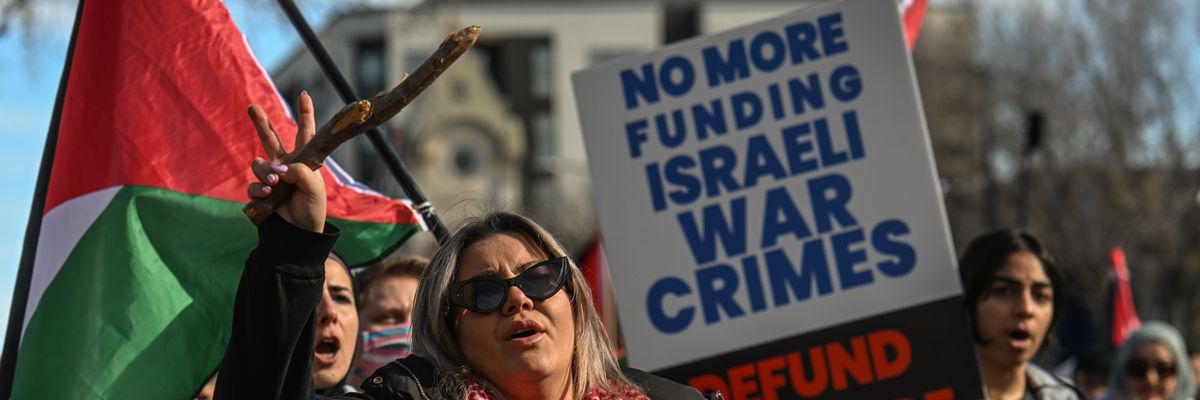
Members of the Palestinian diaspora, supported by the local Muslim community and activists, rally for Gaza on March 10, 2024, in Edmonton, Alberta, Canada.
(Photo by Artur Widak/NurPhoto via Getty Images)
Common Dreams


For decades, Canada has carefully cultivated a global reputation for principle, human rights, and moral clarity. However, that image is now cracking, and cracking fast. For too long, Canada has cloaked its inaction and complicity, rather spectacularly, behind political correctness. But as the global crises grow more brutal—and more visible—it has become harder for Canada to maintain this facade.

Canadians and people around the world are catching on to the gap between what the country claims to stand for and what it actually does. That gap is just impossible to ignore when it comes to the situation in Gaza. Since October 2023, Israel’s military campaign in Gaza has killed over 80,000 Palestinians—and that figure represents only the confirmed deaths, excluding those trapped beneath the rubble. Experts have estimated that nearly 600,000 total Palestinians have lost their lives, including thousands of children, and nearly 2 million more have been displaced, an overwhelming portion of the strip’s population.


With Global Attention on Venezuela, Israel Intensifies Assault on Gaza, Lebanon


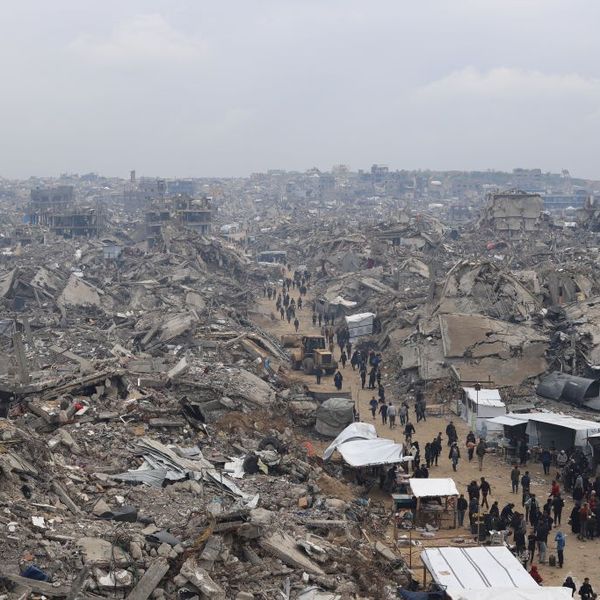
United Nations experts and international human rights organizations have increasingly raised alarms, calling this horrific massacre what it is: a genocide. Gaza now lies beneath 68 million tons of rubble, roughly the weight of 186 Empire State Buildings—enough debris to spread 215 pounds over every square inch of Manhattan. Meanwhile, the United States continues to ship to Israel, and Canada, despite claiming to have imposed an arms embargo, continues to fuel the violence unabated, its factories producing fighter jet components, explosives, and munitions that move through US channels directly into the assault.

The latest Arms Embargo Now report documents hundreds of shipments of Canadian-made fighter jet components, explosives, and propellants flowing through US facilities to Israel. Shipping data, contract records, ports of exit, and delivery timelines confirm that Canadian military goods are directly sustaining Israel’s assault on Gaza. Between late 2023 and mid-2025, over 360 shipments of Canadian aircraft parts reached Lockheed Martin’s F-35 assembly plant in Fort Worth, Texas. Analysis of commercially available shipping data revealed that at least 34 shipments were forwarded from US facilities directly to Israeli military bases and defense firms. Canadian explosives and propellants, including the M31A2 triple-base propellant and TNT, transshipped through the Port of Saguenay, Quebec, were routed through US munitions plants to produce bombs and artillery shells used in Gaza.

Why is Canada so determined to continue funneling weapons parts and ammunition to the US, unquestioningly, even as it allows itself to be used as an accessory to Israel’s genocide and deepens dependence on a country that has openly entertained annexing Canada?

The report further shows that many of these controlled military components were transported from Canada to the United States as cargo on commercial passenger flights, departing from major airports such as Toronto Pearson and Montréal-Trudeau. These components support both new aircraft production and ongoing maintenance, keeping Israeli F-35s operational during the Gaza assault, while the use of civilian airlines blurs the line between ordinary passenger travel and an active military supply chain. Every shipment appears to flow through a calculated, politically engineered pipeline fueling war.

This evidence exposes a stark truth: Public assurances by Canadian officials are incompatible with reality. Former Foreign Affairs Minister Mélanie Joly promised that Canada would not allow “any form of arms or parts of arms” to reach Gaza, directly or indirectly. Her successor, Anita Anand, repeated similar commitments. Yet the shipments continue. Canada has not stopped sending arms; it has simply outsourced accountability.

The government’s defense relies on the so-called US Loophole: Military exports to the United States are exempt from Canada’s permit requirements and human rights assessments. Once in US hands, Canada claims no responsibility for where the arms go next. However, international law does not vanish because weapons cross a border. The Arms Trade Treaty prohibits authorizing transfers when there is a substantial risk of facilitating serious violations of humanitarian law. Knowledge, foreseeability, and contribution still matter.

The pattern of misrepresentation is clear. From December 2023 to January 2024, officials, including former Prime Minister Justin Trudeau and GAC Assistant Deputy Minister Alexandre Lévêque, claimed no arms exports or permits had been issued to Israel, a statement contradicted by nearly $30 million in new export permits. Early 2024 saw a pivot to “non-lethal” exports, with night-vision goggles and protective gear cited to obscure lethal shipments of bomb accessories and explosives. Parliamentary motions and public statements claiming a halt to arms exports were largely symbolic, leaving the vast majority of existing permits intact.

By 2024-2025, claims that exports were restricted to “defensive” uses, such as the Iron Dome, or would not reach Gaza, were impossible to verify and did not prevent Canadian-made components from being incorporated into Israeli munitions. The government’s narrative meandered endlessly, offering Kafkaesque explanations that dissolved accountability into legalistic semantics.

If Canada were truly innocent, it would have promptly and publicly refuted the findings of the Arms Embargo Now report. Instead, it has responded with silence. Even after Member of Parliament Jenny Kwan introduced Bill C-233 in September 2025 to close the US loophole and impose meaningful parliamentary oversight on arms exports, the bill has been left to languish untouched. This legislation offers a straightforward safeguard to prevent Canadian weapons and components from being routed through the United States to fuel conflicts abroad, yet the government refuses to move.

If this were merely bureaucratic oversight, and if sending arms indirectly to Israel were not the objective, why has there been no momentum on a measure so clearly aligned with transparency and human rights? Why is Canada so determined to continue funneling weapons parts and ammunition to the US, unquestioningly, even as it allows itself to be used as an accessory to Israel’s genocide and deepens dependence on a country that has openly entertained annexing Canada? And why do weapon components and ammunition continue to flow even as Canadian representatives and humanitarian delegates are barred from entering the occupied West Bank, prevented from witnessing conditions on the ground themselves?

At this point, one can only wonder how much longer Canada’s moral facade can plausibly endure. As Aldous Huxley once observed, “The greatest triumphs of propaganda have been accomplished, not by doing something, but by refraining from doing.” This appears to be the goal here. The government has offered no coherent defense, only theatrical explanations in which responsibility dissolves into process and legality is reduced to paperwork. There is no counterstrategy, no rebuttal, and no attempt at persuasion. There is only silence, complexity, and delay.

Perhaps the unspoken calculation is that this response will be enough. After all, when public schools report alarming declines in reading and comprehension skills, critical engagement becomes harder to sustain. If citizens struggle to parse policy documents or follow supply-chain evidence, denial need not be convincing; it merely needs to be exhausting. In such an environment, ignorance becomes not a failure of governance, but a quiet line of defense.

In light of all this, recognition of the State of Palestine now reads like a scripted apology: Yes, we see your suffering, we hear your cries, but don’t worry, we’ll keep arming your oppressor through the US. Meanwhile, Canadian factories quietly churn out fighter jet parts, explosives, and munitions that fuel Israel’s assault on Gaza. As Joseph Heller observed in Catch-22, “The enemy is anybody who’s going to get you killed, no matter which side he’s on.” It is a brutal reminder that, regardless of what the government says, Canada’s military industry has reduced Palestinian lives in Gaza to expendable instruments, sacrificed to preserve contracts, alliances, and profit. Words without action are meaningless; they are a costume of virtue, while the violence continues unabated.

Canada’s reputation cannot survive on statements alone. It rests on the belief that credible evidence of mass harm would prompt action. That belief no longer holds. The facts are documented. The loopholes are exposed. The silence is deliberate.

History will not remember Canada for its statements or parliamentary motions. It will remember the arms it allowed to flow, the civilians killed with its components, and the moral compromise it has embraced. Canada’s rhetoric of principle is a veneer, one that is cracking as a majority of Canadians now demand recognition of Israel’s genocide in Gaza. Behind this veneer lies complicity, deliberate and undeniable.


Our work is licensed under Creative Commons (CC BY-NC-ND 3.0). Feel free to republish and share widely.


Anne Kamath
Anne Kamath is an activist from Windsor, Ontario whose work began over 20 years ago in opposition to the Iraq and Afghanistan wars. Currently, she serves as one of the organizers of CODEPINK Ontario, where a central focus of her advocacy is supporting the Land Back movement and Indigenous sovereignty. Her two decades of organizing reflect a sustained commitment to peace, justice, and decolonization.
Full Bio >

Umer Azad
Umer Azad is a software engineer by profession and a volunteer with CODEPINK and the Palestinian Youth Movement (PYM). He previously served as the regional social media expert for Pakistan Tehreek-e-Insaf (PTI), where he worked on digital outreach, exposing voter fraud, and documenting human rights violations.
Full Bio >

Trump Is Just the Latest Strongman to Think He Can Control Venezuela

Again and again, external actors arrive convinced that this time, through capital, force, or expertise, they have finally grasped what Venezuela is and what it needs. The confidence never lasts.


Supporters of Venezuela’s President Nicolas Maduro gather in the streets of Caracas on January 3, 2026, after US forces captured him.
(Photo by Federico Parra / AFP via Getty Images)


George Cassidy Payne
Jan 11, 2026
Common Dreams


When US forces carried out a large-scale military operation in Caracas on January 3, 2026—capturing President Nicolás Maduro and transporting him to New York to face US indictments—Washington framed the moment as resolution. President Donald Trump declared Venezuela’s long crisis effectively over, announcing that the United States would “run” the country for a period of time and openly discussing the reinstallation of US oil interests. The language was casual, almost improvisational, as if Venezuela were an unruly subsidiary finally brought to heel.

What the operation revealed, however, was not strategic clarity but a familiar blindness. Once again, US power moved decisively while understanding lagged far behind. Leadership was removed, headlines were captured, yet the deeper structures shaping Venezuelan life—its history of extraction, its social networks, its hard-earned skepticism toward imposed authority—remained untouched. The episode fit neatly into a long pattern: Outsiders mistaking control for comprehension.

For more than five centuries, Venezuela has attracted this kind of attention. It has been treated as a resource cache, a geopolitical puzzle, a cautionary tale, or a problem to be solved. Rarely has it been approached as a society with its own internal logic. Again and again, external actors arrive convinced that this time, through capital, force, or expertise, they have finally grasped what Venezuela is and what it needs. The confidence never lasts.

The misreading begins early. When Alonso de Ojeda and Amerigo Vespucci reached the northern coast in 1499 and named it Veneziola, they imposed a European metaphor on a place already dense with meaning. Indigenous societies—the Timoto-Cuica in the Andes, Carib and Arawak peoples along the coast—had built complex agricultural systems, trade routes, and ecological knowledge. Spanish conquest dismantled much of this world, extracting pearls, gold, and cacao while concentrating power in Caracas, a city whose monumental architecture masked the fragility beneath it.

Venezuela has been misread repeatedly. Not because it is unknowable, but because powerful outsiders rarely bother to know it on its own terms.

Colonial Venezuela was never cohesive. Authority flowed downward; legitimacy never followed. The German Welser banking house, granted control of the territory in the 16th century, pursued gold through enslavement and violence. Later, the Guipuzcoan Company monopolized trade, choking local economic life. Periodic uprisings were crushed rather than resolved. The lesson repeated itself quietly but insistently: Wealth could be extracted, order imposed temporarily, but social trust could not be engineered from afar.

Independence did not resolve these tensions. 19th century unfolded through fragmentation, regionalism, and civil war. Simón Bolívar understood Venezuela better than most foreign admirers or critics since, yet even he struggled to translate military success into durable political unity. The Federal War left the country devastated and more unequal, reinforcing a pattern in which power was centralized while social cohesion remained elusive. European creditors and early oil prospectors took note, circling patiently.

Oil altered Venezuela’s position in the world but not its underlying dynamics. In the early 20th century, Juan Vicente Gómez offered foreign companies stability and access in exchange for political backing. Later, Marcos Pérez Jiménez presented a gleaming vision of modernization—highways, towers, civic monuments—that impressed visiting dignitaries. The spectacle worked. Venezuela appeared governable, even exemplary. Yet outside the frame, inequality hardened and participation narrowed. Development was visible; legitimacy was thin.

By the time the bolívar collapsed on Black Friday in 1983, the illusion was difficult to sustain. An economy tethered to oil rents proved dangerously exposed to global shocks, while political institutions remained distant from everyday life. The Caracazo riots of 1989 were not a sudden breakdown but a release, an eruption from a society that had absorbed decades of exclusion. International observers described chaos. Venezuelans recognized continuity.

Hugo Chávez entered this landscape not as a rupture but as a condensation of long-simmering forces. His rise drew on popular frustration with a system that had promised stability and delivered precarity. The brief 2002 coup against him, quietly welcomed in Washington, collapsed almost immediately, undone by mass mobilization. Power changed hands; legitimacy reasserted itself. Chávez’s social programs produced real gains while deepening reliance on oil, leaving unresolved the same vulnerability that had defined Venezuelan political economy for a century.

After Chávez’s death, Nicolás Maduro governed a system already under strain. Falling oil prices, hyperinflation, protest cycles, mass migration, and partial dollarization followed. External pressure mounted, sanctions, recognition battles, diplomatic theater, often treating Venezuela less as a society than as a message. Leadership was personalized; history flattened.

The capture of Maduro followed this script. It was decisive, dramatic, and legible to a US political culture that favors clear villains and clean endings. What it did not do was engage the complexity of Venezuelan life: the informal economies that keep neighborhoods fed, the communal networks that substitute for absent institutions, the cultural memory shaped by centuries of extraction and resistance. These dynamics do not disappear when a president boards a plane.

Venezuelan resilience rarely makes headlines because it lacks spectacle. It is found in Indigenous land stewardship, Afro-Venezuelan cultural traditions, cooperative food systems, remittance networks, and everyday improvisation. Migration, so often framed solely as collapse, has also become a form of continuity, extending social ties across borders rather than severing them.

Oil still looms over everything. The 1970s boom, including Saudi-Venezuelan cooperation, promised autonomy through abundance and delivered deeper dependence instead. Resource wealth invited intervention and centralization while postponing harder questions about participation and governance. The pattern has proven remarkably durable.

Venezuela’s history does not yield easily to slogans or interventions. It resists tidy moral arcs and quick fixes. Again and again, external actors—most recently the Trump administration—have approached the country as if force, markets, or managerial confidence could substitute for understanding. Each time, they discover too late that Venezuela is not an abstraction but a living society shaped by long memory and adaptive survival.Venezuela has been misread repeatedly. Not because it is unknowable, but because powerful outsiders rarely bother to know it on its own terms. And so the cycle continues: decisive action, confident declarations, and, beneath them all, a society that endures—complex, unfinished, and stubbornly beyond control.


Our work is licensed under Creative Commons (CC BY-NC-ND 3.0). Feel free to republish and share widely.

George Cassidy Payne
George Cassidy Payne is a writer, educator, and social justice advocate. He lives in Irondequoit, New York.
Full Bio >