Brazil Accused Of Climate Hypocrisy As Amazon Oil Blocks Auctioned Ahead Of COP30 – OpEd

Climate protest in Bonn. Credit: 350.0rg
By IDN
By Rita Joshi
While Brazil positions itself as a global climate leader in the lead-up to COP30, its actions at home are drawing sharp criticism. On 17 June, as diplomats and civil society gathered in Bonn for pre-COP30 negotiations, Brazil’s National Agency for Petroleum, Natural Gas and Biofuels (ANP) held its 5th Cycle of the Permanent Concession Offer—a fossil fuel auction that included 172 oil and gas blocks, with 68 located in the ecologically critical Brazilian Amazon.
Among the blocks auctioned, 47 were situated in the mouth of the Amazon, one of the most biodiverse and environmentally sensitive marine regions on the planet. Of these, 19 were successfully concessioned, covering 16,312 km² of marine territory. Multinational giants Chevron and China’s CNPC acquired nine blocks, while ExxonMobil and state-owned Petrobras secured ten, furthering the fossil fuel industry’s encroachment into the Amazon biome.
Indigenous rights sidelined, legal norms ignored
The decision has provoked fierce backlash from Indigenous leaders, environmentalists, and legal experts who accuse the Brazilian government of hypocrisy and negligence. The auction proceeded without the free, prior, and informed consent of Indigenous and traditional communities in the region—an explicit violation of ILO Convention 169, to which Brazil is a signatory.
“This auction took place without respecting our right to be consulted,” said Chief Jonas Mura, a leader of the Mura People. “If the Great Creator left oil and gas deep underground, it’s because it’s not meant to be brought up. It brings destruction, pollution, poverty, and disease. We want the Amazon free from oil and gas.”
The environmental risks of the auction are compounded by the lack of comprehensive impact assessments. No Environmental Assessment of Sedimentary Area (AAAS) was conducted prior to the concessioning of the blocks. Although not legally mandatory, Brazil’s environmental regulator Ibama and the Ministry of Environment have repeatedly emphasized the importance of such studies to guide responsible planning and licensing.
In addition, Brazil’s Federal Public Prosecutor’s Office recently filed for an injunction to suspend the auction, citing procedural flaws, insufficient environmental and social impact analysis, and the failure to consult affected communities. The government proceeded regardless.
Critics argue that the auction severely undermines Brazil’s credibility as host of COP30—the world’s most important climate summit, scheduled to be held later this year in the Amazonian city of Belém. They warn that Brazil is sending contradictory signals to the international community: advocating for climate action abroad while expanding fossil fuel frontiers at home.
‘Auction of Death’: Campaigners condemn ‘climate betrayal’
“At the very moment the world gathers in Bonn to prepare for COP30, the Brazilian government is auctioning the Amazon to the fossil fuel industry,” said Gisela Hurtado, senior Amazonia campaigner at Stand.earth. “This ‘Leilão da Morte’—Auction of Death—not only threatens Indigenous territories but defies the principles of the Paris Agreement. There is no climate justice without Indigenous rights, no just transition without keeping fossil fuels in the ground.”
Brazilian President Luiz Inácio Lula da Silva has styled himself as a champion of climate action, promising to reduce Amazon deforestation and support a just energy transition. Yet the auction reveals deep contradictions between this narrative and domestic energy policy. Environmental advocates say Brazil is missing a crucial opportunity to lead by example and transition to renewable energy, especially given its vast potential in wind, solar, and hydroelectric power.
“This decision contradicts the environmental protection promises made by a government elected under that very banner,” said Ilan Zugman, director of 350.org Latin America. “Rather than leading a just energy transition, the government is doubling down on an outdated fossil fuel model—one that jeopardizes the future and repeats the mistakes of the past.”
The stakes are especially high given the Amazon’s critical role in regulating the global climate. Scientific studies have warned that any new fossil fuel development in the Amazon threatens to push ecosystems closer to collapse, releasing massive amounts of carbon and accelerating global warming. Environmentalists point out that with the world teetering near the 1.5°C warming threshold, Brazil’s auction sends the wrong message at a crucial moment.
“Brazil has just sent a terrible signal to those who care about life and the future of this planet,” said Carolina Marçal of Instituto ClimaInfo.”By auctioning off oil blocks in the Amazon, the country is fueling the climate crisis. Beautiful words and empty agreements will not save the world from extreme weather events. Brazil has everything it needs to lead a just transition—and oil is certainly not part of the future in a world on fire.”
Legal experts are also alarmed by the decision, warning that it may contravene Brazil’s constitutional and international obligations. “With the world on the brink of reaching the 1.5°C threshold, the decision to auction oil blocks in sensitive areas puts Brazil at odds with global climate efforts,” said Mauricio Guetta of Avaaz. “The damage to biodiversity and Indigenous Peoples will be irreversible.”
As the countdown to COP30 continues, civil society is demanding greater coherence between Brazil’s climate rhetoric and its domestic policies. The auction may have delivered short-term wins for oil companies, but it has also sparked a long-term political and ethical reckoning. [IDN-InDepthNews]
- Note: This report is based on a press release of 350.org, an international advocacy organization dedicated to fighting the climate crisis.

IDN
IDN-InDepthNews offers news analyses, features, reports and viewpoints that impact the world and its peoples. It has been online since 2009. Its network spans countries around the world.
Brazil: Nine Companies Win 34 Blocks In Oil Exploration Auction
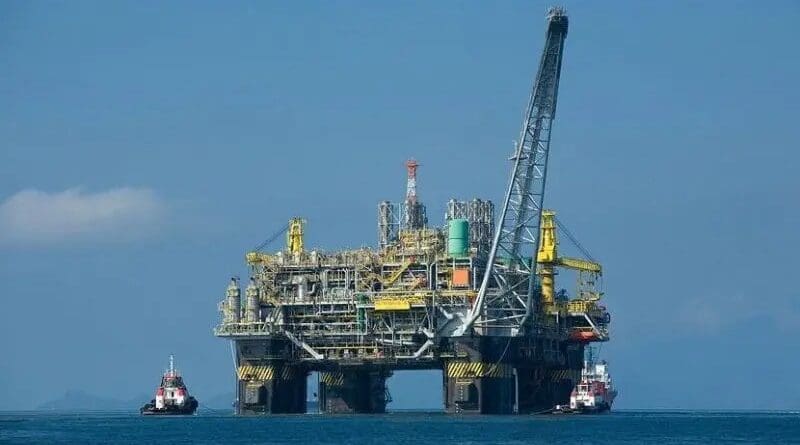
Oil platform P-51 offshore Brazil. Photo by Divulgação Petrobras / ABr, Wikipedia Commons.
By ABr
By Rafael Cardoso
The auction held Tuesday (Jun. 17) by the Brazilian oil authority ANP ended with 34 oil exploration blocks awarded in the basins of Parecis, Foz do Amazonas, Santos, and Pelotas—an area of 28,359.55 km². In total, 172 areas were put up for auction.

Nine winning companies—two Brazilian, seven international—paid over BRL 989 million to acquire the blocks. The minimum investment forecast for the exploration phase is BRL 1.45 billion. Petrobras acquired ten blocks in the Foz do Amazonas basin and three blocks in the Pelotas basin, with an outlay of BRL 139 million.
ANP acting Director-General Patricia Baran highlighted the results obtained in the Equatorial Margin—the Amazon river delta, a region that encompasses the Foz do Amazonas Basin and four other basins (Potiguar, Ceará, Barreirinhas, and Pará-Maranhão).
“We had a premium of nearly 3 thousand percent in areas of the Equatorial Margin and competition in seven of the 19 blocks awarded. This was the first time that areas in this region were offered under the permanent bidding modality,” said Baran. “In the agency’s view, today’s result was really positive, and showed investors’ confidence in Brazil’s exploration potential,” she added.
Minister of Mines and Energy Alexandre Silveira said the inclusion of areas in the Equatorial Margin, the Parecis basin, and the Pelotas basin is part of a strategy for a more balanced distribution of revenue from the oil and gas sector.
“We are fully capable of taking the wealth from oil very responsibly to all regions of Brazil. We are working to ensure that economic growth is accompanied by social inclusion, environmental commitment, and the creation of quality jobs across the country,” he stated.
Protests
Indigenous leaders from the Tapayuna people of Mato Grosso state held a demonstration outside the Courtyard Hotel in Rio de Janeiro, where the auction took place. Young leader Yaiku Tapayuna described the auction as an attack on traditional peoples.
“It’s an impact on our territory. We indigenous peoples are against it because it’s a sacred place. We don’t want this exploitation within our territory,” he said.
Quilombola association CONAQ, formed by members of communities originally created by runaway enslaved people, issued a statement condemning the auction of block 59, off the coast of Amapá state, close to quilombola territories.
“We denounce the lack of dialog as well as the authorities’ resistance to listening to the quilombola people and the other people who inhabit the impacted regions. This institutional negligence is the result of environmental and structural racism, as it puts rural black communities and their territories at risk, favoring economic interests and big corporations,” their note reads.
Fishing workers and members of the Arayara Institute held a protest in Rio de Janeiro’s Guanabara Bay. They held up a banner that read: “Stop the Doomsday Auction,” because they believe that oil exploration threatens the climate as well as communities. The group argued that, in the year of COP 30 in Brazil, the government should stop what they classify as a major environmental risk.
Conservation specialist and WWF-Brasil energy transition leader Ricardo Fujii said that the authorities and oil companies are ignoring scientific warnings and socio-environmental risks.
“We are talking about one of the most sensitive regions on the planet, home to unique ecosystems such as the great Amazonian reef system and more than 80 percent of Brazil’s mangrove swamps—cradles of fishing, food security, and the livelihoods of thousands of families. Instead of leading the energy transition, Petrobras is choosing to expand a high-impact portfolio with uncertain yields, putting both Brazil’s and the planet’s climate future at risk,” Fujii declared.

ABr
Agência Brasil (ABr) is the national public news agency, run by the Brazilian government. It is a part of the public media corporation Empresa Brasil de Comunicação (EBC), created in 2007 to unite two government media enterprises Radiobrás and TVE (Televisão Educativa).

No comments:
Post a Comment