It’s possible that I shall make an ass of myself. But in that case one can always get out of it with a little dialectic. I have, of course, so worded my proposition as to be right either way (K.Marx, Letter to F.Engels on the Indian Mutiny)
Thursday, June 19, 2025
LITTER IS POLLUTION
Plastic bag policies are effective in reducing shoreline litter in the US
Summary author: Walter Beckwith
American Association for the Advancement of Science (AAAS)
Plastic bag regulations – bans and consumer fees – have led to meaningful reductions in plastic litter on U.S. shorelines, according to a new study. Plastic pollution has become a pervasive environmental issue; plastic debris comprises most of the marine litter worldwide and has been shown to pose serious threats to ocean life, ecosystems, and coastal economies. Much of this pollution originates from land and enters the ocean via rivers, wastewater, or wind. Among the most problematic items entering marine systems are single-use plastic shopping bags, which has prompted the implementation of a variety of policies – ranging from fees to outright bans – to curb this pollution. Although these policies are being increasingly used worldwide, their effectiveness in reducing plastic waste in the environment remains unknown. To address this gap, Anna Papp and Kimberly Oremus evaluated the effects of plastic bag bans and fees in the United States on the prevalence of plastic bag litter on shorelines. Papp and Oremus analyzed crowdsourced data from more than 45,067 U.S. shoreline cleanups alongside 611 local and state-level plastic bag regulations enacted between 2017 and 2023. By applying robust causal inference methods, the authors found that plastic bag policies led to a 25–47% reduction in the proportion of plastic bags among total litter collected during cleanups compared to locations without such regulations. According to the findings, policies involving consumer fees potentially have the largest impact on reducing litter. While complete bag bans also reduced litter, partial bans, which often allow exceptions for thicker “reusable” bags, appeared to be the least effective. Moreover, the largest reductions in plastic litter occurred in places that had the highest baseline levels of plastic bag pollution, suggesting that these policies are most effective where the problem is most severe. Papp and Oremus also suggest that plastic bag policies may reduce wildlife entanglement by 30 to 37%, though they note that these estimates are imprecise due to data limitations.
A segment of Science's weekly podcast with Anna Papp, related to this research, will be available on the Science.org podcast landing page after the embargo lifts. Reporters are free to make use of the segments for broadcast purposes and/or quote from them – with appropriate attribution (i.e., cite "Science podcast"). Please note that the file itself should not be posted to any other Web site.
Among the biggest culprits of plastic pollution in the ocean and along shorelines are thin plastic shopping bags, which have low recycling rates and often become litter when they blow away in the wind. Once there, they can entangle animals and break down into harmful microplastics. As awareness of this problem has grown, more than 100 countries have instituted bans or fees on plastic bags. But what effect those policies are having on the amount of plastic litter in the marine environment had not been systematically evaluated until now.
A new study from the University of Delaware and Columbia University took a thorough look at plastic bag bans and fees in jurisdictions across the United States to gauge their effectiveness. The researchers found that plastic bag policies led to a 25% to 47% decrease in plastic bags as a share of total items collected in shoreline cleanups relative to areas without policies. This decrease grows in magnitude over time, with no evidence of the rates rebounding.
Oremus got the idea for the study when she learned that volunteers at coastal beach cleanups in Delaware were using an app called Clean Swell to track the litter collected. The data goes into the Ocean Conservancy’s Trash Information and Data for Education and Solutions (TIDES) database, which keeps crowdsourced records from thousands of cleanups around the world each year.
“When we found the database that had information on different shoreline cleanups, we realized we could look at the composition of litter before and after a policy to see what effect it had,” Oremus said. “And then we could compare that to places that never got a plastic bag policy.”
Papp, the study’s lead author, said the plastic collected in shoreline cleanups can serve as a proxy for the total amount of plastic litter in the local marine or aquatic environment.
“A lot of the previous economics literature on plastic bag policies has used checkout data at the store level,” Papp said. “So we were excited to add to that a direct measurement of plastic litter on these shorelines.”
“We always remind volunteers and our partner organizations that the data they collect are used to make real change, and these findings are a great example of that,” said Allison Schutes, senior director of conservation cleanups at Ocean Conservancy.
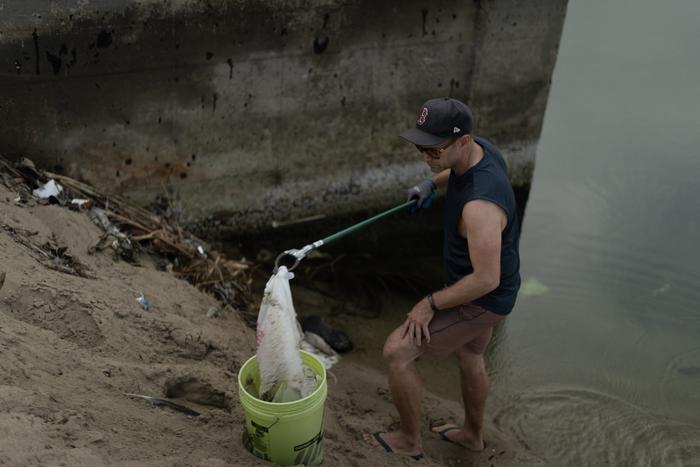
To conduct their study, the researchers looked at tens of thousands of shoreline cleanups and hundreds of local policies to determine how the policies worked in terms of reducing plastic litter in the environment. They focused on the United States because it has no federal plastic bag policy, allowing them to compare the effects of different types of policies at the town, county and state level within a single country.
While it might not seem surprising that banning or taxing plastic bags would reduce litter, Oremus said the results were more robust than she had expected.
“There are so many pathways a bag can take from the checkout line at the store,” Oremus said. “It’s great to see a policy that works in such a clearly measurable way.”
Papp added that looking into the plastic bag policies, she was surprised to find that roughly one third of Americans are living in an area with some sort of plastic bag policy in place.
“It was interesting to quantify the reach of the policies,” said Papp. “We compiled over 600 policies for 2007-2023, with a lot of variation in their scope and geographic scale.”
The study also found that some types of policies seemed to be more effective than others in reducing plastic litter. For instance, they found more robust impacts from state-level policies than town-level policies, with fees appearing to reduce litter even more than bans, though more study is needed to understand why. Another finding was that the bag bans and fees were most effective in places where the plastic bag litter problem was more severe to begin with.
An important caveat of the research is that despite these policies working to reduce the percentage of plastic bags on the shorelines, the overall percentage of plastic bags is increasing in both places with and without the policies. It’s just increasing less in places with these policies than those without. That’s because plastic pollution is growing in general, and bag policies can only mitigate some of its impacts.
“We’re still getting more plastic bags on shorelines as a percentage of all the cleanup items over time,” said Oremus. “It’s not eliminating the problem, it’s just making it grow more slowly.”
With the United Nations Environment Programme announcing the next round of negotiations on an international plastic treaty will happen in August 2025, Oremus and Papp said their study highlights the opportunity for a more comprehensive approach to the problem.
“Overall, our findings do show that plastic bag policies are broadly effective in limiting litter along shorelines,” said Papp. “Ours is the first large-scale study to use hundreds of policies and tens of thousands of cleanups to look at their effects. But it is important to keep in mind that this is a relative decrease in affected areas compared to areas without policies.”
Would you rather have 10 cents in your pocket or a 1-in-10,000 shot at $1,000?
Many people would choose the latter, and that could be the key to getting people to recycle more, a new University of British Columbia psychology study has found.
The researchers tested the idea of offering people who return used bottles a tiny chance to win a big cash prize, instead of the typical 10-cent deposit return. The result was that people recycled 47 per cent more bottles.
“This small change in how we reward recycling made a big difference. People were more excited, more engaged, and they brought in more bottles,” said Dr. Jiaying Zhao (she/her), associate professor in the department of psychology and senior author of the study published this week in Waste Management. “It turns out that the thrill of possibly winning a big prize is more motivating than a small guaranteed reward. It’s the same reason people buy lottery tickets. That tiny chance of a big win is exciting.”
The study took place in B.C. and Alberta, where bottle deposit systems are already in place. But even though these systems give people a small refund when they return empty beverage containers, many bottles still end up in the trash.
The researchers ran three experiments. In the first two, people could choose between a guaranteed 10-cent refund or a chance to win a larger amount—like $1, $10, $100 or even $1,000. The odds of winning were low, but many people chose the lottery-style option.
In the third experiment, people were randomly assigned to either the guaranteed refund or the lottery-style refund. Those in the lottery group brought in almost three bottles for every two returned by the other group.
The study also found that people felt happier when they had the chance to win a big prize, even if they didn’t actually win. This feeling—called “anticipatory happiness”—made the recycling experience more enjoyable.
“Norway is the only country in the world that has a similar recycling lottery, and their bottle return rate is close to 100 per cent,” said Dr. Zhao. “The probabilistic refund could be their secret sauce. We hope Canada can adopt this innovative idea as well.”
To bring the idea to Canada, the researchers suggest starting with pilot programs at selected bottle depots. These trials could test how well the lottery option works in real-world settings before expanding it across provinces or the country. In Norway, “reverse vending machines” let people return bottles and choose between a guaranteed refund or a lottery entry. These machines could also be installed in Canada to make the process easy and automatic.
Importantly, the lottery-style refund wouldn’t cost any more than the regular system. Both options have the same average payout. That means cities and provinces could adopt this approach without spending extra money.
The researchers say it’s important to keep the guaranteed refund option, especially for people who rely on it for income. Offering both choices ensures fairness and flexibility.
If adopted widely, the researchers estimate that this approach could help recycle millions more bottles and reduce greenhouse gas emissions equal to taking one million cars off the road each year.


No comments:
Post a Comment