SPACE/COSMOS
Is Space-Based Solar Power Finally Ready to Shine?
- Space-based solar power, a long-envisioned technology, is gaining momentum as a crucial solution to meet growing energy demands and achieve decarbonization targets.
- This technology offers significant benefits, including 24/7 high-intensity sunlight collection, potential for substantial reductions in land-based renewable energy and battery storage needs, and lower overall energy system costs.
- Despite its promise, space-based solar power faces challenges in financing long-term infrastructure projects, with startups increasingly relying on government contracts to scale the technology.
Scientists have dreamed of putting solar panels in outer space since the late 1960s, and have known that space-based solar power was technologically feasible since the 1970s. But the true race for space-based solar has only just begun, driven by the intensifying need to produce more electricity to meet rapidly growing energy demand. As more of the world becomes electrified, big data and AI become omnipresent, and decarbonization deadlines draw closer, innovative energy solutions are needed more than ever. As a result, space-based solar power is finally ready for its day in the sun.
This nascent technology employs enormous satellites to collect high-intensity sunlight and beam it down to Earth, either through microwaves or lasers. A receptor on Earth receives that energy and converts it into electricity to be fed into the grid. This energy would be dispatchable, as satellites would have gargantuan range and could flexibly beam energy to where the demand is greatest.
The production potential of space-based solar power is enormous. Because the panels are situated beyond clouds and the atmosphere, and are not impacted by the rotation of the earth, they receive high levels of unadulterated sunlight 24 hours a day, 7 days a week. As a result, these systems are capable of producing a potentially game-changing amount of clean energy.
According to calculations by researchers from King’s College London, space-based solar power could reduce Europe’s need for land-based renewable energy by as much as 80 percent, and reduce battery-based energy storage needs by more than two-thirds. The kicker? It would reduce the cost of Europe’s energy system by as much as 15 percent. The researchers found that the associated savings in terms “energy generation, storage and network infrastructure costs” would save an estimated 35.9 billion euros (41.7 U.S. Dollars) per year.
The higher energy density of space-based solar means that energy systems would need far fewer costly resources. Such a system “requires orders of magnitude fewer critical minerals to provide the same continuous power as a terrestrial solution with large-scale energy storage,” reads a recent article from the World Economic Forum. “This offers a more sustainable path, alleviating the strain on resources that the International Energy Agency (IEA) has identified as a key challenge,” the report continues.
Critically, these systems would also require far, far less land than Earthbound solar farms. Not only would we be outsourcing solar panels to outer space, the receptors that receive the solar energy here on Earth would be relatively small and mostly transparent, meaning that they would be well-suited to mixed-use spaces. This would alleviate intensifying issues of land scarcity faced by utility-scale renewable energies.
As the considerable benefits of space-based solar gain more attention, investment in their development has ramped up considerably. Labs in the United States, the United Kingdom, China, Japan, Europe, and other locations around the globe are all accelerating their research programs to advance space-based solar power, and high-profile private investors are now joining the trend as well. Big tech bigwig Baiju Bhatt, a co-founder of Robin Hood, launched the space solar startup called Aetherflux last year.
But space-based solar power still faces some key hurdles before it can be scaled for commercial use. The most significant of these, according to the World Economic Forum, is the way that private finance is structured around early-stage startups and not long-term infrastructure projects. While space-based solar power will be a big money saver in the long term, it will not provide quick or necessarily predictable returns on investment.
For this reason, startups are looking to government contracts to get space-based solar power off the ground. "We think that the military customer is large enough — and for lack of better word, difficult enough — of a customer that if we can serve, we can build a constellation and we can be at scale, Christian Garcia, managing partner at Breakthrough Energy Ventures, one of Aetherflux’s backers, told CNBC. “And at that point, we will have dropped the cost of the technology such that we can expand into other customers."
By Haley Zaremba for Oilprice.com

Tomorrow (October 8) should see entrepreneur Danna Karagussova become the first Kazakh woman to travel into space.
She and five others are to join Blue Origin’s New Shepard NS-36 mission.
Karagussova, who has more than 25 years of experience in media, distribution and event management, is the co-founder of Portals, a project combining digital self-regulation tools with science and art.
Kazakhstan is famed for the Baikonur Cosmodrome, from where the first human to reach space, Russian cosmonaut Yuri Gagarin, was launched in 1961.
The reusable New Shepard suborbital rocket system is to take Karagussova – as well as American entrepreneur Jeff Elgin, engineer Clint Kelly III, startup founder Aaron Newman, Ukrainian businessman Vitalii Ostrovsky and one participant who has opted to remain anonymous – on an 11-minute journey. The astronauts, after being launched from West Texas, will soar past the Karman line (100 kilometres/62 miles above mean sea level it is a conventional but not universally accepted definition of the edge of space), and experience several minutes of weightlessness, while witnessing views of Earth.
The vehicle is fully autonomous—there are no pilots.
The NS-36 launch will be Blue Origin’s 15th crewed mission. To date, the company’s spacecraft have carried 75 people.
Blue Origin was created by Amazon founder Jeff Bezos.
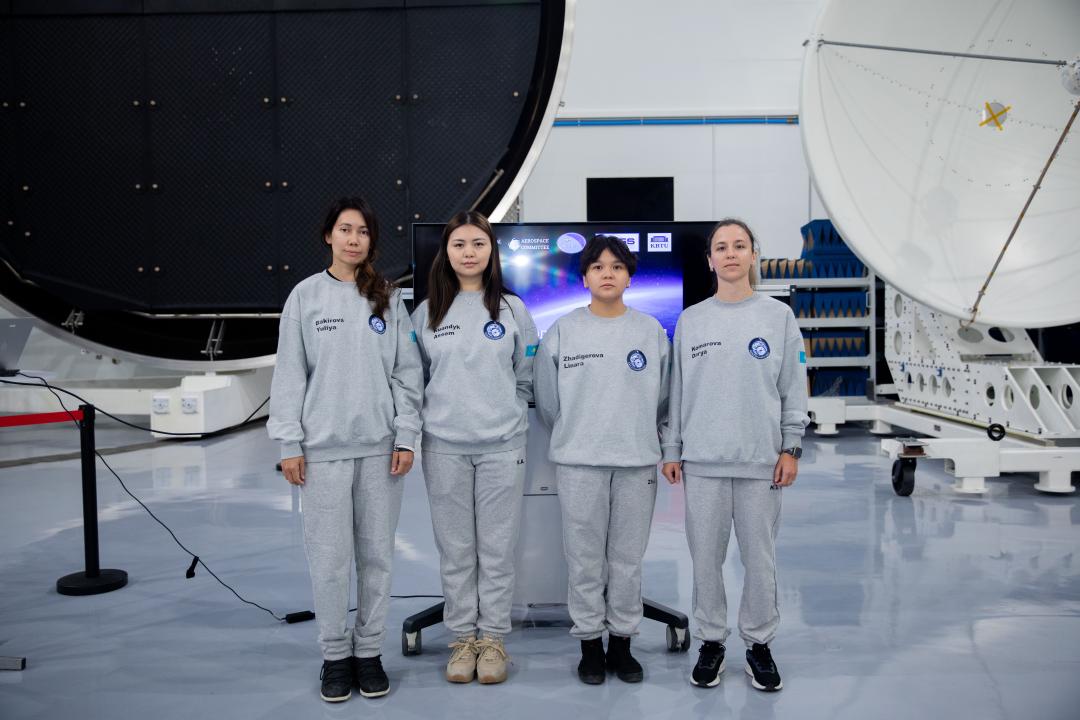
The space crew isolation experiment is the first in Kazakhstan to have an all-women "crew" (Credit: gov.kz).
Kazakhstan, meanwhile, has initiated its first long-term crew isolation experiment simulating space flight that involves an all-women “crew”.
Research project SANA-1 was formally launched at the National Space Centre on October 1, The Times of Central Asia has reported.
The initiative is being carried out by the Aerospace Committee of the Ministry of Artificial Intelligence and Digital Development in partnership with Eurasian Space Ventures and several leading national scientific and educational institutions.
The all-female "crew" of four specialists is drawn from organisations under the Aerospace Committee. They are Yuliya Bakirova, who serves as commander, Assem Kuandyk, Daria Komarova and Linara Zhadygerova. The group will spend 10 days inside a spacecraft simulator built by Eurasian Ventures Group, created at the initiative of cosmonaut and Hero of Kazakhstan Aidyn Aimbetov, according to the ministry’s press service.
During the mission, the team will carry out a range of studies on medical and psychological factors, as well as team dynamics, alongside a set of educational experiments. The scientific programme is led by Alina Gutoreva, a PhD in psychology and head of the AI Lab at the Kazakh-British Technical University.
SANA-1 represents Kazakhstan’s first integrated study combining psychological, medical and engineering aspects of human spaceflight. Officials said the project is intended to strengthen the country’s space research capabilities, inspire younger generations to pursue careers in science and technology, and underscore the role of women in research.
The all-female participation is presented as a milestone for gender equality and a step towards preparing Kazakhstan’s own researchers for future space missions.

No comments:
Post a Comment