Tanintharyi’s Mangrove Deforestation Amid Political Crisis – Analysis
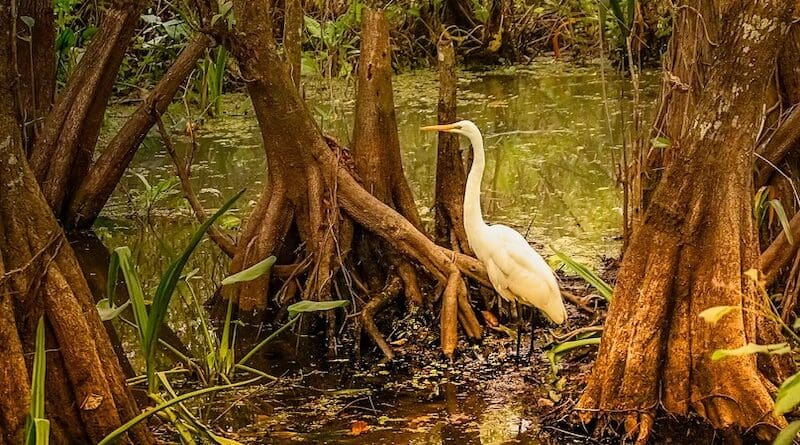
Credit: The Sabai Times
October 10, 2025
By Shwetaungthagathu Reform Initiative Centre
By Hnin Eaindra Khine
Mangroves play a crucial role as a guardian angel of coastal towns, for many communities, but the need to secure food is more important than saving the guardian.
Key Takeaways:Mangroves provide environmental and community benefits, while also serving as one of the most effective natural systems for carbon sequestration in combating climate change.
In the Tanintharyi Region, charcoal production has accelerated mangrove deforestation, especially without effective governance and legal control following the 2021 military coup.
Although the SAC tries to meet the targets of the Forestry Master Plan (2001–2030), its efforts seem to be symbolic conservation designed for international recognition rather than genuine protection.
Mangrove: The Guardian Angel of Coastal Towns
Mangroves are one of the richest sources of blue carbon, offering environmental and community benefits. They act as natural barriers, protecting coastal villages from cyclones, storm surges, tsunamis, and erosion. At the same time, they provide vital habitats for marine biodiversity and shelter for birds, reptiles, and other wildlife. Their intricate root systems trap sediments and filter pollutants, improving water quality. Most importantly, mangroves absorb around 12.3 kg of CO₂ annually, 2 – 4 times more than most other tropical forests, and are crucial in mitigating climate change.
Mangroves support fisheries, tourism, aquaculture, and agriculture for community benefits. Many coastal communities depend on fish, prawns, and crabs that thrive within mangrove ecosystems. The leaf litter and nutrients mangroves release enrich coastal soils and waters, sustaining nearby agriculture and aquaculture. In addition, healthy mangrove forests attract ecotourism, creating opportunities to boost local livelihoods and strengthen community income.
Although mangroves comprise only about 1% of Myanmar’s total forest cover (42.92%), they play a crucial role in the country’s ecological and community well-being. Myanmar’s mangrove forests are the 3rd largest in Southeast Asia. In Myanmar, mangroves are found in Tanintharyi, Ayeyarwady, Yangon, Bago, Rakhine, and Mon States.
Killing the Guardian Angel for A living
Most people in Myanmar continue to rely heavily on nonrenewable fuels, particularly charcoal, as their primary source of cooking fuel. It is estimated that 90% of charcoal production in the country comes from coastal mangrove forests. Among the coastal regions where mangroves are found, Tanintharyi is the center of charcoal production, providing domestic markets and supplying cross-border trade with Thailand.
Even before the 2021 military coup, communities in the Tanintharyi Region had relied on cutting mangroves and trading charcoal illegally to Thailand as a source of livelihood. Villages in Myeik, Kyunsu, Boatpyin, and Kawthaung townships have already engaged in mass charcoal production since Thailand’s charcoal ban in the late 1990s. However, in the economic downturn following the coup, mangrove deforestation only intensified as more people turned to mangrove cutting and charcoal burning for their living. In particular, charcoal kilns have rapidly expanded in villages across Kyunsu and Boat Pyin townships.
Mrs. Htway Naing, a local villager who made a living from making charcoal, shared her experiences and insights into the culture of charcoal production. Mrs. Htway Naing and her husband did mangrove burning in Shwe Ge Nyo Village from Kyun Su Township, their main livelihood for nearly a decade. She said, “Nearly all households in those villages are involved in mangrove cutting. In Shwe Ge Nyo Village, where we once lived, there were two main charcoal producers, each owning about 12 large kilns and over a hundred small-scale burners across the village.”
She continued, “The owners hire men to cut mangroves using chainsaws. On average, they harvest 10 – 15 Pone San per day.” A Pone San is a local unit of measurement for firewood, referring to a stack of wood measuring approximately 5 feet in length by 6 feet in height. Each unit is valued at around 8 to 9 USD in the market.
“Some villagers cut and sell mangroves per trunk. During tidal days, they cut daily, filling boats with nearly 100 or 200 trees based on the size of the boats. Once the tide recedes, they focus on the charcoal-making process,” explained Mrs. Htway Naing. The charcoal kilns vary in size. A 7×7 ft kiln takes about 10 days to bake, a 12×12 ft kiln lasts around a month and a half, and a 16×16 ft kiln can take more than two months to produce charcoal.
There are over a hundred household-level charcoal-burning camps in larger villages such as Yay Aye and Shwe Ge Nyo. Following the economic downturn and rising inflation, grassroots communities have struggled to sustain their livelihoods from agriculture, fisheries, and rubber plantations. As a result, charcoal production has become one of the few remaining income sources; however, it also brings the added burden of unofficial payments to local administrators and SAC officials.
Community-led Conservation in Kaw Thaung Township, Tanintharyi Region
Even before the coup, community-led conservation efforts had taken root in Kawthaung Townships. In Kawthaung, Mr. Shwe Fun, a local environmental enthusiast, founded the Pakchan River Conservation Group in 2016, bringing together five villages from the upper part of the Pakchan River. “ Since 2017, some active villagers and I have been actively planting trees and raising awareness among local villagers about the importance of mangrove protection and community forests. Through these collective efforts, we have grown more than a hundred thousand trees together,” said Mr. Shwe Fun.
The Pakchan River, also known as the Kraburi River, forms the natural boundary between Myanmar and Thailand. Rising in the Tenasserim Hills flows into the Andaman Sea near Kawthaung (Myanmar) and Ranong (Thailand). It provides a wide range of benefits to both people and nature. Its extensive mangrove forests serve as critical habitats for marine life. Villages along the river from both sides rely on its resources daily.
Mangrove conservation in the southern coastal area is crucial since Irrawaddy dolphins can be found in the Myeik to Kawthaung coastal line. The Irrawaddy dolphin, Orcaella brevirostris, one of the endangered species, is found in both freshwater and coastal environments in South and Southeast Asia, mainly in three rivers: the Ayeyarwady (Myanmar), the Mahakam (Indonesian Borneo), and the Mekong in Southeast Asia.
Hence, mangrove forests in Tanintharyi Region are important for Irrawaddy dolphins because they are crucial habitats that provide food, shelter, and nursery grounds for the dolphins and their prey. These coastal ecosystems support rich biodiversity, including various fish and invertebrates that form the dolphins’ diet, and their interconnected waterways serve as vital areas for dolphin movement and survival in the Ayeyarwady’s estuaries.
SAC’s Showpiece Conservation and Efforts
The Forestry Master Plan (2001–2030) sets targets: to increase reserved and protected public forests to 30% of the country’s land area, to establish 10% as protected areas, and to create 2.27 million acres (919,000 ha) of Community Forests. Under this framework, the State Administration Council (SAC), a council founded by the military junta following the February 2021 coup d’état, hasdesignated more than 660,000 acres of reserved and protected public forests and 610,000 acres of protected areas during its tenure. However, no new community forests have been established.
According to the Community Forest Instruction (2019), community forest user groups have rights to be granted for at least 30 years for the first time, allowing them to benefit from and self-manage these forests. As of November 2021, there were 7,010 user groups with nearly 180,000 members, collectively managing 965,600 acres (390,761 ha) of community forests nationwide. Yet, since the SAC’s takeover, no additional community forests have been developed, only focusing on the reserved and protected public forests, which are meant to be under the state’s complete control and managed primarily to extract forest products.
In July 2025, the SAC designated 54,000 acres of six mangrove forests as protected public forests in Kyun Su Township, Tanintharyi Region, including two forests established in 2024. However, no additional conservation or monitoring measures have been implemented. Since before the 2010 political transition, and even under the civilian government (2015 – 2020), forestry inspectors regularly visited villages, and patrol boats monitored activities around coastal areas. But after the 2021 military coup, there were clashes between the Kyun Su People’s Defense Force(PDF) and SAC troops in coastal villages in late 2023. Following the ambushes and clashes with the Kyun Su PDF, patrol officials do not dare to patrol around, leaving these areas largely unmonitored. Despite this, SAC has kept designating two mangrove forests as protected public forests in 2024 and four in 2025 in Kyun Su Township, Tanintharyi Region. On the other hand, small-scale charcoal burners continue making charcoal by paying unofficial payments to village administrators and SAC forestry officials.
To conclude, while the SAC has declared new reserved forests and protected public forests nationwide, it is clear that it cannot effectively monitor or controlthem. Since the 2021 military coup, local people’s defense forces have emerged across the country, and the SAC has lost control of roughly 42% of Myanmar’s territory, leaving vast forest areas beyond its reach. Hence, these designations seem aimed at gaining international recognition or projecting the image that the military regime can manage all sectors, including environmental sustainability, despite the ongoing civil war. In reality, such measures are for show, intended to make the country appear stable in international news, even as the SAC struggles to govern nearly half the nation.
About the author: Hnin Eaindra Khine is a Junior Research Fellow at the Sustainability Lab of the Shwetaungthagathu Reform Initiative Centre (SRIc). She is also currently interning at RecyGlo Myanmar, where she supports various environmental sustainability projects.
Source: This article was published at The Sabia Times
Shwetaungthagathu Reform Initiative Centre
The Shwetaungthagathu Reform Initiative Centre (SRIc) is a hybrid think tank (non-partisan) and consultancy firm that advances sustainable governance, policy innovation, and sustainability literacy in Myanmar. Through its Sustainability Lab, SRIc conducts in-depth public policy research and analysis to promote sustainable development and guide Myanmar toward a more resilient, equitable, and environmentally conscious future. SRIc provides strategic policy advocacy, CSR consultation, and the development of sustainability roadmaps grounded in Environmental, Social, and Governance (ESG) principles. These services support public institutions and private sector actors in aligning their operations with the Sustainable Development Goals. By integrating rigorous research with actionable consultancy, SRIc supports responsible business practices, fosters innovative CSR strategies, and designs impactful sustainability pathways. SRIc contributes to local transformation & global sustainability efforts through this dual approach.
Source: This article was published at The Sabia Times
Shwetaungthagathu Reform Initiative Centre
The Shwetaungthagathu Reform Initiative Centre (SRIc) is a hybrid think tank (non-partisan) and consultancy firm that advances sustainable governance, policy innovation, and sustainability literacy in Myanmar. Through its Sustainability Lab, SRIc conducts in-depth public policy research and analysis to promote sustainable development and guide Myanmar toward a more resilient, equitable, and environmentally conscious future. SRIc provides strategic policy advocacy, CSR consultation, and the development of sustainability roadmaps grounded in Environmental, Social, and Governance (ESG) principles. These services support public institutions and private sector actors in aligning their operations with the Sustainable Development Goals. By integrating rigorous research with actionable consultancy, SRIc supports responsible business practices, fosters innovative CSR strategies, and designs impactful sustainability pathways. SRIc contributes to local transformation & global sustainability efforts through this dual approach.

No comments:
Post a Comment