It’s possible that I shall make an ass of myself. But in that case one can always get out of it with a little dialectic. I have, of course, so worded my proposition as to be right either way (K.Marx, Letter to F.Engels on the Indian Mutiny)
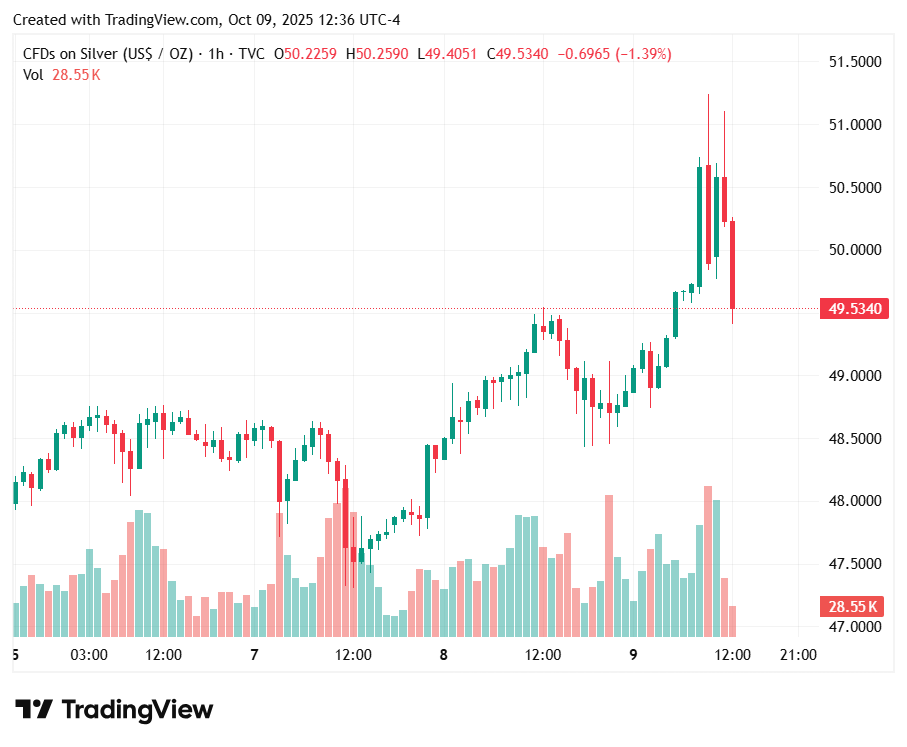
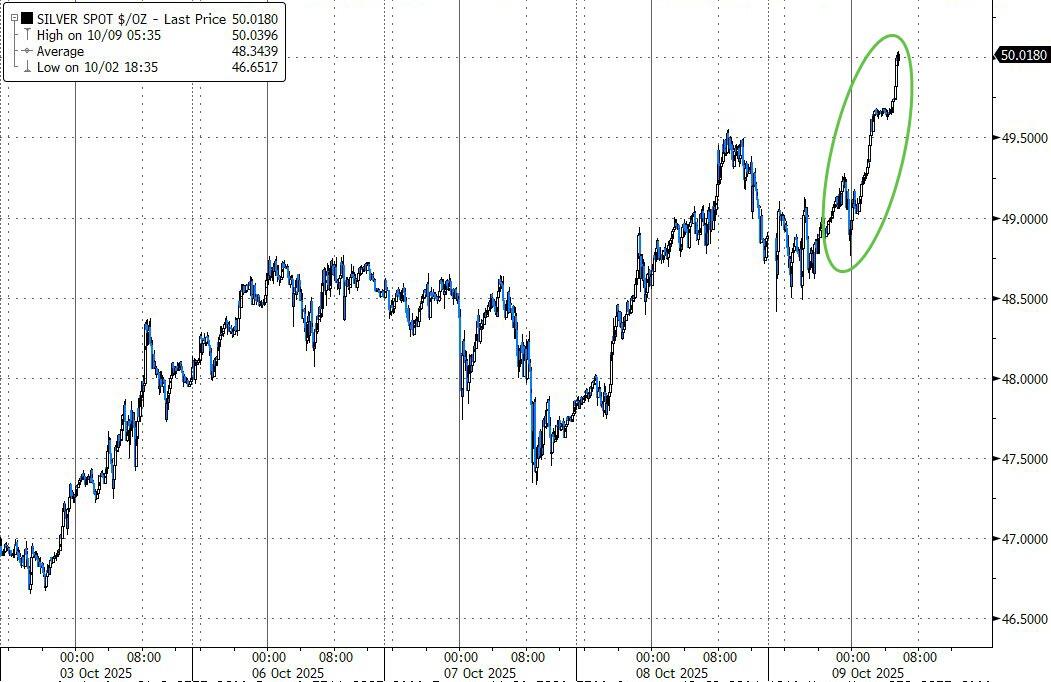
Silver reached the $50-an-ounce level for the first time in decades on Thursday as surging demand for safe-haven assets led to a squeeze on the already-tightened London bullion market.
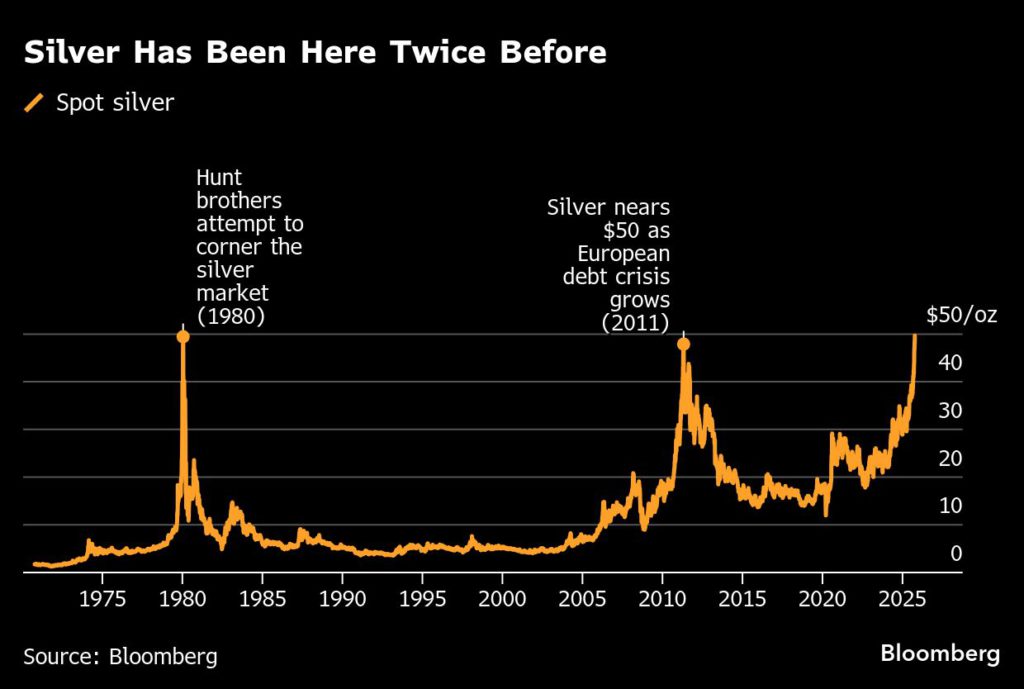
Spot silver traded as high as $51.23 per ounce, the highest since a notorious squeeze orchestrated by the billionaire Hunt brothers in 1980, as investors continued to pile into precious metals.
This takes silver’s year-to-date gains to nearly 70%, even surpassing that of gold, which scaled record highs 40 times in 2025 and recently hit the $4,000-an-ounce milestone.
The precious metals rally comes amid rising demand for haven assets sparked by US fiscal risks, an overheating stock market and threats to the Federal Reserve’s independence. These uncertainties have boosted the so-called “debasement trade” — characterized by a reallocation away from fiat currencies and into “harder” assets.
“The conversation around debasement, irrespective of its realities, has ignited investors’ enthusiasm towards gold and silver to the point where regression analysis gives way to something more akin to how investors view AI or the technology sector,” Kieron Hodgson, commodity analyst at Peel Hunt, said in a note to Bloomberg.
Market in deficit
Behind silver’s fast rise is its dual role as both an investment asset and an industrial input. The metal is a key ingredient in solar panels and wind turbines, which collectively account for more than half of its demand.
This year, demand for the metal is expected to exceed supply for the fifth consecutive year, according to Silver Institute forecasts.
“I think the deficits are the slow burn,” said Philip Newman, director of consultancy Metals Focus. “Just the size of the deficits have been so remarkable, and it takes time for that to manifest itself in the price.”
London constraints
Meanwhile, the silver market in London has also tightened to an almost unprecedented degree, with sky-high borrowing costs for the metal. This year, fears that the US could label the metal as a critical mineral and levy tariffs spurred a dash to ship the metal into New York, drawing down inventories in London.
Much of the stock of silver in London is held in vaults backing exchange-traded funds, and therefore not available to buy or borrow on the market.
“I think when you look at above-ground stocks of silver in London you are looking at an increasingly small share, which is not allocated against ETFs,” Newman said.
However, TD Securities recently said that this massive silver squeeze is approaching its “end game” as the London market begins to restore its liquidity.
Silver volatility
While silver often moves in tandem with gold, sharing its strong negative correlation with the US dollar and interest rates, it is much more volatile than its more expensive sister metal.
The metal also has a stronger cult following among retail investors, who view silver as being suppressed by large banks and institutions.
That impassioned following has helped drive sharp rallies in silver in 2011 and 2020, when it surged 140% in less than five months. Over the following year, Redditors jumped on board, while #silversqueeze rapidly gained momentum on social media.
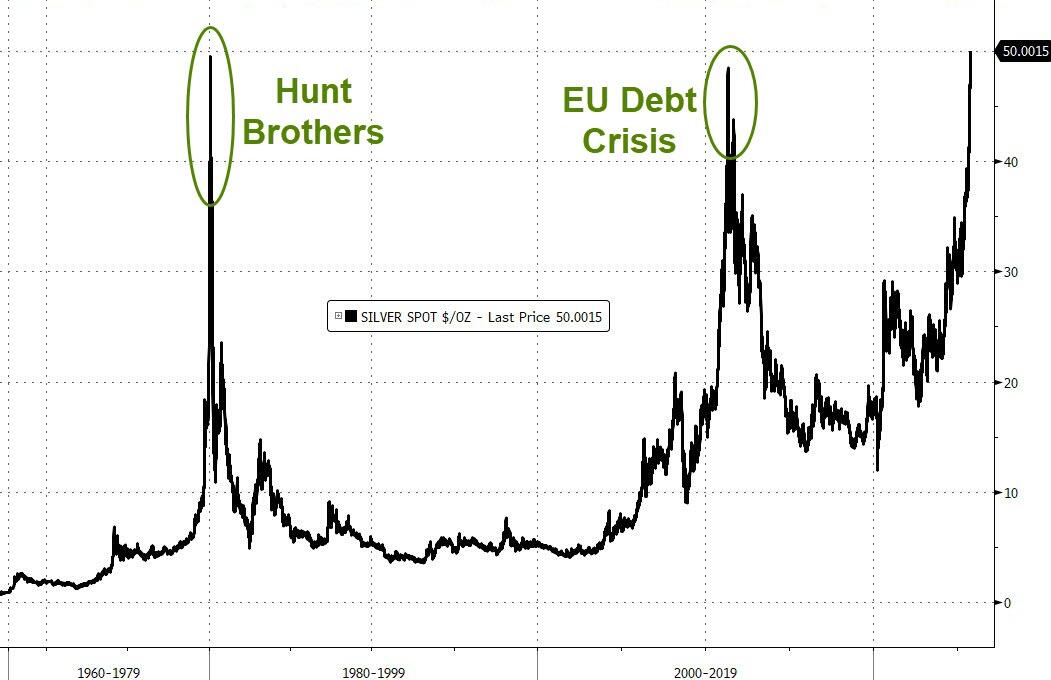
In 1980, it was the Hunt brothers, Texan oil billionaires and notorious speculators, whose fear of inflation and belief in the metal as a store of wealth prompted them to try to corner the global market. They stockpiled more than 200 million oz. of silver, driving the price above $50 before it crashed below $11.
That makes silver one of only a small handful of markets whose record highs from the commodity spikes of the 1970s and 1980s have yet to be surpassed. In inflation-adjusted terms, silver’s new high is only worth approximately one quarter of its 1980 peak, according to Bloomberg.
Gold has reached record highs above $4,000, driven by investors seeking safety in alternative assets amidst a "debasement trade" and a perceived shift in monetary regimes.
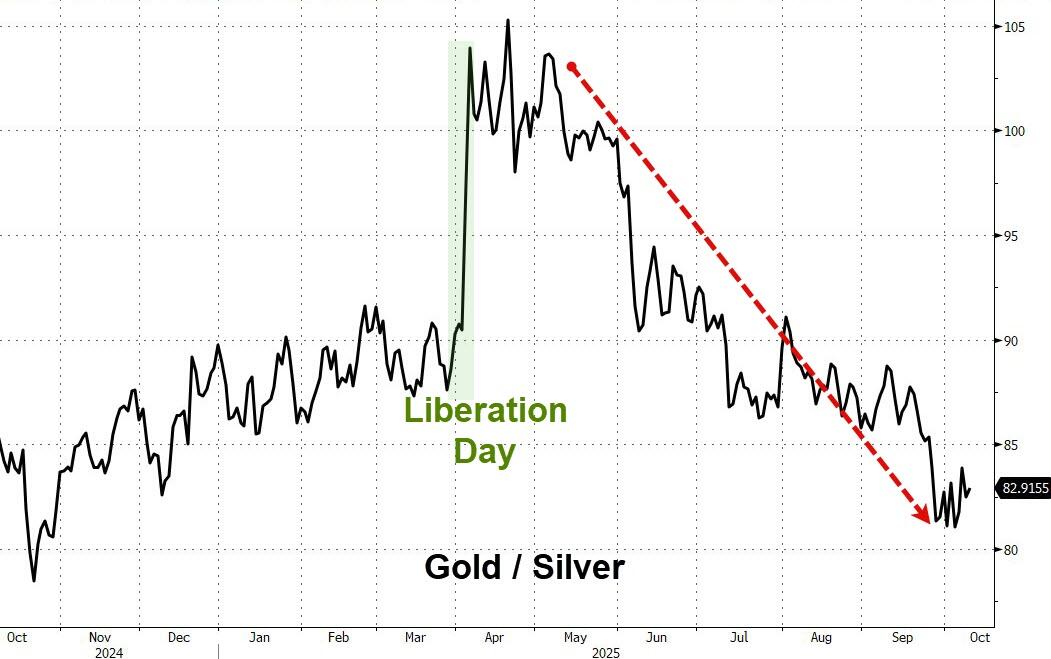
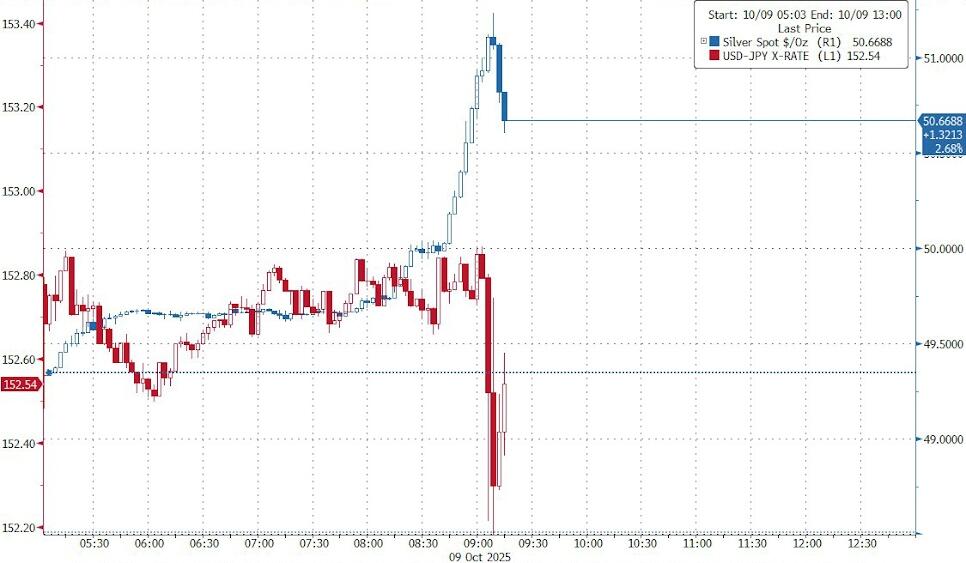
Silver has significantly outperformed gold, with its price topping $50, echoing its 1980 highs and potentially linked to the forced closing of silver and yen shorts.
The silver market faces tightening conditions due to industrial demand exceeding supply for the fifth consecutive year, high borrowing costs in London, and fears of U.S. tariffs.
The last few months have seen gold soar to record highs above $4,000 amid the so-called “debasement trade,” with investors flocking to the perceived safety of alternates while pulling away from major currencies.
However, quietly on the side, silver has been outperforming gold...
Source: Bloomberg
Citadel's Ken Griffin said investors are starting to view gold as a safer asset than the dollar, a development that's "really concerning" to the billionaire investor.
“The conversation around debasement, irrespective of its realities, has ignited investors enthusiasm towards gold and silver to the point where regression analysis gives way to something more akin to how investors view AI or the technology sector,” said Kieron Hodgson, commodity analyst at Peel Hunt Ltd.
And now that is spreading to bitcoin and silver as the white metal topped $50 this morning...
Silver's surge takes it back to the highs from 1980...
...when the Hunt brothers, Texan oil billionaires and notorious speculators, whose fear of inflation and belief in the metal as a store of wealth prompted them to try to corner the global market. They stockpiled more than 200 million ounces, driving the price above $50 an ounce before it crashed below $11.
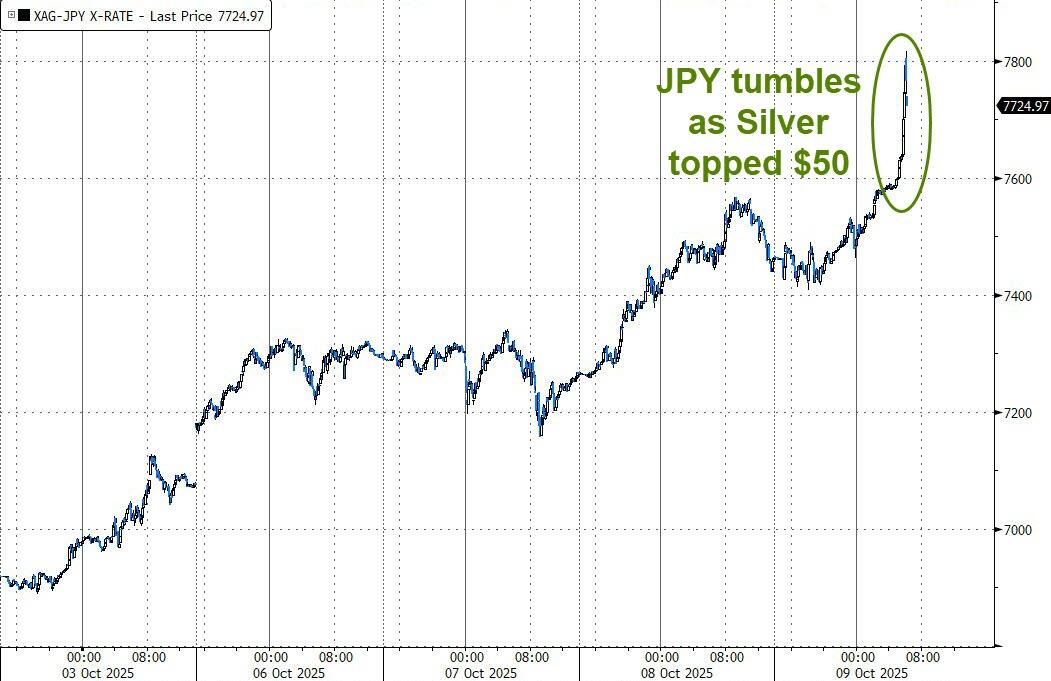
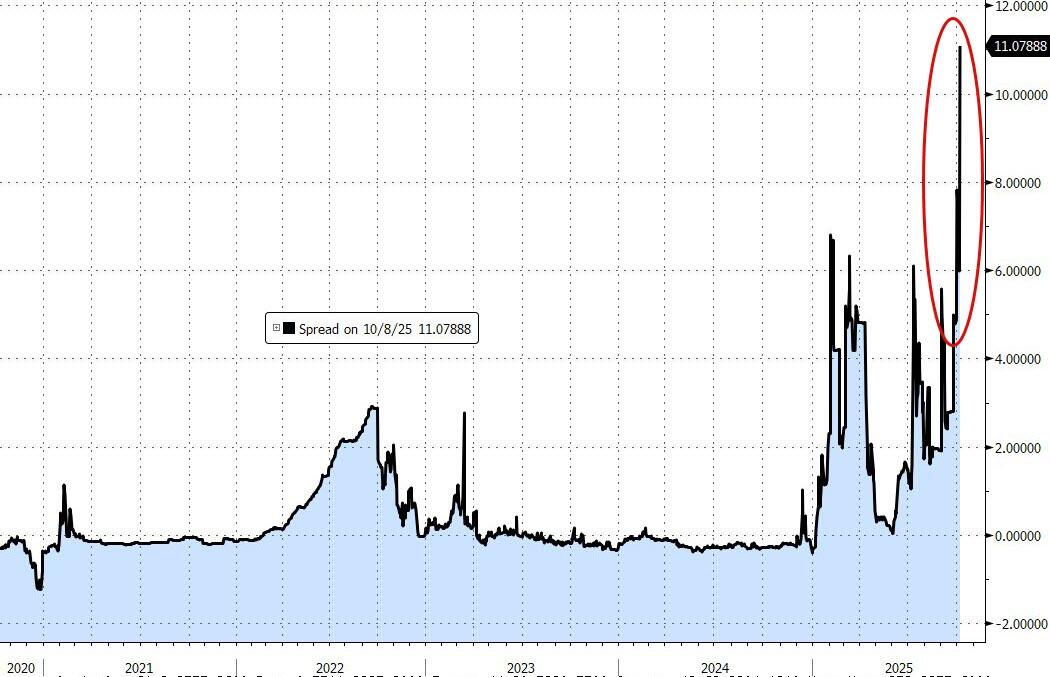
Notably, silver in yen really snapped higher this morning...
With a break in the relationship as silver topped $50 - Something's going on there... Were silver shorts being funded with Yen shorts? It appears that forced closing of silver shorts led to forced closing of yen shorts?
The white metal is used around the world as an investment asset, but also has industrial applications including in solar panels and wind turbines, which collectively account for more than half of the silver sold. Demand is set to exceed supply for the fifth consecutive year in 2025.
“I think the deficits are the slow burn,” said Philip Newman, director of consultancy Metals Focus Ltd.
“Just the size of the deficits have been so remarkable, and it takes time for that to manifest itself in the price.”
Additionally, Bloomberg reports that the silver market in London has tightened to an almost unprecedented degree, with sky-high borrowing costs for the metal.
This year, fears that the US could levy tariffs on silver have spurred a dash to ship the metal to the US, drawing down inventories in London and reducing the amount of material available to borrow.
Much of the stock of silver in London is held in vaults backing exchange-traded funds, and not available to buy or borrow on the market.
“I think when you look at above-ground stocks of silver in London you are looking at an increasingly small share, which is not allocated against ETFs,” Newman said.
As we detailed earlier in the week, it appears the so-called "debasement trade" - driving investors to bet more on gold, silver, and bitcoin - is set to continue with Gold remaining Goldman Sachs' highest-conviction long commodity recommendation because of the:
Additional price upside in our base case (driven by structurally higher central bank gold demand)
Large upside risks to our price forecast from potential additional private sector diversification
Attractive portfolio hedging properties in downside (tail) scenarios that .are less favorable for equity-bond portfolios than our base case (e.g. global growth slowdown, rising market concerns about DM macro policy)
This price hike is likely to trigger more fears from Citadel's Griffin who warned, during and interview with Bloomberg's Francine Lacqua, that "we're seeing substantial asset inflation away from the dollar as people are looking for ways to effectively de-dollarize, or de-risk their portfolios vis-a-vis US sovereign risk."
By Zerohedge
GRAPHIC:
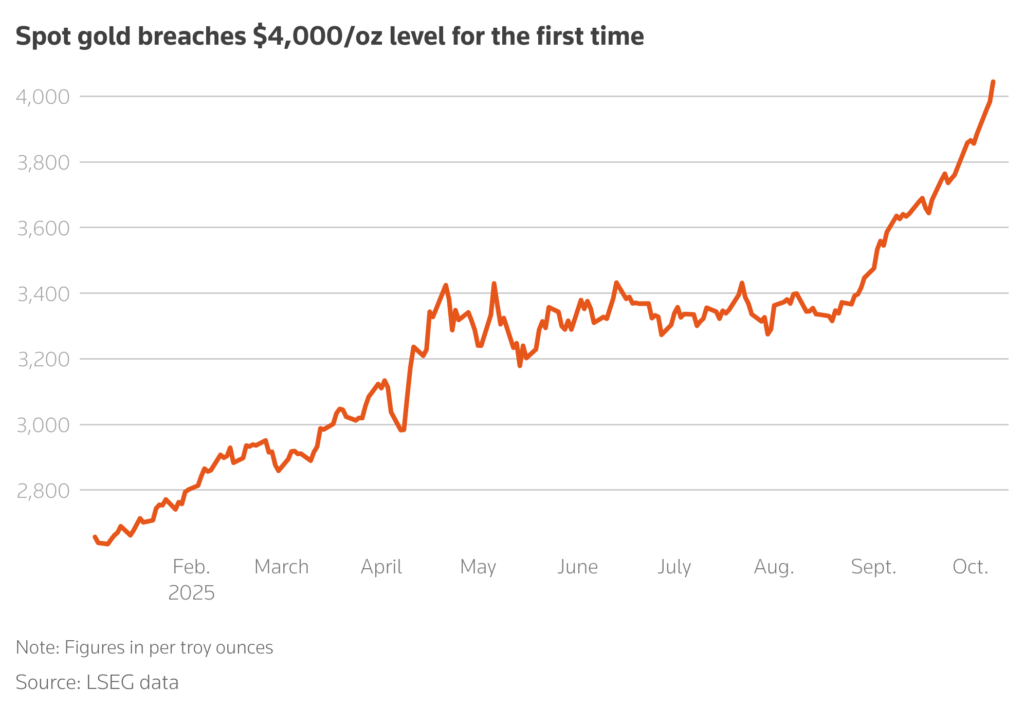
Gold’s rush above $4,000 cements status as global bellwether
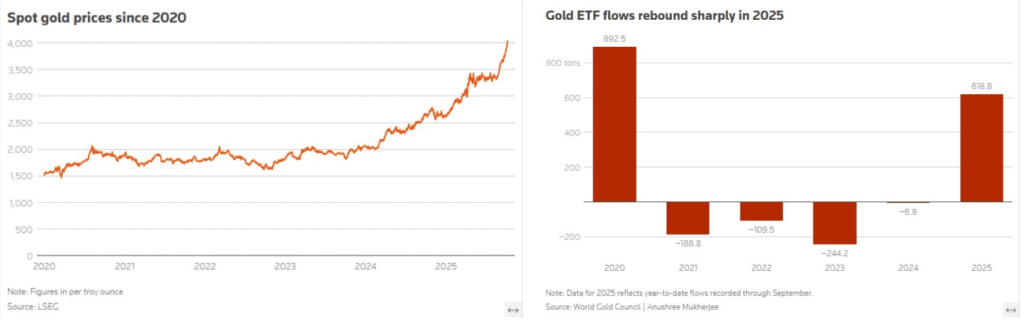
Gold’s unprecedented ascent this week to the $4,000 an ounce milestone and beyond puts it on course for its best year since the Iranian Revolution in 1979, solidifying its status as a barometer for global geopolitics and the economy.
Bullion’s 53% gain so far this year follows a stellar 27% rise in 2024.
The steady upward trajectory has been driven by a rush to the asset considered a safe store of value as investors seek cover from uncertainties spurred by conflicts in the Middle East, between Russia and Ukraine, political developments in the US, Japan and France, all supplemented by bets for more US interest rate cuts.
“Gold is performing its important role as a bellwether or a barometer, which gauges when things just aren’t right,” said Ross Norman, an independent analyst.
Spot gold steadied at around $4,025 per ounce on Thursday, hitting pause after surging to an all-time high of $4,059.05 on Wednesday, as investors assessed an Israel-Hamas ceasefire deal.
“Having cleared the $4,000 hurdle, by rights gold should pause for breath. That said, it has not shown much restraint year to date,” Norman said.
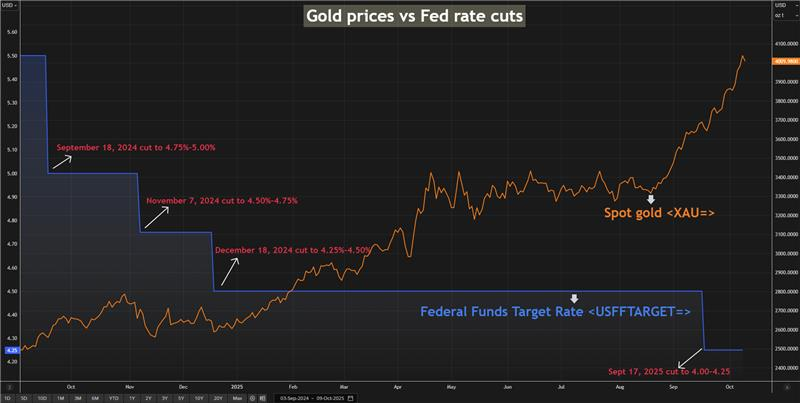
Bullion has logged multiple record highs this year, shattering analyst expectations, also underpinned by expectations of US interest rate cuts since that would translate into reduced opportunity cost of holding assets such as gold, which pays no interest or dividends, while also weakening the dollar.
Market participants see chances of two more rate cuts this year, with the CME FedWatch tool showing a 95% chance of a 25 basis-point cut during the Federal Reserve’s upcoming meeting on October 29.
A continued rise in central bank purchases as a means to diversify assets, along with increased flow into gold-backed exchange-traded funds, has also boosted gold’s status.
Globally, inflows into gold ETFs have hit $64 billion year-to-date, according to World Gold Council data, flipping from outflows of about $23 billion over the last four years.
Gold-backed ETFs in the second-biggest bullion consumer India, meanwhile, registered their largest monthly inflow in September, taking assets under management to a record $10 billion.
And there is more room to go, market participants said.
“Investor appetite isn’t slowing down… this upward trajectory suggests more room for expansion, and less reason for it to drop,” said Fawad Razaqzada, market analyst at City Index and FOREX.com.
Silver, meanwhile, was trading at $51 per ounce, after hitting its all-time high of $51.22 earlier in the session. The metal has gained 72% this year, driven by the same factors driving gold and supported by underlying market tightness.
“Silver has also benefited as investors cast their sights across the precious metals complex amid the broader safe-haven play,” said Han Tan, chief market analyst at Nemo.money.
(By Anjana Anil, Kavya Balaraman and Anushree Mukherjee; Editing by Arpan Varghese and Marguerita Choy)


No comments:
Post a Comment