As Trump Disrupts International Trade, Southeast Asia Must Look To Europe – Analysis
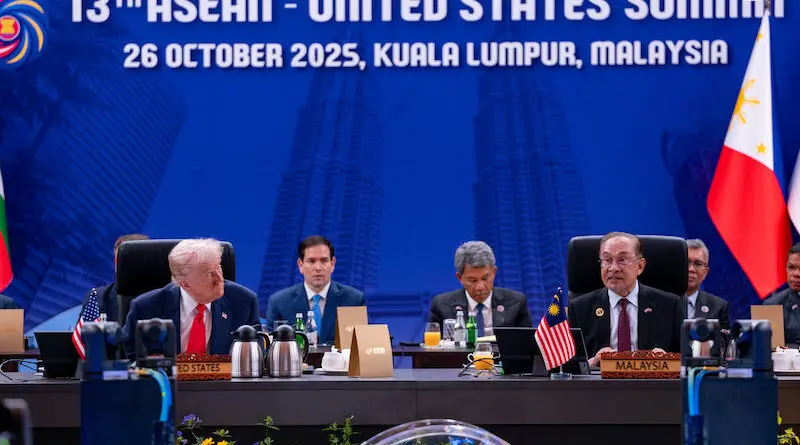
US President Donald Trump with Malaysia's Prime Minister Anwar Ibrahim.
By Stephen Olson
A new trade world is gradually emerging as US President Donald Trump continues his assault on the rules-based global trade structure. The basic contours of this new world are starting to come into focus, and for Southeast Asia, the news is not good.
While ongoing efforts to deepen integration within the region and strengthen ties with other fast-growing regions could hold promise, a more European-focused external orientation offers the region the best prospects to successfully navigate this fraught transition. Pursuing closer trade ties with the EU, however, will also bring its own unique set of obstacles that will have to be skilfully managed.
A changed world requires new approaches
The strategies that have guided remarkably successful development trajectories in countries across Southeast Asia for decades now need to be fundamentally reassessed. Geostrategic assumptions that have provided stability now appear shaky.
For most of the post-war era, the US has been a reliable partner, an open export market, and a source of investment and development assistance. For better or for worse, the US has also provided strong – sometimes heavy-handed – philosophical leadership, extolling the virtues of free market economics, free trade, and governments keeping their nose out of business.
Those days are over. The US has turned dramatically inward. It now relies on protectionism, mercantilism, and statism while aggressively using strong-arm tactics to obtain the economic and strategic outcomes it desires, including domestic employment. For Southeast Asia, relations with the US now constitute a combustible source of risk that needs to be managed. The main objective is to minimise damage rather than seeking to capitalise on opportunities.
Less obviously, the region’s calculations vis-a-vis China will also shift. Over a period of decades, China has grown to become the most important economic partner for most countries in the region. The relevance of the US has been in relative decline, at least in some respects, although it remains an important investor and export market.
The prevailing hope – if not expectation – throughout most of Southeast Asia has been that this ongoing transition between superpowers could be successfully managed by maintaining close ties with both, benefiting from the formidable size and general openness of the US consumer market while also gaining from China’s unprecedented economic and technological ascent, especially given their inclusion in China-centric supply chains.
Until Trump’s return to the White House, there was little reason to doubt the wisdom of this strategy. Trump’s remaking of the US approach to trade is, however, unleashing new dynamics that will substantially complicate Southeast Asia’s relationship not only with the US but also with China.
As countries in the region reorient themselves to this changed world, the “EU factor” should figure more prominently in their revised external calculus. Managing the most significant reshuffling of the global system in 80 years will require regional leaders to understand three key dynamics: 1) the deep and longer-term ripple effects of the US rejection of rules-based trade, 2) the inevitably intensifying complications of the China relationship, and 3) the imperative – and challenges – of closer links with the EU.
A new era of “might makes right”?
The new reciprocal tariff regime put into place by the Trump administration on 7 August[i] has decimated the principle of MFN and tilted the system back in the direction of “might makes right”. This new regime throws out the old rulebook and arbitrarily “assigns” new and higher tariff rates ranging from a baseline 10% up to 41%. Some countries, such as India and Brazil, face additional tariffs for issues unrelated to trade with the US. Potentially higher sectoral tariffs have been threatened and according to President Trump could rise as high as 250% on products such as pharmaceuticals[ii].
The EU bloc and six countries opted to negotiate so-called trade “deals” with the Trump administration in order to secure a reduction in the previously threatened reciprocal tariff rate. In order to secure a break on tariffs, these countries agreed to provisions that violate the core principles of rules-based, market-driven trade.
By providing the US with lower tariff rates than those applied to other WTO members through an agreement that falls far short of the requirement that preferential agreements cover “substantially all trade”, these countries have joined the US in subverting MFN. By agreeing to purchase specified levels of US exports based not on economic efficiency but rather on government arm-twisting, they have turned away from the principles of market-based trade. In both cases, the net effect will be to displace potential exports from other WTO members around the world, further devaluing the relevance – and benefits – of the system.
Each of these countries was caught between a rock and a hard place, and concluded that its national interests were best served by acquiescing to Trump’s terms. It is difficult to second-guess or be overly critical of any of these decisions. Particularly in the case of the EU, it is clear that the principles reflected in the agreement with the US are not an accurate reflection of the bloc’s preferred approach to trade overall.
Nonetheless, Southeast Asian leaders should not entertain any hope that the US abdication can easily be contained. The US is not only the founder and historical leader of the rules-based trade system, it also continues to be the largest single economy and the world’s largest importer. The reciprocal tariff regime itself directly covers roughly 62%[iii] of global trade, but perhaps more importantly it will have contaminative effects throughout the system. We have already seen that even some of the most stalwart advocates of non-discrimination in trade have been pressured into reluctantly joining the US in diluting MFN.
The orderly, stable, and predictable global tariff regime, which has provided a framework for steadily reducing tariffs – along with the accompanying expansion in global trade and development – now lies in tatters.
This is the world Southeast Asia needs to prepare for.
The China calculus is also shifting
A traditional proverb often cited in Southeast Asia states that when two elephants fight, it is the grass that suffers. In the context of the US-China economic and geopolitical rivalry, Southeast Asia is usually perceived to be the grass.
While there are undoubtedly aspects in which that perception of a “suffering” Southeast Asia is warranted, it belies some unique advantages that have accrued to the region as a result of its “caught in the middle” position, particularly if a critical mass of countries in the region tilted decisively in one direction or the other. As long as both the US and China view Southeast Asia as a potentially influential “swing vote” in their broader rivalry, it guarantees a certain degree of goodwill from both sides.
To varying degrees and at various times, the US and China have sought to “court” allegiance from countries in the region, perhaps partially a result of an ideological hangover from the Cold War. This has taken a multitude of forms including investment, development assistance, preferential trade concessions, and security guarantees.
This dynamic has essentially established a floor underneath Southeast Asia’s bilateral relationships with the two fighting elephants. While frictions are inevitable, neither the US nor China would allow relations to deteriorate beyond a certain point. Neither would want to run the risk of pushing any Southeast Asian nation closer to the camp of the other side.
Dumping will become a bigger flashpoint
With China’s post-pandemic economic recovery still lagging[iv], the government has aggressively sought to boost industrial manufacturing through subsidisation and other incentives. This is in keeping with longstanding Chinese industrial policies and has created excess capacity[v] in sectors such as steel, electric vehicles, and solar panels.
Inevitably, this excess capacity ends up in export markets. With the US market closing, much of this excess capacity that would have previously found its way into the US is now ending up in Southeast Asia.
Importantly, because of the subsidisation received, already competitive Chinese companies are able to export these products at unfairly low prices that threaten to push domestic competitors in Southeast Asia out of business. This practice is known as “dumping” and is illegal under trade rules if material injury to domestic competitors can be demonstrated. In these cases, countries are permitted to apply countervailing tariffs (in the case of subsidisation) or anti-dumping tariffs (in the case of predatory pricing to gain market share) to bring the cost of the unfairly low-priced imports up to market levels.
A number of Southeast Asia countries, including Vietnam, Thailand, and Malaysia have either implemented or are considering antidumping tariffs[vi] against China, creating trade antagonisms with China and opening the door to potential future retaliation from China.
Trump’s reciprocal tariff regime has battered trade relations between Southeast Asia and the US for reasons that are direct and obvious. Less obviously, these tariffs are also fueling intensifying frictions between Southeast Asia and China, as a greater influx of damaging low-cost Chinese products lead to retaliation, while US disinterest in courting Southeast Asian favour leaves China with less incentive to accommodate regional concerns.
THE IMPERATIVE – AND CHALLENGES – FOR SOUTHEAST ASIA AND THE EU
Given the rocky road ahead with both the US and China, the imperative for Southeast Asia to collaborate more closely with the EU is exceedingly strong.
The synergies are self-evident: notwithstanding the strong-armed deal the EU was pressed to conclude with the US, the EU has historically been a stalwart supporter of non-discrimination, most favoured nation treatment, and progressively decreased trade barriers – the foundational principles of the rules-based system that has been so beneficial for Southeast Asia. The erosion underway in that orderly system presents the trade-dependent economies of Southeast Asia with a potentially existential threat, and the need to expand collaboration with like-minded partners.
With a $19 trillion GDP, the size of the EU consumer market is second only to the US. The EU provides a more hospitable tariff regime and a transparent and predictable trade and regulatory environment that stands in sharp contrast to the US.
While the EU could not significantly offset Southeast Asia’s reliance on China for global value chain[vii] backward linkages (Chinese inputs into Southeast Asian exports), prospects are brighter for GVC forward linkages – that is, Southeast Asian inputs that are included in an EU country’s exports. For instance, Malaysia is a critical supplier of electronic inputs[viii] for automobiles and medical devices assembled in – and exported from – the EU. EU manufacturers Infineon and Bosch include Southeast Asian inputs in finished products that are ultimately exported, including to the US and China.
The EU offers Southeast Asia economic heft, stability, and an abiding commitment to the foundational principles of free trade – a combination that neither the US nor China can match.
While the rationale for Southeast Asia to draw closer to Europe is compelling, institutional and philosophical challenges would have to be surmounted. The primary institutional challenge will be to identify the most effective platform or vehicle to operationalise a more deeply integrated trade and investment relationship.
Are more trade agreements the answer?
The EU currently has free trade agreements (FTAs) in place with Singapore and Vietnam[ix]. A Comprehensive Economic Partnership Agreement (CEPA)[x] with Indonesia is expected to take effect in 2027. Previously stalled negotiations with Malaysia and Thailand have been resumed.
As has been demonstrated by the “start and stop” nature of negotiations already initiated and the impracticality of going “one by one” with each Southeast Asian country, individual FTAs are a non-starter.
The idea of an EU-ASEAN FTA[xi] has been on the table since 2007 but quickly fizzled, thanks in part to wide gaps in regulatory approach, differing viewpoints among ASEAN members, and developmental differences between the blocs. Resuscitation of these talks should be considered a worthy long-term aspiration but it holds no realistic hope to provide a short-term ameliorative to current circumstances.
A looser arrangement?
An alternative approach would be to leverage off an existing agreement: The Comprehensive and Progressive Agreement for Trans-Pacific Partnership (CPTPP). The CPTPP was founded in 2018 and its membership consists [xii] of Australia, Brunei, Canada, Chile, Japan, Malaysia, Mexico, New Zealand, Peru, Singapore, the UK and Vietnam. It is generally considered to be the highest quality plurilateral agreement in existence, with commitments in areas such as digital trade and state-owned enterprises far exceeding the WTO or other regional or bilateral accords.
Formal membership in CPTPP, at least in the short term, is not a practical option either for the EU or the Southeast Asian countries that are not already members. There is a queue of applicant countries already lined-up and even under the best of circumstances, the process does not move quickly. The lone successful applicant – the UK – endured a more than two-year wait to gain membership. This is to say nothing of the potential difficulty, especially for less developed Southeast Asian countries, in meeting some of the CPTPP’s more demanding provisions.
Short of full membership, the CPTPP could provide an already operational institutional framework in which the EU and like-minded Southeast Asian nations (some of which are already full CPTPP members) can identify and advance shared interests and a shared desire for closer trade and investment relations.
For their part, the existing members of the CPTPP have unambiguously signalled their interest in tightening bonds with both the EU and ASEAN. In a joint statement[xiii] issued in May this year, members said:
“We decided to work towards dialogues as soon as possible in 2025 with the European Union (EU) and the Association of Southeast Asian Nations (ASEAN) and tasked senior officials to work out details for these engagements…”
While reduced tariffs and market access commitments would not be part of this necessarily less-codified arrangement, meaningful work could still be accomplished. The high-quality provisions of the CPTPP would serve as a rallying point – a focus for exploratory discussions, map charting, and a deeper understanding of respective sensitivities. Importantly, the various stumbling blocks that have thus far frustrated achievement of an EU-ASEAN FTA could simply be set aside under this more flexible and loose approach.
Far from perfect, but…
Ultimately, the two regions could hope for an imperfect accommodation in which the EU and as many Southeast Asia nations that are willing and able become associate/affiliate/observer members of the CPTPP (along with the four Southeast Asian countries that already enjoy full membership). Do not waste time parsing the terminology. The exact formulation is irrelevant. The point is to create a more institutionalised platform for these two regions to advance their mutual interests in preserving orderly trade relations. Although not a panacea, it would provide the best available hedge against a trade system that is trending towards a more “Wild West” ethos.
Normative divergences create additional challenges
Irrespective of the institutional form it might take, the effort to draw the EU and Southeast Asia closer together will have to navigate a substantial normative gap. In recent years, the EU has sought to increasingly condition its trade relationships on alignment with a host of value-laden issues[xiv], including attitudes towards climate change mitigation, labour standards, press freedoms, and freedom of expression. Particularly on environmental issues, the EU has been willing to circumscribe market access when it deems there has been insufficient alignment.
While dialogues between the regions proliferate on issues such as these, Southeast Asia does not necessarily share European views on such value-laden issues. In fact, in some cases, viewpoints sharply diverge, creating tension between the desire for access to the EU market and fealty to local social sensibilities.
In these cases, practical pragmatism is needed. Both regions need to acknowledge that a convergence on societal viewpoints on all issues will not happen in the foreseeable future. With earnest effort, it should be possible to identify acceptable “middle grounds” in which neither side is required to make unacceptable compromises to their value-systems but obstacles to trade are avoided. Neither side can afford to allow these issues to form an impediment to the closer trade and investment relations that are overwhelmingly in the best interests of both the EU and Southeast Asia.
In some cases, the main problem is more practical than it is philosophical. Some of the EU’s climate-related demands would require codification and documentation of environmental conditions which are simply beyond the capacities of many companies, especially MSMEs, in the region to comply with. For example, the EU Deforestation Regulation (EUDR)[xv] has received significant pushback from Indonesia and others, arguing that it imposes unrealistic expectations on the ability of small farmers to provide geolocation data and traceability.
An accommodation here is long overdue. Some combination of technical and financial support from the EU along with extended phase-in periods for rigorous compliance requirements could help bridge the gap.
US AND CHINA CONTINUE TO BE IMPORTANT, BUT EU’S ROLE SHOULD BE EXPANDED
For better or worse, the US and China will continue to cast wide shadows and wield significant influence, both economic and strategic, in Southeast Asia for the foreseeable future. Balancing between the superpowers has never been easy, but most countries in the region have been able to navigate the tightrope with skill and success. That tightrope is now growing even more narrow and the crosswinds are intensifying.
As the trade environment grows more precarious, countries in Southeast Asia should look increasingly towards Europe. The synergies are evident and provide a hedge against the erraticism of the US as well as increasingly antagonised trade relations with China.
Although the primacy of free trade principles and a belief in rules-based trade have taken a beating, both the EU and Southeast Asia have historically been among the most stalwart proponents. In this new trade era we are entering, countries that are still “true believers” in the benefits that flow from freer and more orderly trade need to stand up, and stand together.
For appendix and endnotes, please refer to the original pdf document.
Source: This article was published by ISEAS – Yusof Ishak Institute

ISEAS - Yusof Ishak Institute
The Institute of Southeast Asian Studies (ISEAS), an autonomous organization established by an Act of Parliament in 1968, was renamed ISEAS - Yusof Ishak Institute in August 2015. Its aims are: To be a leading research centre and think tank dedicated to the study of socio-political, security, and economic trends and developments in Southeast Asia and its wider geostrategic and economic environment. To stimulate research and debate within scholarly circles, enhance public awareness of the region, and facilitate the search for viable solutions to the varied problems confronting the region. To serve as a centre for international, regional and local scholars and other researchers to do research on the region and publish and publicize their findings. To achieve these aims, the Institute conducts a range of research programmes; holds conferences, workshops, lectures and seminars; publishes briefs, research journals and books; and generally provides a range of research support facilities, including a large library collection.
US President Donald Trump with Malaysia's Prime Minister Anwar Ibrahim.
Photo Credit: @anwaribrahim, X
November 25, 2025
ISEAS - Yusof Ishak Institute
November 25, 2025
ISEAS - Yusof Ishak Institute
By Stephen Olson
A new trade world is gradually emerging as US President Donald Trump continues his assault on the rules-based global trade structure. The basic contours of this new world are starting to come into focus, and for Southeast Asia, the news is not good.
While ongoing efforts to deepen integration within the region and strengthen ties with other fast-growing regions could hold promise, a more European-focused external orientation offers the region the best prospects to successfully navigate this fraught transition. Pursuing closer trade ties with the EU, however, will also bring its own unique set of obstacles that will have to be skilfully managed.
A changed world requires new approaches
The strategies that have guided remarkably successful development trajectories in countries across Southeast Asia for decades now need to be fundamentally reassessed. Geostrategic assumptions that have provided stability now appear shaky.
For most of the post-war era, the US has been a reliable partner, an open export market, and a source of investment and development assistance. For better or for worse, the US has also provided strong – sometimes heavy-handed – philosophical leadership, extolling the virtues of free market economics, free trade, and governments keeping their nose out of business.
Those days are over. The US has turned dramatically inward. It now relies on protectionism, mercantilism, and statism while aggressively using strong-arm tactics to obtain the economic and strategic outcomes it desires, including domestic employment. For Southeast Asia, relations with the US now constitute a combustible source of risk that needs to be managed. The main objective is to minimise damage rather than seeking to capitalise on opportunities.
Less obviously, the region’s calculations vis-a-vis China will also shift. Over a period of decades, China has grown to become the most important economic partner for most countries in the region. The relevance of the US has been in relative decline, at least in some respects, although it remains an important investor and export market.
The prevailing hope – if not expectation – throughout most of Southeast Asia has been that this ongoing transition between superpowers could be successfully managed by maintaining close ties with both, benefiting from the formidable size and general openness of the US consumer market while also gaining from China’s unprecedented economic and technological ascent, especially given their inclusion in China-centric supply chains.
Until Trump’s return to the White House, there was little reason to doubt the wisdom of this strategy. Trump’s remaking of the US approach to trade is, however, unleashing new dynamics that will substantially complicate Southeast Asia’s relationship not only with the US but also with China.
As countries in the region reorient themselves to this changed world, the “EU factor” should figure more prominently in their revised external calculus. Managing the most significant reshuffling of the global system in 80 years will require regional leaders to understand three key dynamics: 1) the deep and longer-term ripple effects of the US rejection of rules-based trade, 2) the inevitably intensifying complications of the China relationship, and 3) the imperative – and challenges – of closer links with the EU.
RIPPLE EFFECTS REACH DEEPLY
The US’ unilateral rejection of the fundamental principles underpinning the rules-based trade system it created is not an implosion. It is not a house collapsing inward on itself. Rather, it is an explosion, launching jagged projectiles into every corner of the universe.
It will take years if not decades to fully assess the damage from this big bang, but we can already see the initial ripple effects starting to cascade throughout the system. First and foremost is the destruction of the seminal principle of Most Favoured Nation (MFN) treatment.
Since its founding in the aftermath of the Second World War, the concept of MFN has been a cornerstone of the US-led multilateral trade system. The basic premise is that all members of the system are accorded the same level of non-discriminatory tariff treatment. So, for example, if Peru assesses a 6% tariff on wooden desks imported from WTO members, it cannot arbitrarily decide to apply a 50% tariff on wooden desks imported from Kenya.
While there are limited exceptions, the MFN principle has provided a rock-solid foundation of fairness and predictability in the trade system, while also fostering a cooperative spirit among WTO members and a belief that the system works to the benefit of all. It roots non-discrimination at the heart of trade, and establishes a clear and transparent rules-based approach to assessing and gradually reducing tariffs and generally managing trade among nations.
Perhaps most importantly for Southeast Asia, adherence to MFN puts smaller nations on an equal footing with the larger ones. Simply put, under rules-based trade and MFN, the big guys cannot bully the little guys.
The US’ unilateral rejection of the fundamental principles underpinning the rules-based trade system it created is not an implosion. It is not a house collapsing inward on itself. Rather, it is an explosion, launching jagged projectiles into every corner of the universe.
It will take years if not decades to fully assess the damage from this big bang, but we can already see the initial ripple effects starting to cascade throughout the system. First and foremost is the destruction of the seminal principle of Most Favoured Nation (MFN) treatment.
Since its founding in the aftermath of the Second World War, the concept of MFN has been a cornerstone of the US-led multilateral trade system. The basic premise is that all members of the system are accorded the same level of non-discriminatory tariff treatment. So, for example, if Peru assesses a 6% tariff on wooden desks imported from WTO members, it cannot arbitrarily decide to apply a 50% tariff on wooden desks imported from Kenya.
While there are limited exceptions, the MFN principle has provided a rock-solid foundation of fairness and predictability in the trade system, while also fostering a cooperative spirit among WTO members and a belief that the system works to the benefit of all. It roots non-discrimination at the heart of trade, and establishes a clear and transparent rules-based approach to assessing and gradually reducing tariffs and generally managing trade among nations.
Perhaps most importantly for Southeast Asia, adherence to MFN puts smaller nations on an equal footing with the larger ones. Simply put, under rules-based trade and MFN, the big guys cannot bully the little guys.
A new era of “might makes right”?
The new reciprocal tariff regime put into place by the Trump administration on 7 August[i] has decimated the principle of MFN and tilted the system back in the direction of “might makes right”. This new regime throws out the old rulebook and arbitrarily “assigns” new and higher tariff rates ranging from a baseline 10% up to 41%. Some countries, such as India and Brazil, face additional tariffs for issues unrelated to trade with the US. Potentially higher sectoral tariffs have been threatened and according to President Trump could rise as high as 250% on products such as pharmaceuticals[ii].
The EU bloc and six countries opted to negotiate so-called trade “deals” with the Trump administration in order to secure a reduction in the previously threatened reciprocal tariff rate. In order to secure a break on tariffs, these countries agreed to provisions that violate the core principles of rules-based, market-driven trade.
By providing the US with lower tariff rates than those applied to other WTO members through an agreement that falls far short of the requirement that preferential agreements cover “substantially all trade”, these countries have joined the US in subverting MFN. By agreeing to purchase specified levels of US exports based not on economic efficiency but rather on government arm-twisting, they have turned away from the principles of market-based trade. In both cases, the net effect will be to displace potential exports from other WTO members around the world, further devaluing the relevance – and benefits – of the system.
Each of these countries was caught between a rock and a hard place, and concluded that its national interests were best served by acquiescing to Trump’s terms. It is difficult to second-guess or be overly critical of any of these decisions. Particularly in the case of the EU, it is clear that the principles reflected in the agreement with the US are not an accurate reflection of the bloc’s preferred approach to trade overall.
Nonetheless, Southeast Asian leaders should not entertain any hope that the US abdication can easily be contained. The US is not only the founder and historical leader of the rules-based trade system, it also continues to be the largest single economy and the world’s largest importer. The reciprocal tariff regime itself directly covers roughly 62%[iii] of global trade, but perhaps more importantly it will have contaminative effects throughout the system. We have already seen that even some of the most stalwart advocates of non-discrimination in trade have been pressured into reluctantly joining the US in diluting MFN.
The orderly, stable, and predictable global tariff regime, which has provided a framework for steadily reducing tariffs – along with the accompanying expansion in global trade and development – now lies in tatters.
This is the world Southeast Asia needs to prepare for.
The China calculus is also shifting
A traditional proverb often cited in Southeast Asia states that when two elephants fight, it is the grass that suffers. In the context of the US-China economic and geopolitical rivalry, Southeast Asia is usually perceived to be the grass.
While there are undoubtedly aspects in which that perception of a “suffering” Southeast Asia is warranted, it belies some unique advantages that have accrued to the region as a result of its “caught in the middle” position, particularly if a critical mass of countries in the region tilted decisively in one direction or the other. As long as both the US and China view Southeast Asia as a potentially influential “swing vote” in their broader rivalry, it guarantees a certain degree of goodwill from both sides.
To varying degrees and at various times, the US and China have sought to “court” allegiance from countries in the region, perhaps partially a result of an ideological hangover from the Cold War. This has taken a multitude of forms including investment, development assistance, preferential trade concessions, and security guarantees.
This dynamic has essentially established a floor underneath Southeast Asia’s bilateral relationships with the two fighting elephants. While frictions are inevitable, neither the US nor China would allow relations to deteriorate beyond a certain point. Neither would want to run the risk of pushing any Southeast Asian nation closer to the camp of the other side.
A freer hand for China?
The favourable aspects of this dynamic are now rapidly fraying. Under the Trump administration, the US seems inclined to exclusively use “sticks” rather than “carrots” to obtain allegiance. In Trump’s worldview, countries must line up to “court” US favour. The US “courts” no one.
Preferential access to the US market is entirely off the table, at least partially reflecting domestic antipathy towards trade and globalisation more broadly. The only question now is whether the punitive and potentially escalating US tariffs a Southeast Asian nation faces is either higher or lower than that of its competing neighbours. US security guarantees, either implicit or explicit, are now something that countries are expected to “pay” for, either in the form of granting preferential US access to raw materials, trade concessions, purchase and investment commitments, or commercial concessions that strain previous limitations on the involvement of the US government in the affairs of private companies.
With the US opting out of the competition to “court” Southeast Asian favour, China is under less pressure to “play nice”. While closer economic and strategic ties between China and Southeast Asia are entirely possible, China will feel emboldened to dictate terms more strongly in its own favour.
Other ripple effects from the US rejection of rules-based trade are already contributing to an intensification of trade frictions between Southeast Asia and China.
The favourable aspects of this dynamic are now rapidly fraying. Under the Trump administration, the US seems inclined to exclusively use “sticks” rather than “carrots” to obtain allegiance. In Trump’s worldview, countries must line up to “court” US favour. The US “courts” no one.
Preferential access to the US market is entirely off the table, at least partially reflecting domestic antipathy towards trade and globalisation more broadly. The only question now is whether the punitive and potentially escalating US tariffs a Southeast Asian nation faces is either higher or lower than that of its competing neighbours. US security guarantees, either implicit or explicit, are now something that countries are expected to “pay” for, either in the form of granting preferential US access to raw materials, trade concessions, purchase and investment commitments, or commercial concessions that strain previous limitations on the involvement of the US government in the affairs of private companies.
With the US opting out of the competition to “court” Southeast Asian favour, China is under less pressure to “play nice”. While closer economic and strategic ties between China and Southeast Asia are entirely possible, China will feel emboldened to dictate terms more strongly in its own favour.
Other ripple effects from the US rejection of rules-based trade are already contributing to an intensification of trade frictions between Southeast Asia and China.
Dumping will become a bigger flashpoint
With China’s post-pandemic economic recovery still lagging[iv], the government has aggressively sought to boost industrial manufacturing through subsidisation and other incentives. This is in keeping with longstanding Chinese industrial policies and has created excess capacity[v] in sectors such as steel, electric vehicles, and solar panels.
Inevitably, this excess capacity ends up in export markets. With the US market closing, much of this excess capacity that would have previously found its way into the US is now ending up in Southeast Asia.
Importantly, because of the subsidisation received, already competitive Chinese companies are able to export these products at unfairly low prices that threaten to push domestic competitors in Southeast Asia out of business. This practice is known as “dumping” and is illegal under trade rules if material injury to domestic competitors can be demonstrated. In these cases, countries are permitted to apply countervailing tariffs (in the case of subsidisation) or anti-dumping tariffs (in the case of predatory pricing to gain market share) to bring the cost of the unfairly low-priced imports up to market levels.
A number of Southeast Asia countries, including Vietnam, Thailand, and Malaysia have either implemented or are considering antidumping tariffs[vi] against China, creating trade antagonisms with China and opening the door to potential future retaliation from China.
Trump’s reciprocal tariff regime has battered trade relations between Southeast Asia and the US for reasons that are direct and obvious. Less obviously, these tariffs are also fueling intensifying frictions between Southeast Asia and China, as a greater influx of damaging low-cost Chinese products lead to retaliation, while US disinterest in courting Southeast Asian favour leaves China with less incentive to accommodate regional concerns.
THE IMPERATIVE – AND CHALLENGES – FOR SOUTHEAST ASIA AND THE EU
Given the rocky road ahead with both the US and China, the imperative for Southeast Asia to collaborate more closely with the EU is exceedingly strong.
The synergies are self-evident: notwithstanding the strong-armed deal the EU was pressed to conclude with the US, the EU has historically been a stalwart supporter of non-discrimination, most favoured nation treatment, and progressively decreased trade barriers – the foundational principles of the rules-based system that has been so beneficial for Southeast Asia. The erosion underway in that orderly system presents the trade-dependent economies of Southeast Asia with a potentially existential threat, and the need to expand collaboration with like-minded partners.
With a $19 trillion GDP, the size of the EU consumer market is second only to the US. The EU provides a more hospitable tariff regime and a transparent and predictable trade and regulatory environment that stands in sharp contrast to the US.
While the EU could not significantly offset Southeast Asia’s reliance on China for global value chain[vii] backward linkages (Chinese inputs into Southeast Asian exports), prospects are brighter for GVC forward linkages – that is, Southeast Asian inputs that are included in an EU country’s exports. For instance, Malaysia is a critical supplier of electronic inputs[viii] for automobiles and medical devices assembled in – and exported from – the EU. EU manufacturers Infineon and Bosch include Southeast Asian inputs in finished products that are ultimately exported, including to the US and China.
The EU offers Southeast Asia economic heft, stability, and an abiding commitment to the foundational principles of free trade – a combination that neither the US nor China can match.
While the rationale for Southeast Asia to draw closer to Europe is compelling, institutional and philosophical challenges would have to be surmounted. The primary institutional challenge will be to identify the most effective platform or vehicle to operationalise a more deeply integrated trade and investment relationship.
Are more trade agreements the answer?
The EU currently has free trade agreements (FTAs) in place with Singapore and Vietnam[ix]. A Comprehensive Economic Partnership Agreement (CEPA)[x] with Indonesia is expected to take effect in 2027. Previously stalled negotiations with Malaysia and Thailand have been resumed.
As has been demonstrated by the “start and stop” nature of negotiations already initiated and the impracticality of going “one by one” with each Southeast Asian country, individual FTAs are a non-starter.
The idea of an EU-ASEAN FTA[xi] has been on the table since 2007 but quickly fizzled, thanks in part to wide gaps in regulatory approach, differing viewpoints among ASEAN members, and developmental differences between the blocs. Resuscitation of these talks should be considered a worthy long-term aspiration but it holds no realistic hope to provide a short-term ameliorative to current circumstances.
A looser arrangement?
An alternative approach would be to leverage off an existing agreement: The Comprehensive and Progressive Agreement for Trans-Pacific Partnership (CPTPP). The CPTPP was founded in 2018 and its membership consists [xii] of Australia, Brunei, Canada, Chile, Japan, Malaysia, Mexico, New Zealand, Peru, Singapore, the UK and Vietnam. It is generally considered to be the highest quality plurilateral agreement in existence, with commitments in areas such as digital trade and state-owned enterprises far exceeding the WTO or other regional or bilateral accords.
Formal membership in CPTPP, at least in the short term, is not a practical option either for the EU or the Southeast Asian countries that are not already members. There is a queue of applicant countries already lined-up and even under the best of circumstances, the process does not move quickly. The lone successful applicant – the UK – endured a more than two-year wait to gain membership. This is to say nothing of the potential difficulty, especially for less developed Southeast Asian countries, in meeting some of the CPTPP’s more demanding provisions.
Short of full membership, the CPTPP could provide an already operational institutional framework in which the EU and like-minded Southeast Asian nations (some of which are already full CPTPP members) can identify and advance shared interests and a shared desire for closer trade and investment relations.
For their part, the existing members of the CPTPP have unambiguously signalled their interest in tightening bonds with both the EU and ASEAN. In a joint statement[xiii] issued in May this year, members said:
“We decided to work towards dialogues as soon as possible in 2025 with the European Union (EU) and the Association of Southeast Asian Nations (ASEAN) and tasked senior officials to work out details for these engagements…”
While reduced tariffs and market access commitments would not be part of this necessarily less-codified arrangement, meaningful work could still be accomplished. The high-quality provisions of the CPTPP would serve as a rallying point – a focus for exploratory discussions, map charting, and a deeper understanding of respective sensitivities. Importantly, the various stumbling blocks that have thus far frustrated achievement of an EU-ASEAN FTA could simply be set aside under this more flexible and loose approach.
Far from perfect, but…
Ultimately, the two regions could hope for an imperfect accommodation in which the EU and as many Southeast Asia nations that are willing and able become associate/affiliate/observer members of the CPTPP (along with the four Southeast Asian countries that already enjoy full membership). Do not waste time parsing the terminology. The exact formulation is irrelevant. The point is to create a more institutionalised platform for these two regions to advance their mutual interests in preserving orderly trade relations. Although not a panacea, it would provide the best available hedge against a trade system that is trending towards a more “Wild West” ethos.
Normative divergences create additional challenges
Irrespective of the institutional form it might take, the effort to draw the EU and Southeast Asia closer together will have to navigate a substantial normative gap. In recent years, the EU has sought to increasingly condition its trade relationships on alignment with a host of value-laden issues[xiv], including attitudes towards climate change mitigation, labour standards, press freedoms, and freedom of expression. Particularly on environmental issues, the EU has been willing to circumscribe market access when it deems there has been insufficient alignment.
While dialogues between the regions proliferate on issues such as these, Southeast Asia does not necessarily share European views on such value-laden issues. In fact, in some cases, viewpoints sharply diverge, creating tension between the desire for access to the EU market and fealty to local social sensibilities.
In these cases, practical pragmatism is needed. Both regions need to acknowledge that a convergence on societal viewpoints on all issues will not happen in the foreseeable future. With earnest effort, it should be possible to identify acceptable “middle grounds” in which neither side is required to make unacceptable compromises to their value-systems but obstacles to trade are avoided. Neither side can afford to allow these issues to form an impediment to the closer trade and investment relations that are overwhelmingly in the best interests of both the EU and Southeast Asia.
In some cases, the main problem is more practical than it is philosophical. Some of the EU’s climate-related demands would require codification and documentation of environmental conditions which are simply beyond the capacities of many companies, especially MSMEs, in the region to comply with. For example, the EU Deforestation Regulation (EUDR)[xv] has received significant pushback from Indonesia and others, arguing that it imposes unrealistic expectations on the ability of small farmers to provide geolocation data and traceability.
An accommodation here is long overdue. Some combination of technical and financial support from the EU along with extended phase-in periods for rigorous compliance requirements could help bridge the gap.
US AND CHINA CONTINUE TO BE IMPORTANT, BUT EU’S ROLE SHOULD BE EXPANDED
For better or worse, the US and China will continue to cast wide shadows and wield significant influence, both economic and strategic, in Southeast Asia for the foreseeable future. Balancing between the superpowers has never been easy, but most countries in the region have been able to navigate the tightrope with skill and success. That tightrope is now growing even more narrow and the crosswinds are intensifying.
As the trade environment grows more precarious, countries in Southeast Asia should look increasingly towards Europe. The synergies are evident and provide a hedge against the erraticism of the US as well as increasingly antagonised trade relations with China.
Although the primacy of free trade principles and a belief in rules-based trade have taken a beating, both the EU and Southeast Asia have historically been among the most stalwart proponents. In this new trade era we are entering, countries that are still “true believers” in the benefits that flow from freer and more orderly trade need to stand up, and stand together.
For appendix and endnotes, please refer to the original pdf document.
About the author: Stephen Olson is Visiting Senior Fellow at ISEAS – Yusof Ishak Institute and a Non-Resident Fellow and Visiting Lecturer at the Yeutter Institute of International Trade. Olson is a member of the World Economic Forum Global Futures Council on Trade and co-leads a joint workstream on geopolitics and trade. He began his career in Washington DC as a US trade negotiator.
Source: This article was published by ISEAS – Yusof Ishak Institute
ISEAS - Yusof Ishak Institute
The Institute of Southeast Asian Studies (ISEAS), an autonomous organization established by an Act of Parliament in 1968, was renamed ISEAS - Yusof Ishak Institute in August 2015. Its aims are: To be a leading research centre and think tank dedicated to the study of socio-political, security, and economic trends and developments in Southeast Asia and its wider geostrategic and economic environment. To stimulate research and debate within scholarly circles, enhance public awareness of the region, and facilitate the search for viable solutions to the varied problems confronting the region. To serve as a centre for international, regional and local scholars and other researchers to do research on the region and publish and publicize their findings. To achieve these aims, the Institute conducts a range of research programmes; holds conferences, workshops, lectures and seminars; publishes briefs, research journals and books; and generally provides a range of research support facilities, including a large library collection.

No comments:
Post a Comment