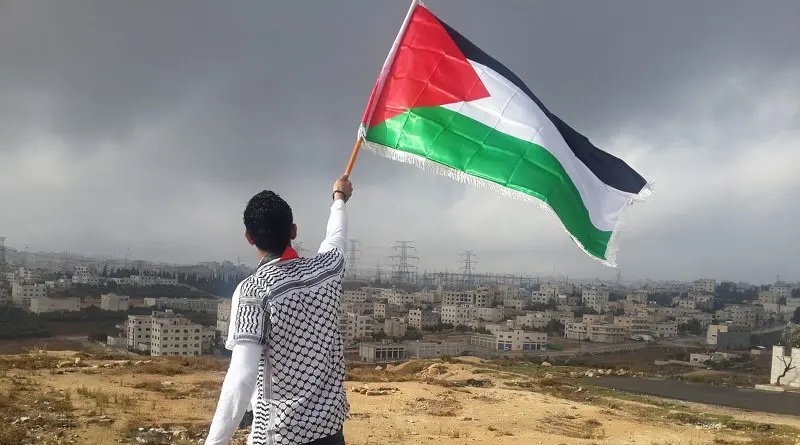
Young man with Palestine flag.
Photo by Ahmed Abu Hameeda on Unsplash
November 25, 2025
SwissInfo
By Giannis Mavris
At the UN General Assembly in New York at the end of September 2025, several states recognised Palestine as an independent state. These included France and the UK, meaning that four of the five members of the UN Security Council recognise a Palestinian state. The US is now the only Security Council member that does not recognise Palestine as a state.
Switzerland has long backed the two-state solution to the Middle East conflict. However, it currently rules out recognising Palestine. Here is what you need to know to understand the Swiss position.
November 25, 2025
SwissInfo
By Giannis Mavris
At the UN General Assembly in New York at the end of September 2025, several states recognised Palestine as an independent state. These included France and the UK, meaning that four of the five members of the UN Security Council recognise a Palestinian state. The US is now the only Security Council member that does not recognise Palestine as a state.
Switzerland has long backed the two-state solution to the Middle East conflict. However, it currently rules out recognising Palestine. Here is what you need to know to understand the Swiss position.
Where does Switzerland stand on the recognition issue?
Switzerland is committed to the two-state solution outlined by the UN, based on 1967 borders and with East Jerusalem as the capital of an independent Palestinian state. This is sometimes considered unrealistic or impossible, but it remains the only vision for Israel/Palestine that enjoys broad support under international law. Palestinian statehood has so far been recognised by 157 of the 193 UN member states (some 81%).
At the UN conference on the Middle East in July, Swiss foreign ministry representative Monika Schmutz Kirgöz said that “Switzerland considers the recognition of the Palestinian state to be intrinsic to a lasting peace based on the two-state solution”. Recognition could be considered if “concrete measures” that would help a two-state solution – which “guarantee both Israel’s security and the Palestinian people’s right to self-determination” – were put in place.
This means Switzerland will only recognise a Palestinian state once there is a comprehensive peace solution and a corresponding political roadmap agreed with Israel.
Switzerland has thus taken a different approach from many other states, which see recognition of Palestine as a means to increase pressure on Israel to advance the two-state solution.
Whether pressure against Israel will work is questionable. Last year the Israeli parliament, the Knesset, passed a resolution declaring a Palestinian state to be an “existential danger to Israel” and “firmly” opposing its establishment.
How does Switzerland recognise other states?
Since the Second World War, Switzerland has only recognised states – and not governments, as many other countries do. Whether and when a state recognises another is not defined by international law. Recognition is understood as an expression of a unilateral declaration of intent; it is an expression of state sovereignty. Each state therefore has its own rules and traditions for recognising other states as subjects of international law.
For Switzerland, the key principle is effective statehood, which is usually shown by three elements: a national territory, a national people and a national authority. Depending on the political climate, Switzerland has always allowed itself a wide range of options in applying these criteria. The decision to recognise a state is at Switzerland’s “political discretion”. Other elements such as “the behaviour of the international community or a group of states relevant to Switzerland” are also considered.
The recognition of a state is carried out by the federal government, which is responsible for the country’s foreign policy. In the past, there have been repeated discussions about giving parliament a greater role; for example, in the case of Kosovo, which Switzerland was one of the first countries to recognise. This has not happened so far.
When it comes to the Middle East, however, the stance of the Swiss government aligns with that of parliament. In 2024, a motion in the House of Representatives called for the recognition of Palestine. The motion was the subject of heated debate but was ultimately rejected by 131 votes to 61. Foreign Minister Ignazio Cassis said in the debate that, from the government’s point of view, “now is not the right time” for recognition. At the time, it was also said that state recognition must be part of a peace plan.
Before that, Switzerland had abstained from voting on Palestine’s application for full UN membership (Palestine has had observer status at the UN since 2012). Switzerland “concluded that granting Palestine full UN membership at this time would not be conducive to easing the situation and peace efforts in the Middle East,” the government wrote in April 2024.
When did Switzerland recognise Israel – and what can be deduced from this?
Israel is recognised by 164 of the 192 UN member states (around 85%). According to the UN partition plan for Palestine adopted in November 1947, the territory was to be divided into an Arab and a Jewish state. Israel declared independence on May 14, 1948, and was admitted to the UN a year later.
Switzerland officially recognised Israel on March 18, 1949. “In an effort to maintain good relations with the Arab countries of the Middle East, the government waited for other states to make their decision,” according to the Historical Lexicon of Switzerland.
What is the Swiss policy on the Middle East?
The recognition of states has thus always depended on various factors – not least global developments and domestic political considerations. And while international momentum is currently growing for a recognition of Palestine as a way to enable peace in the region, Switzerland’s official position is still against this.
Switzerland has repeatedly emphasised its “firm support” for international efforts to implement the two-state solution. Talks on this issue have been held repeatedly in Geneva; initiatives have also been launched there. If Switzerland were to move to recognise a Palestinian state – which Israel strongly opposes – Geneva might no longer be considered as a venue for talks.
Ultimately, Switzerland has a generally cautious Middle East policy. It clearly condemns military escalation in the West Bank, as well as the “complete impunity” for acts of violence. Yet unlike the US and the EU, it has not yet imposed sanctions on extremist Israeli settlers – even if the government reserves the right to do so.
SwissInfo
swissinfo is an enterprise of the Swiss Broadcasting Corporation (SBC). Its role is to inform Swiss living abroad about events in their homeland and to raise awareness of Switzerland in other countries. swissinfo achieves this through its nine-language internet news and information platform.
swissinfo is an enterprise of the Swiss Broadcasting Corporation (SBC). Its role is to inform Swiss living abroad about events in their homeland and to raise awareness of Switzerland in other countries. swissinfo achieves this through its nine-language internet news and information platform.

No comments:
Post a Comment