Anti-mafia demonstrations calling for "fear to change sides" took place on the French island of Corsica on 15 November, with several thousand people marching in Ajaccio and Bastia.
Issued on: 19/11/2025 - RFI
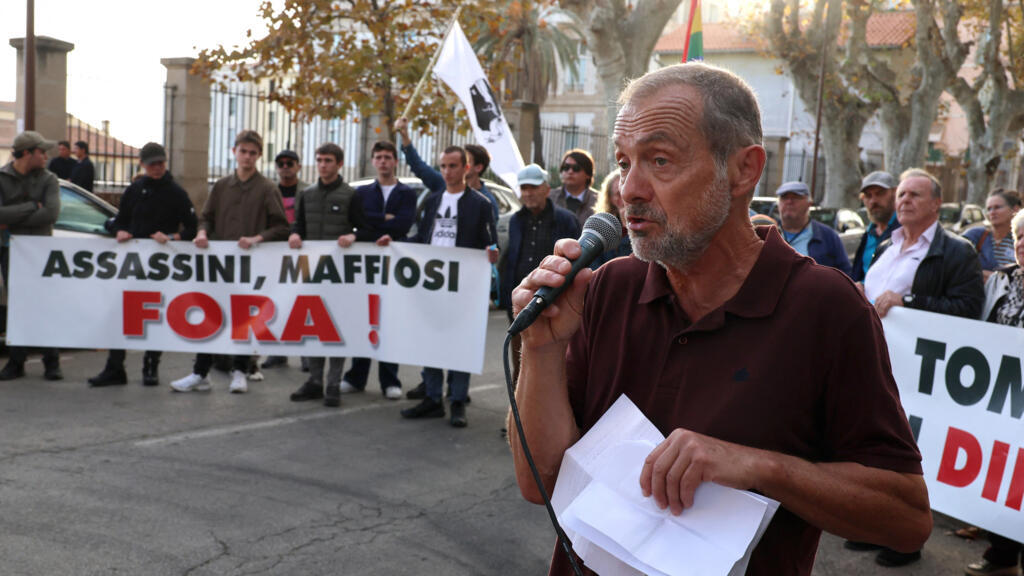
President of the anti-Mafia association A Massimu, Jean-Toussaint Plasenzotti, addresses the crowd in Ajaccio on 15 November. AFP - PASCAL POCHARD-CASABIANCA
Under the slogan "Assassins, mafiosi, get out", between 1,700 (according to police) and 3,000 people (according to the organisers) took to the streets of Ajaccio and Bastia, the island's two largest cities.
A second banner, written in Corsican, proclaimed "A maffia tomba, U silenziu dino" – "The mafia kills, silence kills too".
Other banners paid tribute to Pierre Alessandri, secretary-general of the Via Campagnola agricultural union who was murdered in March, nine days after he took part in the island's first anti-mafia demonstration, and to Massimu Susini, an environmental activist who was shot dead in front of his beach hut in September 2019.
'We are defenceless'
The marches were in response to a call for action from an unprecedented coalition of a local organisations. The coordinating committee, set up in September, brings together collectives including Maffia no, a Vita ié ("No to the mafia, yes to life"), Via Campagnola and the environmental protection groups U Levante and Le Garde.
"We are defenceless," said Jean-Toussaint Plasenzotti, Susini's uncle and the founder of the Massimu Susini collective, another participant, from the podium.
He said the protesters represent "the Corsica of civilisation, culture and legality, the Corsica that wants the problem solved" versus "a mafia that is predatory, exploitative, threatening, intimidating, violent and deadly".
He emphasised that the mobilisation of ordinary Corsicans is vital, given that "the mafia's grip is still as strong as ever".
"We would like it to be all Corsicans, but for the moment, it is only some of them," he told RFI. "The struggle will be long, extremely difficult and dangerous, but we have no choice."
'Threats are part of daily reality'
The Unione Corse was a historical term for Corsican organised crime from the 1930s to the 1970s, which formed a key part of the infamous French Connection heroin trade and involved groups which carried out most of their activities abroad.
The end of the French Connection caused the disbandment of Corsican clans involved. However the Corsican mafia regrouped and evolved in the 1980s, when investment plans were being drawn up for the island, with the groups from that point concentrating their activities on the island, according to Josette Dall'Ava-Santucci, a doctor and member of Maffia no, a Vita ié
A summer 2025 report by SIRASCO, the police department charged with gathering intelligence on organised crime, identified 20 such groups currently active, dominated by the Petit Bar gang and the Mattei clan, as reported by Le Monde.
These groups are involved in activities such as racketeering, drug trafficking and illegal slot machines, as well as in legal businesses including construction, tourism, real estate and night clubs and bars.
According to SIRASCO: "Most of them have infiltrated every political, social and economic sector of the island and seek to dominate the legal activities they deem most profitable."
In April 2024, German news agency DPA reported that: "For the locals, threats, hush money payments and fudged construction work are part of daily reality."
Hollywood and the mafia myth: how Italian organised crime went global
Under the slogan "Assassins, mafiosi, get out", between 1,700 (according to police) and 3,000 people (according to the organisers) took to the streets of Ajaccio and Bastia, the island's two largest cities.
A second banner, written in Corsican, proclaimed "A maffia tomba, U silenziu dino" – "The mafia kills, silence kills too".
Other banners paid tribute to Pierre Alessandri, secretary-general of the Via Campagnola agricultural union who was murdered in March, nine days after he took part in the island's first anti-mafia demonstration, and to Massimu Susini, an environmental activist who was shot dead in front of his beach hut in September 2019.
'We are defenceless'
The marches were in response to a call for action from an unprecedented coalition of a local organisations. The coordinating committee, set up in September, brings together collectives including Maffia no, a Vita ié ("No to the mafia, yes to life"), Via Campagnola and the environmental protection groups U Levante and Le Garde.
"We are defenceless," said Jean-Toussaint Plasenzotti, Susini's uncle and the founder of the Massimu Susini collective, another participant, from the podium.
He said the protesters represent "the Corsica of civilisation, culture and legality, the Corsica that wants the problem solved" versus "a mafia that is predatory, exploitative, threatening, intimidating, violent and deadly".
He emphasised that the mobilisation of ordinary Corsicans is vital, given that "the mafia's grip is still as strong as ever".
"We would like it to be all Corsicans, but for the moment, it is only some of them," he told RFI. "The struggle will be long, extremely difficult and dangerous, but we have no choice."
'Threats are part of daily reality'
The Unione Corse was a historical term for Corsican organised crime from the 1930s to the 1970s, which formed a key part of the infamous French Connection heroin trade and involved groups which carried out most of their activities abroad.
The end of the French Connection caused the disbandment of Corsican clans involved. However the Corsican mafia regrouped and evolved in the 1980s, when investment plans were being drawn up for the island, with the groups from that point concentrating their activities on the island, according to Josette Dall'Ava-Santucci, a doctor and member of Maffia no, a Vita ié
A summer 2025 report by SIRASCO, the police department charged with gathering intelligence on organised crime, identified 20 such groups currently active, dominated by the Petit Bar gang and the Mattei clan, as reported by Le Monde.
These groups are involved in activities such as racketeering, drug trafficking and illegal slot machines, as well as in legal businesses including construction, tourism, real estate and night clubs and bars.
According to SIRASCO: "Most of them have infiltrated every political, social and economic sector of the island and seek to dominate the legal activities they deem most profitable."
In April 2024, German news agency DPA reported that: "For the locals, threats, hush money payments and fudged construction work are part of daily reality."
Hollywood and the mafia myth: how Italian organised crime went global
Prosecutors' response
Bastia prosecutor Jean-Philippe Navarre told French news agency AFP: "Everyone must support this movement... which demonstrates the strong desire of Corsican society to stand up against criminal practices that are stifling its economy."
He said he would implement "a strategy of harassing criminal groups" by "increasing the number of investigations in sensitive sectors such as sea excursions, public works and catering" – all of which are common victims of racketeering.
It is an approach shared by his colleague Nicolas Septe, public prosecutor in Ajaccio, who told AFP that he would "support this awakening of consciousness and whatever will enable every Corsican to regain their freedom to do business".
A minute's silence was observed at the marches in tribute to the victims of organised crime, before Jean-Dominique Musso, regional president of Via Campagnola made an emotional demand for "justice" for Alessandri, as his widow looked on.
This article was adapted from the original version in French.

No comments:
Post a Comment