South Africa ends its G20 presidency this weekend with a two-day head of states summit focused on debt relief and global inequality – a meeting the United States says it will boycott. Pretoria says it has held talks with Washington about possible limited participation, but the White House insists the US will not join the discussions and will send only a diplomat for the handover.
Issued on: 21/11/2025 - RFI

Cyril Ramaphosa addresses reporters following the opening session of the G20 foreign ministers meeting in Johannesburg, 20 February 2025. © AP - Jerome Delay
By: Melissa Chemam
The theme of South Africa's G20 leadership was "Solidarity, Equality, Sustainability", with a pledge to focus on supporting developing countries through debt relief, and financing measures to help them cope with disasters caused by climate change.
United States Secretary of State Marco Rubio in February branded the agenda "anti-American" and snubbed the G20 meeting that month, setting the tone for a complicated year for South Africa's presidency.
Trump has said that no US officials will attend this weekend's summit, over widely discredited claims that white people are being persecuted in South Africa.
Ramaphosa told reporters ahead of the 22-23 November event that the US's absence is "their loss".
Pretoria has made debt relief the priority, targeting repayments that meant limiting investment in essential infrastructure for healthcare and education.
According to the United Nations, between 2021 and 2023 Africa spent $70 per capita on debt interest payments – more than on education or health, which saw spending of $63 and $44 per capita respectively.
Inequalities Panel
At this weekend's summit, South Africa's President Cyril Ramaphosa will also push for the creation of an International Inequalities Panel – modelled after the UN's Intergovernmental Panel on Climate Change (IPCC) – to tackle massive global inequality.
A report for the G20 published earlier this month, led by Nobel laureate economist Joseph Stiglitz, labelled wealth inequality as a global crisis that threatens democracy and social cohesion worldwide, saying it should be confronted with the same urgency as the climate crisis.
If adopted, the International Inequalities Panel pushed by Ramaphosa "would mark a significant win not just for Pretoria's presidency, but for the millions across the Global South whose voices are often sidelined in elite economic forums," according to Tendai Mbanje, a researcher at the the University of Pretoria's Centre for Human Rights.
By: Melissa Chemam
The theme of South Africa's G20 leadership was "Solidarity, Equality, Sustainability", with a pledge to focus on supporting developing countries through debt relief, and financing measures to help them cope with disasters caused by climate change.
United States Secretary of State Marco Rubio in February branded the agenda "anti-American" and snubbed the G20 meeting that month, setting the tone for a complicated year for South Africa's presidency.
Trump has said that no US officials will attend this weekend's summit, over widely discredited claims that white people are being persecuted in South Africa.
Ramaphosa told reporters ahead of the 22-23 November event that the US's absence is "their loss".
Pretoria has made debt relief the priority, targeting repayments that meant limiting investment in essential infrastructure for healthcare and education.
According to the United Nations, between 2021 and 2023 Africa spent $70 per capita on debt interest payments – more than on education or health, which saw spending of $63 and $44 per capita respectively.
Inequalities Panel
At this weekend's summit, South Africa's President Cyril Ramaphosa will also push for the creation of an International Inequalities Panel – modelled after the UN's Intergovernmental Panel on Climate Change (IPCC) – to tackle massive global inequality.
A report for the G20 published earlier this month, led by Nobel laureate economist Joseph Stiglitz, labelled wealth inequality as a global crisis that threatens democracy and social cohesion worldwide, saying it should be confronted with the same urgency as the climate crisis.
If adopted, the International Inequalities Panel pushed by Ramaphosa "would mark a significant win not just for Pretoria's presidency, but for the millions across the Global South whose voices are often sidelined in elite economic forums," according to Tendai Mbanje, a researcher at the the University of Pretoria's Centre for Human Rights.
'I see a lot of determination'
Désiré Assogbavi, advisor on Africa at the Open Society Foundations grantmaking network, believes huge progress has been made.
"This G20 is happening in a very particular situation," Assogbavi told RFI. "You see what's happening in the world; multilateralism has been being challenged around the world. So this is a particular moment. The G20 is supposed to be one of the best expressions of countries, with people working together to find greater solutions for world problems."
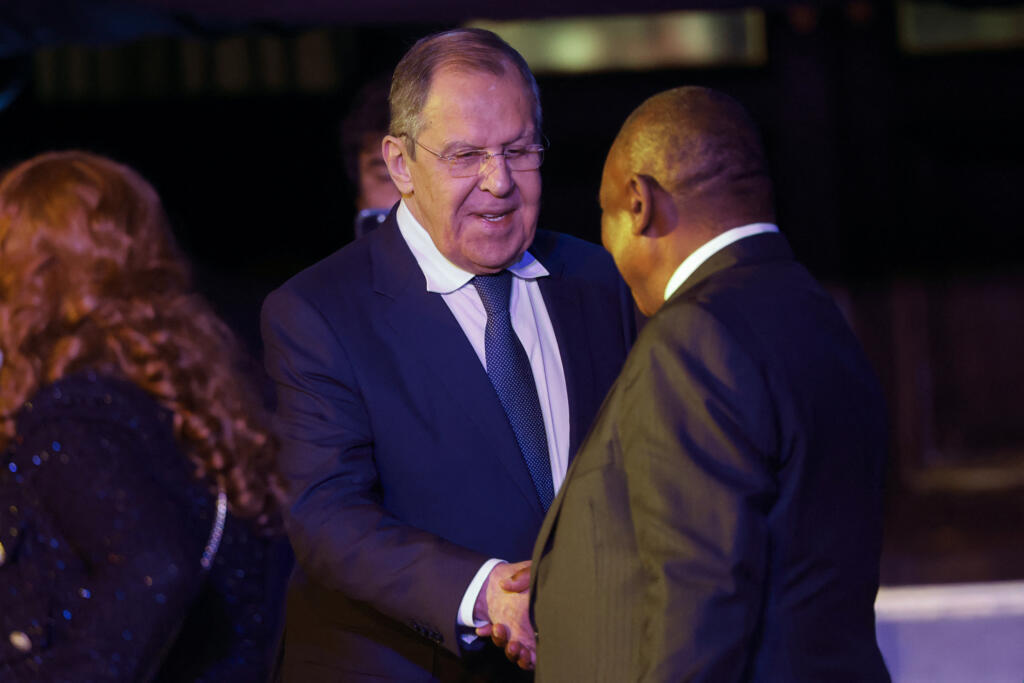
Russia's Foreign Minister Sergei Lavrov shakes hands with Cyril Ramaphosa during the G20 Foreign Ministers Meeting in Johannesburg, 20 February. AFP - PHILL MAGAKOE
He underlined that even if not everybody will be at the table, the vast majority of countries are keen to move forwards.
"The United States has decided not to endorse the presidency of South Africa and decided to boycott it, while it is happening for the first time in Africa. This is regrettable, really unfortunate. I wish everybody came," he said.
"However, the summit will go ahead. And I see a lot of determination from various delegations, from various actors to move forward anyway, to try to resolve the big problem that our continent, and the whole world, is having."
He added: "It seems to be one of the most inclusive presidencies. Over the last few days, since I landed here in Johannesburg, I've seen various groups having their own meetings around the key thematics of the summit. And the conclusions of those discussions will be part of the general debates of the leaders."
A pan-African presidency
The G20 represents 85 percent of global GDP and around two-thirds of the world's population, and includes 19 countries as well as the European Union – as well as now the African Union.
South Africa has insisted throughout the year of its G20 leadership that it has been a presidency of the whole of Africa.
It has been a success in that sense according to Assogbavi, with the African Union being admitted as a full member.
"So we have South Africa as a member, and we also have the African Union as a full member at the table now," Assogbavi told RFI. "And I can say this is one of the achievements of President Ramaphosa at the helm of the G20, allowing the continental agenda to be a priority and not only the South African agenda."
Debt sustainability is the African Union's priority too, with its heads of state meeting in Lomé, Togo in May to sign the Lomé Declaration on debt sustainability on the continent.
He underlined that even if not everybody will be at the table, the vast majority of countries are keen to move forwards.
"The United States has decided not to endorse the presidency of South Africa and decided to boycott it, while it is happening for the first time in Africa. This is regrettable, really unfortunate. I wish everybody came," he said.
"However, the summit will go ahead. And I see a lot of determination from various delegations, from various actors to move forward anyway, to try to resolve the big problem that our continent, and the whole world, is having."
He added: "It seems to be one of the most inclusive presidencies. Over the last few days, since I landed here in Johannesburg, I've seen various groups having their own meetings around the key thematics of the summit. And the conclusions of those discussions will be part of the general debates of the leaders."
A pan-African presidency
The G20 represents 85 percent of global GDP and around two-thirds of the world's population, and includes 19 countries as well as the European Union – as well as now the African Union.
South Africa has insisted throughout the year of its G20 leadership that it has been a presidency of the whole of Africa.
It has been a success in that sense according to Assogbavi, with the African Union being admitted as a full member.
"So we have South Africa as a member, and we also have the African Union as a full member at the table now," Assogbavi told RFI. "And I can say this is one of the achievements of President Ramaphosa at the helm of the G20, allowing the continental agenda to be a priority and not only the South African agenda."
Debt sustainability is the African Union's priority too, with its heads of state meeting in Lomé, Togo in May to sign the Lomé Declaration on debt sustainability on the continent.
Mineral exploitation
Another key issue for Africans is the management of the mineral mining projects exploding across the continent.
This week South Africa and the European Union also signed a new agreement on critical minerals and processing, reflecting the continent’s effort to secure more value from its resources and shape its role in the green-energy transition.
"Let's be clear: we're not going to resolve all the problems of the continent in one G20 meeting, but what is positive is that we have been seeing the entire continent speaking with one voice on those critical issues – and most importantly the issue of Africa being a provider of raw critical minerals to the rest of the world, and only taking 5 percent of the profits," said Assogbavi.
He added that the South African presidency comes at an interesting moment for the continent, as the world is talking about the production of critical minerals, which are considered green sources of energy.
"There's a realisation in the whole world that they are useful to tackle the climate issue, instead of using the old fossil fuel to generate energy," Assogbavi said.
"Africa is targeted as a reserve of minerals that the whole world needs. It is important for Africa to be united and to speak with one voice on how they're going to manage that situation. And this is happening. The G20 is one part of it, but there will be other gatherings internationally where this discussion will have its way," he added.
Looking forward
It remains unclear whether South Africa's G20 presidency will manage to secure a consensus and release a joint final declaration on these issues.
Delegates involved in preparatory work report that some participants have been obstructive – including Argentina's representatives, as the country's President Javier Milei, a Trump ally, is also boycotting the event.
China's representative Premier Li Qiang is expected to advocate for multilateralism. "Economic globalisation and multipolarity are irreversible," Li said at an Asian regional summit in October.
Russia will be represented by President Vladimir Putin's economic advisor and deputy chief of staff, Maxim Oreshkin, in the notable absence of Foreign Minister Sergei Lavrov.
The summit also begins a day after the conclusion of Cop30 in Belem, Brazil, and its final negotiations could influence discussions in Johannesburg.
At a press conference in Johannesburg, European Commission President Ursula von der Leyen said the EU was fighting emissions rather than fossil fuels themselves, prompting criticism from environmental groups and raising questions about how strongly the bloc will push for a global fossil fuel phase-out in Cop30’s final hours.
The summit will mark the end of a cycle of G20 presidencies by Global South countries, after Indonesia in 2022, India in 2023 and Brazil in 2024. The next country to take on the presidency will be the US.
First in Africa: What to know about the G20 summit boycotted by Trump
Leaders from the G20 group of the world's largest economies meet this weekend for a summit in South Africa – the first on African soil. US President Donald Trump said he would boycott the event over his widely dismissed claims that the host country is persecuting its Afrikaner white minority.
Issued on: 21/11/2025
By: FRANCE 24
'Solidarity, Equality, Sustainability'
South Africa lists its priorities for its G20 presidency as strengthening disaster resilience, debt sustainability for low-income countries, financing a "just energy transition" and harnessing "critical minerals for inclusive growth and sustainable development".
Its theme is "Solidarity, Equality, Sustainability".
Ranked by the World Bank as "the world's most unequal country", South Africa commissioned an expert team to analyse global wealth inequality and offer solutions to the summit.
The team led by Nobel Prize-winning economist Joseph Stiglitz called for the creation of an intergovernmental panel to tackle the "inequality emergency" that leaves 2.3 billion people hungry worldwide.
US boycott
President Donald Trump said this month no US officials would attend the meeting and called South Africa's presidency a "total disgrace".
Trump has singled out South Africa for harsh treatment on a number of issues since he returned to the White House in January, notably making false claims of a "white genocide".
He has slapped the country with 30 percent tariffs, the highest in sub-Saharan Africa.
While a US boycott could undermine South Africa's agenda, Pretoria said the absence was Washington's "loss" and it was still looking forward to a successful summit.
Argentinan President Javier Milei, a Trump ally, will not attend and is sending his foreign minister.
As in previous meetings, Russian President Vladimir Putin will also not be present.
Johannesburg in the spotlight
The G20 leaders' meeting will be hosted at the Nasrec Expo Centre, South Africa's largest purpose-built conference venue.
Situated on the edge of the iconic Soweto township and chosen as a symbol of post-apartheid "spatial integration", the venue hosts large-scale events such as the ruling African National Congress annual convention.
It is also adjacent to the stadium that hosted the 2010 FIFA World Cup final.
The event has brought attention to the plight of the city that was formed in a gold rush in the late 1880s and is now home to around six million people, according to official July estimates.
Home to Africa's richest square mile, Johannesburg is also scarred by crumbling infrastructure, lack of services and chronic mismanagement.
President Cyril Ramaphosa lashed out at the disrepair in March and demanded improvements. The African Development Bank in July approved a $139 million loan for upgrades.
End of a 'Global South' run
South Africa will hand the G20 to the United States, marking the end of a cycle of "Global South" presidencies following those of Brazil, India and Indonesia.
Trump has said he plans to radically reduce the platform, which has over the years expanded to include multiple working groups and social issues beyond its original financial scope.
The US president has also questioned whether South Africa should "even be in the Gs any more", raising questions about the G20's future.
(FRANCE 24 with AFP)
Leaders from the G20 group of the world's largest economies meet this weekend for a summit in South Africa – the first on African soil. US President Donald Trump said he would boycott the event over his widely dismissed claims that the host country is persecuting its Afrikaner white minority.
Issued on: 21/11/2025
By: FRANCE 24
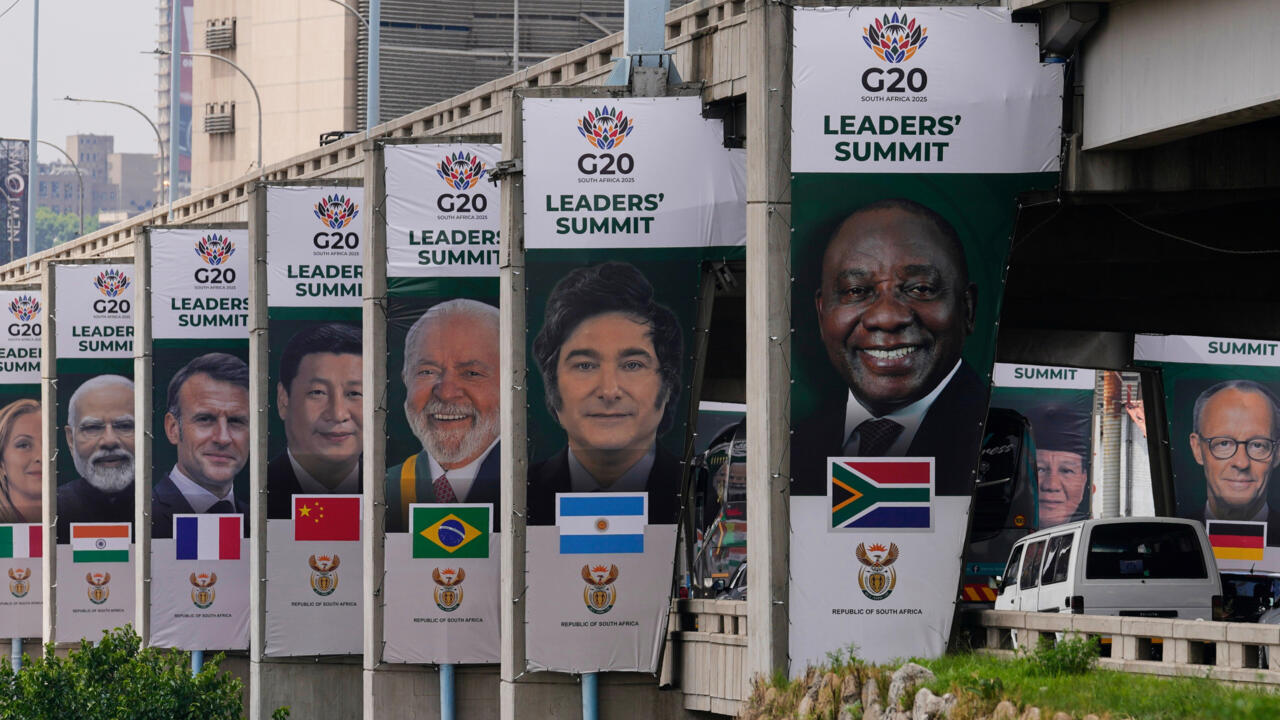
Banners of G20 leaders are displayed along a Johannesburg freeway in the run-up to the summit. © Themba Hadebe, AP
Leaders of the world's largest economies will meet in Johannesburg on November 22 and 23 for the G20 summit, the first of its kind in Africa.
Here are five things to know about the annual meeting, which is taking place at a time of heightened global instability and tensions between Pretoria and Washington.
A first for Africa
Founded in 1999, the Group of 20 (G20) leading economies comprises 19 countries and two regional bodies, the European Union and the African Union (AU).
Its rotating presidency will be held by South Africa this year and mark the first time the summit will be in Africa.
G20 members represent 85 percent of the world's GDP and about two-thirds of its population.
South Africa is the only member state from the continent, although the AU was admitted as a group in 2023.
Leaders of the world's largest economies will meet in Johannesburg on November 22 and 23 for the G20 summit, the first of its kind in Africa.
Here are five things to know about the annual meeting, which is taking place at a time of heightened global instability and tensions between Pretoria and Washington.
A first for Africa
Founded in 1999, the Group of 20 (G20) leading economies comprises 19 countries and two regional bodies, the European Union and the African Union (AU).
Its rotating presidency will be held by South Africa this year and mark the first time the summit will be in Africa.
G20 members represent 85 percent of the world's GDP and about two-thirds of its population.
South Africa is the only member state from the continent, although the AU was admitted as a group in 2023.
'Solidarity, Equality, Sustainability'
South Africa lists its priorities for its G20 presidency as strengthening disaster resilience, debt sustainability for low-income countries, financing a "just energy transition" and harnessing "critical minerals for inclusive growth and sustainable development".
Its theme is "Solidarity, Equality, Sustainability".
Ranked by the World Bank as "the world's most unequal country", South Africa commissioned an expert team to analyse global wealth inequality and offer solutions to the summit.
The team led by Nobel Prize-winning economist Joseph Stiglitz called for the creation of an intergovernmental panel to tackle the "inequality emergency" that leaves 2.3 billion people hungry worldwide.
US boycott
President Donald Trump said this month no US officials would attend the meeting and called South Africa's presidency a "total disgrace".
Trump has singled out South Africa for harsh treatment on a number of issues since he returned to the White House in January, notably making false claims of a "white genocide".
He has slapped the country with 30 percent tariffs, the highest in sub-Saharan Africa.
While a US boycott could undermine South Africa's agenda, Pretoria said the absence was Washington's "loss" and it was still looking forward to a successful summit.
Argentinan President Javier Milei, a Trump ally, will not attend and is sending his foreign minister.
As in previous meetings, Russian President Vladimir Putin will also not be present.
Johannesburg in the spotlight
The G20 leaders' meeting will be hosted at the Nasrec Expo Centre, South Africa's largest purpose-built conference venue.
Situated on the edge of the iconic Soweto township and chosen as a symbol of post-apartheid "spatial integration", the venue hosts large-scale events such as the ruling African National Congress annual convention.
It is also adjacent to the stadium that hosted the 2010 FIFA World Cup final.
The event has brought attention to the plight of the city that was formed in a gold rush in the late 1880s and is now home to around six million people, according to official July estimates.
Home to Africa's richest square mile, Johannesburg is also scarred by crumbling infrastructure, lack of services and chronic mismanagement.
President Cyril Ramaphosa lashed out at the disrepair in March and demanded improvements. The African Development Bank in July approved a $139 million loan for upgrades.
End of a 'Global South' run
South Africa will hand the G20 to the United States, marking the end of a cycle of "Global South" presidencies following those of Brazil, India and Indonesia.
Trump has said he plans to radically reduce the platform, which has over the years expanded to include multiple working groups and social issues beyond its original financial scope.
The US president has also questioned whether South Africa should "even be in the Gs any more", raising questions about the G20's future.
(FRANCE 24 with AFP)

No comments:
Post a Comment