UKRAINE CAPITULATION PLAN
'Absurd and obscene': Expert trashes Trump's 28-point peace plan
Robert Davis
November 21, 2025
RAW STORY
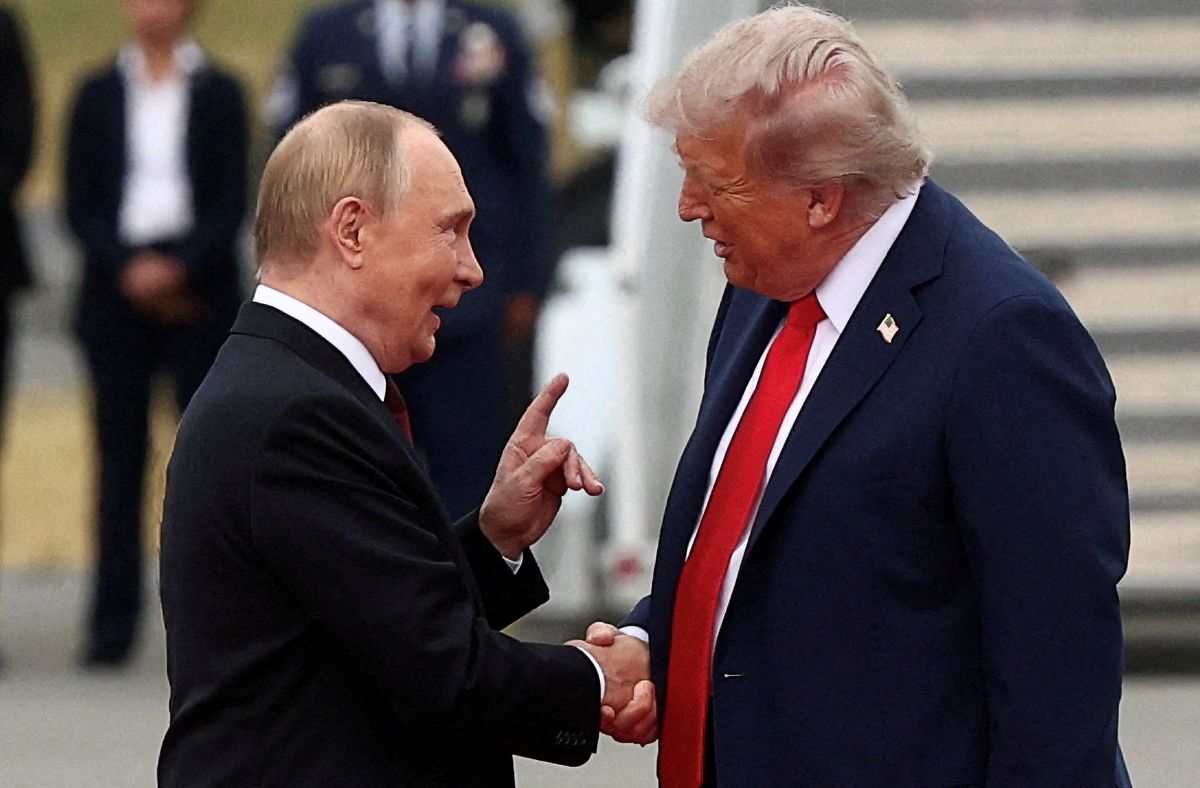
FILE PHOTO: U.S. President Donald Trump shakes hand with Russian President Vladimir Putin, as they meet to negotiate for an end to the war in Ukraine, at Joint Base Elmendorf-Richardson in Anchorage, Alaska, U.S., August 15, 2025. REUTERS/Kevin Lamarque
An analyst bashed President Donald Trump's latest 28-point peace plan for Russia's war in Ukraine on Friday, calling it "absurd" and "obscene."
Ukrainian President Volodymyr Zelensky met with senior administration officials on Thursday to discuss the plan, which includes demands that Ukraine cut its military by over 600,000 troops, give up long-range missiles that can strike Moscow, and give up land occupied by Russian forces, according to reports.
Michael Bociurkiw, nonresident senior fellow at the Atlantic Council's Eurasia Center, discussed the leaked plan in a new interview with Times Radio on Friday.
"This so-called plan...is something that could have been easily scripted by the Kremlin," Bociurkiw said. "It has mostly everything that they've asked for, and it's absurd and obscene what's being asked for, including limiting the size of Ukraine's military, saying Ukraine can't get into NATO, and no NATO troops on the ground. So there goes the coalition of the willing."
Experts have often criticized Trump for parroting Russian talking points about the war and presenting peace plans that seem to favor the Russians.
"I think I also heard something right down to the micro level of Western diplomats not being able to come to Ukraine," he continued. "So if you take all of that together as well as some of the other elements, it's game over for Ukraine as we know it. The key elements of this deal are nothing any Ukrainian president could ever sign."
Europe uneasy as leaked US plan urges Ukraine to give up Donbas
A leaked US peace plan to end the war in Ukraine has unsettled European governments by calling for Kyiv to cede the whole Donbas region to Russia and sharply reduce its armed forces. The move comes as Ukraine says it is ready to work with Washington.
Issued on: 21/11/2025 - RFI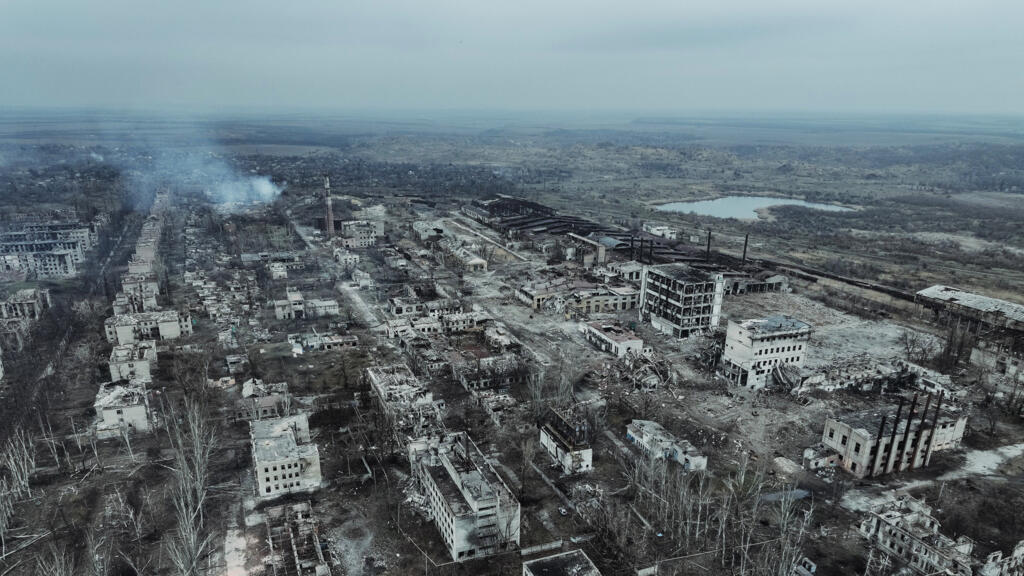
President Volodymyr Zelensky said Ukraine is ready for “constructive” and “honest” work with the United States on the draft plan, even as key European allies warned against any deal that demands sweeping concessions to Moscow.
His comments followed a meeting in Kyiv on Thursday with US Army Secretary Daniel Driscoll after details emerged of a US-backed proposal that would require Ukraine to give up the entire Donbas region and cut its army to 600,000 troops.
The plan, a 28-point document not yet released in full, also promises as-yet-undefined “robust security guarantees”.
Major concessions
The proposal includes US recognition of Crimea, Luhansk and Donetsk as de facto Russian territory and calls for Ukrainian troops to withdraw from the remaining parts of Donetsk they still control.
It was reportedly drafted after discussions with Rustem Umerov, one of Zelensky’s top advisers, who “agreed to the majority of the plan” after making several changes. Umerov then presented it to the president.
Zelensky’s office said he had received the draft and that US and Ukrainian teams would now work on its elements. Writing on Telegram, the president said: “We are ready for constructive, honest and prompt work.”
While not commenting directly on the leaked content, Zelensky’s office said he had set out the “fundamental principles that matter to our people”.
It added that he expects to discuss “existing diplomatic opportunities and the key points required to achieve peace” with President Trump in the coming days.
The draft also proposes a non-aggression pact between Russia, Ukraine and Europe, a freeze on NATO expansion and a ban on stationing alliance troops in Ukraine.
Ukraine seeks $43bn in climate compensation from Russia over war
Economic reintegration
In exchange, Russia would be eased back into the global economy as sanctions are lifted “in phases and on a case-by-case basis”.
The plan also raises the possibility of inviting Moscow back into what was once the G8 and creating a broad US-Russia economic and technological partnership covering energy, infrastructure, artificial intelligence, data centres and rare earth extraction in the Arctic.
White House press secretary Karoline Leavitt said Secretary of State Marco Rubio and US special envoy Steve Witkoff had worked on the plan for a month, which she said President Donald Trump supports.
“This plan was crafted to reflect the realities of the situation,” she said, calling it a possible “win-win scenario”.
European resistance
In Brussels, EU foreign ministers avoided direct comment on the leak but signalled resistance to any deal based on one-sided concessions.
“Ukrainians want peace – a just peace that respects everyone’s sovereignty, a durable peace that can’t be called into question by future aggression,” France’s foreign minister Jean-Noel Barrot said. “But peace cannot be a capitulation.”
The diplomatic push comes as Ukrainian forces face pressure on several fronts and Zelensky’s government deals with a corruption scandal that led to the dismissal of two cabinet ministers last week.
Rubio said on X that the United States would continue developing “potential ideas” based on input from both sides and said any peace would require concessions from both Kyiv and Moscow.
Russia plays it down
The Kremlin moved to cool speculation of movement. Spokesperson Dmitry Peskov said there were “contacts, of course, but no process that could be called consultations”, adding that Russia’s position remains what President Putin set out during his August summit with Trump.
As winter approaches and the war enters its fourth year, Russian forces hold nearly a fifth of Ukraine and continue slow advances while striking energy sites and front-line cities.
On Thursday, Moscow said Putin had visited the command post of Russia’s “West” grouping, meeting General Valery Gerasimov and other senior officers. Gerasimov claimed Russian troops had captured the city of Kupiansk.
Ukraine’s military rejected that claim and also denied that Russia controls 70 percent of Pokrovsk, a shattered railway hub in the east.
(with newswires)
.png)
A new US 28-point plan to end the war in Ukraine suddenly burst on to the scene on November 20, as the White House hopes to use the growing pressure on Ukraine to force terms on Kyiv as soon as this week.
After the Alaska summit on August 15 between US President Donald Trump and Ukrainian President Volodymyr Zelenskiy and the subsequent failure to organize the Budapest trilateral meeting with Russian President Vladimir Putin, the ceasefire talks have been dead in the water. Despite suggesting that he is open to talks, Putin has stuck to his maximalist demands that are tantamount to a demand for Ukraine to capitulate and contain no significant concessions at all.
The existence of the "secret deal” was independently confirmed today by Politico, Financial Times and Axios, although the details are not know but the plan's 28 points fall into four general buckets, sources told Axios: peace in Ukraine, security guarantees, security in Europe, and future U.S. relations with Russia and Ukraine. The FT confirmed the broad brush strokes speaking to Ukrainian officials that have seen the text:
- Reduce the size of the military by at least half;
- Ban certain powerful western-supplied weapons;
- Ban on deployment of foreign peacekeeping troops in Ukraine;
- Exit and hand over the remaining territory in Donbas that is not held by Russia;
- US security guarantees;
- Recognition of Russia as an official language;
- Russian Orthodox Church given permission to operate in Ukraine; and
- Zelenskiy replaced as president.
There has been no mention of Nato in the deal and reportedly the Trump administration is still debating what position to take on this question. The Kremlin has from the start insisted that the West provide legally binding ironclad guarantees that Ukraine never applies for membership.
More details emerged by evening. Specifically, Russia will agree to recognize the part of Donbas not actually occupied by the Armed Forces of Russia (AFR) as a demilitarized zone and not deploy troops there, Axios reports.
In the Kherson and Zaporizhzhia regions, the front line is expected to be largely frozen, but negotiated territory swaps are not ruled out.
The deal also specifies that the US and other countries recognize Crimea and Donbas as Russian territory, but will not demand the same from Ukraine, effectively kicking the Crimea question down the road.
A Kremlin-connected source told The Bell that the US proposals are "not a plan, but a mixture of real points with good intentions," noting that some of them are completely unacceptable to Ukraine. However, the Kremlin believes that the plan's appearance is a step forward, although peace is still a long way off.
The plan is inspired by Trump's successful push for a deal in Gaza, Axios reported. Dmitriev said the new effort was entirely unrelated to the UK-led push to draft a Gaza-style peace plan for Ukraine, which he said had no chance of success because it disregards Russia's positions.
Parallel talks
The deal has emerged from talks between Special Envoy to the Middle East Steve Witkoff and Kirill Dmitriev, the head of Russia’s sovereign wealth fund, who met in Miami between October 24 and 26.
Dmitriev expressed optimism about the deal's chances of success in comments to Axios because, unlike past efforts, "we feel the Russian position is really being heard."
According to reports, Witkoff also talked to Ukraine’s Defence Minister Rustam Umerov, who is currently in the US with his family. According to the FT, Witkoff conveyed the plan to Ukraine through Umerov.
The White House is upbeat about the prospects for the plan, saying it could be agreed by the end of this month, or “even this week.”
Kyiv and Brussels were caught out by the announcement of the plan, which appears to have been leaked to the US press by Dmitriev. They have not been consulted and Politico reported that the White House intends to present the plan to Ukrainian President Volodymyr Zelenskiy as a fait accompli.
“It seems that Trump and Putin thought that events in Pokrovsk and the Energoatom affair have weakened Ze to the point that he is now desperate for a deal - hence the effort to cram him into this bad deal for Ukraine. It is not going to happen,” Timothy Ash, the senior sovereign strategist at BlueBay Asset Management in London, said in an emailed comment.
Zelenskiy was in Istanbul on November 19 to discuss "revitalizing negotiations" and a "just peace" with Turkish President Recep Tayyip Erdogan, who is offering to intermediate. Witkoff was supposed to join that meeting, but cancelled after Zelenskiy made it clear that he would reject the US plan.
Turkey participated in the preparation of the American plan, according to Axios, which also reported that Zelenskiy has an alternative plan that has been worked out with his EU allies, but it is totally unacceptable to Moscow.
Same deal as before
The new US plan appears to be very similar to both the terms of the Istanbul peace deal agreed in April 2022, but later rejected by Zelenskiy after the West refused to provide Ukraine with security deals. US President Donald Trump also pushed a revived version of the same proposals with his “final offer” in April this year, which again largely contained all of Russian President Vladimir Putin’s maximalist demands, which Zelenskiy also refused.
The new plan highlights the growing disconnect between Washington and Brussels which appear to be working on different tracks. The White House is bullish on this matter: it believes Ukraine should approve the plan as a whole, as it is "reasonable" and acceptable to them.
"We're not particularly interested in what Europe thinks," Politico quotes its source as saying. "The question is whether Ukraine will accept it."
Trump has clearly become frustrated with the lack of a deal that he claimed he could close on his first day in office during his election campaign last year. He finally upped the pressure on the Kremlin earlier this month with his first new oil sanctions on Russia, but as bne IntelliNews reported, he remains keen to do business with Russia as part of his minerals diplomacy that has driven foreign policy so far.
The feeling in Washington is that a weakened Zelenskiy will have no choice and will have to accept any terms offered to him. Ukraine is still suffering from a chronic lack of men, money and materiel but in addition, Bankova has been hit by the debilitating $100mn Energoatom corruption scandal that was perpetrated by close friends of the president, some of whom immediately fled the country.
The scandal continues to expand. National Anti-Corruption Bureau of Ukraine (NABU) that carried out the investigation said on November 19 that a total of 40 government officials are implicated and confirmed that Zelenskiy and head of Ukraine’s presidential office, Andriy Yermak, are both included in the evidence, but has given no details year. Calls for Zelenskiy have already begun amongst his political opponents and the scandal could potentially bring the government down.
Military delegation
In parallel to the diplomatic shell game being played out on a ceasefire deal, on the same day a US military delegation led by US Army Secretary Dan Driscoll and several senior US army generals arrived in Kyiv for talks with the Ukrainian leadership.
Officially, on a fact-finding mission, but The Wall Street Journal reported that the generals were acting on Trump's instructions and may have met with Russian representatives on terms to end the war.
Driscoll has played a key role in the war, overseeing all arms shipments from US arsenals to Ukraine. Before leaving for Kyiv, he received instructions from Witkoff, CNN reports. Furthermore, he is a classmate and close friend of US Vice President J.D. Vance, the agency notes. Zelenskiy will meet with Driscoll on Thursday, November 20.
Zelenskyy: Ukraine faces choice between 'loss of dignity' or losing key ally over US-Russia plan
“Ukraine may now face a very difficult choice: either loss of dignity, or the risk of losing a key partner,” Ukrainian president said on Friday, as Kyiv is “under tremendous pressure” over the latest draft proposal by the US and Russia, which mainly includes concessions from Ukraine and not Russia.
Ukraine must do everything to make sure the end of the war does not mean "the end of Ukraine", President Volodymyr Zelenskyy said on Friday, admitting that the country is currently undergoing “one of the most difficult moments in our history”.
“The pressure on Ukraine is now one of the most severe”, he stated. Referring to the 28-point plan drafted by the US and Russia, Zelenskyy said he will fight to “ensure that at least two points are not overlooked in the plan.”
“These are the dignity and freedom of Ukrainians, because everything else is based on this,” he pointed out.
Zelenskyy emphasised the country “may now face a very difficult choice: either loss of dignity, or the risk of losing a key partner.”
“Either 28 difficult points, or an extremely harsh winter, the most difficult one yet, and further risks," he said. “A life without freedom, without dignity, without justice. And we are expected to trust someone who has attacked us twice already.”
The US and Russia are pressing Kyiv with a new draft for ending Moscow’s war against Ukraine.
The framework, reportedly approved by US President Donald Trump earlier this week, includes numerous concessions from Ukraine and hardly any from Russia.
Russia wants Ukraine to cede territory
According to the leaked plan, Russia demands Crimea, Luhansk and Donetsk to be “as de facto Russian, including by the United States”.
It is unclear if Washington agreed to this demand as well because the draft includes Moscow’s demands of “international recognition of all of Ukraine’s Donetsk region as territory belonging to the Russian Federation.”
Russia wants Ukraine to withdraw its forces from the Donetsk region and says this “withdrawal zone” will be considered a “neutral demilitarised buffer zone, internationally recognised as territory belonging to Russia." Russian forces would not enter this zone, according to the plan.
Russia has been trying to occupy all of the Donetsk and Luhansk regions – known together as Donbas – since its first invasion of 2014. Until now, Moscow's troops have not fully controlled these areas.
The Kremlin would in return agree to a ceasefire in the regions of Kherson and Zaporizhzhia along the current contact line.
Kherson city was the only regional capital Russia managed to briefly occupy in 2022. Ukrainian forces liberated the city eight months later and pushed Moscow’s troops across the Dnipro to the left bank. Since autumn 2022 the contact line has hardly moved here.
In the Zaporizhzhia region, the contact line has not changed much until recently, when Russia renewed its assault in eastern Zaporizhzhia.
Ukraine together with the EU and previously the US, suggested freezing the fighting at the current contact line across all of Ukraine’s frontlines and only after the ceasefire to have further negotiations.
The Kremlin also wants Ukraine to scale down its military force to 600,000 personnel, with European fighter jets stationed in neighbouring Poland, as well as plans for Ukraine to forgo many of its weapons.
Russia 'expected' not to invade neighbouring countries
The leaked plan also includes rather vague indications that Moscow will not invade other countries, apart from Ukraine.
“It is expected that Russia will not invade neighbouring countries”.
“Russia will enshrine in law its policy of non-aggression towards Europe and Ukraine”.
In return Moscow demands NATO “not to expand further” and “not to station troops in Ukraine”.
Moreover, Russia wants Ukraine to agree “to enshrine in its constitution that it will not join NATO” and the alliance “to include in its statutes a provision that Ukraine will not be admitted in the future”.
Seems like it is only Ukraine’s NATO aspirations which Russia strongly protests against.
Finland and Sweden both joined the defence alliance after Russia’s full-scale invasion of Ukraine without any comment from Moscow.
The Kremlin also wants the US to mediate a “dialog” between Moscow and NATO “to resolve all security issues and create conditions for de-escalation in order to ensure global security and increase opportunities for cooperation and future economic development.”
Russia wants to be back in the global arena
The leaked plan clearly states that Russia wants to be “reintegrated into the global economy” with the sanction lifting to be “discussed and agreed upon in stages and on a case-by-case basis”.
Moscow’s renewed push for negotiations with the US is largely driven by the tough sanctions imposed by Washington on its oil giants Lukoil and Rosneft in October.
The Kremlin says it wants the US to “enter into a long-term economic cooperation agreement for mutual development in the areas of energy, natural resources, infrastructure, artificial intelligence, data centres, rare earth metal extraction projects in the Arctic, and other mutually beneficial corporate opportunities”.
On top of that Moscow wants to be invited back to the G8. Russia was expelled in 2014 after the annexation of Crimea.
The draft also includes several points regarding Russia’s accountability and responsibility for its actions in Ukraine and beyond.
“All parties involved in this conflict will receive full amnesty for their actions during the war and agree not to make any claims or consider any complaints in the future”, the draft framework suggests.
This would mean that Moscow’s troops will not be held accountable for the atrocities committed in Ukraine against the soldiers and the civilians.
Moscow also demands “a comprehensive non-aggression agreement” to be concluded not only with Ukraine, but also with Europe. “All ambiguities of the last 30 years will be considered settled.”
This could possibly include Russia’s actions in Moldova, another EU membership candidate, where Moscow-backed separatists have been occupying and controlling Transnistria since the early 90s.
'This sounds ominous': Foreign ally told to
'buckle up' for new peace deal being
imposed
Travis Gettys
November 19, 2025
ALTERNET

FILE PHOTO: Republican presidential nominee and former U.S. President Donald Trump and Ukraine's President Volodymyr Zelensky meet at Trump Tower in New York City, U.S., September 27, 2024. REUTERS/Shannon Stapleton/File Photo
New details have emerged about a Ukraine peace plan secretly worked up between the U.S. and Russia – and how Trump administration officials intend to impose its conditions.
President Donald Trump's special envoy Steve Witkoff has been drafting the 28-point plan with Russian envoy Kirill Dmitriev, according to reporting from Tuesday night, and Politico Playbook reported Wednesday the White House will soon unveil the agreement to end the three-and-a-half year war to an end.
"So this is one way to distract from the Epstein files," Playbook reported. "A senior White House official [says] they expect a framework for ending the conflict to be agreed by all parties by the end of this month — and possibly 'as soon as this week.'"
"Buckle up," the report added.
Army Secretary Dan Driscoll, along with a pair of four-star general and other senior U.S. military officials, made a highly unusual trip to Kyiv on Wednesday to meet with Ukrainian President Volodymyr Zelenskyy ahead of his talks with Turkish President Recep Tayyip Erdoğan, and Trump administration officials said a plan was on the table to end the Russian invasion.
"But here’s the thing: This new peace plan has seemingly had no direct input from Ukraine, nor from America’s allies in Europe," Playbook reported. "And we have no sense yet of the details, of what’s been hammered out on the thorniest questions around Russia’s seizure of vast swathes of Ukrainian territory, the kidnapping of tens of thousands of Ukrainian children or the security guarantees being offered to Ukraine in the aftermath."
The White House feels confident an agreement will be reached because, as administration officials said, Zelenskyy is under too much pressure to turn it down.
"What we are going to present is reasonable," a senior White House official said.
Russian officials apparently agree, and Playbook noted "this sounds ominous."
“We feel the Russian position is really being heard," Dmitriev, the Russian envoy. "[This is a proposal] to address the Ukraine conflict, but also how to restore U.S.-Russia ties [and] address Russia's security concerns. It's actually a much broader framework, basically saying, 'How do we really bring, finally, lasting security to Europe, not just Ukraine.'"
A senior White House official was asked to comment on Europe's possible input on the agreement and dismissed the issue entirely.
“We don't really care about the Europeans,” the official told Playbook. “It's about Ukraine accepting.”
What is the US-backed, 28-point peace plan for Ukraine?
EXPLAINER
A draft 28-point plan backed by US President Donald Trump would require Ukraine to cede Crimea and areas of the Donbas to Russia and permanently give up its NATO ambitions in exchange for US security guarantees. Russia would codify in law a promise not to invade Ukraine or the rest of Europe in exchange for holding onto parts of east Ukraine and a reintegration into the global economy.
Issued on: 21/11/2025 -
By: FRANCE 24
Video by:Solange MOUGIN
01:50
A draft of the 28-point plan reviewed by AFP:
1. Ukraine's sovereignty will be confirmed.
2. A comprehensive non-aggression agreement will be concluded between Russia, Ukraine and Europe. All ambiguities of the last 30 years will be considered settled.
3. It is expected that Russia will not invade neighbouring countries and NATO will not expand further.
4. A dialogue will be held between Russia and NATO, mediated by the United States, to resolve all security issues and create conditions for de-escalation.
5. Ukraine will receive reliable security guarantees.
6. The size of the Ukrainian Armed Forces will be limited to 600,000 personnel.
7. Ukraine agrees to enshrine in its constitution that it will not join NATO, and NATO agrees to include in its statutes a provision that Ukraine will not be admitted in the future.
8. NATO agrees not to station troops in Ukraine.
9. European fighter jets will be stationed in Poland.
10. The US will receive compensation for the security guarantees it provides. If Ukraine invades Russia, it will lose the guarantee. If Russia invades Ukraine, in addition to a decisive coordinated military response, all global sanctions will be reinstated and recognition of its new territories and all other benefits of this deal will be revoked. If Ukraine launches a missile at Moscow or St. Petersburg without cause, the security guarantee will also be deemed invalid.
11. Ukraine is eligible for EU membership and will receive short-term preferential access to the European market while this issue is being considered.
12. A powerful global package of measures to rebuild Ukraine will be established, including the creation of a Ukraine Development Fund, the rebuilding of Ukraine's gas infrastructure, the rehabilitation of war-affected areas, the development of new infrastructure and a resumption of the extraction of minerals and natural resources, all with a special finance package developed by the World Bank.
13. Russia will be reintegrated into the global economy, with discussions on lifting sanctions, rejoining the G8 group and entering a long-term economic cooperation agreement with the United States.
14. Some $100 billion in frozen Russian assets will be invested in US-led efforts to rebuild and invest in Ukraine, with the US receiving 50 percent of the profits from the venture. Europe will add $100 billion to increase the amount of investment available for Ukraine's reconstruction. Frozen European funds will be unfrozen, and the remainder of the frozen Russian funds will be invested in a separate US-Russian investment vehicle.
15. A joint American-Russian working group on security issues will be established to promote and ensure compliance with all provisions of this agreement.
16. Russia will enshrine in law its policy of non-aggression towards Europe and Ukraine.
17. The United States and Russia will agree to extend the validity of treaties on the non-proliferation and control of nuclear weapons, including the START I Treaty.
18. Ukraine agrees to be a non-nuclear state in accordance with the Treaty on the Non-Proliferation of Nuclear Weapons.
19. The Zaporizhzhia Nuclear Power Plant will be launched under the supervision of the UN's International Atomic Energy Agency (IAEA), and the electricity produced will be distributed equally between Russia and Ukraine.
20. Both countries undertake to implement educational programmes in schools and society aimed at promoting understanding and tolerance.
21. Crimea, Luhansk and Donetsk will be recognised as de facto Russian, including by the United States. Kherson and Zaporizhzhia will be frozen along the line of contact, which will mean de-facto recognition along the line of contact. Russia will relinquish other agreed territories it controls outside the five regions. Ukrainian forces will withdraw from the part of Donetsk Oblast that they currently control, which will then be used to create a buffer zone.
22. After agreeing on future territorial arrangements, both the Russian Federation and Ukraine undertake not to change these arrangements by force. Any security guarantees will not apply in the event of a breach of this commitment.
23. Russia will not prevent Ukraine from using the Dnieper River for commercial activities, and agreements will be reached on the free transport of grain across the Black Sea.
24. A humanitarian committee will be established to resolve prisoner exchanges and the return of remains, hostages and civilian detainees, and a family reunification programme will be implemented.
25. Ukraine will hold elections in 100 days.
26. All parties involved in this conflict will receive full amnesty for their actions during the war and agree not to make any claims or consider any complaints in the future.
27. This agreement will be legally binding. Its implementation will be monitored and guaranteed by the Peace Council, headed by US President Donald Trump. Sanctions will be imposed for violations.
28. Once all parties agree to this memorandum, the ceasefire will take effect immediately after both sides retreat to the agreed points to begin implementation of the agreement.
(FRANCE 24 with AFP)
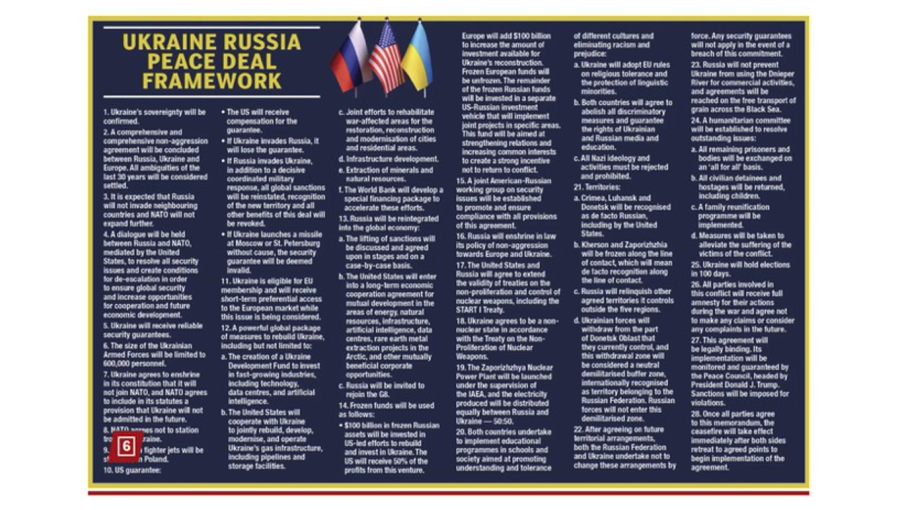
The full text of the US-Russian 28-point peace plan was released on November 20 that the White House hopes will bring the war in Ukraine to an end.
The proposal was leaked earlier this year and thrashed out in talks between Special Envoy to the Middle East Steve Witkoff and Russia’s special envoy and sovereign fund manager head Kirill Dmitriev in secret and without the participation of either Ukraine or the EU.
Bankova (Ukraine’s equivalent of the Kremlin) has yet to comment on the plan, but it is widely expected that Ukrainian President Volodymyr Zelenskiy will reject it.
The list contains most of Russian President Vladimir Putin’s maximalist demands and few concessions to Ukraine. It also includes a demand that Ukraine in effect cede some 20% of its territory to Russia and reduce its military by half – both red lines for Bankova. Reportedly he has been working on an alternative plan together with his European partners, who have taken over the entire burden of supporting Ukraine since Trump pulled out.
The EU has also pushed back against the plan. In comments to journalists on November 20, EU foreign policy chief and former Estonian Prime Minister Kaja Kallas said the EU had a much simpler 2-point plan: weaken Russia and support Ukraine.
Land: The controversial plan concedes the Donbas territories that Russia does not already occupy, which will become demilitarized zones, but freezes the frontline in Zaporizhzhia and Kherson. The Crimea will also be ceded to Russia and all these territorial claims will be recognized by the US, but Ukraine is implicitly not required to recognize the claim. Zaporizhzhia nuclear power plant (ZNPP), the largest in Europe, will be returned to Ukraine, but half its power will be sold to Russia.
Sanctions: Russia will be reintegrated into the global economy with a phased sanctions relief. It will also be invited to join the G8.
Nato and security guarantees: Ukraine will alter its constitution and return to neutrality that was part of its basic law prior to 2014. Nato’s charter will be changed to preclude Ukraine’s membership and expansion will be halted. Instead, Ukraine will be offered security guarantees by the US, which will demand compensation for its services. In effect, the deal would be a step towards the pan-European post-Cold War security deal that Russia first proposed in 2008. The US also commits to renewing the Cold War-era missile agreements, long a top ask by the Kremlin, starting with the renewal of the START II missile agreement, which is due to expire in February.
Reconstruction: Ukraine’s EU accession will be fast-tracked. The European part of the frozen Central Bank of Russia (CBR) funds will be returned and the rest will be invested in a joint US-Russian fund. A $100bn US investment fund will be set up to pay for reconstruction with the US taking half of its returns. Europe will also raise a $100bn fund to help with reconstruction. The Trump administration specifically includes mineral deals that are part of his minerals diplomacy foreign policy. The US will engage in extensive, but undetailed, business deals with Russia covering minerals, energy and technology.
Culture: Russian will become a second official language and restrictions on language and the operations of the Russian Orthodox Church will be lifted.
Politics: all sides will receive a full amnesty for any war crimes committed. Fresh presidential elections will be held within 100 days (with the implication that Zelenskiy will be replaced with someone like General Valerii Zaluzhnyi, a preferred US candidate to take over.)
Text of the 28-point peace plan
1. Ukraine’s sovereignty will be confirmed.
2. A full and comprehensive non-aggression agreement will be concluded between Russia, Ukraine, and Europe. All ambiguities of the last 30 years will be considered resolved.
3. Russia will not invade neighbouring countries, and Nato will not expand further.
4. A US-mediated dialogue will be held between Russia and Nato to resolve security issues, create conditions for de-escalation, ensure global security, and improve opportunities for cooperation and future economic growth.
5. Ukraine will receive reliable security guarantees.
6. The size of Ukraine’s Armed Forces will be limited to 600,000 personnel [down from about 1mn currently].
7. Ukraine will enshrine in its Constitution that it will not join Nato, and Nato will adopt a provision stating that Ukraine will not be admitted at any time in the future.
8. Nato will not deploy its troops in Ukraine.
9. European Nato forces will be stationed in Poland.
10. US security guarantees:
a. The US will receive compensation for providing guarantees.
b. If Ukraine invades Russia, it will lose the guarantees.
c. If Russia invades Ukraine (except for a rapid coordinated military response), all global sanctions will be restored and recognition of new territories will be revoked.
d. If Ukraine unintentionally fires a missile at Moscow or St. Petersburg, the guarantees become invalid.
11. Ukraine may apply for EU membership and will receive short-term preferential access to the European market pending review.
12. A global reconstruction package for Ukraine will include:
a. A fund for investing in high-tech sectors (transport, logistics, data centres, AI).
b. US–Ukraine cooperation on restoring and operating gas infrastructure (pipelines, storage).
c. Joint efforts to rebuild war-affected territories, cities, and residential areas.
d. Infrastructure development.
e. Extraction of minerals and natural resources.
f. A World Bank financing package to accelerate reconstruction.
13. Russia will be reintegrated into the global economy:
a. Sanctions relief will be discussed and agreed individually and gradually.
b. The US will sign a long-term economic cooperation agreement with Russia covering energy, resources, infrastructure, AI, data centres, Arctic rare-earth mining, and other corporate opportunities.
c. Russia will be invited to return to the G8.
14. Frozen Russian assets:
a. $100bn will be invested in US-led reconstruction projects in Ukraine.
b. The US will receive 50% of profits from these projects.
c. Europe will add another $100bn for Ukraine’s reconstruction.
d. European frozen assets will be unfrozen.
e. Remaining Russian assets will be invested in a special US–Russia investment instrument for joint projects aimed at strengthening mutual interests and long-term stability.
15. A joint US–Ukraine–Russia working group on security issues will be established to monitor compliance with the agreement.
16. Russia will legally adopt a policy of non-aggression toward Europe and Ukraine.
17. The US and Russia will extend nuclear non-proliferation and nuclear arms control treaties, including START-1.
18. Ukraine will remain a non-nuclear state under the NPT.
19. The Zaporizhzhia Nuclear Power Plant will be restarted under IAEA supervision, with electricity output divided equally (50/50) between Russia and Ukraine.
20. Both countries will implement educational programs fostering cultural tolerance, understanding, and the elimination of racism and prejudice:
a. Ukraine will adopt EU standards on religious tolerance and minority protection.
b. Both sides will lift discriminatory measures and guarantee equal access for Ukrainian and Russian media and education.
c. Nazi ideology and activity will be banned in both countries.
21. Territorial arrangements:
a. Crimea, Luhansk, and Donetsk will be recognized de facto as Russian, including by the United States.
b. Kherson and Zaporizhzhia will be frozen along current front lines.
c. Russia renounces claims to any other territories it controls beyond these five regions.
d. Ukrainian troops will withdraw from the part of Donetsk region they currently control; this zone becomes a demilitarized neutral buffer internationally recognized as Russian Federation territory. Russian forces will not enter the demilitarized zone.
22. Future territorial arrangements cannot be changed by force; security guarantees will not apply if violated.
23. Russia will not obstruct Ukraine’s commercial use of the Dnipro River, and agreements will be reached on free grain shipments via the Black Sea.
24. A humanitarian committee will resolve outstanding issues:
a. Prisoners and bodies exchanged under “all for all.”
b. All civilian detainees and hostages returned, including children.
c. Family reunification program.
d. Measures to alleviate suffering of conflict victims.
25. Ukraine will hold elections within 100 days.
26. All parties to the conflict will receive full amnesty for wartime actions and agree not to file claims or pursue grievances.
27. The agreement will be legally binding. Its implementation will be monitored and guaranteed by a Peace Council chaired by Donald J. Trump. Sanctions will apply to violators.
28. After all sides agree, the ceasefire will take effect immediately once both sides withdraw to the agreed starting lines.
 |
The Nestor Makhno Archive - index |

No comments:
Post a Comment