An image described as a “Fayum portrait”, a naturalistic portrait placed on mummies in Roman Egypt, has been widely shared on social media. It turns out that it is actually a fake AI-generated image that differs in key ways from the real portraits.
Issued on: 21/11/2025
By: The FRANCE 24 Observers/
Quang Pham
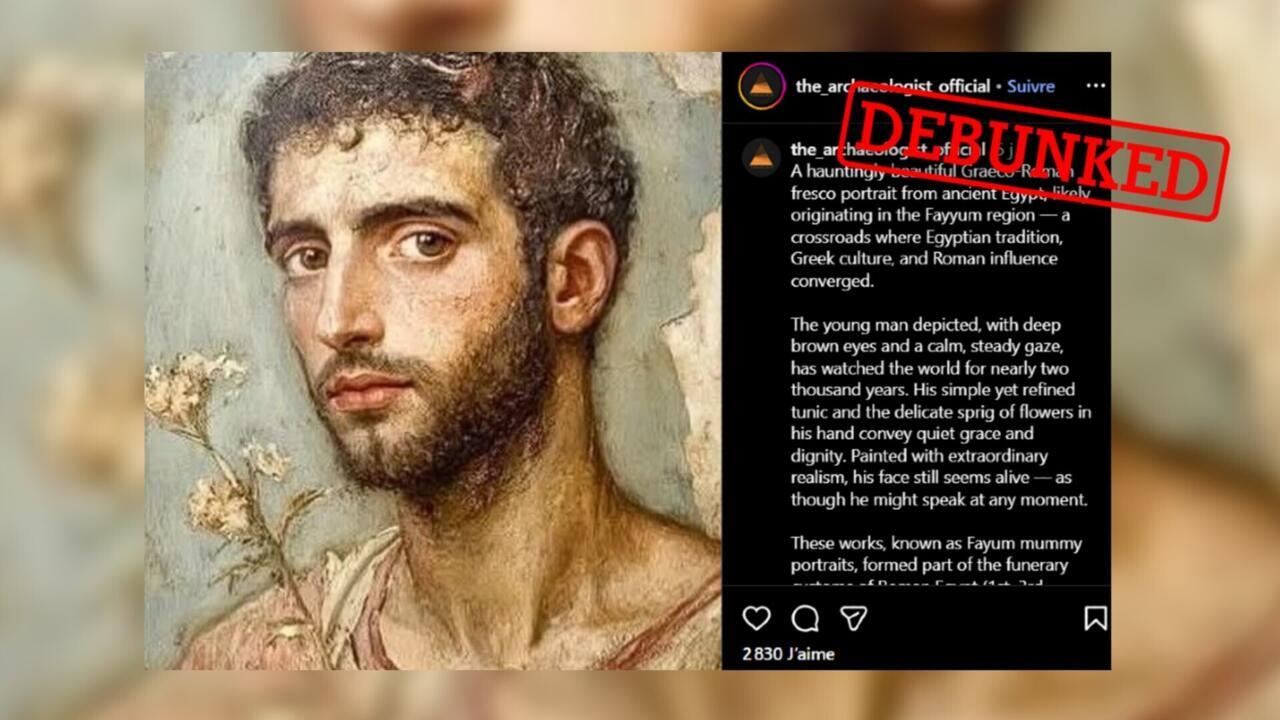
This fake Fayum portrait published on October 7, 2025 was actually created by AI. © Instagram
Fayum portraits are a type of ancient Roman paintings crafted as funerary effigies in and around the Fayum oasis, southwest of Cairo.
The portraits, which were placed on mummies, are a funerary custom dating from the time of Roman Egypt, a period that took place from around the 1st to the 4th century AD.
"The practice follows in the tradition from Egypt under the pharaohs of representing the deceased but incorporates Greek and Roman artistic styles,” says art historian Céline Trouchaud.
Fayum portraits, which depict men, women and children from the Greek and Roman society within ancient Egypt, are “the first relatively ‘realist’ portraits aimed at representing an individual in all their singularity,” says Lucile Brunel-Duverger, a research engineer at the French museum's Centre for Research and Restoration. Brunel-Duverger, who has a PhD in chemistry, studies the material and techniques used to create the colour in these portraits.
An Instagram account called the_archaeologist_official, which claims to specialise in archaeology, posted what they said was a Fayum portrait of a young man on November 14.
“The young man depicted, with deep brown eyes and a calm, steady gaze, has watched the world for nearly two thousand years, “ the account wrote. “Painted with extraordinary realism, his face still seems alive – as if he might speak at any moment.”
The account also mentions the portrait’s “quiet grace”. While some comments marvel at the image of the young man, most raise suspicions that the image is false.
Fayum portraits are a type of ancient Roman paintings crafted as funerary effigies in and around the Fayum oasis, southwest of Cairo.
The portraits, which were placed on mummies, are a funerary custom dating from the time of Roman Egypt, a period that took place from around the 1st to the 4th century AD.
"The practice follows in the tradition from Egypt under the pharaohs of representing the deceased but incorporates Greek and Roman artistic styles,” says art historian Céline Trouchaud.
Fayum portraits, which depict men, women and children from the Greek and Roman society within ancient Egypt, are “the first relatively ‘realist’ portraits aimed at representing an individual in all their singularity,” says Lucile Brunel-Duverger, a research engineer at the French museum's Centre for Research and Restoration. Brunel-Duverger, who has a PhD in chemistry, studies the material and techniques used to create the colour in these portraits.
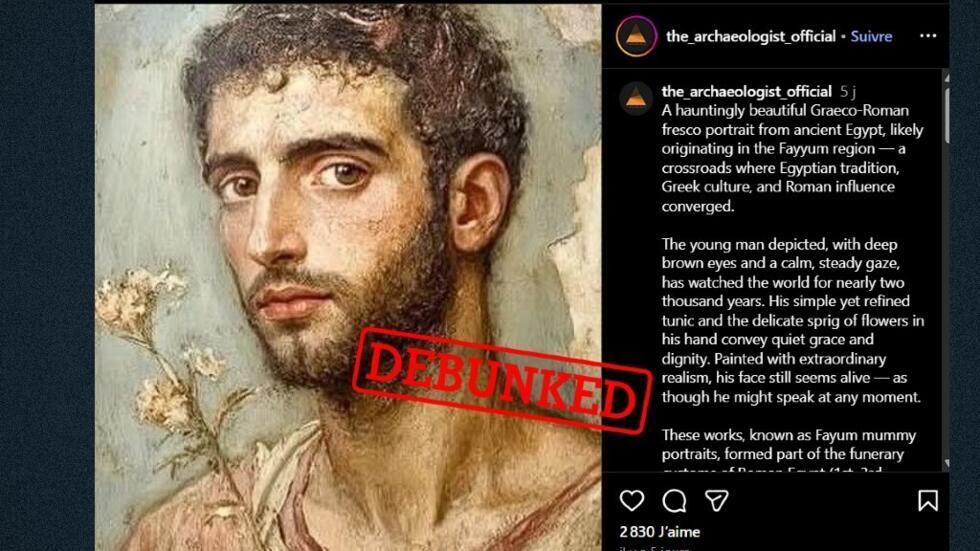
An Instagram account called the_archaeologist_official, which claims to specialise in archaeology, posted what they said was a Fayum portrait of a young man on November 14.
“The young man depicted, with deep brown eyes and a calm, steady gaze, has watched the world for nearly two thousand years, “ the account wrote. “Painted with extraordinary realism, his face still seems alive – as if he might speak at any moment.”
The account also mentions the portrait’s “quiet grace”. While some comments marvel at the image of the young man, most raise suspicions that the image is false.
This image, said to be a Fayum portrait, was posted online on November 14. It was actually AI-generated. © Instagram
A portrait created by Midjourney
They are right – this Fayum portrait is, indeed, a fake. We ran the image through a reverse image search using Google Lens (check out how to do one yourself by following our handy guide) and found the original image, which was generated by AI image generator Midjourney. We even found the prompt, the instructions used to generate the portrait, on the site ai-img-gen.com.
This prompt shows that a user asked Midjourney to generate a Fayum portrait showing an “ancient” Greek man. The image was meant to replicate the style of encaustic painting – a painting technique using wax common during antiquity. It also had to use two other portraits, also created by Midjourney, as inspiration.
A portrait created by Midjourney
They are right – this Fayum portrait is, indeed, a fake. We ran the image through a reverse image search using Google Lens (check out how to do one yourself by following our handy guide) and found the original image, which was generated by AI image generator Midjourney. We even found the prompt, the instructions used to generate the portrait, on the site ai-img-gen.com.
This prompt shows that a user asked Midjourney to generate a Fayum portrait showing an “ancient” Greek man. The image was meant to replicate the style of encaustic painting – a painting technique using wax common during antiquity. It also had to use two other portraits, also created by Midjourney, as inspiration.
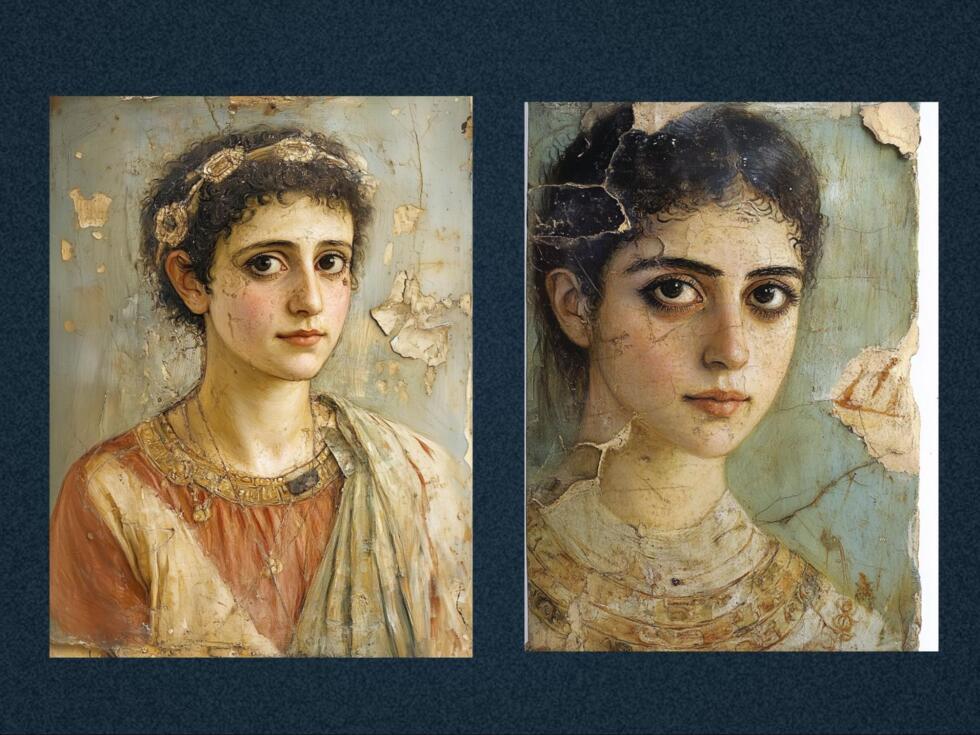
Midjourney was provided with these two images as inspiration when it generated the fake Fayum portrait of the young man. © Midjourney
Too realist for paintings of the time
The fake image does, in some ways, model the style of a Fayum portrait. For example, the man’s face is turned to the side. However, the portrait also features anomalies – clues that it is a fake.
First of all, the backdrop. The account "the_archaeologist_official" claims that the image comes from a fresco. However, real Fayum portraits were painted on wood or canvas, says Trouchaud.
The historian adds that the AI-generated image is missing elements of the encaustic technique used in real Fayum portraits:
"The portrait has some characteristics of a painting done with oil paints – like a realistic depiction of human skin, a desire [to get as close as possible to depicting] a real face, which doesn’t exist in encaustic painting. And while the Fayum portraits do include a form of realism, that in some ways is quite modern, it also presents the deceased in an idealised way with, for example, very large eyes or prominent features.”
Too realist for paintings of the time
The fake image does, in some ways, model the style of a Fayum portrait. For example, the man’s face is turned to the side. However, the portrait also features anomalies – clues that it is a fake.
First of all, the backdrop. The account "the_archaeologist_official" claims that the image comes from a fresco. However, real Fayum portraits were painted on wood or canvas, says Trouchaud.
The historian adds that the AI-generated image is missing elements of the encaustic technique used in real Fayum portraits:
"The portrait has some characteristics of a painting done with oil paints – like a realistic depiction of human skin, a desire [to get as close as possible to depicting] a real face, which doesn’t exist in encaustic painting. And while the Fayum portraits do include a form of realism, that in some ways is quite modern, it also presents the deceased in an idealised way with, for example, very large eyes or prominent features.”
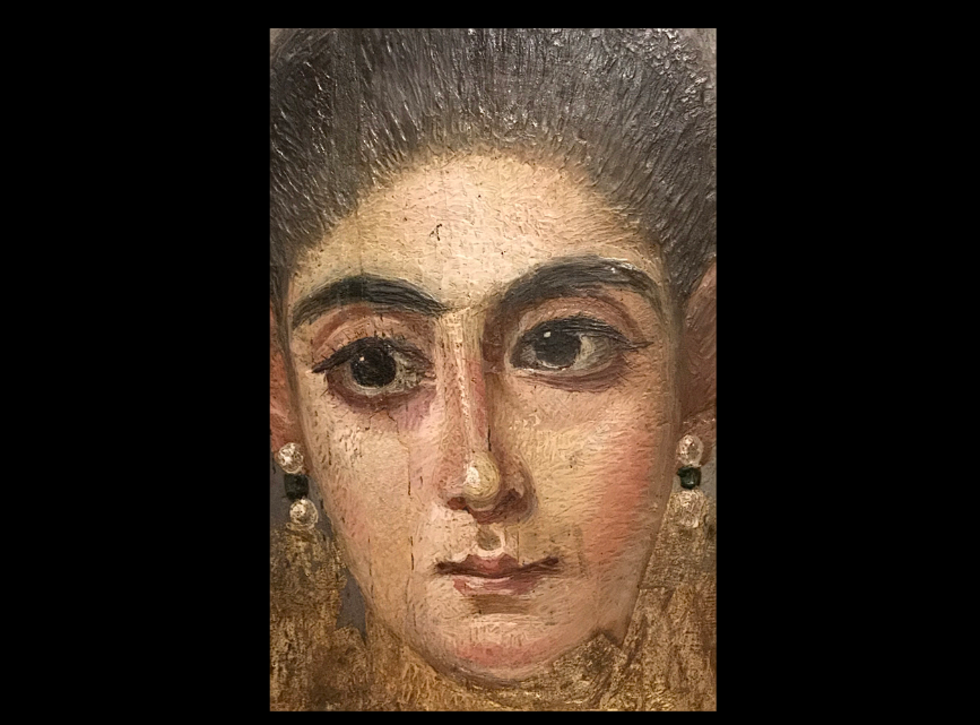
This is a real Fayum portrait - an encaustic painting of a young woman on cedar wood. It was created in the 2nd century AD in Roman-ruled Egypt. © Musée du Louvre.
Brunel-Duverger adds:
"The treatment of size and light is very different in encaustic paintings. Wax is used to create modulations in the colour, but that makes it difficult to create real nuance [as in the fake portrait]. [In a real painting], we should be able to see the application of the material, brush marks, for example, which don’t appear in the generated image, which is very smooth.”
The researcher concludes:
“AI still isn’t able to create [totally] convincing fakes. But if that happens, experts in materials like us will still be able to verify the material used to see if they really do come from Roman-ruled Egypt."
This article has been translated from the original in French.
Brunel-Duverger adds:
"The treatment of size and light is very different in encaustic paintings. Wax is used to create modulations in the colour, but that makes it difficult to create real nuance [as in the fake portrait]. [In a real painting], we should be able to see the application of the material, brush marks, for example, which don’t appear in the generated image, which is very smooth.”
The researcher concludes:
“AI still isn’t able to create [totally] convincing fakes. But if that happens, experts in materials like us will still be able to verify the material used to see if they really do come from Roman-ruled Egypt."
This article has been translated from the original in French.

No comments:
Post a Comment