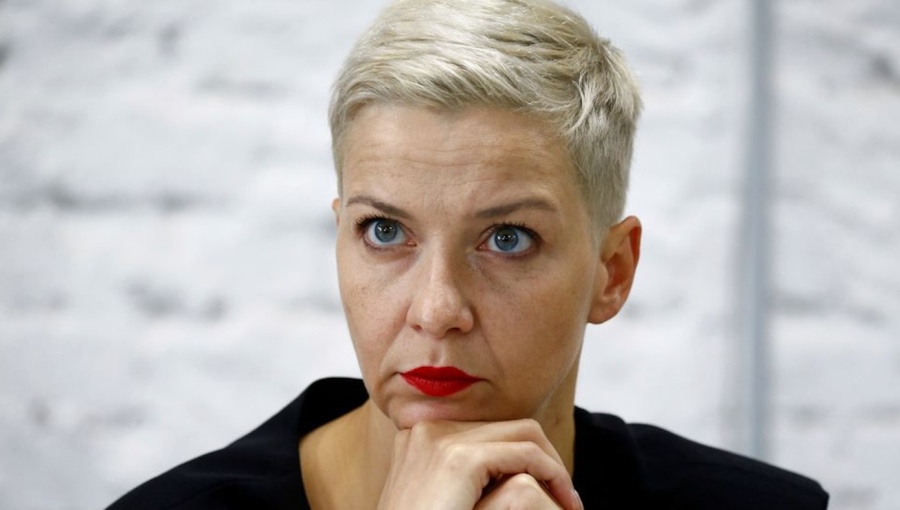
Belarusian opposition leader Maria Kolesnikova said that it's time for Europe to engage in talks with pariahed Belarus President Alexander Lukashenko, in a remarkable contrast with her colleagues who have spent more than five years asking for the sanctions screws on Minks to be tightened.
Recently released from jail where she was serving an 11-year sentence on politically motivated charges, Kolesnikova argues that “Lukashenko is a pragmatic person. He understands the language of business. If he is ready for humanitarian steps in response to a relaxation of sanctions, including the release of prisoners and allowing independent media and NGOs into Belarus, this needs to be discussed.”
While her opposition leader colleagues largely fled the country after the mass demonstrations sparked by the massively falsified presidential election in August 2020 began to fade, Kolesnikova stayed on until she was snatched from the street by security forces and thrown in jail.
As bne IntelliNews reported, there has been arguments amongst the Belarusian government in exile, headed by Belarusian opposition leader Svetlana Tikhanovskaya (Sviatlana Tsikhanouskaya) who ran in the 2020 elections against Lukashenko and is believed to have won by a landslide.
Tikhanovskaya leads a faction within the opposition that believe they should lobby Europe to tighten sanctions and release all of the some 1,300 remaining political prisoners still in jail at once.
However, after a string of political prisoner releases brokered by the White House, there are others that believe a step by step approach would be more effective – an argument boosted by the release of high profile prisoners in a series of deals in the last year, including the release of Kolesnikov herself and Tikhanovskaya’s husband, Sergei last June.
The US success has clearly had an impact on the debate. “But as someone with a European mindset, I do not understand why Europe did not start talking to Lukashenko before the US,” Kolesnikova said. “It is obvious that Germany, for example, has far more ties with Belarus than the States.”
Her argument runs counter to Europe’s approach of keeping links with Belarusian democratic forces in exile, minimising contacts with the regime, and maintaining economic sanctions on exports, a ban on flights and tighter visa rules.
Promoting this kind of dialogue — particularly aimed at securing the release of other political prisoners and preventing further repressions — is now her focus. “I think it’s clear that I’m not leaving politics.”
“One day the regime will change,” Kolesnikova told the FT. “And by that point, there must not be scorched earth there. We must prepare the ground.”
Europe’s hardline is softening
For all his myriad faults, Trump’s two biggest successes has been to hold the first direct talks with Putin since the failed 2022 Istanbul peace deal talks and make real progress towards bringing the war in Ukraine to an end. The second is he has brokered the release of some 200 political prisoners from Belarusian jails as relations with the US begin to thaw.
Europe’s hardline policy of sending authoritarian leaders to Coventry is starting to melt as the war in Ukraine goes nowhere, Europe finds itself in increasingly difficult financial straits and US President Donald Trump puts the cat amongst the pigeons with his efforts to dismantle the international rules-based order.
The pressure on Kyiv to capitulate is mounting fast and Europe is increasingly powerless to prevent that from happening. Since the start of January Russia has launched a missile and drone barrage against Ukraine’s biggest cities that has plunged them into a hell of freezing cold and darkness. As of the time of writing, residents of Kyiv are starting to flee the increasingly uninhabitable capital where temperatures inside some of the blacked out apartment blocks have fallen to below -5°C according to local reports.
Around one in six residents heeded Mayor Vitali Klitschko's call for temporary evacuation: 600,000 of the 3.6mn inhabitants have left the city since January 9, Klitschko told the AFP news agency. "Not everyone has the opportunity to leave the city, but the population is currently shrinking," Klitschko said.
And since the Trump administration cut off all funding to Ukraine and won’t sell it weapons unless Europe pays for them, the already economically distressed leading European governments are wondering how they can foot a €100bn a year bill that continuing the war in Ukraine will cost. In December the EU raised a €90bn loan to keep the government in Kyiv afloat, two thirds of which will be spent on weapons, but even that was around €50bn short of what the war is expected to cost over the next two years. Moreover, Europe’s defence industry will struggle to produce the number and quality of weapons Ukraine is so desperate for – more air defence ammo topping the list.
Zelenskiy appeared to be facing harsh realities when he said earlier this month that the war may be over by this summer – an unusual statement as the Ukraine’s president is usually reluctant to ascribe timelines to comments like this.
French President Emmanuel Macron was the first to say it outloud, calling for Europe to open direct talks with the Kremlin. He was followed soon after by Italy’s Prime Minister Giorgia Meloni who agreed that the time had come for direct negotiations. German Chancellor Friedrich Merz did an abrupt about face a week later, calling Russia a "European" country and saying Berlin was also open to direct negotiations.
Maybe most surprising of all was former Nato Secretary General Jens Stoltenberg, who added his voice to the growing cacophony on January 17, saying Western countries should "talk to Russia as a neighbour."
"We need to discuss ending the fighting in Ukraine with Russia just as we, the United States, and other countries are doing... We need to talk to Russia as a neighbor," he said in an interview with Der Spiegel magazine.
Unity within the EU in its support of Ukraine and opposition to Russia is crumbling. Ukraine fatigue has built up steadily as it becomes increasingly obvious that Ukraine will not be able to win a military victory against Russia.
Add to that there is a certain ennui amongst EU leaders to the fact that as the US-sponsored peace talks got underway in earnest in December with the peace plan thrashed out between US envoys and Putin in a Moscow meeting on December 3 where the EU suggestions were entirely ignored. Part of the motivation for calling for direct talks is to reinject European interests into the dialogue, although the Kremlin is unlikely to welcome engaging in the negotiations. Russian President Vladimir Putin has said in the last month that he sees Europe as the biggest obstacle to doing a peace deal.

No comments:
Post a Comment