Sunday, February 08, 2026

US government plans new mining house to tap Africa’s copperbelt


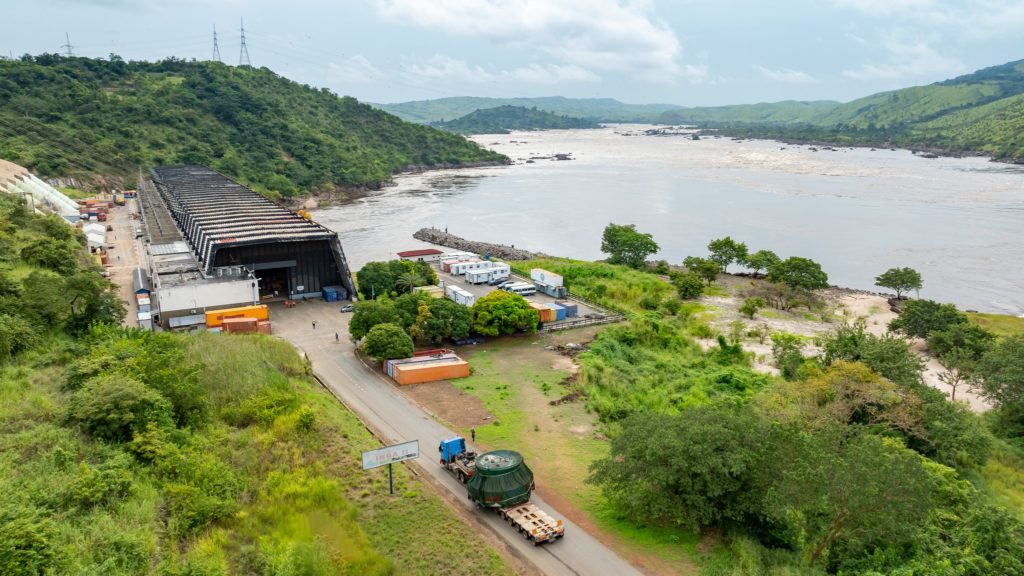
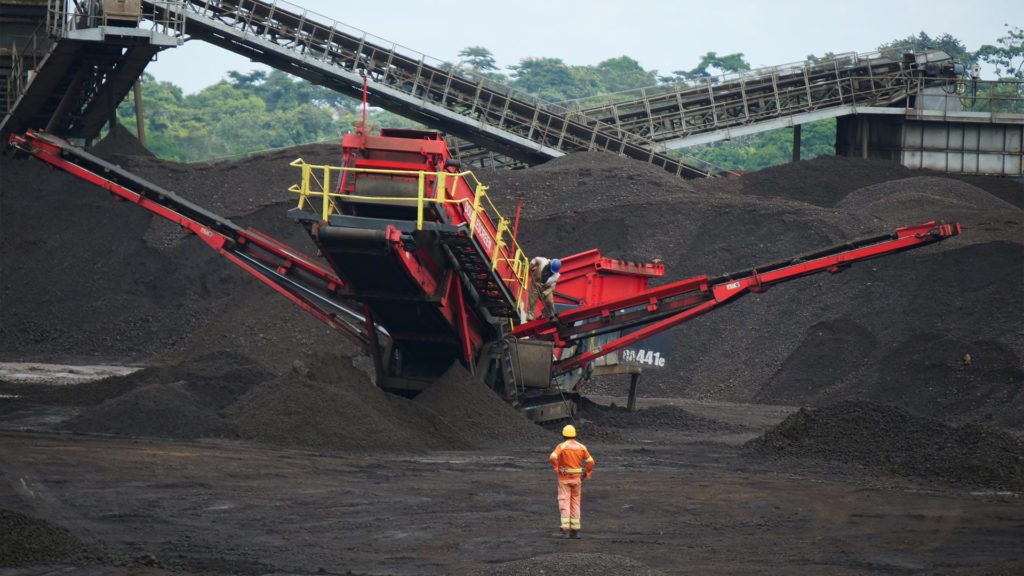
Companies operating in the Congo copperbelt include Ivanhoe Mines. Credit: Ivanhoe Mines

A US government-backed group’s plan to take stakes in Glencore Plc’s Congolese copper operations could be the first step in creating an American company to accumulate mining assets in Africa.

Orion CMC – a new venture led by Orion Resource Partners with sovereign backing from the US International Development Finance Corp. and Abu Dhabi’s ADQ – on Tuesday announced a preliminary deal to buy 40% of Glencore’s stakes in its copper-cobalt mines in the Democratic Republic of Congo.

The deal would be the first major transaction since the creation of the consortium late last year and deepens the Trump administration’s efforts to shore up supplies of critical minerals and make up ground lost to China. Having relied on the private mining sector for decades, the US is now seeking government-level supply alliances worldwide, funding a vast new stockpiling program, and pursuing pricing floors to keep miners in operation during market downswings.

The transaction would create a new entity – 60% owned by Glencore and 40% by Orion CMC – that could become a vehicle to buy up additional assets in the so-called Central African Copperbelt, according to people familiar with the matter.

That company could take on new investors and eventually seek to go public, they said, asking not to be named discussing matters that haven’t been disclosed. While the two sides have discussed various structures and plans for the new vehicle, the talks are ongoing and the final strategy has yet to be agreed upon, one of the people cautioned.

The Copperbelt spans Congo and Zambia, which are Africa’s top two producers of the industrial metal that’s also key to electrification and the broader energy transition. Congo is the world’s largest supplier of cobalt, which is used in electric-vehicle batteries as well as the defense and aerospace industries.

Chinese miners account for most output of the metals in Congo, while western firms First Quantum Minerals Ltd. and Barrick Mining Corp. are the biggest copper producers across the border in Zambia.

The proposed transaction represents a turnaround for Glencore’s relationship with the US government. The Swiss trader settled a corruption probe in May 2022 by pleading guilty to bribery allegations that involved payments made to officials in Congo. The US Justice Department ended a monitoring program at Glencore just 10 months ago — earlier than initially planned — which was part of the plea agreement.

Glencore is currently in talks to sell itself to Rio Tinto Group to create the world’s largest mining company. A key attraction for Rio is Glencore’s copper portfolio, although principally assets in South America rather than its Congolese units: Mutanda Mining and Kamoto Copper Co.

While the statement announcing the agreement said the enterprise value of the assets would be about $9 billion, Orion CMC is likely to pay Glencore considerably less for its 40% stakes. That’s because Glencore owns 70% of Kamoto and 95% of Mutanda, and there’s also substantial debt at the asset level. Based on the $9 billion valuation, Orion CMC could pay a little over $2 billion, one of the people said, although they cautioned that the final price is still being negotiated.

Potential deals involving the Glencore subsidiaries have been complicated in recent years by Dan Gertler, an Israeli billionaire who’s under US sanctions and receives royalties from both mines in non-US currency. The US government is working to ensure that Orion CMC’s transaction can occur without breaking American law, the people said.

A DFC spokesperson said that, while the organization can’t comment on specific deals due to commercial sensitivities, it “takes compliance with US sanctions very seriously in all transactions it supports.” The State Department and Treasury Department didn’t respond to emailed requests for comment.

Orion has been discussing an investment in Glencore’s Congolese mines since it made an initial approach in late 2024, Bloomberg has reported. But the partnership with the DFC unveiled in October and a minerals pact signed by the US and Congolese governments in December accelerated the talks, the people said.

The deal between Orion CMC and Glencore “reflects the core objectives of the US-DRC Strategic Partnership Agreement by encouraging greater US investment in the DRC’s mining sector,” US Deputy Secretary of State Christopher Landau said in the statement.

The US government’s investment in Orion CMC “aims to leverage Orion’s market knowledge and expertise” to “enhance critical mineral supply chain security for the US and its allies,” the DFC spokesperson told Bloomberg by email.

Orion CMC is also involved in another smaller deal in Congo, backing Delaware-registered Virtus Minerals Inc.’s efforts to buy Chemaf SA, which ran into financial difficulties while building one of the world’s biggest cobalt mines, according to people familiar with the matter.

The agreement with Glencore was announced the day before a ministerial meeting on critical minerals hosted by US Secretary of State Marco Rubio. Orion CMC wants other allied countries to join the US and United Arab Emirates as investors in the venture, the people said.

(By William Clowes and Jack Farchy)

Trafigura in talks with China’s ITG to set up credit fund

Image: Trafigura

Commodity trading house Trafigura Group is in talks with Chinese supply chain conglomerate Xiamen ITG Group to form a joint venture to trade raw materials and finance commodity deals, according to people familiar with the matter.

The venture is being set up at a time when competition is heating up among traders for lucrative financing deals with commodity producers, with margins from simply buying, transporting and selling resources like oil, gas and metals expected to tighten.

Trafigura is facing competition as a dominant player in metal markets from other big energy traders offering cash in exchange for ores and refined metal. Meanwhile, Chinese domestic traders are also seeking opportunities to expand overseas as competition at home intensifies.

Over the past year, Mercuria Energy Group has been rapidly growing its trading book, underwriting more than $3.5 billion in financing for metals flows under Trafigura’s former metals co-head Kostas Bintas.

Partnering with a Chinese state-owned firm could provide Trafigura, one of the world’s top traders and a major borrower, with additional and competitive access to funds, the people said, asking not to be named because the discussions are private. For ITG the deal would help expand its global network, they added.

Since 2022, Trafigura has been diversifying its funding base through deals with national export credit agencies in Europe, Saudi Arabia and the US.

A spokesperson for Trafigura declined to comment. ITG did not respond to a request for comment.

ITG is the largest of a trio of state-owned raw materials and logistics conglomerates from the Chinese coastal city of Xiamen that have expanded rapidly into natural resources in recent years.

These Xiamen-based firms, owned by the city’s government, differ from both their closest Western competitors and Chinese central-government owned conglomerates. They are more diversified, spanning the supply chain from production to trading to property, placing them closer to Japan’s trading houses.

(By Archie Hunter, Alfred Cang and Julian Luk)


Reimagining magnet materials: How AML is challenging the rare earth status quo 


Floating magnet on a superconductor. AI-generated stock image.

For decades, permanent magnets have been one of the least questioned links in the electrification supply chain. Motor makers bought block magnets, designed around them, and accepted a system dominated by sintered neodymium-iron-boron (NdFeB) alloys — and by China. 

This complacency is being called into question increasingly as technology startups push the boundaries of possibility. 

Florida-based Advanced Magnet Lab (AML) is among a small but growing group of companies arguing that the permanent magnet industry has been constrained not only by geopolitics but also manufacturing orthodoxy.  

From particle accelerators to permanent magnets 

Rather than competing head-on with Chinese mega scale producers, the company is taking a different path: redesigning the materials in permanent magnets, which are crucial for decarbonization, powering motors in electric vehicles (EVs), wind turbines, and industrial automation. 

The company began in high-energy physics, developing superconducting and magnet technologies for particle accelerators. In 2008, it pivoted toward superconductivity for power generation and transmission, before encountering a familiar problem: the market was slow to materialize. 

By the mid-2010s, the company identified a new opportunity — permanent magnets —  but approached it from an unconventional angle. Drawing on experience producing superconducting wire, Magnet Lab developed a magnet manufacturing process that looks less like traditional press-and-sinter techniques and more like continuous wire production. 

“We came up with a concept for producing permanent magnets in a process very similar to how you produce superconducting wire,” CEO Wade Senti told MINING.com in a December interview.  

Escaping the NdFeB bottleneck 

Traditional sintered magnet production is capital-intensive, IP-constrained, and highly sensitive to raw material costs, which can account for 60–70% of total magnet pricing, Senti noted.  

Historically, this left little room for alternative materials or new entrants. 

When Magnet Lab filed its core patents around 2015–2016, the environment was very different from today. The trade war, supply-chain shocks, and reshoring incentives that now dominate policy discussions did not yet exist. 

“At that time, it would have been very difficult to get industry to adopt US-made magnets outside China because of price,” Senti said. “So the question was: how do we reduce steps, try different materials, and still create a viable market?” 

The team then turned its attention to material flexibility. 

Rather than anchoring its business exclusively to NdFeB, Magnet Lab has been developing magnets based on samarium nitride, manganese-bismuth, and select NdFeB compositions tailored to specific applications.  

Many of these materials are poorly suited to conventional sintering but perform well in Magnet Lab’s process, Senti said.

Focused scale, not megaton ambitions 

Unlike some Western magnet hopefuls chasing 10,000-tonne-per-year ambitions, Magnet Lab is deliberately targeting smaller, higher-value markets. 

“This isn’t a 10,000 metric ton per year problem,” Senti said. “This is a 100 metric ton per year problem.”  

The company is currently operating at pilot scale, with plans to ramp production selectively. 

Samarium nitride magnets are scaling fastest, and manganese-bismuth magnets are entering qualification with motor OEMs, and NdFeB production is expanding to several days per week, primarily for defense and specialty applications. 

Design freedom 

While Magnet Lab’s magnets can be used in EV motors, the company sees its biggest near-term opportunity in industrial motors and generators — a massive but often overlooked segment of electrification. 

Motor designers, the company says, have been constrained by decades of reliance on block magnets. Alternative geometries and materials could enable faster development cycles, new motor architectures, and greater resilience against supply shocks. 

“There’s a growing open-mindedness in the motor market,” Senti said. “People are starting to realize they’ve been limited by how magnets are made and supplied.”  

Supply chains still run through China — for now 

Despite its US manufacturing focus, Magnet Lab is candid about supply chain realities. Raw materials are sourced from a mix of US and Japanese suppliers, and China remains difficult to fully avoid. 

“People like to talk about getting out of China, but is it fully doable? Probably not in this lifetime,” Senti said, noting that even miners often lose visibility once concentrates leave their sites . 

What is changing, he said, is customer behavior. OEMs increasingly demand traceability across the entire supply chain and are willing to pay premiums — sometimes $10–$20 per kilogram — for diversified sourcing and reduced geopolitical exposure. 

The overlooked bottleneck: equipment 

Another observation from Magnet Lab’s vantage point is the scarcity of magnet-making equipment. Lead times of 14 to 20 months are becoming common, even as dozens of magnet projects race to scale. 

That has raised uncomfortable questions for equipment suppliers themselves: is the current demand surge a short-term cycle or a structural shift? 

“By the time some of this equipment arrives, the market may already have changed,” Senti pointed out 

Magnet Lab expects early 2026 to mark a more visible commercial phase, including strategic supplier announcements and increased engagement with OEMs. 

For an industry long treated as a commodity footnote, permanent magnets are finally receiving sustained attention — and companies like Magnet Lab are betting that rethinking how magnets are made could matter as much as where they’re made. 

This week, the US Vice president announced it will collaborate with the European Union, Japan and Mexico on critical minerals strategies as part of its efforts to weaken China’s dominance in the market for materials used in defense and high-tech industries. 

“From the industry perspective, it’s critical to see the United States take decisive steps to shore up our supply of all kinds of minerals and rare earths, Senti said in a emailed statement on Thursday. “But looking ahead, what is even more critical will be putting these minerals to use in permanent magnets that power the technologies of the future—from EVs to humanoid robots.  

Innovative permanent magnet technology can perform with a large variety of different critical minerals—not just neodymium—giving America more optionality and tools in supply chain security.” 

Column: As global metals fever spreads, markets buckle under the heat

Stock image.

The word on the Chinese street is that metals are the next hot thing. All you need to join the bull party is an online trading account, a bit of cash for the initial margin and access to the right WeChat chatroom to meet like-minded punters.

China’s metal exchanges have for two months been struggling to contain the unprecedented liquidity rush caused by the spreading metals mania.

The Shanghai Futures Exchange and the Guangzhou Futures Exchange have between them raised margins and tightened trading rules 38 times to maintain order.

The spate of interventions has covered the metallic spectrum from precious metals gold and silver to industrial inputs such as nickel and lithium.

China has a long history of manias in markets as obscure as ferro-silicon but nothing before on this scale.

Moreover, metals fever has swept up the rest of the world. The speculative stampede has generated extreme volatility in the silver market and rocked even safe-haven gold.

ShFE volumes of aluminium, copper, nickel and tin
ShFE volumes of aluminum, copper, nickel and tin

Mass momentum

The Shanghai Futures Exchange registered record levels of trading activity across multiple metal contracts in January.

Tin volumes exceeded one million metric tons on a single day as the price accelerated to fresh all-time highs. That’s more than twice the world’s annual physical usage.

The crowding of retail investors acts as a giant momentum fund, every price gain feeding the next leg higher as more money joins the uptrend. Short positions held by industrial hedgers are stopped out, throwing further fuel on the flames.


Outside of China, only silver has seen similar mass surges in the past, most notably in 2021, when the Reddit message board launched a wave of retail buying in pursuit of a mythical market short.

No surprise then that silver has once again been the wildest of all markets in recent days.

But this phenomenon is spreading.

The late-January surge in the CME copper contract to a record high of $6.58 per lb wasn’t accompanied by any outsize increase in managed money long positions.

CME micro copper and micro gold volumes

Rather, the real action was taking place in the CME’s smaller contracts aimed squarely at retail investors.

The micro copper contract, which at 2,500 pounds is a tenth of the size of the main contract, saw volumes mushroom from 369,000 lots in December to 969,000 in January. That’s equivalent to over one million metric tons of physical metal.

The micro gold contract has experienced an equally dramatic jump in activity after bursting into life around the middle of last year.

Delta force

The wave of investment money has been flowing into metal options as well as futures.

The CME’s copper event option contract, which offers a simple binary punt on the underlying price, notched up volumes of almost 83,000 lots in December and January, more than the total traded since the product was launched in September 2022.

Options act as accelerators on already super-charged rallies.

With everyone looking to snap up call options, conferring the right to buy, sellers have to hedge their exposure by themselves buying into a rising market.

Such delta-hedging creates a mechanistic feedback loop, which runs until the momentum turns, at which point the process starts working in reverse as those who sold the options sell back their cover in a falling market.

The whiplash can be extreme, as silver investors have just found out.

Liquidity trap

Animal spirits, compounded by options leverage, created the conditions for both the wild upswing in precious metals prices and the subsequent violent unwind.

Gold should be cushioned against such speculative storms by central bank reserves but it too is ultimately a finite physical commodity.

Analysts at Citi calculate that were investors to increase their purchases of gold from the current $300-400 billion per year to $2 trillion, the price could exceed $10,000 per ounce.

That may sound like a lot of money but an increase from $1 trillion to $2 trillion would represent just one six-hundredth of global household wealth, according to Citi.

If even gold is vulnerable to the raw power of money, consider the potentially destructive impact on smaller industrial metal markets such as nickel or tin.

That’s why China, the world’s foremost industrial metals producer and consumer, has been taking ever more stringent measures to prevent paper market wildness contaminating real-world supply chains.


Theme and meme collision

January’s perfect metallic storm marks the collision of two powerful investment themes.

The fear of dollar “debasement” is causing both institutional and individual investors to diversify into harder assets.

Metals, meanwhile, were already attracting investor interest due to their central role in both energy transition and internet-of-things mega-trends.

Silver, which is both a precious and industrial metal, has been the pivot between macro- and micro-investment narratives.

In the new world of social media, these colliding metallic themes have morphed into internet memes, amplified by message boards such as WeChat in China and Reddit in the West.

The result is unprecedented investment appetite for metals, both precious and base, at global scale.

And it’s unlikely to be sated any time soon.

More turbulence seems guaranteed until the fever breaks.

If it breaks.

(The opinions expressed here are those of the author, Andy Home, a columnist for Reuters.)

(Editing by David Holmes)


US mineral supply chains remain exposed to China chokehold: USGS report


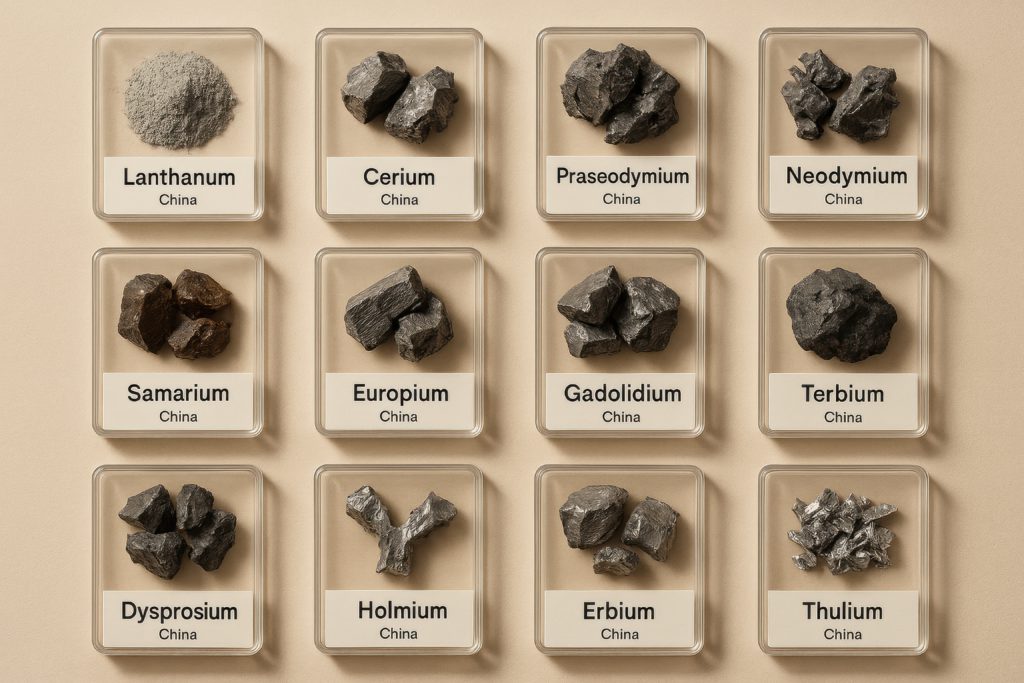
A display of various rare earth elements in labeled containers, showcasing their distinct forms and origins, primarily from China. Stock image.

A new report by the US Geological Survey reveals that the United States has grown more reliant on foreign imports of minerals over the past year, highlighting the increased urgency to bolster its domestic supply chains.

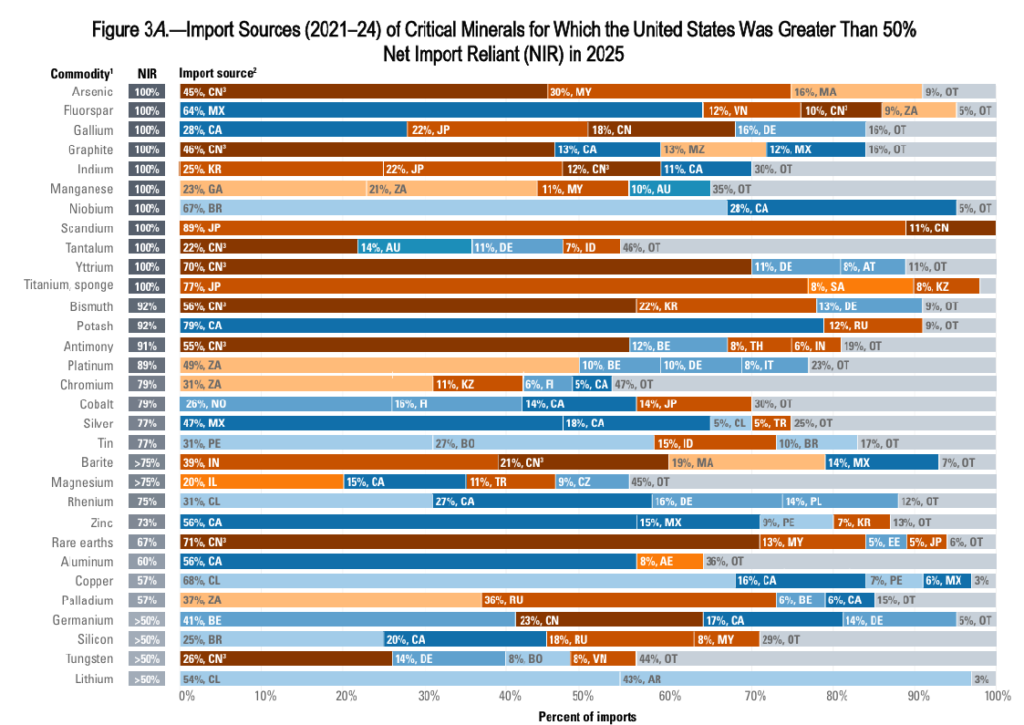
In its annual mineral commodities summary published on Friday, the USGS found that the country was 100% import reliant last year for 16 out of the 90 non-fuel commodities that it tracked. In addition, the US relied more than one-half of its apparent consumption for 54 of the minerals, the report showed.

Credit: USGS

In comparison, the 2024 data showed 100% import reliance for 15 commodities and more than one-half import reliant for 46 minerals, the USGS said.

As highlighted in the report, the United States is totally reliant on its imports of arsenic (all forms), asbestos, cesium, fluorspar, gallium, graphite (natural), indium, manganese, mica (natural), niobium (columbium), rubidium, scandium, strontium, tantalum, titanium (sponge metal) and yttrium. Most of these are on the USGS critical minerals list, with asbestos, mica and strontium being the only absentees.

An additional 20 critical minerals had a net import reliance of greater than 50%, down from 28 in 2024, USGS noted.

China’s chokehold

For many of the USGS critical minerals, China features prominently as a key supply source, accounting for nearly half of its arsenic and graphite imports, 55% of its antimony, and 70% of rare earths.

“This report underscores just how hard it is to put a dent in China’s decades-long strategy to dominate the world’s minerals markets,” said Rich Nolan, president and CEO of the National Mining Association (NMA), in a press release.

Another leading source of critical minerals is Canada, which supplies the aluminum, gallium, potash and zinc to the US. For copper and silver, which were recently added to the USGS list, Chile and Mexico were the leading import sources respectively.

The USGS report comes at a time when the US government is intensifying efforts to establish a critical minerals supply chain that is independent of China. Earlier this week, the Trump administration unveiled plans for a $12 billion stockpile of critical minerals. Vice President JD Vance followed that up by announcing plans to marshal allies into a preferential trade bloc for critical minerals.

“We have an administration and Congress that have united around the need to de-risk our supply chains and reshore minerals production and processing, but it still takes an average of 29 years to bring a mine online in the US,” Nolan said.

“That’s far too long. Quick action by the administration has been key in jumpstarting domestic mining efforts but we need Congress to act on permitting reform to create the kind of lasting certainty that mining companies need in order to make long-term investments in US projects.”


Argentina trade deals with US do not box out China, minister says


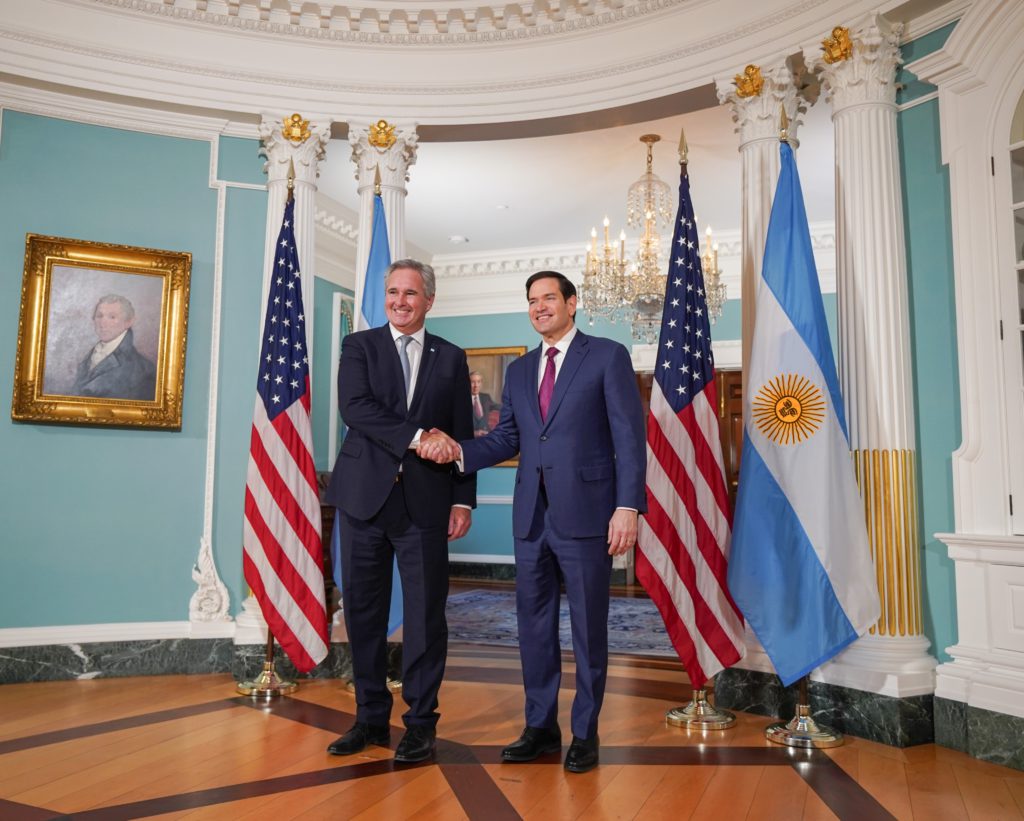
Argentine Foreign Minister Pablo Quirno meeting with US Secretary of State Marco Rubio. Credit: Secretary Marco Rubio | X

A deal on critical minerals between Argentina and the US signed this week does not rule out Chinese investment in the country’s mining sector, Argentine Foreign Minister Pablo Quirno said on Friday.

“This, as of today, does not imply that China cannot participate or will not participate in investments in Argentina. In fact, it has investments in Argentina, in minerals,” Quirno said in a press conference.

The agreement was announced after a meeting of more than 50 countries in Washington this week where US Vice President JD Vance proposed a trading bloc for critical minerals, with the US establishing a system creating price floors for the commodities.


The two countries also finalized a reciprocal trade and investment agreement on Thursday, with Argentina committing to prioritizing the US as a trading partner for its copper, lithium and other critical minerals over “market manipulating economies or enterprises” – a reference to China.

“What this Argentina-United States agreement does is that it gives greater predictability so that American companies, which are already the leading investor in Argentina, can increase their investments,” Quirno said.

Standing alongside Quirno, Argentina President Javier Milei”s cabinet chief Manuel Adorni did not directly respond to a question about whether Milei had plans to visit China, referring instead to upcoming visits he will make to the US.

Argentina was also seeking more “flexibility” within the Mercosur trade bloc, which also includes Brazil, Paraguay and Uruguay, with Bolivia poised to become a full member, Quirno said. He said that the Mercosur trade bloc doesn’t prohibit Argentina from reaching bilateral agreements, like this one, which he said took just over a year to finalize.

The reciprocal trade and investment agreement will have to be approved by Argentina’s Congress but Quirno said parts could go into effect through a presidential decree.

(By Leila Miller and Brendan O’Boyle; Editing by Cassandra Garrison and Mark Porter)


Brazil’s only rare earth producer offers US stake option for loan deal

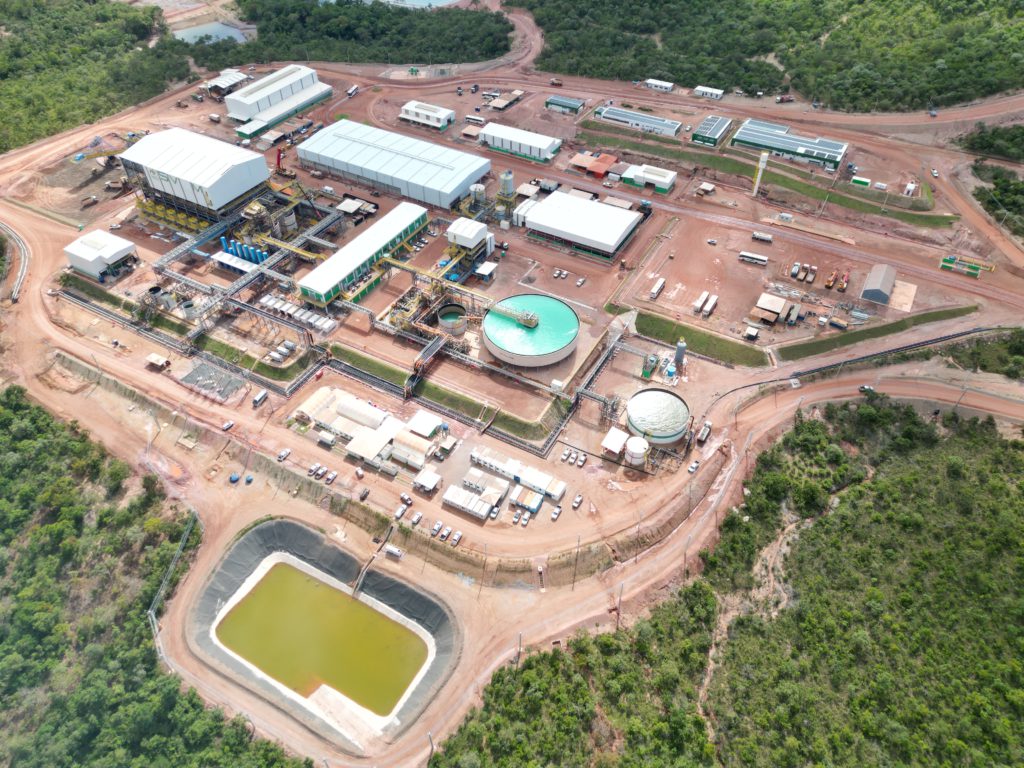
Serra Verde’s mine is expected to produce 6,500 tonnes of rare earth oxides this year. (Image: Serra Verde)

Brazil’s only producing rare earth miner has given the US an option to acquire a stake in the company as part of a financing deal.

Serra Verde Group secured a $565 million loan with the US International Development Finance Corporation — an amount 22% more than initially approved by the agency’s board last year. The loan is to help cover upgrades to the company’s Pela Ema operations in Brazil’s Goiás state. The final terms, disclosed by the company, opens the door to US involvement in the closely held firm.

“It is an option for the US government to take a minority stake in the company, with no role in management,” Serra Verde chief operating officer Ricardo Grossi said in an interview.

The Trump administration has been accelerating its backing of companies in the rare earth supply chain to counter China’s dominance in the sector, with the government offering loans and taking equity stakes in companies including MP Materials Corp. and Vulcan Elements. Meteoric Resources NL and Aclara Resources Inc., two developers with Brazilian rare earth projects, have also secured US financing, though at much lower amounts.

Talks between Serra Verde and the DFC have been ongoing for about 18 months, according to Grossi. The company is backed by Denham Capital, Energy and Minerals Group and the UK’s Vision Blue Resources Ltd.

The financing announcement comes after the Trump administration unveiled plans for a strategic critical minerals stockpile to insulate manufacturers from supply shocks as the US works to cut its reliance on Chinese rare earths and other metals. The venture, dubbed Project Vault, sets to marry $1.67 billion in private capital with a $10 billion loan from the US Export-Import Bank to procure and store minerals for automakers, tech firms and other manufacturers.

“It makes complete sense” for Serra Verde to be part of Project Vault, Grossi said, though such participation is still under discussion. “We view the initiative positively, as it could be a way to bring forward revenue for early-stage projects and help buy time until rare earth separation plants outside Asia mature.”

Grossi wouldn’t say whether the DFC funding will be tied to future supply deals, known in the industry as offtake agreements. Serra Verde is renegotiating rare earth supply agreements previously signed with Chinese customers, he said, with contracts expected to conclude by year end — opening the door to contracts with Western companies.

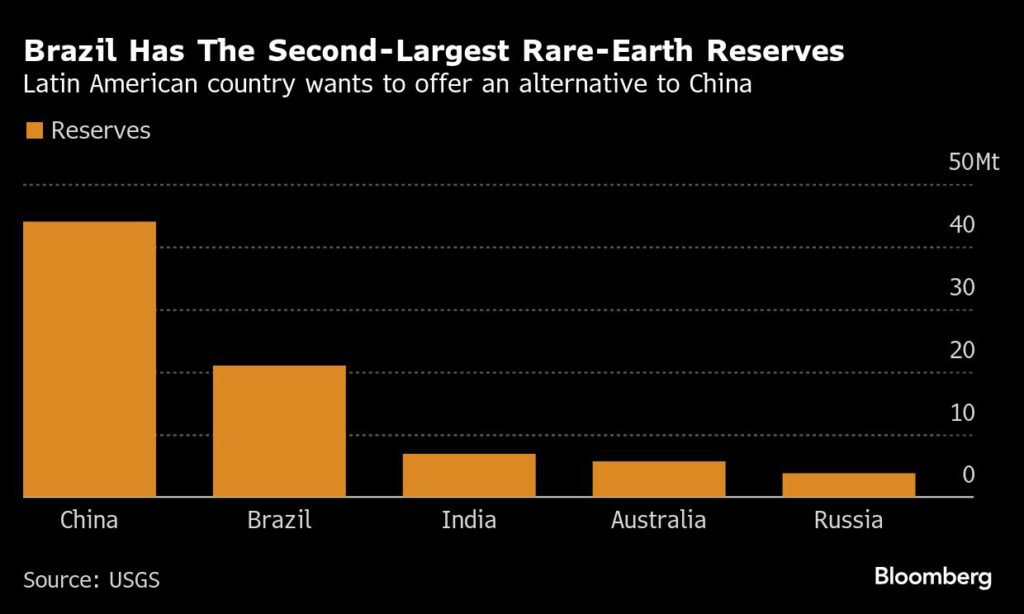
Brazil has the largest rare earth reserves outside China and Serra Verde is the country’s only producer of those metals. Its Pela Ema deposit contains light and heavy rare earth elements — mainly neodymium, praseodymium, terbium and dysprosium – that are key to making magnets used in a wide range of applications.

Serra Verde began commercial output at its mine and processing plant in 2024. The company aims to ramp up annual output to 6,500 metric tons of total rare earth oxides by the end of next year. The company is considering doubling production capacity within the next four years.

(By Mariana Durao)


Vance pitches price floors for key minerals to counter China

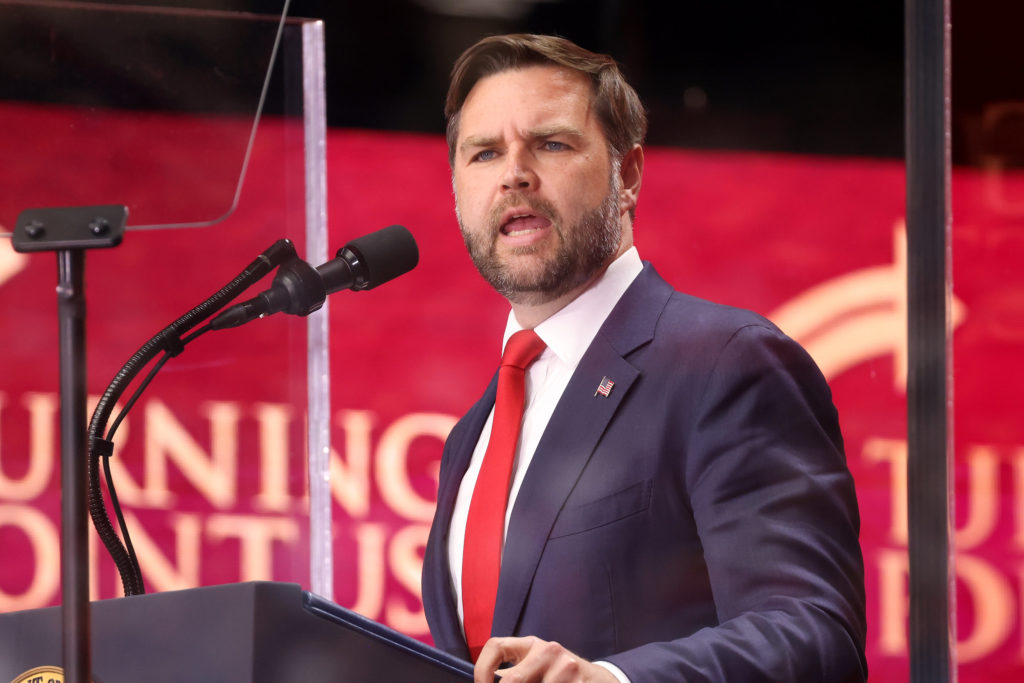
JD Vance. Credit: Gage Skidmore | Flickr, under licence CC BY-SA 4.0.

The Trump administration hosted 55 countries at a critical minerals summit on Wednesday, pitching price floors and a flood of US private equity in a bid to reduce dependence on China and ensure US manufacturers have stable access to key resources.

The European Union, Japan and Mexico each agreed with the US to set up new policies including price floors to help solve critical mineral supply chain vulnerabilities, according to statements from the US Trade Representative’s office.

Each also pledged to work toward a binding multilateral agreement on trade in critical minerals.

“Today, the international market for critical minerals is failing,” Vice President JD Vance said Wednesday in remarks to open the summit. “Consistent investment is nearly impossible, and it will stay that way so long as prices are erratic and unpredictable.”

Vance called on the audience of foreign officials to help create stable investment conditions. He pitched a “preferential trade center for critical minerals protected from external disruptions,” and made it clear the US is seeking coordinated agreement on price floors.

Price floors have long been discussed among critical minerals industry players as a way to shield non-Chinese companies from the Asian nation flooding markets and depressing Western firms’ profits.

For months, the US and its trading partners have worked toward some sort of cooperation to wean their global supply chains off China. The public statements Wednesday by key US partners, as well as the open discussion of price floors, suggest they’re getting closer to a solution.

The US and EU have committed to concluding a memorandum of understanding within the next 30 days aimed at boosting critical minerals supply chain security.

The US-Mexico arrangement will also include identifying specific critical minerals of interest and exploring price floors for metals imports, according to the USTR. Their agreement comes ahead of a joint review this year of the US-Mexico-Canada free-trade agreement, which could see significant revisions under Trump’s second term.

In his remarks, Vance cast the market for critical minerals as broken, with mining and processing projects abandoned due to volatile prices, and highlighted the administration’s $100 billion lending authority for critical minerals.

His comments built on President Donald Trump’s Monday announcement of plans for a nearly $12 billion critical minerals stockpile, in his latest effort to aid US manufacturers. What the administration has called Project Vault is meant to “ensure that American businesses and workers are never harmed by any shortages,” Trump said at the White House.

The stockpile is set to be financed through $1.67 billion in private capital and a record $10 billion loan from the Export-Import Bank, whose chief executive officer cast the new setup as a “uniquely American” mechanism that relies on a government-led push for private funding.

“We’re crowding in, most importantly, US private equity participation,” Ex-Im CEO John Jovanovic said in a Bloomberg Television interview on Wednesday. The Bank has “an assurance of repayment, we have a fantastic basket of credit risk to look to, and we have physical inventory upon which we’ll earn interest,” he added.

While ending US reliance on China has long been a goal for Washington, it became more urgent last year after Beijing announced export restrictions on so-called rare earths. Trump and Xi Jinping agreed to a trade truce in October that delayed the implementation of the Chinese measures by a year.

Trump spoke with Xi by phone on Wednesday, with the US president saying in in a social media post the two leaders had a “long and thorough call” that included trade. Trump said he looks forward to his April visit to China.

US officials on Wednesday avoided singling out China by name during the summit, with Secretary of State Marco Rubio noting that critical minerals supply “is heavily concentrated in the hands of one country.”

“That lends itself to — at the worst-case scenario — being used as a tool of leverage and geopolitics, but it also lends itself to any sort of disruptions, like a pandemic,” Rubio said in a press conference.

China is home to more than 90% of global rare earths and permanent magnets refining capacity, compared with just 4% for second-place Malaysia, according to the Paris-based International Energy Agency. The rapid expansion of AI is fueling demand for critical minerals used in data centers and high-performance chips.

“Everything is geographically concentrated in China, which really isn’t a value judgment — it’s an objective fact,” said Under Secretary of State for Economic Affairs Jacob Helberg, speaking with reporters on Tuesday to preview the summit. “And so, ultimately, countries want to diversify and de-risk the supply chain, which inherently means de-risking single points of failure.”

The summit and initiative build on years of efforts by prior administrations, including the US Energy Resource Governance Initiative in Trump’s first term and the Biden administration’s Minerals Security Partnership.

Rubio is hosting the talks on Wednesday and the summit is attended mainly by foreign ministers and other diplomats, but Treasury Secretary Scott Bessent and Trade Representative Jamieson Greer have also been involved in the discussions.

(By Eric Martin and Joe Deaux)


How Rio–Glencore talks fell apart

MINING.COM Editor | February 6, 2026 

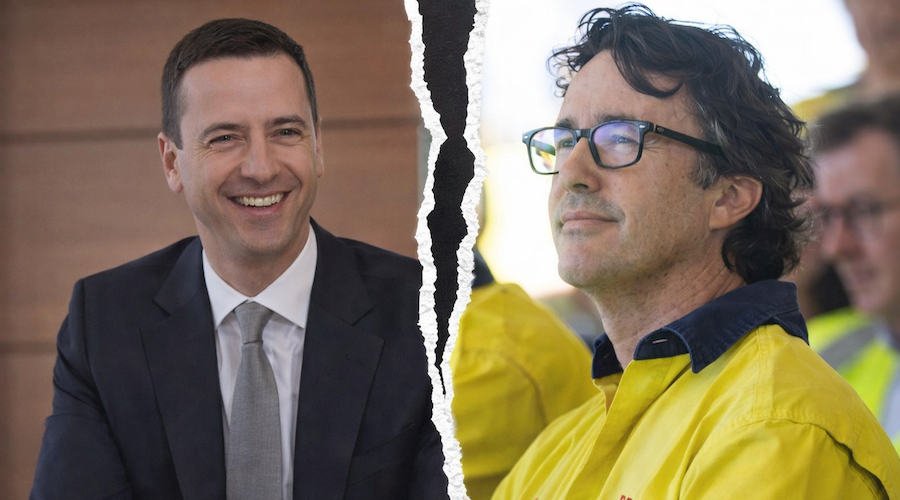
Glencore’s Gary Nagle and Rio Tinto’s Simon Trott. (AI-assisted image.)

Former Glencore (LON: GLEN) chief executive Ivan Glasenberg spent years pursuing one prize above all others: a merger between his firm and Rio Tinto (ASX, LON: RIO) that could have reshaped global mining.

That ambition died quickly this week, with the latest talks collapsing in less than 24 hours as Rio announced it would no longer pursue a merger or any other business combination. The miner concluded it could not strike a deal that didn’t deliver enough value for its shareholders. 

Glencore’s response opened with who would be in charge, saying Rio wanted to retain both the chief executive and chair roles, before getting to what it considered the real issue, the Financial Review reported. The company said Rio’s proposed ownership structure “significantly undervalued Glencore’s underlying relative value contribution to the combined group,” even before any takeover premium.

To be clear, leadership mattered to both sides. Ben Davis at RBC summed it up neatly, saying the talks were always going to be difficult and that it was unclear what brought the two companies back together so quickly, or what pushed them apart just as fast.

Still, no one close to the negotiations believes this deal collapsed because executives could not agree on titles or office space. Glencore’s CEO Gary Nagle was prepared to walk if the price was wrong, and for Rio’s Simon Trott, control was inseparable from valuation. In the end, who would be in charge was simply a stand-in for the only question that mattered: who was paying for what.

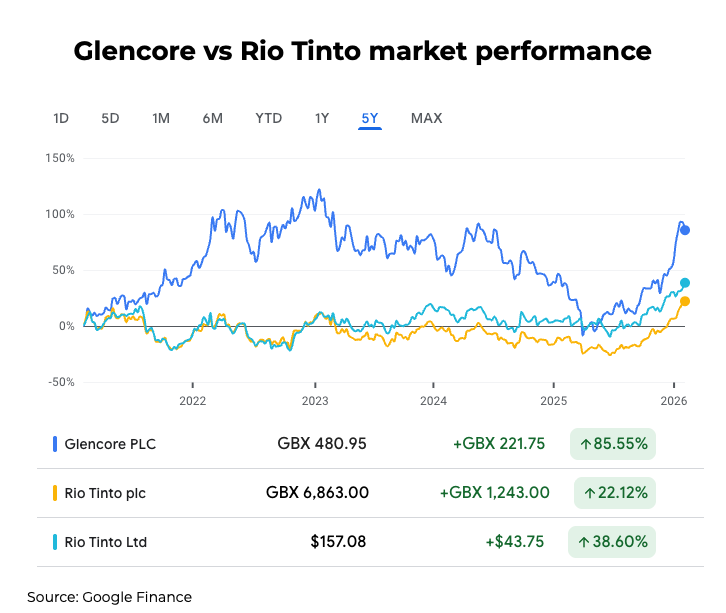
Rio entered the talks as the larger company, with more than double Glencore’s market value, and wanted any merger to reflect that dominance. 

Glencore, by contrast, pushed for a more balanced structure, with one company naming the chair and the other the CEO, framing the transaction as a merger rather than a takeover. Strip away the rhetoric, and that balance was simply Glencore’s way of defending its valuation.

Beginning of the end

The mood shifted sharply just a day before Rio’s deadline to make a formal bid, when it became clear Glencore was not going to move far from its demand that its shareholders own about 40% of the combined company. With Glasenberg still Glencore’s largest shareholder, that line was not going to soften.

Strategically, both sides had plenty to gain. Glencore was coming off a decade in which its copper output had fallen more than 40%, even as copper prices surged to record highs. Management was in the middle of convincing investors the business had turned a corner. Rio, meanwhile, saw a way to loosen its dependence on iron ore at a time when prices were sagging under rising supply and softer demand, and to unlock growth in Glencore’s copper portfolio.

A tie-up would have been transformative. Rio could have overtaken BHP Group as the world’s largest miner, folding Glencore’s coal, copper and trading operations into its iron ore powerhouse. More importantly, Rio would have doubled its copper output, positioning itself as the world’s top copper miner with roughly one million tons of future growth.

The sticking point

Before talks began, the implied value split between the companies sat around 69–31 in Rio’s favour, while Glencore pushed for something closer to 60–40. That gap sat at the heart of the dispute. 

From Glencore’s perspective, the 69–31 split reflected a snapshot that flattered Rio, taken when coal prices were weak and iron ore prices unusually strong, partly due to tensions between BHP and the Chinese government that constrained some iron ore flows.

Glencore argued a 60–40 split better captured the long-term value of its portfolio, especially its 10 copper growth projects. If Rio wanted full control, including both chair and CEO roles, Glencore believed Rio should also pay a clear takeover premium.

Financial Review columnist James Thomson noted before the talks collapsed that Glencore effectively had two prices in mind: a merger price with shared leadership, and a higher takeover price if Rio took the reins outright.

On Thursday, the combined value of the two companies stood at about $232 billion. The gap between what Rio was willing to pay and what Glencore believed it was worth proved impossible to bridge.

In the end, this was not a story about bruised egos or corporate pride. It was about timing, market cycles and a fundamental disagreement over value. Until those numbers align, the mining industry’s most tantalizing merger will remain just that: a deal that made strategic sense, but never added up.

Eramet’s finance chief steps aside temporarily, days after CEO ouster

Moanda mine in Gabon. Credit: Eramet

French miner Eramet’s finance chief Abel Martins-Alexandre has stepped aside temporarily during a probe into management methods, a company spokesperson said on Friday, days after Eramet ousted its chief executive.

“Eramet confirms that an interim management has been put in place in its finance department while its CFO steps aside temporarily during an investigation into management methods,” the spokesperson told Reuters.

CEO Paulo Castellari’s dismissal on Sunday was due to coordination issues with the board and staff, rather than the company’s financial results, Chair Christel Bories said previously.

The Financial Times, which first reported the news on Friday, said Martins-Alexandre, who joined the company in September and was considered close to the ousted CEO, had been on sick leave after Castellari’s exit.

Castellari’s ouster just months into his term raised questions over governance at the nickel, manganese and lithium miner, which is partly owned by the French state. Shares of the company are down nearly 8% this week.

The FT, citing sources, said Castellari’s dismissal and Martins-Alexandre’s suspension are not related to any allegations of wrongdoing.

Martins-Alexandre and Bories did not immediately respond to requests for comment.

The FT report added that Castellari and Martins-Alexandre had in recent weeks been setting up an internal task force to look into potential financial mismanagement within the group in recent years

Eramet has cited weakness in metal prices and production setbacks at some of its mines for declining results in the past year.

(By Abu Sultan and Gus Trompiz; Editing by Vijay Kishore and Will Dunham)

Prabowo puts Indonesia on collision course with global investors

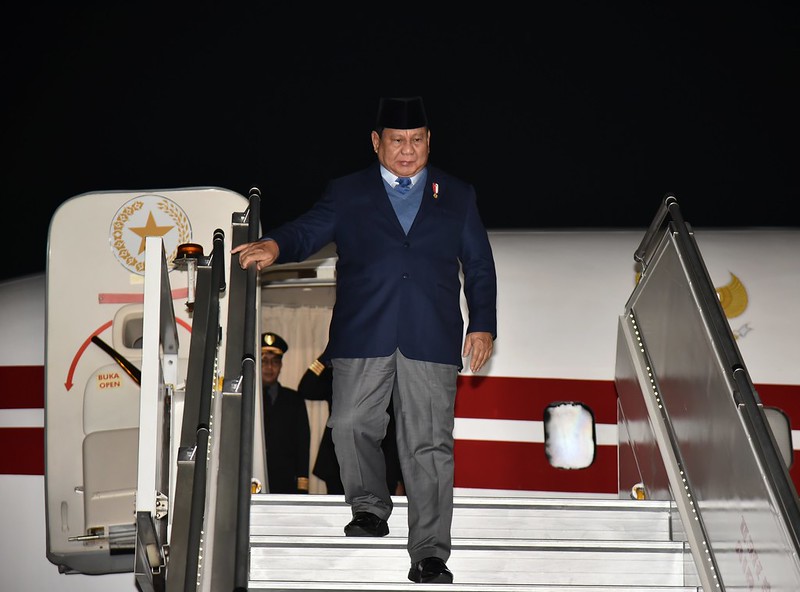
Indonesian president Prabowo Subianto during a visit to India earlier this year. Credit: MEAphotogallery via Flickr

As Indonesia’s stocks plummeted last week, a group of executives thousands of miles away were starting to panic for a different reason.

Reports emerged that Danantara, a sovereign wealth fund that reports directly to President Prabowo Subianto, was considering a takeover of one of Indonesia’s largest gold mines. Key investors of Jardine Matheson Holdings Ltd., a Hong Kong-based conglomerate that controlled the mine, were getting anxious, according to people familiar with the situation. The investors wanted Jardine to answer a simple question: Do you still own the gold mine or not?

The episode underscores the quandary facing investors looking at Southeast Asia’s biggest economy: Is the “New Indonesia” envisioned by former leader Joko Widodo — one that would propel the nation into the ranks of the world’s top five economies by 2045 — still on track?

For the moment, the answer remains unclear. On the one hand, regulators reacted quickly to MSCI Inc.’s warning that Indonesia may be relegated to frontier-market status, halting a two-day market meltdown and reassuring many money managers about the nation’s long-term prospects. But at the same time, the threatened gold mine seizure suggests that Prabowo may yet find himself on a collision course with foreign investors and Indonesia’s most influential tycoons.

Moody’s Ratings on Thursday lowered its outlook on the country’s credit rating to negative, citing “reduced predictability in policymaking” and poor communication by Prabowo’s government. Stocks, bonds and the rupiah all slid on Friday, even as Finance Minister Purbaya Yudhi Sadewa pushed back and said Indonesia was in a “better position” than other countries regarding its fiscal deficit and growth prospects.

“Overall I see the state as more centralized and predatory under Prabowo,” said Eve Warburton, research fellow at the Coral Bell School of Asia Pacific Affairs at the Australian National University and author of Resource Nationalism in Indonesia: Booms, Big Business and the State. “Understandably, the domestic private sector is anxious and foreign investors are spooked.”

Having waited in the wings for decades, including as a military leader under the late dictator Suharto, Prabowo is now in a hurry. In power for a little more than a year, the 74-year-old former special forces commander is centralizing control, squeezing tycoons, expanding the military’s role in government and putting confidants into key roles, including installing his nephew at the central bank.

After deadly protests broke out last year over inequality and the cost of living, he responded by firing his finance minister, the well-regarded technocrat Sri Mulyani Indrawati, and elevating a loyalist more willing to loosen the fiscal strings. His government last year came close to hitting a long-held fiscal ceiling imposed after the 1997 Asian Financial Crisis.

For Prabowo, the changes are necessary. The goal of Danantara is to harness Indonesia’s wealth, make state-run companies more efficient and provide funds to invest in industries of the future. Land seizures are all about enforcing the law.

Speaking at the World Economic Forum in Davos last month, Prabowo railed against “robber barons” and “greednomics” while vowing to lift up poorer citizens who live in shacks with no clean water or toilets. He has already begun targeting the nation’s tycoons and billionaires, including considering a new law that would allow authorities to seize assets of individuals allegedly involved in corruption without waiting for a criminal process to prove their guilt.

“Let me say this clearly: There is no investment climate without the certainty of equitable rule of law,” Prabowo said. “Nobody will come in to invest in a country that’s lawless or of dubious legal tradition.”

The Martabe gold mine in Sumatra, Indonesia’s westernmost main island, is just the latest bellwether for where Indonesia might be heading. The communications have been confusing throughout, and it remains unclear how the dispute will be resolved.

Within Danantara, an agency created by Prabowo last year that brought Indonesia’s state-owned enterprises under one roof, a debate has been brewing over the merits of obtaining the gold mine. The fund’s mining unit has yet to communicate plans internally to initiate a takeover, according to one person familiar with its inner workings, noting there is some concern among Danantara executives that a seizure would hurt investor sentiment.

Jardine’s executives initially told institutional investors they didn’t know the status of the gold mine and were racing to find out, according to people familiar with the matter. Senior officials at Danantara eventually told Jardine that the sovereign wealth fund had no intention to take over the mine, but they needed to wait for guidance from Prabowo before formally responding, one of the people said, asking not to be identified discussing private conversations.

Prabowo’s communications office declined to comment and referred questions to Danantara, which didn’t respond to requests for comment. Asked for comment, Jardine said Thursday that its subsidiaries hadn’t received any formal communication from Prabowo’s government about the status of the mine. Discussions are ongoing with Indonesian regulators but next steps are still to be determined, the company added.

Although Indonesia has many things going for it — a young and large population, relatively high levels of consumption and abundant resources like nickel, coal and gas — the negatives are adding up both for companies making investments and traders looking for alternatives to the dollar.

Amid one of the biggest selloffs in Indonesia in decades, officials in Jakarta last week raced to stem the bleeding: They vowed to quickly address MSCI’s concerns over the transparency of shareholding structures, including by doubling the free float to 15% — a figure on par with Thailand though below the 25% in India. The heads of the stock exchange and Financial Services Authority resigned.

The flurry of activity worked, at least for a bit, with the index appearing to halt its freefall despite large swings in recent days. Market players noted that the MSCI move mainly affected equities, without much initial impact on the currency and bonds.

But they also said the index provider had a point. The problems had been festering for years, with regulators taking little action to make changes before MSCI stepped in with a statement. Now Indonesian officials have until May to prevent a downgrade, and many investors are hopeful that the episode will spur reforms that ultimately boost market sentiment in the long term.

“If they don’t shape up, they will have lost a big opportunity,” said Greg Lesko, portfolio manager at Deltec Asset Management, citing Indonesia’s demographics and the global rate cycle as positives. “Hopefully the MSCI was a wakeup call.”

That sentiment was echoed even by key officials with Danantara. Pandu Sjahrir, its chief investment officer, said at an economic forum last week that MSCI had long been clear about what the overseers of Indonesia’s stock market need to do.

“I’ll leave it up to the regulators to decide how they want to work on this,” he told an audience at the Grand Ballroom of the Ritz Carlton Pacific Place, across the street from the stock exchange. “I think the information is accurate, and you can’t blame anyone. I think what MSCI did was right.”

The swift reaction by Prabowo’s government to the MSCI statement stood in stark contrast to the confusion over the land seizures. His government last year confiscated an area the size of Switzerland, describing the land as being used illegally. Prabowo last month suggested he could double those holdings in 2026 to fight what he called “hundreds of illegal mines.


In Davos, the president made no apologies.

“Perhaps these rapacious so-called entrepreneurs feel that they need not recognize the sovereignty of the Indonesian government,” Prabowo said.

The Martabe mine, which is controlled by Jardine through subsidiary PT Astra International, is among 28 operations that had licenses revoked for alleged environmental damage in the wake of devastating floods in December that killed more than 1,100 people in Sumatra. Jardine said Thursday that government investigations into whether the mine impacted flooding are still ongoing.

The dripfeed of statements on government actions regarding the Martabe mine are adding to the confusion, along with Danantara’s role in the episode. The plan for a new company called Perminas to take over the gold mine slipped out when Dony Oskaria, Danantara’s chief operating officer, made the disclosure last week to reporters at a public forum.

At a business forum in Jakarta this week, Purbaya — who took over as finance minister in September — said MSCI’s warning was good for Indonesia. He also called Prabowo’s government “very fair,” saying the revocation of permits for some mining companies was a step toward fostering a positive investment climate.

“It’s not the end of the game,” Purbaya said, referring to the disputed gold mine. “Jardine can always complain, or complain to our government, as long as they conduct their business properly.”

Separately, Hashim Djojohadikusumo, Prabowo’s younger brother and one of his closest advisers, said Tuesday that the 28 companies could appeal the decisions in the courts. In particular, he noted, firms with operations unrelated to floods should have them restored.

“The president has said several times, including to me, that he doesn’t want a miscarriage of justice,” Hashim said. “If the company objects, they should immediately file an objection. I think that’s absolutely right.”

PT Agincourt Resources, which directly operates the Martabe mine, didn’t respond to requests for comment. PT United Tractors, the listed unit that controls Agincourt, said late Thursday in a response to a stock exchange inquiry that Agincourt hadn’t received any information regarding the proposed transfer of the mine to Perminas. Astra International didn’t respond to a request for comment.

Indonesia has refrained from outright cancellation of contracts since 1998, when Suharto’s order to suspend all infrastructure projects led to a prolonged international legal battle over a power plant that involved US investors, according to Kevin O’Rourke, a principal at Jakarta-based consultancy Reformasi Information Services, who has written about the country’s business climate for decades.

“If the government does indeed proceed with unilateral revocation of Agincourt’s contract, this would inevitably reverberate in all economic sectors and further hamper prospects for valuable FDI,” O’Rourke said.

The episode also lands at a moment investors are watching a broader set of signals about how power is being exercised — from court cases that draw international attention to changes that touch core economic institutions.

Prabowo raised eyebrows last year when he backed Suharto, his former father-in-law who led Indonesia for three decades, as a national hero — a move that infuriated human rights groups. Critics have questioned the military’s expanding role, including new development battalions linked to the food-security push behind Prabowo’s free meals program, even as troops have been used to accompany teams seizing illegal plantations.

The narrative of a “New Indonesia” took hold a decade ago when the country elected Widodo, its first president from outside the military or political elite. He presided over an expansion of infrastructure in Indonesia, including a planned new capital outside Jakarta, but he also disappointed many supporters by eroding democratic institutions during his second term.

The concentration of power in the presidency under Widodo has now accelerated under Prabowo, according to John Sidel, director of the Saw Swee Hock Southeast Asia Centre at the London School of Economics and Political Science.

“The election and inauguration of Prabowo has marked a real low point in terms of the evolution of Indonesian democracy,” he said. “Arguably it could be worse, and perhaps there is worse to come.”

(By Ben Otto, Rosalind Mathieson, Abhishek Vishnoi and Echo Wong)