
Friday, February 20, 2026

Trump praises Czech Foreign Minister Macinka for attacks on EU and US liberals

Trump praises Czech Foreign Minister Macinka for attacks on EU and US liberals
Petr Macinka of the anti-green, eurosceptic Motorists clashed with his Polish counterpart Radek Sikorksi and former US presidential candidate Hillary Clinton at the Munich Security Conference. / Munich Security Conference
By bne IntelliNews February 20, 2026

US President Donald Trump praised the Czech Minister of Foreign Affairs and the leader of the anti-green and Eurosceptic Motorists for Themselves party Petr Macinka following Macinka’s participation at a debate at the Munich Security Conference where he provoked clashes with Hillary Clinton and his Polish counterpart Radek Sikorksi.

“Great job in your Debate against Hillary Clinton on various subjects, including her ridiculous views on Gender. Say hello to everybody in your wonderful Country! President DJT,” Trump wrote on his Truth Social online platform.  

At the debate on February 14, Macinka defended Trump policies in the US, saying that “I think what Trump is doing in America is a reaction that in some political areas it went too far, too far from regular people, too far from reality,” as reported by the Czech Press Agency (CTK) and other media.

 “I disagree with gender revolution, with climate alarmism,” Macinka stated, pushing the gender issues on the agenda of the security conference, to which Clinton replied “what gender, that women have their rights?”

During the debate at a panel, which also included Bulgarian political scientist Ivan Krastev and Hungarian political scientist Gladden Pappin, Clinton slammed the Trump administration for “pushing Ukraine into a capitulation to Putin,” which she described as “shameful”.

“I think that the efforts of Trump and Putin to benefit from the suffering and death of Ukrainians is a historical mistake,” Clinton also stated.

Macinka also criticised the European Parliament at the debate suggesting that national parliaments are supposed to have more democratic legitimacy, which prompted Macinka’s Polish counterpart Radek Sikorski to point out that both EU and national parliaments emerge from democratic elections held in the EU member states.

Macinka also travelled as a Czech observer to the first meeting of Trump’s Board of Peace in Washington D.C. where he said he had met with leaders of US administration and Trump had asked him whether he saw his Truth Social post.

“Surprisingly everyone, the American President, as well as the American Vice President and the Minister of Foreign Affairs, saw a record of my debate with Hillary Clinton at the Munich conference,” Macinka was quoted as saying by online news outlet Seznam Zprávy.

AU CONTRAIRE

RAGOZIN: Rubio in Budapest, pulling Orban's puppet strings
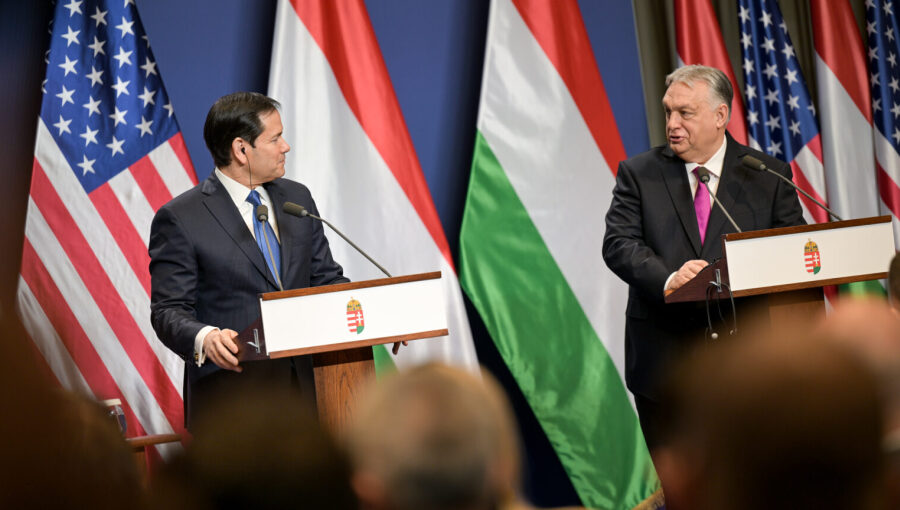
RAGOZIN: Rubio in Budapest, pulling Orban's puppet strings
US Secretary of State Marco Rubio’s endorsement of Hungarian Prime Minister Viktor Orbán has drawn criticism from American liberals ahead of Hungary’s April elections, highlighting deepening transatlantic political divisions. / bne IntelliNews
By Leonid Ragozin in Riga February 20, 2026

When US state secretary Marco Rubio toured Hungary and Slovakia last weekend, American liberals were aghast. They were specifically flared up by Rubio openly endorsing the incumbent Hungarian prime minister, Viktor Orbán, in the upcoming elections scheduled in April.

Some claimed Rubio had no right to interfere in the democratic process in a European country, others made it clear that they simply wanted Orbán, who defies EU leadership and Western liberal mainstream on Ukraine, to be defeated. “If I were just an average Hungarian, my attitude would be: I want to be electing somebody who’s for Hungary, not somebody who is a puppet of Donald Trump”, Rubio’s predecessor Hillary Clinton said in an interview.

Interfering in other country’s political process is of course a staple of standard America foreign policy, which Clinton embodies. She was instrumental in overthrowing Muammar Gaddafi’s regime in 2011 - a move which instead of helping to democratise Libya, plunged it into a civil war that kept raging for many years. Her husband, Bill Clinton, intervened in Yugoslavia, taking the anti-Serbian side instead of trying to act as an arbiter and genuinely trying to prevent ethnic cleansing, on all sides. By doing so, he triggered Russian prime minister’s Yevgeny Primakov famous U-turn over the Atlantic and with it - a new historical cycle of superpower confrontation in Europe that would eventually lead to the war in Ukraine.

One larger than life feature of American interference in Eastern Europe, by both Democratic and Republican administrations has always been their flirtation with local nationalism, no matter how rabid - as long as it is anti-Russian. This pattern reached grotesque proportions in Ukraine, starting with US undersecretary of state Victoria Nuland touring Maidan barricades and posing for photos with revolutionary leaders, including the anti-Semitic far-right leader Oleh Tiahnibok, and going all the way to the US funding of corps-sized ideologically far-right military formations controlled by people with clear neo-Nazi roots, such as Andriy Biletsky.

But - thanks to globalism and American leadership - local politics in Europe has to a large extent become an extension of domestic American politics, which in its turn has grown critically polarised during the last decade. These days, the American political barricade - between far-right populists and self-proclaimed “liberals” (their liberal credentials warrant much scrutiny, especially in foreign policy matters) - extends into countries like Hungary and Poland. This is the context behind Rubio’s visit to Hungary with a clear aim of endorsing the Trump administration’s ideological ally in Europe on the eve of Hungarian elections - in defiance of the EU leadership which sides with Trump’s liberal rivals in America.

Rubio’s political intervention in Hungary triggers the liberals, but what they will never admit is the causality between their own endorsement and nurturing of rabid East European nationalism over past decades and Eastern Europe turning against them now, as manifested by Orbán and many others today.

Liberal poster child           

Orbán might be currently trailing behind his chief rival Peter Magyar of the Tisza party, but he represents a larger-than-life trend - that which spreads all across the former Eastern Bloc, especially across the Visegrad Group (Poland, Czechia, Slovakia and Hungary), once a prime showcase of the radical Westernisation former Soviet satellites underwent in the 1990s. To a varying extent, these countries have all fallen under the spell of modern far-right politics, which - as its inner logic dictates - brings them to questioning their geopolitical choices, either cautiously or brazenly, as Orbán has been doing over the last decade.

This trend is not going away even if Orbán loses the election in April. His rival Magyar, to begin with, is a former functionary of Orbán’s own party who treads carefully in order not to antagonise the undecided electorate by saying things that veer too far away from Orbán’s nationalist paradigm, especially on Ukraine.

With Orbán serving as the region’s most prominent political role model, two neighbouring countries - Slovakia and Czechia - have been overtaken in recent years by politicians of the same political streak. Even the main bulwark of hardcore Atlanticist supremacism in Eastern Europe, Poland, elected a far-right Ukraine sceptic, Karol Nawrocki, as it president. Meanwhile in Romania, it took a brazen interference of the secret services in democratic process to prevent Russia-friendly far-right candidates from seizing the presidential office.

While liberal commentators favour conspiracy theories about the European far-right being Russian assets, alongside Donald Trump, this trend truly stems from the inherent bug of velvet revolutions that swept away Europe’s communist regimes back in 1989-91. It was the liberals who sowed what they are reaping today.

These revolutions liberated a few dozen countries from a totalitarian regime, but they truly weren’t genuinely liberal. They were engineered by an alliance of liberals and nationalists in which the former were - a) often phoney, b) a minority.

Nationalism and Western supremacism, not liberalism, were the main components of velvet revolutions. The instincts of East European politicians were far closer to their right-wing authoritarian and, at times, quasi-fascist predecessors from the 1930s, an epoch celebrated as a golden age across the region, then to the slogans of multiculturalism and tolerance championed by Bill Clinton or later by Barack Obama.

They played along with what they thought was the decadent West’s childish games of fancy until the West itself began embracing far-right politics, whereupon they began showing their true colours. Orbán embodies this evolution. Back in the 1990s he was a poster child of East European liberalisation, becoming the vice-chairman of the global Liberal International in 1992. But mindless and cynical geopolitics trumped liberalism from the outset. Like Lech Wałęsa of Poland and Václav Havel of Czech Republic, he championed the policy of extending NATO to the Russian borders while explicitly keeping Russia out of the Euro-Atlantic integration - a policy that lies at the heart of the current conflict in Ukraine.

Orbán’s later evolution into a conservative and nationalist politician first, and into Putin’s ally in the EU later, was only natural and logical, dictated by the original algorithm of an East European politician from his generation. Russian President Vladimir Putin himself underwent the same evolution since being elected in 1999. But his or Orbán’s trajectory reflect the political and cultural evolution of the entire Global North, of which Russia remains a prominent part, even as a temporary outcast. The trend of far-right radicalisation doesn’t originate in Moscow or Budapest, on the West’s cultural and political periphery. It comes from its very heart - Washington DC.

The inherently illiberal and xenophobic component of velvet revolutions affected the political thinking in the 1990s. In her famous book Not One Inch, US historian of international diplomacy Mary Sarotte describes how the constant pressure from Eastern European leaders Wałęsa and Havel, aided by personal ambitions of middle-ranking Clinton administration staffers, resulted in the US-led West losing a historical chance to integrate Russia and forget about conflicts in Europe for at least another century. Their argument boiled down to a vague future Russian threat, which was non-existent at the time, but it turned into a self-fulfilling prophecy as Moscow began to feel more and more ignored, alienated and excluded from European integration in the late 1990s.

Orbán model in Ukraine?

Fast-forward to the conflict in Ukraine and Western liberals find themselves irreversibly stuck in an unholy alliance with far-right extremists, far worse than Orbán, which they’ve now spent decades whitewashing and nurturing, while simultaneously denying its very existence.

People like the leader of Azov Movement (a vast network of huge army units, paramilitary youth and veteran organisations) Andriy Biletsky, has long become one of the liberal Western media’s darlings in Ukraine, while Yevhen Karas of the neo-Nazi group C14 gets invited to lecture British highbrow society at Chatham House.

What completely escapes the liberal mainstream is that people like Biletsky and Karas are ideologically infinitely closer to more obscurantist elements inside Putin’s regime than to liberal values. The Azov Movement’s ideas of Reconquista, a white supremacist revolution in Europe, are a version of Russia’s Duginism, the only true difference being over the choice of capital for the new Reich - Kyiv or Moscow.

Just like their like-minded comrades and old friends in Russia, the Ukrainian far-right is a largely inorganic political force that derives from an unholy alliance of secret services and organised crime groups, both adopting neofascism as their corporate ideology. The Azov Movement in particular was strongly influenced by Russian neo-Nazis with clear FSB links from its inception as “Little Black Men” in the Kharkiv region in the spring of 2014.

These elements are traditionally easier for the Kremlin to negotiate with than with the more mainstream politicians in Ukraine. Just look at Georgia, if you wonder how far-right ideology, along with the West's bizarrely counter-productive foreign policy, helped to sway this country, once a showcase of post-Soviet Westernisation, to Moscow’s side.

Look at the oscillations of major Ukrainian far-right leaders, Illia Kyva and Oleh Shiryayev, in recent years for a foretaste of things to come, if the war ends on the terms largely dictated by Moscow, which it most likely will.

A prominent Right Sector personality who once called for executing pro-Russian Ukrainians in Donbas, Kyva, broke up with Ukrainian ultra-nationalism and united forces with Putin’s main ally in Ukraine, Viktor Medvedchuk, helping to set up a paramilitary wing of the latter’s parliamentary party in 2019. He managed to recruit Oleh Shiriayev, an influential Azov Movement figure who controlled a large chunk of the movement’s paramilitary force in Kharkiv.

When Russia launched an all-out invasion of Ukraine in 2022, their paths parted. Kyva escaped to Russia where he was assassinated by Ukraine’s secret services a year later. Shiryayev, on the other hand, chose the Ukrainian side and eventually became the commander of the 225th regiment, which played a prominent role in Ukraine’s failed Kursk operation. Ukrainian President Volodymyr Zelenskiy awarded him with the Hero of Ukraine title.

Today, Shiryayev appears on major English-language TV networks, such as CNN and Sky News, being presented as a brave hero, his past digressions never pointed out or even remembered. But what further career twists we might expect from him is the million dollar question. His current glorification by Western media highlights modern Western liberals’ trademark unscrupulousness coupled with extreme arrogance when it comes to anything related to the former Soviet Union. What will they say if, disillusioned with the lack of sufficient Western aid, the Ukrainian far-right will start turning to Putin, like Chechen President Ramzan Kadyrov’s clan did in Chechnya in the early 2000s? Perhaps nothing - today’s liberal milieu is hardly known for deep strategic thinking, more about immediate gain at the expense of their own future.

But is it even fair to call them liberals these days when what they represent is just another streak of Western supremacist populism, simply with another set of bogeymen and conspiracy theories than Trump? That’s a bigger question, which warrants another investigation.


Fact Check: German parade floats mocking Trump are real. Here's why the caricatures were displayed

Emery Winter
Wed, February 18, 2026 


Getty Images

Images circulating on social media show floats mocking U.S. President Donald Trump at German parades, including a float of a pantsless Trump and a gagged Statue of Liberty.See more


Claim:

Images authentically show floats mocking U.S. President Donald Trump at a German parade, including a float of a pantsless Trump and a gagged Statue of Liberty.

Rating:
Rating: True

In February 2026, social media users (archived) shared images of a parade float with a caricature of U.S. President Donald Trump licking a gagged Statue of Liberty.

According to a Facebook post, the float was one of three satirizing Trump in "Düsseldorf's infamous Rose Monday carnival parade." Düsseldorf is a city in western Germany.


Different versions of the claim circulated on various social media platforms. For example, another Facebook post (archived) shared an image of the same float, claiming it was from a "German Presidents Day Festival." On X, one user claimed (archived) it was from a carnival in Mainz, Germany.


A Reddit post (archived) included the image among other parade floats mocking Trump, claiming they were from "Düsseldorf's Rose Monday Parade." Other purported parade floats depicted Trump punching Jesus and trying to devour Europe with Russian President Vladimir Putin.

The images of the satirical Trump and Statue of Liberty float, as well as other floats mocking Trump, were authentic photos depicting scenes from real German parades. While the parades were held on America's Presidents Day, the German parades are annual traditions dating back to before that holiday existed.

Photos of the float with Trump and the Statue of Liberty were available from Getty Images, Alamy and Reuters. All three photo agencies said the float was from a Rose Monday parade in Mainz.

The city of Mainz describes Rose Monday as the highlight of carnival season, which it called its folk festival with "fantastic days and nights of revelry." Carnival starts annually on Nov. 11 and ends on Ash Wednesday. Each year, the city hosts a parade on Rose Monday, the final Monday before Ash Wednesday.


In 2026, Rose Monday was Feb. 16, the same date that the U.S. celebrated Presidents Day. A Mainz Carnival website, which dates these celebrations back to 1838, also confirmed the annual parade was scheduled for Feb. 16.

Congress didn't create Presidents Day, celebrated on the third Monday of February, until 1968.

The Mainz Carnival Museum says that the floats which satirize current events and politics are an "important part of the parade."

The photo of the float with Trump and the Statue of Liberty was often shared alongside the photos of floats depicting Trump punching Jesus and trying to devour Europe with Putin. Getty Images placed the other two floats as being from Düsseldorf.

Düsseldorf, Mainz and Cologne, another German city, are the "three strongholds of the Rhineland Carnival," according to a nonprofit group that seeks to preserve and share Düsseldorf's carnival traditions. Düsseldorf, like Mainz, celebrates Rose Monday with a parade that includes floats satirizing current events and politics.
Sources:

"Fünfte Jahreszeit in Mainz." Landeshauptstadt Mainz, www.mainz.de/freizeit-und-sport/feste-und-veranstaltungen/fuenfte-jahreszeit.php#SP-grouplist-4-1:1. Accessed 18 Feb. 2026.

"George Washington's Birthday or Presidents Day?" George Washington's Mount Vernon, www.mountvernon.org/george-washington/facts/the-truth-about-presidents-day. Accessed 18 Feb. 2026.

"Karneval in Düsseldorf." Karneval in Düsseldorf, www.karneval-in-duesseldorf.de/. Accessed 18 Feb. 2026.


Lohnes, Thomas. "A Carnival Float Shows US President Donald Trump Dancing..." Getty Images, 16 Feb. 2026, www.gettyimages.com/detail/news-photo/carnival-float-shows-us-president-donald-trump-dancing-news-photo/2261916604?adppopup=true. Accessed 18 Feb. 2026.

REUTERS. "Rose Monday Parade in Mainz." Reuters Connect, 16 Feb. 2026, www.reutersconnect.com/item/rose-monday-parade-in-mainz/dGFnOnJldXRlcnMuY29tLDIwMjY6bmV3c21sX1JDMjBOSkFDSTFEQw. Accessed 18 Feb. 2026.

Roessler, Boris. "Mainz, Germany. 16th Feb, 2026. One Float Shows a Figure of US President Trump with a Crown Trying to Lick a Tied-up Statue of Liberty during the Rose Monday Parade. The "Foolish Lindworm" Includes Political Floats, "Schwellköppe", Musical Processions, Flag Bearers and Guards. The Length of the Parade Route Is over Seven Kilometers. Credit: Boris Roessler/Dpa/Alamy Live News," Alamy.com, 16 Feb. 2026, www.alamy.com/mainz-germany-16th-feb-2026-one-float-shows-a-figure-of-us-president-trump-with-a-crown-trying-to-lick-a-tied-up-statue-of-liberty-during-the-rose-monday-parade-the-foolish-lindworm-includes-political-floats-schwellkppe-musical-processions-flag-bearers-and-guards-the-length-of-the-parade-route-is-over-seven-kilometers-credit-boris-roesslerdpaalamy-live-news-image719717850.html. Accessed 18 Feb. 2026.

"Straßenfastnacht." Mainzer-Fastnachtsmuseum.de, www.mainzer-fastnachtsmuseum.de/html/strassenfastnacht.html. Accessed 18 Feb. 2026.

"Straßenfastnacht | Mainzer Carneval-Verein." Mainzer-Carneval-Verein.de, mainzer-carneval-verein.de/strassenfastnacht/. Accessed 18 Feb. 2026.
Why Trump's comment on discussing Taiwan arms sales with China has raised concerns

LIKE HIS TALKS WITH PUTIN ON UKRAINE

SIMINA MISTREANU
Wed, February 18, 2026 


In this photo released by the Taiwan Presidential Office, Taiwan's President Lai Ching-te speaks during a press conference on "Taiwan-U.S. Economic Prosperity Partnership" in Taipei, Taiwan on Feb. 3, 2026. (Taiwan Presidential Office via AP)(ASSOCIATED PRESS)More

U.S. President Donald Trump’s comment that he is discussing potential arms sales to Taiwan with Chinese President Xi Jinping is raising concerns in Taipei as the island democracy relies on U.S. backing in the face of China ’s territorial claims.

On Monday, Trump told journalists he is discussing the potential sales with the Chinese leader, an unexpected statement that experts say might violate decades-old foreign policy principles defining the United States' relationship with self-ruled Taiwan.

“I’m talking to him about it. We had a good conversation, and we’ll make a determination pretty soon,” Trump said when asked about Xi’s opposition to the arms sales. He added he has “a very good relationship with President Xi.”


His comments have stirred a debate among some experts and politicians about whether this signals a potential change in U.S. policy toward Taiwan ahead of Trump's planned visit to China in April.

 Here is some context:

A ‘dangerous precedent’?

Trump consulting Xi about arms sales to Taiwan may violate the so-called Six Assurances, a set of non-binding U.S. policy principles formulated in 1982 under President Ronald Reagan that have helped to guide the U.S. relationship with Taipei, said William Yang, a senior Northeast Asia analyst for the International Crisis Group.

The second of the Six Assurances states that the U.S. “did not agree to consult with the People’s Republic of China on arms sales to Taiwan.”

“That basically has been executed by several U.S. presidents after Ronald Reagan to justify and continue the arms sales to Taiwan without actually discussing the topic with China over the past few decades,” Yang said.

He added that Trump may be creating a “dangerous precedent” allowing for Beijing to make demands regarding U.S. arms sales to Taiwan.

Taiwan's government, which is observing a weeklong Lunar New Year holiday, has not reacted to Trump's statements.

China has condemned record U.S. arms sales to Taiwan


The tensions are rooted in China's claims over Taiwan, which China says needs to be annexed, by force if necessary. Beijing prohibits any country it has diplomatic relations with from having formal ties with Taipei and regularly sends warships and military aircraft near the island.

Despite not having official ties with Taiwan, the U.S. is the island's biggest informal backer and arms supplier. It is obligated by domestic law to provide Taiwan with sufficient hardware to deter any armed attack from the mainland.

In December, the Trump administration announced a record-breaking arms sales package to Taiwan worth more than $11 billion.

China bristled at the deal, and in a phone conversation with Trump earlier this month, Xi warned that “the U.S. must handle the issue of arms sales to Taiwan with prudence.”

Xi also stressed that “the Taiwan question is the most important issue in China-U.S. relations,” according to a readout of their call published by the Chinese foreign ministry.
Three pillars of U.S.-Taiwan relations

In the absence of formal diplomatic relations with Taiwan, U.S. policies toward the self-ruled island are based on three pillars, said Lev Nachman, a political science professor at National Taiwan University.

The first pillar, and the only one that's been formalized into law, is the Taiwan Relations Act. It was passed by Congress in 1979, the year the U.S. established formal diplomatic relations with China and severed ties with Taiwan. The act binds the U.S. to provide Taiwan with the means to defend itself while regarding all threats to the island as a security concern.

Secondly, the Three Communiques are three sets of statements by the U.S. and Chinese governments in the 1970s and 1980s that cover a variety of topics including Taiwan. Through the communiques, the U.S. acknowledges that there is only one China without recognizing Beijing’s sovereignty over Taiwan. The Three Communiques form the basis of U.S. strategic ambiguity on Taiwan, leaving the U.S. with room to support the island while not breaking its diplomatic agreements with China.

Finally, the Six Assurances were formulated as a means to reassure Taiwan of continued U.S. support, and they are believed to have been upheld by all U.S. presidents since Reagan.

Trump’s comments give the impression that China may have a say in the quantity of arms sales to Taiwan, said Hoo Tiang Boon, an associate professor of international relations at Nanyang Technological University in Singapore.

“Even if eventually the U.S. will approve whatever arms sales packages to Taiwan, it is a disturbing development, particularly from the perspective of Taiwan because it sounds like it would be an issue that would be bargained away,” Hoo said.
Taiwan to feature prominently in Trump’s China visit

Trump is set to make his first trip to China in his current term in April, and Taiwan likely will feature prominently during his meetings with Xi, along with issues such as trade and access to advanced technologies.

Uncertainty about whether Trump will address the issue of arms sales to Taiwan during his visit is set to amplify skepticism on the island about whether the U.S. would intervene in a potential Chinese attack, Yang said.

“This further surge of skepticism, anxiety about the United States within Taiwan is exactly what China would be aiming for,” he added.

The island's independence-leaning government led by President Lai Ching-te is already having a hard time securing payment for the existing U.S. arms sales packages, with the budget stalled in parliament.

Taiwan's opposition lawmakers said Monday they would review a $40 billion special defense budget once they reconvene after the holiday on Feb. 23.

___

This version corrects Trump’s quote to “I’m talking to him about it. We had a good conversation” from the previous versions that incorrectly quoted him as saying “I’ve talked to him about it, made a good conversation.”

___

Trump orders complete withdrawal of all troops from Syria within two months: report

Greg Wehner
Wed, February 18, 2026 at 3:27 PM MST

The U.S. is set to withdraw all troops from Syria within the next two months, ending a decade-long military mission in the region.

The U.S. is preparing to withdraw all roughly 1,000 troops from Syria, ending a decade-long military mission as President Donald Trump reshapes America’s posture in the Middle East, according to a report.


Three American officials familiar with the matter told The Wall Street Journal that U.S. forces are expected to depart the country within the next two months, completing a full withdrawal after the military already vacated several key positions earlier this year.

The move would mark the end of a U.S. ground presence that began in 2014 under Operation Inherent Resolve, the coalition campaign aimed at dismantling ISIS.

American troops remained in Syria after the terrorist group’s territorial defeat in 2019 to support partner forces, prevent an ISIS resurgence and counter Iran-backed militias operating across the region.

Top Gop Senator Says Syria Ceasefire Welcome But Actions Must Match Words


U.S. military vehicles escort passenger buses transporting Islamic State detainees from northeastern Syria into Iraq, Feb. 8, 2026.(Getty Images)More

U.S. forces previously withdrew from al-Tanf Garrison, a strategic outpost near the borders of Syria, Jordan and Iraq, as part of a broader posture adjustment announced earlier this year. At the time, U.S. Central Command said American forces would remain prepared to strike ISIS targets and safeguard long-term stability

Officials told the Journal the broader withdrawal is not tied to the current buildup of U.S. naval and air assets in the Middle East amid tensions with Iran over its nuclear program. Tehran has threatened retaliation against American troops in the region if the U.S. launches airstrikes.

The Trump administration has determined a continued military footprint in Syria is no longer necessary following shifts in control on the ground, including the integration of Kurdish-led forces into the Syrian army after the ouster of Bashar al-Assad, the officials told the Journal.

134 House Republicans Demand 'Assurances' Before Us Eases Syria Sanctions


People ride a motorbike as a US-led coalition plane operates at a base in Al-Shaddadi, Syria, Jan. 26, 2026.

Secretary of State Marco Rubio recently met with Syria’s foreign minister to discuss counterterrorism coordination and maintaining a fragile cease-fire.

The change in posture comes just weeks after U.S. forces transferred 150 ISIS fighters from a detention facility in Hasakah, Syria, to a secure location in Iraq.

Us Forces Complete Withdrawal From Strategic Al-tanf Garrison In Syria


Soldiers from the US-led coalition walk with members of the Kurdish-led Syrian Democratic Forces (SDF) during a joint patrol in the countryside of Qamishli, northeastern Syria, Feb. 8, 2024.

Officials indicated in late January that thousands more detainees could also be moved as part of the broader effort to maintain long-term security in the region.

Syria became the 90th member of the Global Coalition to Defeat ISIS, a U.S.-led alliance formed to coordinate international efforts against the extremist group, in November.

Tom Barrack, the U.S. ambassador to Turkey and special envoy for Syria, said Damascus – under interim President Ahmed al-Sharaa – is prepared to assume security responsibilities, including control of ISIS detention facilities and camps, following the 2024 ouster of al-Assad.

Fox News Digital’s Ashley Carnahan contributed to this report.
CULTURAL GENOCIDE

Israel heavily curbs Palestinians from Ramadan Friday prayers at Al-Aqsa

Al Jazeera staff
Fri, February 20, 2026 

Israel is severely restricting Palestinians' access to the Al-Aqsa Mosque compound in occupied East Jerusalem for the first Friday prayers of Ramadan, allowing only a fraction of the usual number of worshippers to enter with permits.See more

Israel is severely restricting Palestinians’ access to the Al-Aqsa Mosque compound in occupied East Jerusalem for the first Friday prayers of Ramadan, with many hundreds queueing at the Qalandiya checkpoint near Ramallah, hoping and waiting to get in.

But Israeli authorities say they will allow no more than 10,000 Palestinians from the occupied West Bank into one of Islam’s holiest sites for the day, and only with permits – a fraction of the number who have visited to mark the occasion in previous years.

Only children under the age of 12, men over 55, and women 50 years or older are eligible.

Israel’s Channel 12 reported that only about 2,000 Palestinians were able to cross through the Qalandiya checkpoint towards Jerusalem by the morning, amid a state of Israeli military high alert at checkpoints separating the West Bank and East Jerusalem.


Palestinian worshippers line up to pass through the Israeli military’s Qalandiya checkpoint between the West Bank city of Ramallah and Jerusalem in hopes of attending Friday prayers at Al-Aqsa Mosque during the Muslim holy month of Ramadan, on Friday, February 20, 2026 [Leo Correa/AP]


‘Getting to Al-Aqsa Mosque compound is part of Palestinian tradition’

“There are 3.3 million people in the occupied West Bank … so allowing only 10,000 to pray on this first Friday or Ramadan is a drop in the ocean, and only a trickle have been able to make it in,” Al Jazeera’s Nour Odeh reported from the Qalandiya checkpoint.

“In previous years, we’ve seen up to 250,000 worshippers in that holy site, and now only a fraction of that is expected. And it will be from the occupied West Bank, from occupied East Jerusalem itself and Palestinian-Israeli citizens from inside Israel proper.”

In the meantime, she added, “hundreds of people are still stuck at the checkpoint trying to get inside, trying to make it to the holy mosque, but are being barred.”

Odeh said the new restrictions are attempting to break bonds between communities.

“Getting to the Al-Aqsa Mosque compound is part of the Palestinian tradition, which has been going on for generations, for hundreds of years. Spending the day there is extremely important; it’s part of the heritage of Palestinians,” she said.

But this year, she added, many “will not be allowed to break their fast in Jerusalem as they’re used to, and that is just one more way that Israel is severing ties between occupied East Jerusalem and the rest of the occupied West Bank”.


Palestinian worshippers line up to pass through the Israeli military’s Qalandiya checkpoint between the occupied West Bank city of Ramallah and occupied East Jerusalem on their way to attend Friday prayers, at the Al-Aqsa Mosque compound, during the Muslim holy month of Ramadan, on Friday, February 20, 2026
 [Leo Correa/AP]


Israel conducting 'gradual de facto annexation' of  W. Bank: UN official

Gregory WALTON
Wed, February 18, 2026
AFP


Israel has approved a series of initiatives backed by far-right ministers to consolidate control over the West Bank (HAZEM BADER)(HAZEM BADER/AFP/AFP)

A top UN official warned Wednesday that steps by Israel to tighten control of areas of the West Bank administered by the Palestinian Authority amount to "gradual de facto annexation."

Since last week, Israel has approved a series of initiatives backed by far-right ministers to consolidate control over the West Bank where the Palestinians exercise limited autonomy under past deals.

"We are witnessing the gradual de facto annexation of the West Bank, as unilateral Israeli steps steadily transform the landscape," UN Under-Secretary-General Rosemary DiCarlo told a meeting of the Security Council on the Palestinian question.

"If implemented, these measures will constitute a dangerous expansion of Israeli civil authority in the occupied West Bank, including in sensitive areas like Hebron.

"The moves could lead to settlement expansion by removing bureaucratic barriers and easing land purchases and building permits."

The recently approved steps are set to increase Israel's control in parts of the West Bank where the Palestinian Authority currently exercises power.

- 'Prevent destabilization' -

Under the Oslo Accords, the West Bank was divided into areas A, B and C -- under Palestinian, mixed and Israeli governance respectively.

The West Bank would form the largest part of any future Palestinian state, but many on Israel's religious right view it as Israeli land.

The Oslo Accords, in place since the 1990s, were signed with the stated aim of paving the way for an independent Palestinian state.

The UN missions for 85 member states issued a joint statement Tuesday condemning Israel's encroaching control of the West Bank.

"We strongly condemn unilateral Israeli decisions and measures aimed at expanding Israel's unlawful presence in the West Bank," the statement said.

Israeli Foreign Minister Gideon Sa'ar said ahead of DiCarlo's remarks that "amazingly so many countries say the Jewish presence in our ancient homeland violates international law."

"No other nation in any other place in the world has a stronger right than our historical and documented right to the land of the Bible."

Britain's Foreign Secretary Yvette Cooper, who chaired the meeting, said "we must prevent the destabilization of the West Bank and preserve the viability of a Palestinian state."

"We have seen the Palestinian economy face strangulation, including the Israeli government withholding some of the Palestinian Authority's own tax revenues," she said.

Wednesday's meeting was reportedly brought forward as Trump prepares to convene a meeting of his "Board of Peace" in Washington.

The board, of which Trump is the chairman, was initially designed to oversee the Gaza truce and the territory's reconstruction after the war between Hamas and Israel.

But its purpose has since morphed into resolving myriad international conflicts, triggering suspicions the US president wants to create a rival to the United Nations.

"The board is not talking. It's doing," US ambassador to the UN Mike Waltz said, accusing "the chattering classes" of criticizing the structure of the board.

The UN will be unrepresented at the meeting of the board.

gw/msp


Gaza death toll a third higher than previously thought

Lilia Sebouai
Wed, February 18, 2026 


The study’s lead author said the research not only confirmed the Ministry of Health’s death toll but indicated a substantial undercount - EYAD BABA/AFP via Getty Images


The number of people killed in Gaza during the first 15 months of the war is a third higher than previously reported, according to a major new study in The Lancet.

The research is the first to use independent, population-based survey methods in Gaza, rather than relying on individual death records from Gaza’s Ministry of Health.

It estimates about 75,200 people were killed violently by early January 2025 – roughly a third more than the 49,000 reported.

Another 16,300 people died from indirect or non-violent causes, including pre-existing health conditions and the broader collapse of essential services during the conflict.

“Our research confirms that the Ministry of Health is not inflating the numbers – in fact, their figures were a substantial undercount, not an over count,” said Prof Michael Spagat, the study’s lead author, a Professor of Economics at Royal Holloway College, University of London and chair of Every Casualty Counts.

Last month, Haaretz reported that Israel’s military now accepted the body count undertaken by Gaza’s health authorities was likely to be accurate, citing unnamed IDF sources.

The Gaza Health ministry currently puts the death toll at 72,063 since October 7, but says many others remain buried under rubble.

Prof Michael Spagat, lead author of the Lancet study, stressed that the Lancet data only covered the first 15 months of the war.

“Our estimate of roughly 75,000 violent deaths covers the period up to early January 2025. It’s now more than a year out of date,” he told The Telegraph.

“The Ministry’s number for that same period was around 49,000 at the time, but because they continue processing reports, that number has been rising.”

He added: “The 35 per cent gap [roughly a third] reported in our paper should not be treated as some fixed law. It’s indicative of a substantial undercount, not an exact figure.”


It is estimated that about 75,200 people were killed violently by early January 2025 - OMAR AL-QATTAA/AFP via Getty Images

Researchers interviewed a “representative” sample of 2,000 households in Gaza between December 30 2024 and January 5 2025, analysing changes since October 6 2023 and adjusting for displacement and areas that were difficult to reach.

The survey found that the demographic profile of those killed closely matches Gaza’s MoH figures. Women, children, and the elderly accounted for around 56 per cent of violent deaths – within roughly two percentage points of the Ministry’s estimate.

The pattern aligns with earlier research by the London School of Hygiene & Tropical Medicine, Yale University, and other institutions, also published in The Lancet, which used a statistical method called capture-recapture analysis to assess mortality during the first nine months of the war.

The study estimated around 16,300 indirect, non-violent deaths, during the first 15 months of the war, including roughly 8,500 more than would have been expected based on pre-war death rates.

Although substantial, these fatalities were far lower than many previous estimates – a result Prof Spagat said he “wasn’t surprised” by.

“Gaza is not like places such as Sudan or Tigray, where health systems were already extremely weak,” he said.

“Before the war, Gaza had high vaccination rates and relatively strong medical infrastructure. Despite severe damage, and despite aid restrictions, there was still significant international assistance flowing in.”

Prof Spagat noted that indirect deaths did not exceed violent deaths – a point that surprised some observers.

“If anything, what surprised me was that the violent death estimate came out as high as it did,” he said.

Rather than examine each reported death individually, the researchers compared pre-war and wartime mortality to establish the number of excess indirect deaths.

Prof Spagat said this approach provides a clearer picture of the human cost, without getting lost in the uncertainty of deciding case by case whether someone would have died anyway.


The Gaza Health ministry believes many bodies remain buried under rubble - EYAD BABA/AFP via Getty Images

The researchers also adjusted for displacement and areas that were hard to reach.

Three areas – North Gaza governorate, Gaza City, where famine was later confirmed, and Rafah governorate – were inaccessible at the time of the survey.

Rather than exclude them, the researchers interviewed households that had fled these areas and were now living elsewhere in Gaza, ensuring the survey still captured experiences from the hardest-hit zones.

“Normally, you base a survey sample on the most recent population census. But displacement in Gaza made that impossible,” said Prof Spagat.

“Instead, our Palestinian survey partners had been tracking population movements throughout the war – monitoring where tent settlements were set up, which schools became shelters, and how many people were living there.”

Prof Spagat added that the survey had worked well in Gaza – a small, densely populated enclave, with existing survey infrastructure – but may not work elsewhere.

“I would not say this is easily replicable in places like Sudan. That would be vastly more challenging,” he said.

Prof Spagat said he hopes the findings demonstrate that “huge numbers of indirect deaths are not inevitable in war”.

“What you do matters. The aid system in Gaza – the doctors, the UN infrastructure – likely prevented far more indirect deaths,” he said. “Dismantling that system would make things far worse in the future.”

An Israeli spokesperson told The Telegraph: “The Lancet is not a reputable source when it comes to assessing the death toll in Gaza.”
This week in 5 numbers: Nearly one-third of US workers want to break up with their jobs
Boeing defense plant workers strike outside of one of the company's facilities on August 5, 2025, in Berkeley, Missouri. IAM District 837-represented workers have been on strike at the jet fighter manufacturer's St. Louis-area facilities since Aug. 4. · HR Dive · Michael B. Thomas via Getty Images

Ginger Christ
February 12, 2026 

This story was originally published on HR Dive. To receive daily news and insights, subscribe to our free daily HR Dive newsletter.

Kaiser Foundation Health Plan Inc. agreed to pay more than $31 million to settle alleged violations of federal mental health parity laws, and Target is laying off more workers.

Here’s a closer look at those numbers and some of the others making headlines in the HR world.

By the numbers


More than 20%

How much the demand for HR workers is below pre-pandemic levels as of December 2025, per a SHRM report.


31%

The share of workers who defined their relationship status with work as “ready to break up,” according to Glassdoor Community poll results.


43%

The percentage of workers who said they would take “heartbreak leave” — formal time off to deal with a breakup — if their company offered it, career site Zety found.


500

The number of positions Target is cutting in order to invest more in payroll, worker hours and customer experience, the mass retailer said.


$28,323,219

The amount Kaiser Foundation Health Plan Inc. agreed to reimburse eligible members to settle allegations by the U.S. Department of Labor that the company failed to provide “timely and appropriate access to mental health and substance use disorder services,” the department said.

Recommended Reading

National family leave bill gets fresh face, bipartisan support
Nurses and New York hospital system reach a tentative deal to end the city’s largest nursing strike


PHILIP MARCELO and JENNIFER PELTZ
Fri, February 20, 2026 


FILE - Nurses and their supporters strike in front of NewYork-Presbyterian hospital in New York, Thursday, Feb. 19, 2026. (AP Photo/Seth Wenig, file)

NEW YORK (AP) — New York City’s largest nursing strike in decades may be on the verge of ending after a union representing more than 4,000 nurses in the NewYork-Presbyterian hospital system reached a tentative contract agreement with management early Friday.

The nurses' union, the New York State Nurses Association, and NewYork-Presbyterian both said their negotiators have reached a tentative deal. The union said provisions include raises topping 12% over three years, staffing improvements and, for the first time, safeguards on the use of artificial intelligence.

Union members were to vote Friday and Saturday on the proposed contract. If it's ratified, the nurses will return to work next week at the last of three major private hospital systems hit by the more than monthlong walkout.

The roughly 4,200 nurses at NewYork-Presbyterian had picketed during bitterly cold temperatures in what their union said was the largest and longest nurse walkout in the city’s history. Union President Nancy Hagans said the nurses "showed this city that they won’t make any compromises to patient care.”

“The wins of our private-sector nurses will improve care for patients, and their perseverance and endurance have shown people worldwide the power of NYSNA nurses,” she added.

The hospital system said in a statement that it was pleased about a tentative settlement “that reflects our tremendous respect for our nurses.”

The strike began Jan. 12 and initially involved NewYork-Presbyterian, Mount Sinai and Montefiore. About 10,500 Montefiore and Mount Sinai nurses ratified new three-year contracts on Feb. 11.

The union said those deals also included pay raises of more than 12% over three years, staffing increases, artificial intelligence protections, no cuts or cost increases on health benefits, more safeguards against workplace violence, and other gains.

NewYork-Presbyterian nurses at that point rejected a similar proposal advanced by mediators.

The union said the new tentative agreement also preserves health benefits and includes workplace safety protections; details weren't immediately released. In any event, comparisons between hospitals' nursing contracts are complicated because facilities may have different units and other specifics.

The strike prompted the hospitals to hire legions of temporary nurses to fill in staffing gaps during a demanding flu season, raising concerns among some of the hospital system’s most vulnerable patients and their families.

During a bumpy, contentious negotiation, hospitals complained the union’s demands were unreasonable and exorbitant. Nurses countered that top hospital executives make millions of dollars a year while saddling nurses with unmanageable workloads.

An arbitrator this month awarded nearly $400,000 to some nurses at NewYork-Presbyterian’s Morgan Stanley Children’s Hospital for having to work while short-staffed in 2023 and 2024, the union said, heralding the decision as evidence of the problems that prompted the strike. NewYork-Presbyterian responded that “safe staffing is always a priority” and that it has hired hundreds of nurses in the last three years.

The strike did not affect every hospital in the NewYork-Presbyterian, Mount Sinai and Montefiore systems, and nurses at city-run hospitals weren't involved. Other private hospitals reached last-minute deals with the union.

___

Associated Press writer Bruce Shipkowski in Trenton, New Jersey, contributed.
TURN YOUR BACKS THEN WALK OUT!

Here are the Democrats who plan to skip Trump’s State of the Union address


Sudiksha Kochi
Wed, February 18, 2026 
THE HILL


Editor’s note: Reps. Jason Crow (Colo.) and Eugene Vindman (D-Va.) will take part in the “State of the Swamp” event, but will also attend the State of the Union address.

President Trump will deliver the first State of the Union address of his second term on Feb. 24, but several House and Senate Democrats plan to skip the high-profile address in favor of counter-rallies and other forms of protest.

Trump’s speech comes as the Department of Homeland Security (DHS) is shut down amid a standoff between the White House and Democrats over immigration reforms, fueled in part by the deaths of two U.S. citizens in Minnesota involving immigration agents.

The State of the Union has typically served as a platform for the minority party to register its opposition to the administration’s agenda — whether through quiet acts like boycotting the speech or more visible protests during the address itself.

But speaking to reporters in the Capitol on Wednesday, House Minority Leader Hakeem Jeffries (D-N.Y.) said he’s advising the members of his caucus to choose one of two approaches to Trump’s visit: either attend the event with “silent defiance” or participate in “different alternate programming that is going to take place in and around the Capitol complex.”

Many members are opting for the latter course of action.

Asked if he will attend, Jeffries was adamant. “My current plan is to attend. We’re not going to Donald Trump’s house. He’s coming to our house. It’s my view that you don’t let anyone, ever, run you off of your block.”


Here is a list of Democrats who plan to skip Trump’s address – and how they intend to spend the evening instead.

‘People’s State of the Union’

A counterrally, dubbed the “People’s State of the Union,” will be held at 8:30 p.m. on the National Mall. The rally, which will feature “everyday Americans most impacted by Trump’s dangerous agenda,” is hosted by liberal group MoveOn Civic Action, progressive media company MeidasTouch and other coalition partners.

Speakers at the event include:

Sen. Ed Markey (Mass.)


Sen. Jeff Merkley (Ore.)


Sen. Chris Murphy (Conn.)


Sen. Tina Smith (Minn.)


Sen. Chris Van Hollen (Md.)


Rep. Yassamin Ansari (Ariz.)


Rep. Becca Balint (Vt.)


Rep. Greg Casar (Texas)


Rep. Veronica Escobar (Texas)


Rep. Pramila Jayapal (Wash.)


Rep. Delia Ramirez (Ill.)


Rep. Bonnie Watson Coleman (N.J.)


Rep. John Larson (Conn.)

‘State of the Swamp’

Other Democrats are planning to attend a different counter-event dubbed “State of the Swamp” at the National Press Club at 7 p.m. that same night. These Democrats include:


Rep. Eric Swalwell (Calif.)


Rep. Seth Moulton (Mass.)


Rep. Dan Goldman (N.Y.)


Sen. Ron Wyden (Ore.)

The event is hosted by advocacy groups DEFIANCE.org and the Portland Frog Brigade, as well as the local newsroom, the COURIER.

While the gathering has been framed as a “boycott” of Trump’s speech, some lawmakers are considering attending the event for a brief period and then attending the State of the Union afterwards.

Rep. Jason Crow (Colo.) office, for instance, indicated that the congressman will be attending both events. Rep. Eugene Vindman’s (D-Va.) office told The Hill that the congressman will be sending in a video for the “State of the Swamp” event, but will be attending the State of the Union address.

DEFIANCE.org co-founder Miles Taylor said in a statement that the event is “not a protest or watch party,” according to a press release.

“It’s a live, public rebuttal — grounded in facts, accountability, and action.”
Other Democrats boycotting Trump’s speech

Other Democrats are also planning to skip this year’s speech.

Rep. Dina Titus (Nev.) does not plan to attend the State of the Union, but will watch it from her office, her spokesperson, Dick Cooper, told The Hill.

Rep. Sydney Kamlager-Dove (Calif.) will also be skipping the event, her office said, though it is not clear whether she will attend a counter-event. She attended Trump’s speech in March but walked out in protest.

When asked last week whether she would attend the event, progressive firebrand Rep. Alexandria Ocasio-Cortez (N.Y.) told reporters, “Probably not, no.”

Rep. Ami Bera (Calif.) wrote in MeidasTouch that as a senior member of the House, he feels an “obligation” to attend the State of the Union.

But, he wrote, “after watching President Trump run roughshod over the Constitution, display utter disregard for Congress, and openly engage in corruption as he and his family use the office to enrich themselves and tarnish this country that I love, I will not give him the dignity of having my presence at the State of the Union.”

Copyright 2026 Nexstar Media, Inc. All rights reserved. 


 Organizers of the Winter Games made clean energy a priority. Here's how they did it


JENNIFER McDERMOTT
Fri, February 20, 2026 
AP


Song Qiwu, of China, soars through the air during the ski jumping men's large hill individual at the 2026 Winter Olympics, in Predazzo, Italy, Saturday, Feb. 14, 2026. (AP Photo/Kirsty Wigglesworth)(ASSOCIATED PRESS)

Teams from the United States, Canada and Switzerland receive their medals following the women's ice hockey gold medal game at the 2026 Winter Olympics, in Milan, Italy, Thursday, Feb. 19, 2026. (AP Photo/Carolyn Kaster)(ASSOCIATED PRESS)

Olympic fans try curling next to signage for Enel at the fan village, during the 2026 Winter Olympics, in Cortina d'Ampezzo, Italy, Feb. 20, 2026. (AP Photo/ Jennifer McDermott)(ASSOCIATED PRESS)

Great Britain's Adele Nicoll, right, slides down the track during a two women bobsled training session at the 2026 Winter Olympics, in Cortina d'Ampezzo, Italy, Thursday, Feb. 19, 2026. (AP Photo/Alessandra Tarantino)(ASSOCIATED PRESS)

CORTINA D'AMPEZZO, Italy (AP) — It takes an immense amount of energy to power venues and make snow for the Winter Olympics and, for the 2026 Milan Cortina Games, organizers pledged that virtually all of the electricity would be clean.

The organizing committee said that energy use is where they can make the most meaningful impact, since it has been one of the main drivers of planet-warming emissions at major events. And Italy’s largest electricity company, Enel, guaranteed the supply of entirely certified renewable electricity for event venues.

Here's a look at what that means:
To guarantee 100% renewable energy, Enel bought certificates

The organizing committee said in its sustainability report from September that its Games-time electrical energy would be 100% green, fed by certified renewable sources. In rare cases where temporary power generation is required, hydrotreated vegetable oil would be substituted for traditional diesel fuels, it said.

“This is also an opportunity to contribute to a broader shift — showing athletes, spectators and future host cities that cleaner energy solutions are increasingly viable for events of this scale,” the committee said Friday in a statement to The Associated Press. “We hope the steps taken for these Games can support ongoing progress across major events.”

Enel said it is supplying 85 gigawatt-hours of power for the Olympic and Paralympic Winter Games. It bought “guarantee of origin” (GO) certificates on the market from renewable energy plants to cover the entire Games’ energy demand.

GO certificates are a European mechanism created in 2001. Each certificate corresponds to 1 megawatt hour of electricity produced using a certified renewable source.
Certificates are a way to prove your energy is green

These certificates are traded on the power market, in negotiations between companies or through brokers.

Once used, they are canceled to prevent the same megawatt hour from being claimed twice. This system is meant to support the development of renewable sources, by helping companies meet their green energy targets.

Enel told the AP in a statement that its commitment to cleanly lighting up the events “translates the values of sustainability and inclusion inherent in the Games into concrete terms, combining technological innovation and environmental protection.”

While many say GOs are vital to promote Earth's decarbonization, the system has its detractors. Matteo Villa, who leads the data lab at the Italian Institute for International Political Studies, said it is a “great way to promote your event,” but it's not making Italy cleaner or more renewable.

The Games can only be as clean, or as sustainable, as the whole of Italy, Villa added.
Enel says it's producing a lot of clean electricity in Italy

Nearly three-quarters of the electricity Enel produced in Italy in 2025 was carbon-free, according to its preliminary full-year operational data. About 50% came from hydropower, followed by 17% geothermal and less than 10% from wind, solar and other renewables. The remainder was mostly from gas-fired power plants.

Many power plants that use water to produce electricity are in northern Italy, where mountains and rivers make for highly productive facilities. But Italy's national grid is still largely reliant on fossil fuels, according country-specific data from the International Energy Agency.

Enel built new primary substations in Livigno and Arabba, so electricity could be distributed throughout the territory. It also built and upgraded distribution infrastructure in the Livigno, Bormio and Cortina areas, which will benefit residents after the Games end.

Enel has a spot in the fan village in Cortina, where events are livestreamed.
Another challenge: emissions from spectators and athletes traveling

Sustainability has been a major focus for the Games, as both the organizers and the International Olympic Committee seek to model how to cut carbon pollution while running a major event. Researchers say the list of locales that could reliably host a Winter Games will shrink substantially in the coming years.

“Every Games we strive to push innovation in sustainability, reduce the overall impact and the carbon footprint,” Julie Duffus, the IOC’s head of sustainability, told the AP Friday. She highlighted the use of clean power, upgrades to the energy system and the way these Games were designed so that most venues would be existing or temporary.

Matteo Di Castelnuovo, a professor of energy economics at the SDA Bocconi School of Management in Milan, said he expects the Olympics will stay committed to clean energy, and that “the challenge lies somewhere else to make them greener.” The thornier issue for Olympic organizers, and for any business, is figuring out how to reduce the emissions they do not have direct control over, notably those stemming from transportation, he added.

The amount of greenhouse gases estimated to be released into the atmosphere as a result of the Games is similar to the emissions of 4 million average-sized, gasoline-fueled cars driving from Paris to Rome, the organizing committee said in its greenhouse gas management strategy. The largest share of the carbon footprint are activities indirectly related to the Games, such as accommodations and spectator travel. Air travel is a significant contributor because burning jet fuel releases carbon dioxide.

Karl Stoss, who chairs the Games’ Future Host Commission, has said they may need to eventually reduce the number of sports, athletes and spectators who attend.

Many skiers, including Team USA members Lindsey Vonn and Mikaela Shiffrin, expressed concern during the Games about climate change accelerating melt of the world’s glaciers.

___

Associated Press writer Colleen Barry and video journalist Brittany Peterson in Milan contributed to this report.

___

AP Winter Olympics coverage: https://apnews.com/hub/milan-cortina-2026-winter-olympics

___

The Associated Press’ climate and environmental coverage receives financial support from multiple private foundations. AP is solely responsible for all content. Find AP’s standards for working with philanthropies, a list of supporters and funded coverage areas at AP.org.