(RNS) – ‘It is necessary for the advanced countries to recognize their historical and ecological debt as perpetrators of greenhouse emissions and resource extraction,’ said one of the cardinals who presented the document.

People ride bikes near signage for the upcoming COP30 U.N. Climate Summit in Belem, Brazil, March 23, 2025. (AP Photo/Jorge Saenz)
July 1, 2025
“Our message today is not diplomatic — it is pastoral,” said Cardinal Filipe Neri Ferrão, archbishop of Goa, India, and president of the Federation of Asian Bishops’ Conferences, who was one of the presenters. “It is a call to conscience in the face of a system that threatens to devour creation.”
The other prelates at Tuesday’s event were Cardinal Jaime Spengler, archbishop of Porto Alegre, Brazil, and president of the Latin American Bishops’ Conference, and Cardinal Fridolin Ambongo Besungu, archbishop of Kinshasa, Congo, and president of the Symposium of Episcopal Conferences of Africa and Madagascar.
The document, “A call for Climate Justice and the Common Home: Ecological Conversion, Transformation and Resistance to False Solutions,” was written by bishops, activists and climate experts from Africa, Asia, Latin America and the Caribbean and addressed to all world leaders. It marks the 10th anniversary of both Pope Francis’ “green” encyclical, “Laudato Si’,” and the signing of the Paris Agreement on climate change by 195 nations.
Its release suggests that Pope Leo XIV, who approved the document and met with its authors, signals his intent to carry forward his predecessor’s legacy on the environment.
The document calls the climate crisis “an existential issue of justice, dignity, and care for our common home” and lays out the Global South’s demands for equity, justice and protection of the most vulnerable.
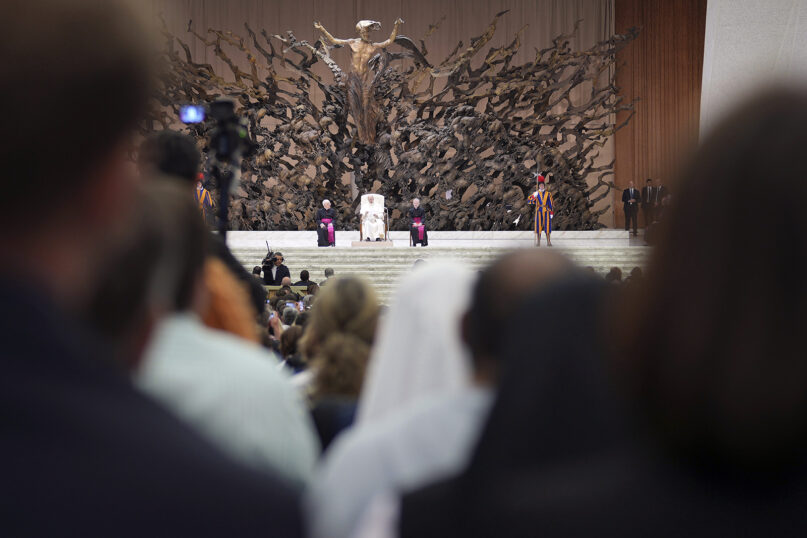
Pope Leo XIV meets members of the international media in the Paul VI Hall at the Vatican, May 12, 2025. (AP Photo/Andrew Medichini)
“There is no climate justice without ecological conversion,” said Spengler. “We need to move from consumption to sacrifice, from greed to generosity, from waste to sharing — from ‘I want’ to what God’s world needs.”
The churches of the Global South pledged to educate Catholics on the environment and cooperate with nations at the local and international levels, but called for the creation of a “historic coalition” between the Global South and North to address debt and promote justice.
“It is necessary for the advanced countries to recognize their historical and ecological debt as perpetrators of greenhouse emissions and resource extraction,” Ferrão said.
The document cites studies showing that North America and Europe are projected to amass $192 trillion in ecological debt — an estimate of the value of past exploitation of resources and the historic difference in emissions released — by 2050, while extracting an estimated $2 trillion each year in current Global South resources. The U.N. has warned that significant funds will be required for the climate adaptation, and the document warned that “countries in the Global South, which have contributed the least to the problem, face the worst consequences.”
Ambongo made an impassioned appeal for the many Africans afflicted by the consequences of climate change. “Africa wants to live. Africa wants to breathe — and to contribute to justice for all humanity,” he said.
As pope, Francis put forward a vision for “happy sobriety,” a model that asks wealthier countries to give up the excesses of wealth and adopt shared responsibility for the climate. Francis saw the indigenous values of “buen vivir” — good living — as an inspiration for how to live in harmony with the environment. The idea was embraced by many climate activists and institutions.
“If the Global North is not willing to make sacrifices, we will not advance in this matter. There is a price to pay,” Spengler said on Tuesday, warning that if wealthy countries are not willing to make “bold decisions,” the next generations will pay the price.
RELATED: Broglio juggles roles as leader of US bishops and shepherd of Catholic troops
The document condemned “elites of power” who take an “openly denialist and apathetic stance” on climate change. Spengler emphasized that despite opposition from world leaders who “deny the data of science,” Catholics are called “to promote conscience, education and have the courage of prophetically declaring what we can and must do and not have fear.”
It also rejected the inequality of “green capitalism,” which it asserted promises economic growth through environmental policies but only enriches the few. The churches of the Global South proposed a system that decentralizes renewable energy policies to benefit local communities and especially the poor.
The cardinals urged Leo to attend the COP30 gathering in Brazil but said that in their meeting with the pope on Tuesday he would not commit to a visit. “We want the forthcoming COP30 to be not just another event, but a moral turning point,” Ferrão said.
Leo is expected to travel to Nicea, Turkey, in November to mark the 1,700th anniversary since the first ecumenical council.
Pope Leo XIV approves new Mass centered on care for the environment
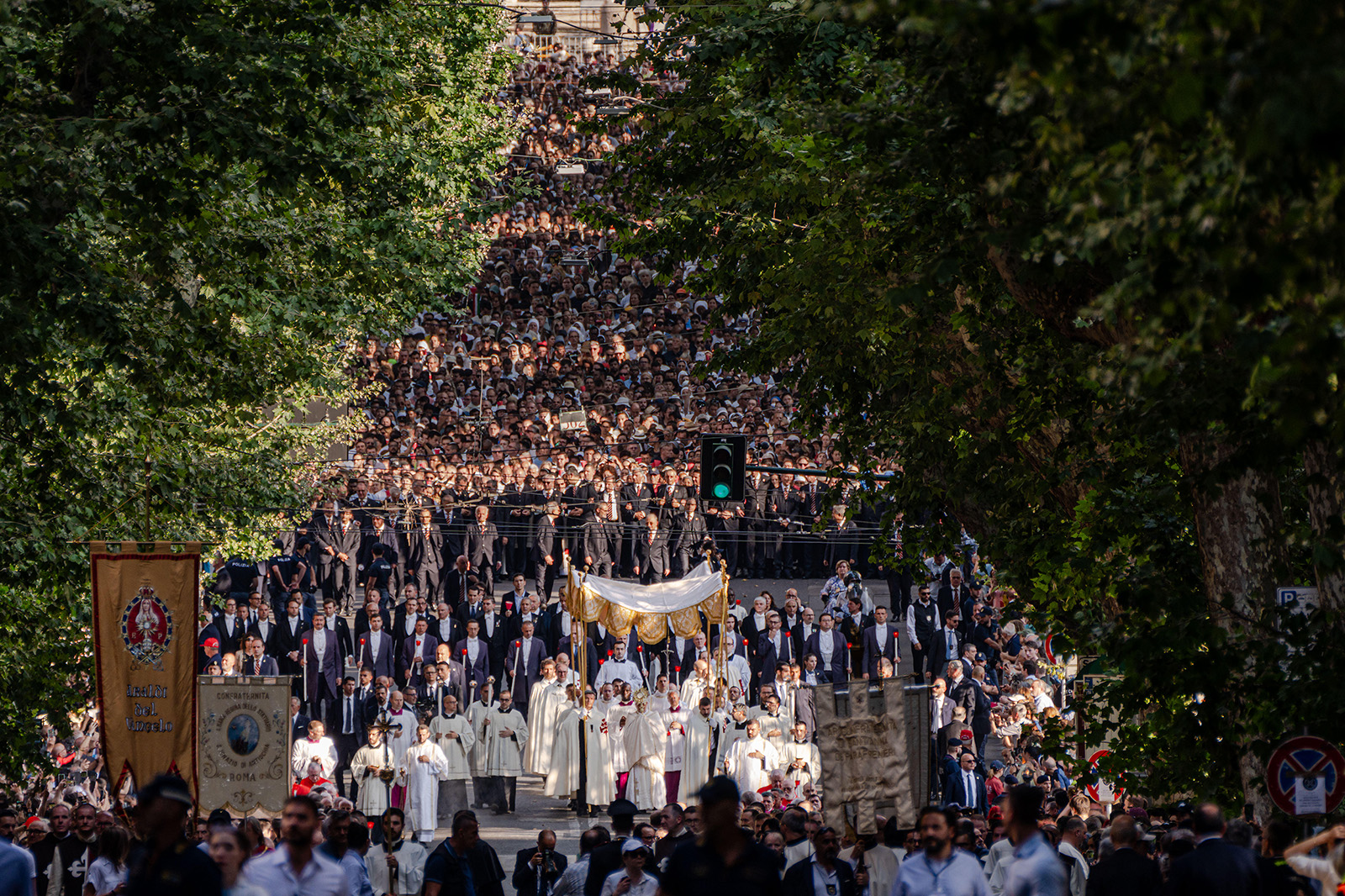
Pope Leo XIV leads the Corpus Christi procession to St. Mary Major Basilica, where he will bestow the Eucharistic blessing, in Rome, on May 22, 2025. (AP Photo/Domenico Stinellis)
VATICAN CITY (RNS) — As record‑breaking heat waves scorch much of Europe — with triple‑digit temperatures, wildfires and deaths reported — the Vatican on Thursday (July 3) released a new liturgy for the Mass reflecting concern for the environment, offering prayers, readings and hymns that highlight the church’s responsibility to protect the Earth.
This new Mass “can be used to ask God for the ability to care for creation,” said Cardinal Michael Czerny, who heads the Vatican’s Dicastery for Integral Human Development, at a press conference.
The new Mass, Pro Custodia Creationis (For the Care of Creation), was initially ordered by Pope Francis, who made the environment a major theme of his papacy and the subject of his second encyclical, “Laudato Si’,” subtitled “On Care for Our Common Home,” in 2015.
Pope Leo XIV has signaled that creation care will be a key area of interest for him as well and a point of continuity between Leo and his predecessors on social issues, especially the environment. Leo will celebrate the new Mass privately on Wednesday at the Borgo Laudato Si’, an eco-village Francis commissioned in the gardens of the papal summer residence in Castel Gandolfo.
Pro Custodia Creationis will be added to the existing list of 17 Masses for special civil needs, which also include Masses for the harvest, rain and migrants, and it’s inspired by Francis’ “green” encyclical, which is celebrating its 10th anniversary this year.
A collaboration between Czerny’s department, which is concerned in part with how climate change impacts vulnerable populations, and the Dicastery for Divine Worship, the new Mass is also inspired by St. John Paul II’s message for the World Day of Peace in 1990, which emphasized the relationship between humanity and creation.
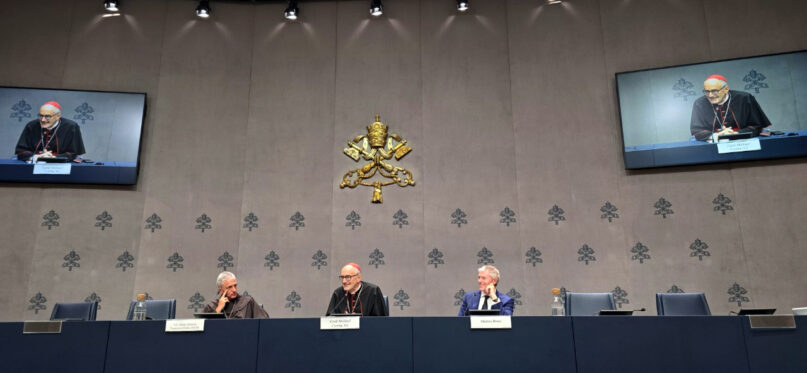
Cardinal Michael Czerny, center, speaks during a press conference on July 3, 2025, at the Vatican about the new Mass for the Care of Creation. (Photo © Dicastery for Promoting Integral Human Development)
“In a world where the most vulnerable of our brothers and sisters are the first to suffer the devastating effects of climate change, deforestation and pollution, care for creation becomes an expression of our faith and humanity,” Czerny said.
At the start of the Mass, the entrance antiphon, the liturgy focuses on creation as a reflection of “the glory of God,” explained Monsignor Vittorio Francesco Viola, secretary of the Vatican’s liturgical department, at Thursday’s press conference.
The celebration culminates in the Eucharist, Viola explained, adding that after Communion, the prayer focuses on humanity’s connection with God, neighbors and the Earth, which was broken by sin according to Laudato Si’.
One reading from the Gospel of Matthew describes how God provides for “the lilies of the field and the birds of the air,” showing that God cares for all of creation. Another reading from the same Gospel tells of Jesus calming the storms. Both readings, Viola explained, focus on Christian believers’ responsibility to preserve the environment and push back against some Catholic interpretations of Genesis as empowering humans to subjugate nature to their own advantage.
Saying “this Mass is a reason for joy,” Czerny said, it “calls us to be faithful stewards of what God has entrusted to us – not only in daily choices and public policies, but also in our prayer, our worship and our way of living in the world.”

No comments:
Post a Comment