(The Conversation) — Amid national truth and reconciliation processes, Scandinavian churches are taking stock of their past policies toward the Sámi people.

A church in Kiruna, Sweden, designed by architect Gustaf Wickman to resemble a Sami hut. (Apolline Guillerot-Malick/SOPA Images/LightRocket via Getty Images)
Thomas A. DuBois
June 27, 2025
(The Conversation) — In May 2025, Tapio Luoma, archbishop of the Evangelical Lutheran Church of Finland, delivered an apology to the Sámi, the only recognized Indigenous people in the European Union.
Speaking on behalf of the church to which more than 6 in 10 of the Finnish populace belong, including most Sámi, Luoma acknowledged its role in past activities that stigmatized Sámi language and culture.
The church “has not respected the rights to self-determination of the Sámi people,” his address began. “Before God and all of you here assembled, we express our regret and ask forgiveness of the Sámi people.”
Luoma’s words were the latest in a series of apologies through which the former state churches in Scandinavia have sought to reset their relations with the Indigenous population of Sápmi, the natural and cultural area of Sámi people. Today, the region is divided between Finland, Norway, Sweden and Russia.
As a scholar of Sámi culture, and as a researcher of Nordic folklore and religion, I have studied the difficult, often painful, relations between Sámi and the various Nordic state churches.
Church’s power
For thousands of years, the Sámi population lived by hunting, fishing and reindeer husbandry along the northern edges of Scandinavia. The Sámi possessed their own languages and maintained distinctive spiritual traditions and healing practices, drawing on traditional ecological knowledge that they had accrued over countless generations. In times of crisis or uncertainty, for example, communities used ceremonial drums to communicate with the spirit world and divine the future.
Conflicts emerged by the 13th century, however, as Christian realms expanded north. Christian clerics condemned Sámi spiritual traditions as “heathen devilry.”
June 27, 2025
(The Conversation) — In May 2025, Tapio Luoma, archbishop of the Evangelical Lutheran Church of Finland, delivered an apology to the Sámi, the only recognized Indigenous people in the European Union.
Speaking on behalf of the church to which more than 6 in 10 of the Finnish populace belong, including most Sámi, Luoma acknowledged its role in past activities that stigmatized Sámi language and culture.
The church “has not respected the rights to self-determination of the Sámi people,” his address began. “Before God and all of you here assembled, we express our regret and ask forgiveness of the Sámi people.”
Luoma’s words were the latest in a series of apologies through which the former state churches in Scandinavia have sought to reset their relations with the Indigenous population of Sápmi, the natural and cultural area of Sámi people. Today, the region is divided between Finland, Norway, Sweden and Russia.
As a scholar of Sámi culture, and as a researcher of Nordic folklore and religion, I have studied the difficult, often painful, relations between Sámi and the various Nordic state churches.
Church’s power
For thousands of years, the Sámi population lived by hunting, fishing and reindeer husbandry along the northern edges of Scandinavia. The Sámi possessed their own languages and maintained distinctive spiritual traditions and healing practices, drawing on traditional ecological knowledge that they had accrued over countless generations. In times of crisis or uncertainty, for example, communities used ceremonial drums to communicate with the spirit world and divine the future.
Conflicts emerged by the 13th century, however, as Christian realms expanded north. Christian clerics condemned Sámi spiritual traditions as “heathen devilry.”
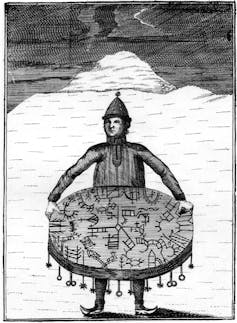
An 18th-century carving of a Sámi shaman with his drum.
Beskrivelse over Finnmarkens Lapper, deres Tungemaal, Levemaade og forrige Afgudsdyrkelse/O. H. von Lode/Wikimedia Commons
During the 16th-century Protestant Reformation, Scandinavian rulers shifted from Catholicism to Lutheranism. In addition to tending to the souls of their flocks, ministers were tasked with keeping track of the comings and goings of congregation members, collecting taxes, and administering justice for lesser crimes.
They aimed to stamp out the spiritual practices that many Sámi continued to practice alongside Christianity. Church authorities arrested, fined and sometimes even executed practitioners, while confiscating sacred drums to be destroyed or sent to distant museums.
The church’s ritual of confirmation, which marks the passage from adolescence into adulthood, also acquired legal status. Being confirmed required the ability to read and interpret the Bible and Martin Luther’s Catechism, a summary of the Lutheran Church’s beliefs. As the church became part of the state, people who had not received confirmation could not represent themselves in court, own land or even marry.
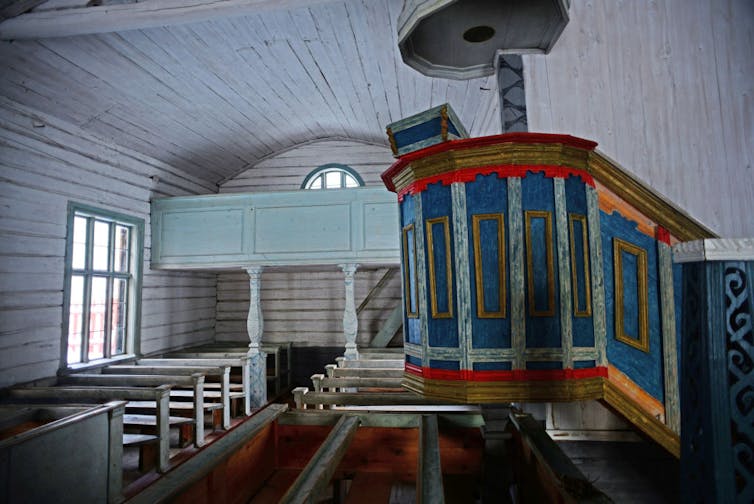
Lake Pielpajarvi Wilderness Church, the oldest Sami church still in use, in Inari Municipality, Lapland, Finland.
VW PICS/Universal Images Group via Getty Images
And where Luther had called for religious instruction to occur in one’s native language, most Nordic clergy provided catechesis only in the majority language, considering Sámi language and traditions impediments to true conversion
Assimilation efforts
During the late 19th and early 20th centuries, the new “nation states” of Finland, Norway and Sweden emerged on the world stage. In each country, political leaders conflated what the ancient Greeks called the “demos” – members of a political nation – with an “ethnos,” a cultural group. In order to belong to the Finnish, Norwegian and Swedish political nations, political and cultural leaders of these new states asserted that it was necessary to belong to the majority linguistic and cultural community.
Finland’s 1919 constitution made provision for Swedish, which is still used by about 5% of the population, as a national language alongside Finnish. However, the government accorded no such status to Sámi.
Both state-run residential boarding schools and schools run by churches included Lutheranism as a subject and strove relentlessly to assimilate Sámi into the majority culture, language and worldview, teaching children to see their culture as backward and shameful. Some church and school authorities cooperated with pseudoscientific racial researchers measuring students’ heads and excavating Sámi graves.
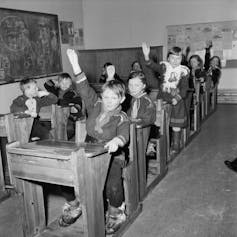
A ‘nomad school’ for Sami children in Jukkasjarvi, Sweden, 250 miles north of the Arctic Circle, in 1956.
John Firth/BIPs/Getty Images
As a result, many students ceased to identify as Sámi and adopted the majority language as their primary mode of communication. Today, only about half the people who identify as Sámi have any facility in Sámi languages, which are considered endangered.
After World War II, church attendance in all the Nordic countries began to plummet. Where 98% of the Finnish population belonged to the state church in 1900, by 2024 that percentage had dropped to 62%. The bulk of defections consisted of people who registered as having no religious affiliation. Membership in the national church shifted from compulsory to voluntary.
Yet as anthropologist David Koester shows, some elements of Lutheran tradition remain extremely popular in all the Nordic countries, particularly Confirmation. The ritual remains a key rite of passage for most Sámi today, yet many of them wrestle with whether they should remain faithful to a church that had worked to suppress their community’s language and culture.
Reconciliation today
Searching for a path forward, contemporary Sámi artist and Lutheran catechist Lars Levi Sunna began to produce church art that incorporated and celebrated pre-Christian Sámi symbols – some of the very traditions that had been demonized by clergy of the past.
For example, in a church in the northern Swedish town of Jukkasjärvi, an image of the sun as it appeared on Sámi ceremonial drums now faces the altar, providing a vivid reminder of the spiritual history and past worldview of the church’s Sámi congregation. The symbol now encloses an image of a communion wafer carved of reindeer antler.
In 2005, Sunna created a traveling art exhibit that portrayed Sámi Christianization as an act of cultural violence. The exhibit, designed for temporary installation in church sanctuaries, aimed to provoke discussion and encourage open dialogue about the past.
Similarly, in 2008, Norwegian Sámi filmmaker Nils Gaup produced “Kautokeino Rebellion,” a film recounting clergy’s role in suppressing religious activism among followers of a Swedish Sámi minister, Lars Levi Laestadius. The so-called uprising in 1852 led to the imprisonment of several dozen Sámi and the execution of two men – whose skulls were deposited in a research institute and did not receive proper burial until 1997.
Descended from one of the punished families, Gaup reminded his audience of past injustice shrouded in shame and silence.
Since church attendance is infrequent in Nordic countries, art and film serve as important vehicles for raising awareness of the church’s past. In November 2021, the archbishop of Sweden, Antje Jackelén, issued a formal apology to the Sámi. Sámi artist and activist Anders Sunna was invited to temporarily redecorate the sanctuary of the Cathedral of Uppsala for the occasion. His decorations included reminders of past Sámi sacrificial traditions that took place both outdoors and around hearth fires. In place of a grand altar, Sunna erected a simple table, surrounded by an octagon of benches where the bishop and members of the Sámi community would sit face to face with a sense of equality and respect.
As Sámi theologian Tore Johnsen notes, formal apologies are necessary first steps in a process of reconciliation. But only once they are followed by concrete acts of “restoration” can real reconciliation occur.
When the Finnish archbishop apologized in May 2025, Sámi in attendance at the Turku Cathedral were appreciative, but they were eager to see what actions might follow, according to reporters at the ceremony. The same wait-and-see attitude characterizes Sámi responses to state-run Truth and Reconciliation processes, which occurred in Norway in 2023 and are currently ongoing in Sweden and Finland.
The process of healing a society injured by colonialism is difficult and slow, requiring extensive discussion – much of it uncomfortable. With Luoma’s words of apology and the arrival of Sámi to listen and witness, an important step in that process occurred.
(Thomas A. DuBois, Professor of Scandinavian Studies, Folklore, and Religious Studies, University of Wisconsin-Madison. The views expressed in this commentary do not necessarily reflect those of Religion News Service.)

A Tohono O'odham family integrates Catholic and Native beliefs in the Arizona desert
TUCSON, Ariz. (AP) — The history of encounters between Catholicism and Native spirituality has often been marred by violence and oppression. But many members of the Tohono O’odham Nation hold onto both faith traditions.
Giovanna Dell'orto
July 2, 2025
TUCSON, Ariz. (AP) — On St. John the Baptist’s feast day in late June, an extended Tohono O’odham family attends Mass out at their desert camp, where they gather to harvest saguaro fruit in a process sacred in their Native spirituality.
“When you’re raised as being a Catholic and raised as being an O’odham, you have both of those within your home, you have both of those within your family,” said Maria Francisco. “So it’s a combination.”
With her cousin, Tanisha Tucker Lohse, and about three dozen other family members and friends, Francisco worshipped at the early morning Mass in a ramada — a canopy topped with saguaro ribs to provide shade, this one decorated with paper flowers. A folding table covered by a white and gold tablecloth served as an altar. A priest visited from Tucson to celebrate the Mass.
A statuette of St. John the Baptist stood by a bunch of fresh flowers, candles and burning desert sage in lieu of incense. There also were photographs of Tucker’s late mom and their great-great-aunt, known as “Grandma Juanita,” whose advocacy preserved the camp. Juana is Spanish for Jane, so she celebrated her name day on St. John’s and the family is continuing the tradition.
A dozen cross-shaped saguaro fruit-picking poles leaned behind the table. Made from saguaro ribs, they’re used to hook the fruits and push or pull them down from the towering plants.
The history of encounters between Catholicism and Native spirituality has often been marred by violence and oppression. But many members of the Tohono O’odham Nation hold onto both faith traditions as they were passed down since the late 17th century, when an Italian-born Jesuit missionary, the Rev. Eusebio Kino, introduced Christianity to these remote deserts in what now are the U.S.-Mexico borderlands.
“To me, it’s the lived consequence of trying to do Catholicism on their own,” said Seth Schermerhorn, a Hamilton College professor who studies Indigenous adoption of Christian practices.
Many O’odham villages have mission churches, though a shortage of priests means regular Mass is a rarity. The Rev. Aro Varnabas came from his parish, Saint Kateri, to celebrate this service.
“Making people feel connected to God through the things they’re familiar with, that’s what I see,” he said.
Michael Enis, who works for the O’odham’s San Xavier’s district — home to one of the most beautifully decorated colonial Catholic churches in the Southwest, San Xavier del Bac — brought his three young children.
He sees a special kinship between his nation and Jesus’ cousin, who lived off the desert, calling for repentance at the risk of his life, and baptized Christ himself in the Jordan River.
“You connect the story of St. John and O’odham life, and you’re stronger for it,” Enis said.
___
Associated Press religion coverage receives support through the AP’s collaboration with The Conversation US, with funding from Lilly Endowment Inc. The AP is solely responsible for this content.
TUCSON, Ariz. (AP) — The history of encounters between Catholicism and Native spirituality has often been marred by violence and oppression. But many members of the Tohono O’odham Nation hold onto both faith traditions.
Giovanna Dell'orto
July 2, 2025
TUCSON, Ariz. (AP) — On St. John the Baptist’s feast day in late June, an extended Tohono O’odham family attends Mass out at their desert camp, where they gather to harvest saguaro fruit in a process sacred in their Native spirituality.
“When you’re raised as being a Catholic and raised as being an O’odham, you have both of those within your home, you have both of those within your family,” said Maria Francisco. “So it’s a combination.”
With her cousin, Tanisha Tucker Lohse, and about three dozen other family members and friends, Francisco worshipped at the early morning Mass in a ramada — a canopy topped with saguaro ribs to provide shade, this one decorated with paper flowers. A folding table covered by a white and gold tablecloth served as an altar. A priest visited from Tucson to celebrate the Mass.
A statuette of St. John the Baptist stood by a bunch of fresh flowers, candles and burning desert sage in lieu of incense. There also were photographs of Tucker’s late mom and their great-great-aunt, known as “Grandma Juanita,” whose advocacy preserved the camp. Juana is Spanish for Jane, so she celebrated her name day on St. John’s and the family is continuing the tradition.
A dozen cross-shaped saguaro fruit-picking poles leaned behind the table. Made from saguaro ribs, they’re used to hook the fruits and push or pull them down from the towering plants.
The history of encounters between Catholicism and Native spirituality has often been marred by violence and oppression. But many members of the Tohono O’odham Nation hold onto both faith traditions as they were passed down since the late 17th century, when an Italian-born Jesuit missionary, the Rev. Eusebio Kino, introduced Christianity to these remote deserts in what now are the U.S.-Mexico borderlands.
“To me, it’s the lived consequence of trying to do Catholicism on their own,” said Seth Schermerhorn, a Hamilton College professor who studies Indigenous adoption of Christian practices.
Many O’odham villages have mission churches, though a shortage of priests means regular Mass is a rarity. The Rev. Aro Varnabas came from his parish, Saint Kateri, to celebrate this service.
“Making people feel connected to God through the things they’re familiar with, that’s what I see,” he said.
Michael Enis, who works for the O’odham’s San Xavier’s district — home to one of the most beautifully decorated colonial Catholic churches in the Southwest, San Xavier del Bac — brought his three young children.
He sees a special kinship between his nation and Jesus’ cousin, who lived off the desert, calling for repentance at the risk of his life, and baptized Christ himself in the Jordan River.
“You connect the story of St. John and O’odham life, and you’re stronger for it,” Enis said.
___
Associated Press religion coverage receives support through the AP’s collaboration with The Conversation US, with funding from Lilly Endowment Inc. The AP is solely responsible for this content.


No comments:
Post a Comment